2012 AMC 10A Problema 25

A continuación está la solución preparada profesionalmente para el Problema 25 del 2012 AMC 10A, de LIVE by Po-Shen Loh. También puedes intentar el examen cronometrado completo, ver todas las soluciones del 2012 AMC 10A, o revisar la clave de respuestas.

Todos los problemas se usan con el permiso legal oficial de la Mathematical Association of America (MAA).

Conceptos:probabilidad geométricavolumensimetría

Nivel de dificultad: 2460

25.

Los números reales x,x, y,y, y zz se eligen de forma independiente y al azar del intervalo [0,n][0,n] para algún entero positivo n.n. La probabilidad de que no haya dos de x,x, y,y, y zz que estén a menos de 1 unidad entre sí es mayor que 12.\dfrac{1}{2}. ¿Cuál es el menor valor posible de nn?

Real numbers x,x, y,y, and zz are chosen independently and at random from the interval [0,n][0,n] for some positive integer n.n. The probability that no two of x,x, y,y, and zz are within 1 unit of each other is greater than 12.\dfrac{1}{2}. What is the smallest possible value of n?n?

77

88

99

1010

1111

Solución:

Este problema se presta a la probabilidad geométrica, ya que podemos ver el intervalo como un rango sobre un eje.

Sin pérdida de generalidad, supongamos nxyz0. n \geq x \geq y \geq z \geq 0.

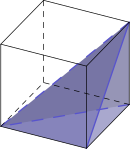
Entonces los puntos (x,y,z)(x, y, z) que satisfacen esta restricción forman un tetraedro.

La altura de este tetraedro es n,n, y la base tiene un área de n22.\dfrac{n^2}{2}. Esto hace que el volumen sea 13n22n=n36. \dfrac{1}{3} \cdot \dfrac{n^2}{2} \cdot n = \dfrac{n^3}{6}.

Ahora debemos aplicar las restricciones del enunciado. Necesitamos hallar la región donde xy,xz,yz1. |x - y|, |x - z|, |y - z| \geq 1.

A partir de la condición de orden que impusimos, estas desigualdades se reducen a xy1 and yz1. x - y \geq 1 \text{ and } y - z \geq 1.

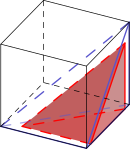
Estas dos restricciones forman otro tetraedro como se muestra a continuación.

Observa que en el nuevo tetraedro, todas las dimensiones se han reducido en 2.2. Esto hace la altura n2n - 2 y la base (n2)22.\dfrac{(n - 2)^2}{2}.

El volumen es entonces 13(n2)22(n2) \dfrac{1}{3} \cdot \dfrac{(n - 2)^2}{2} \cdot (n - 2) =(n2)36. = \dfrac{(n - 2)^3}{6}.

La probabilidad buscada es entonces (n2)36÷n36=(n2)3n3. \dfrac{(n - 2)^3}{6} \div \dfrac{n^3}{6} = \dfrac{(n - 2)^3}{n^3}.

Sustituyendo todas las opciones de respuesta, obtenemos que el menor valor tal que esta fracción es mayor que 12\dfrac{1}{2} es 10.10.

Por lo tanto, D es la respuesta correcta.

This problem lends itself to geometric probability since we can view the interval as a range on an axis.

WLOG, let nxyz0. n \geq x \geq y \geq z \geq 0.

Then we have that the points (x,y,z)(x, y, z) which satisfy this restriction form a tetrahedron.

The height of this tetrahedron is n,n, and the base has an area of n22.\dfrac{n^2}{2}. This makes the volume 13n22n=n36. \dfrac{1}{3} \cdot \dfrac{n^2}{2} \cdot n = \dfrac{n^3}{6}.

Now we have to apply the restrictions from the problem statement. We need to find the region where xy,xz,yz1. |x - y|, |x - z|, |y - z| \geq 1.

From our ordering condition that we imposed, these inequalities reduce to xy1 and yz1. x - y \geq 1 \text{ and } y - z \geq 1.

These two restrictions form another tetrahedron as shown below.

Note that in the new tetrahedron, all the dimensions have been reduced by 2.2. This makes the height n2n - 2 and the base (n2)22.\dfrac{(n - 2)^2}{2}.

The volume is then 13(n2)22(n2) \dfrac{1}{3} \cdot \dfrac{(n - 2)^2}{2} \cdot (n - 2)=(n2)36. = \dfrac{(n - 2)^3}{6}.

The desired probability is then (n2)36÷n36=(n2)3n3. \dfrac{(n - 2)^3}{6} \div \dfrac{n^3}{6} = \dfrac{(n - 2)^3}{n^3}.

Plugging in all the answer choices, we get that the smallest value such that this fraction is greater than 12\dfrac{1}{2} is 10.10.

Thus, D is the correct answer.

← Problema 24#24Examen completo

El Problema 25 en otros años