
Problemas del 2012 AMC 10A
¡Desplázate hacia abajo y presiona Iniciar para intentar el examen! O ve al PDF imprimible, la clave de respuestas, o las soluciones profesionales preparadas por LIVE by Po-Shen Loh.
Todos los problemas se usan con el permiso legal oficial de la Mathematical Association of America (MAA).
O salta directamente a un solo problema con su solución: 1 · 2 · 3 · 4 · 5 · 6 · 7 · 8 · 9 · 10 · 11 · 12 · 13 · 14 · 15 · 16 · 17 · 18 · 19 · 20 · 21 · 22 · 23 · 24 · 25
¿Quieres aprender de forma profesional con clases interactivas en video?
Con tiempo
1:15:00
1.
Cagney puede glasear un pastelito cada segundos y Lacey puede glasear un pastelito cada segundos. Trabajando juntas, ¿cuántos pastelitos pueden glasear en minutos?
Cagney can frost a cupcake every seconds and Lacey can frost a cupcake every seconds. Working together, how many cupcakes can they frost in minutes?
Respuesta: D
Pista pequeña:
Convierte cada velocidad de glaseado a pastelitos por minuto.
Convert each frosting rate to cupcakes per minute
Pista grande:
Suma las dos velocidades y luego multiplica por minutos.
Add the two rates, then multiply by minutes
Solución:
Cagney puede hacer pastelitos por minuto, y Lacey puede hacer
En minutos, pueden hacer
Por lo tanto, D es la respuesta correcta.
Cagney can make cupcakes per minute, and Lacey can make
In minutes, they can make
Thus, D is the correct answer.
2.
Un cuadrado de lado se corta por la mitad, formando dos rectángulos congruentes. ¿Cuáles son las dimensiones de uno de estos rectángulos?
A square with side length is cut in half, creating two congruent rectangles. What are the dimensions of one of these rectangles?
Respuesta: E
Pista pequeña:
Un lado de cada rectángulo sigue siendo .
One side of each rectangle stays
Pista grande:
El otro lado es la mitad del lado del cuadrado.
The other side is half of the square side length
Solución:
Observa que uno de los lados sigue siendo igual que el del cuadrado original.
Esto significa que una dimensión es La otra dimensión es el lado original cortado a la mitad, es decir
Por lo tanto, E es la respuesta correcta.
Note that the one of the sides remains the same as the original square.
This means that one dimension is The other dimension is the original side cut in half, which is
Thus, E is the correct answer.
3.
Un insecto se arrastra a lo largo de una recta numérica, comenzando en Se arrastra hasta luego da la vuelta y se arrastra hasta ¿Cuántas unidades se arrastra el insecto en total?
A bug crawls along a number line, starting at It crawls to then turns around and crawls to How many units does the bug crawl altogether?
Respuesta: E
Pista pequeña:
Suma la distancia de a y de a .
Add the distance from to and from to
Pista grande:
La distancia en una recta numérica se calcula con diferencias absolutas.
Distance on a number line uses absolute differences
Solución:
Recorre una distancia de cuando se mueve de a Luego recorre una distancia de al moverse de a
La distancia total es entonces
Por lo tanto, E es la respuesta correcta.
It crawls a distance of when it moves from to It then travels a distance of as it moves from to
The total distance is then
Thus, E is the correct answer.
4.
Sean y ¿Cuál es la menor medida en grados posible para ?
Let and What is the smallest possible degree measure for
Respuesta: C
Pista pequeña:
Ambos ángulos comparten el rayo .
Both angles share ray
Pista grande:
El ángulo más pequeño ocurre cuando los dos ángulos dados se superponen lo máximo posible.
The smallest angle occurs when the two given angles overlap as much as possible
Solución:
Observa que ambos ángulos comparten el rayo Para minimizar el grado deseado, queremos que esté entre y
Esto daría
Por lo tanto, C es la respuesta correcta.
Note that both of the angles share the ray To minimize the desired degree, we want to be between and
This would make
Thus, C is the correct answer.
5.
El año pasado llevaron gatos adultos, la mitad de los cuales eran hembras, al refugio de animales de Smallville. La mitad de las gatas adultas venían acompañadas de una camada de gatitos. El número promedio de gatitos por camada era ¿Cuál fue el número total de gatos y gatitos que recibió el refugio el año pasado?
Last year adult cats, half of whom were female, were brought into the Smallville Animal Shelter. Half of the adult female cats were accompanied by a litter of kittens. The average number of kittens per litter was What was the total number of cats and kittens received by the shelter last year?
Pista pequeña:
La mitad de los gatos adultos son hembras, y la mitad de ellas tienen camadas.
Half the adult cats are female, and half of those have litters
Pista grande:
Multiplica el número de camadas por el tamaño promedio de la camada.
Multiply the number of litters by the average litter size
Solución:
Tenemos que hay gatas. Luego tenemos que gatas tienen gatitos.
Como el número promedio de gatitos por camada es el número total de gatitos es
El número total de gatos y gatitos es entonces
Por lo tanto, B es la respuesta correcta.
We have that there are female cats. We then have that cats that have kittens.
Since the average number of kittens per litter is the total number of kittens is
The total number of cats and kittens is then
Thus, B is the correct answer.
6.
El producto de dos números positivos es El recíproco de uno de estos números es veces el recíproco del otro número. ¿Cuál es la suma de los dos números?
The product of two positive numbers is The reciprocal of one of these numbers is times the reciprocal of the other number. What is the sum of the two numbers?
Respuesta: D
Pista pequeña:
Sean los dos números y .
Let the two numbers be and
Pista grande:
Usa y la condición de los recíprocos para relacionar y .
Use and the reciprocal condition to relate and
Solución:
Sean los dos números y tales que
Obtenemos que ya que es positivo.
Entonces
La suma buscada es entonces
Por lo tanto, D es la respuesta correcta.
Let the two numbers be and such that
We get that since is positive.
Then
The desired sum is then
Thus, D is the correct answer.
7.
En una bolsa de canicas, de las canicas son azules y el resto son rojas. Si el número de canicas rojas se duplica y el número de canicas azules permanece igual, ¿qué fracción de las canicas será roja?
In a bag of marbles, of the marbles are blue and the rest are red. If the number of red marbles is doubled and the number of blue marbles stays the same, what fraction of the marbles will be red?
Respuesta: C
Pista pequeña:
Comienza con una razón de canicas azules a rojas.
Start with a ratio of blue to red marbles
Pista grande:
Al duplicar las canicas rojas, la razón cambia a .
Doubling the red marbles changes the ratio to
Solución:
Sin pérdida de generalidad, supongamos que el número de canicas en la bolsa es Como solo nos importan las razones, podemos hacer esto. Entonces hay canicas azules y canicas rojas.
Al duplicar las canicas rojas obtenemos de ellas. Entonces la fracción de canicas rojas es
Por lo tanto, C es la respuesta correcta.
WLOG, let the number of marbles in the bag be Since we only care about ratios, we can do this. Then there are blue marbles and red marbles.
Doubling the red marbles gives us of them. Then the fraction of red marbles is
Thus, C is the correct answer.
8.
Las sumas de tres números enteros tomados de dos en dos son y ¿Cuál es el número del medio?
The sums of three whole numbers taken in pairs are and What is the middle number?
Respuesta: D
Pista pequeña:
Suma las tres sumas de pares.
Add the three pair sums
Pista grande:
El total de las tres sumas de pares es el doble de la suma de los tres números.
The total of the three pair sums is twice the sum of the three numbers
Solución:
Sean los tres números donde Ninguno es igual, ya que las tres sumas son distintas.
Entonces y
Sumando las tres ecuaciones obtenemos
Entonces de la cual podemos restar para obtener
Por lo tanto, D es la respuesta correcta.
Let the three numbers be where None of them are equal, since all three sums are different.
Then and
Adding all three equations together gives us
Then from which we can subtract to get
Thus, D is the correct answer.
9.
Un par de dados justos de seis caras están marcados de modo que un dado tiene solo números pares (dos de cada y ), y el otro dado tiene solo números impares (dos de cada y ). Se lanza el par de dados. ¿Cuál es la probabilidad de que la suma de los números en las caras superiores de los dos dados sea ?
A pair of six-sided fair dice are labeled so that one die has only even numbers (two each of and ), and the other die has only odd numbers (two each of and ). The pair of dice is rolled. What is the probability that the sum of the numbers on the tops of the two dice is
Respuesta: D
Pista pequeña:
Enumera los pares par-impar que suman .
List the even-odd pairs that sum to
Pista grande:
Cada valor listado aparece en dos caras de su dado.
Each listed value appears on two faces of its die
Solución:
Los pares de números que suman son
Hay una probabilidad de de obtener cualquiera de estos pares.
Hay pares, lo que significa que la probabilidad total de que los lanzamientos sumen es
Por lo tanto, D es la respuesta correcta.
The pairs of numbers that sum to are
There is a chance that we get any of these pairs.
There are pairs, which means that the total probability that the rolls sum to is
Thus, D is the correct answer.
10.
Mary divide un círculo en sectores. Los ángulos centrales de estos sectores, medidos en grados, son todos enteros y forman una progresión aritmética. ¿Cuál es la medida en grados del menor ángulo posible de un sector?
Mary divides a circle into sectors. The central angles of these sectors, measured in degrees, are all integers and they form an arithmetic sequence. What is the degree measure of the smallest possible sector angle?
Respuesta: C
Pista pequeña:
Sea la progresión aritmética .
Let the arithmetic sequence be
Pista grande:
Usa y maximiza manteniendo positivo.
Use and maximize while keeping positive
Solución:
Sea el menor ángulo posible de un sector y la diferencia de la progresión aritmética.
Entonces tenemos que es la suma de la progresión aritmética.
Tenemos que esto suma así que
Queremos minimizar así que maximizamos Si entonces no es entero, por lo que y
Por lo tanto, C es la respuesta correcta.
Let be the smallest possible sector angle and be the difference in the arithmetic sequence.
Then we have that is the sum of the arithmetic sequence.
We have that this sums to so
We want to minimize so we maximize If then is not an integer, so and
Thus, C is the correct answer.
11.
Circunferencias tangentes exteriormente con centros en los puntos y tienen radios de longitud y respectivamente. Una recta tangente exterior a ambas circunferencias corta al rayo en el punto ¿Cuánto vale ?
Externally tangent circles with centers at points and have radii of lengths and respectively. A line externally tangent to both circles intersects ray at point What is
Respuesta: D
Pista pequeña:
Traza los radios hacia los dos puntos de tangencia.
Draw radii to the two tangent points
Pista grande:
Los dos triángulos rectángulos con vértice son semejantes.
The two right triangles with vertex are similar
Solución:
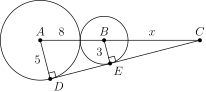
Sea igual a Observa que y son semejantes por el criterio ángulo-ángulo (las rectas tangentes son perpendiculares a los radios).
Entonces Multiplicando en cruz obtenemos
Por lo tanto, D es la respuesta correcta.
Let be Note that and are similar due to angle-angle (tangent lines are perpendicular to radii).
Then Cross-multiplying gives us
Thus, D is the correct answer.
12.
Un año es bisiesto si y solo si el número del año es divisible por (como ) o es divisible por pero no por (como ). El aniversario número del nacimiento del novelista Charles Dickens se celebró el de febrero de un martes. ¿En qué día de la semana nació Dickens?
A year is a leap year if and only if the year number is divisible by (such as ) or is divisible by but not (such as ). The th anniversary of the birth of novelist Charles Dickens was celebrated on February a Tuesday. On what day of the week was Dickens born?
viernes
Friday
sábado
Saturday
domingo
Sunday
lunes
Monday
martes
Tuesday
Respuesta: A
Pista pequeña:
Cuenta los desplazamientos de día módulo .
Count day shifts modulo
Pista grande:
En años, incluye los días bisiestos pero excluye .
In years, include leap days but exclude
Solución:
En un año típico de días, avanzar un año hacia el futuro mueve el día de la semana uno hacia adelante, ya que
Sin embargo, en un año bisiesto, el día de la semana se mueve dos posiciones hacia adelante porque hay un día extra.
Cincuenta de los años entre y son múltiplos de pero hay que descartar lo que nos deja años bisiestos.
Por lo tanto, retroceder años significa que debemos retroceder días, lo que significa que retrocedemos días en la semana.
Esto nos lleva de vuelta al viernes, que es el día correspondiente al de febrero de
Por lo tanto, A es la respuesta correcta.
On a typical year with days, moving one year into the future moves the day of the week forward one since
On a leap year however, the day of the week gets moved forward twice since there is an extra day.
Fifty of the years between and are multiples of but we have to discard which leaves us with leap years.
Therefore, moving back years means we have to go back days, which means we move back days in the week.
This takes us back to Friday, which is the day that corresponds to February
Thus, A is the correct answer.
13.
Un promedio iterativo de los números y se calcula de la siguiente manera. Ordena los cinco números en algún orden. Halla la media de los dos primeros números, luego halla la media de eso con el tercer número, luego la media de eso con el cuarto número, y finalmente la media de eso con el quinto número. ¿Cuál es la diferencia entre el mayor y el menor valor posible que se puede obtener con este procedimiento?
An iterative average of the numbers and is computed the following way. Arrange the five numbers in some order. Find the mean of the first two numbers, then find the mean of that with the third number, then the mean of that with the fourth number, and finally the mean of that with the fifth number. What is the difference between the largest and smallest possible values that can be obtained using this procedure?
Respuesta: C
Pista pequeña:
Escribe el promedio final como una suma ponderada.
Write the final average as a weighted sum
Pista grande:
Los números colocados más tarde reciben pesos mayores.
Later entries receive larger weights
Solución:
Sea el orden de los números
Entonces el promedio iterativo es
Para minimizarlo, tomamos el orden lo que nos da una suma de
Para maximizarlo, invertimos este orden para obtener un promedio de
La diferencia entre estos es
Por lo tanto, C es la respuesta correcta.
Let the order of the numbers be
Then the iterative average is
To minimize this, we make the order which gives us a sum of
To maximize it, we have to reverse this order to get an average of
The difference between these is
Thus, C is the correct answer.
14.
Chubby hace tableros de ajedrez no estándar que tienen casillas en cada lado. Los tableros tienen una casilla negra en cada esquina y alternan casillas rojas y negras a lo largo de cada fila y columna. ¿Cuántas casillas negras hay en tal tablero?
Chubby makes nonstandard checkerboards that have squares on each side. The checkerboards have a black square in every corner and alternate red and black squares along every row and column. How many black squares are there on such a checkerboard?
Respuesta: B
Pista pequeña:
Las filas alternan entre y casillas negras.
Rows alternate between and black squares
Pista grande:
Hay filas de un tipo y del otro.
There are rows of one type and of the other
Solución:
Observa que hay filas con casillas negras y filas con casillas negras.
Esto se ve al observar que la primera fila tiene casillas negras, y todas las demás filas alternan con y casillas.
Luego, debido al patrón alternante, habrá un total de filas con casillas, y las demás filas tienen casillas.
El número total de casillas negras es entonces
Por lo tanto, B es la respuesta correcta.
Note that there are rows with black tiles and rows with black tiles.
This can be seen by observing that the first row has black tiles, and all the other rows alternate with and tiles.
Then, due to the alternating pattern, there will be a total of rows with tiles, and the other rows have tiles.
The total number of black squares is then
Thus, B is the correct answer.
15.
Se muestran tres cuadrados unitarios y dos segmentos de recta que conectan dos pares de vértices. ¿Cuál es el área de ?
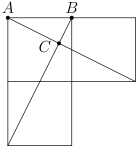
Three unit squares and two line segments connecting two pairs of vertices are shown. What is the area of
Respuesta: B
Pista pequeña:
Coloca y sobre los ejes de coordenadas.
Place and on coordinate axes
Pista grande:
Halla la intersección de las dos rectas dibujadas.
Find the intersection of the two drawn lines
Solución:
Podemos usar geometría de coordenadas para hallar dónde ocurre la intersección de las dos rectas.
Sea el origen y Entonces la pendiente de la recta que pasa por es lo que hace que la ecuación de la recta sea La pendiente de la recta que pasa por es La intersección con el eje es Esto hace que la ecuación de esta recta sea
Igualando las ecuaciones, obtenemos
Esto hace que la coordenada de sea
El área del triángulo es entonces
Por lo tanto, B es la respuesta correcta.
We can use coordinate geometry to figure out where the intersection of the two lines occurs.
Let be the origin and Then the slope of the line through is which makes the equation of the line The slope of the line through is The -intercept is This makes the equation of this line
Equating the equations, we get
This makes the -coordinate of
The area of triangle is then
Thus, B is the correct answer.
16.
Tres corredores comienzan a correr simultáneamente desde el mismo punto de una pista circular de metros. Cada uno corre en el sentido de las agujas del reloj manteniendo velocidades constantes de y metros por segundo. Los corredores se detienen una vez que vuelven a estar todos juntos en algún punto de la pista circular. ¿Cuántos segundos corren los corredores?
Three runners start running simultaneously from the same point on a -meter circular track. They each run clockwise around the course maintaining constant speeds of and meters per second. The runners stop once they are all together again somewhere on the circular course. How many seconds do the runners run?
Respuesta: C
Pista pequeña:
Usa velocidades relativas en la pista circular.
Use relative speeds on the circular track
Pista grande:
Halla cuándo el corredor intermedio y el rápido le sacan vueltas completas al corredor lento.
Find when the middle and fast runners lap the slow runner by whole laps
Solución:
Hallemos el tiempo que le toma al corredor que va a metros por segundo darle una vuelta a la persona más lenta.
Debemos tener que donde es el tiempo que le toma al corredor más rápido darle una vuelta al otro.
Observa que lo que significa que estos dos corredores siempre se encuentran en la línea de salida.
Ahora debemos hallar el menor tiempo, tal que sea múltiplo de y el corredor más rápido termine en la línea de salida.
Cada segundos, el corredor más rápido recorre metros. Entonces en segundos, el corredor más rápido recorre metros, que es un número entero de vueltas.
Por lo tanto, C es la respuesta correcta.
Let us find the amount of time that it takes for the runner running at meters per second to lap the slowest person.
We must have that where is the amount of time it takes for the faster runner to lap the other.
Note that which means that these two runners always intersect at the starting line.
We now have to find the least time, such that is a multiple of and the fastest runner ends up at the starting line.
Every seconds, the fastest runner runs meters. Then in seconds, the fastest runner runs meters, which is a whole number of laps.
Thus, C is the correct answer.
17.
Sean y enteros primos entre sí con y ¿Cuánto vale ?
Let and be relatively prime integers with and What is
Respuesta: C
Pista pequeña:
Factoriza .
Factor
Pista grande:
La ecuación se convierte en una cuadrática en .
The equation becomes a quadratic in
Solución:
Recuerda que podemos factorizar Al cancelar este factor obtenemos que
Multiplicando en cruz y reordenando obtenemos Como podemos dividir todo entre para obtener
Aplicando la fórmula cuadrática y notando que obtenemos que
Como y son primos entre sí, tenemos que y Su diferencia es
Por lo tanto, C es la respuesta correcta.
Recall that we can factor Canceling out this factor gives us that
Cross-multiplying and rearranging gives us Since we can divide through by to get
Applying the quadratic formula and noting that gives us that
Since and are relatively prime, we have that and Their difference is
Thus, C is the correct answer.
18.
La curva cerrada de la figura está formada por arcos circulares congruentes, cada uno de longitud donde cada uno de los centros de las circunferencias correspondientes está entre los vértices de un hexágono regular de lado ¿Cuál es el área encerrada por la curva?
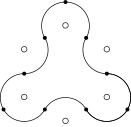
The closed curve in the figure is made up of congruent circular arcs each of length where each of the centers of the corresponding circles is among the vertices of a regular hexagon of side What is the area enclosed by the curve?
Respuesta: E
Pista pequeña:
Cada arco es un arco de de una circunferencia unitaria.
Each arc is a arc of a unit circle
Pista grande:
Reorganiza las piezas de sector alrededor del hexágono regular.
Rearrange the sector pieces around the regular hexagon
Solución:
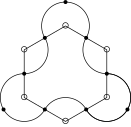
Cada arco tiene radio y longitud así que todos los sectores circulares correspondientes tienen la misma área. Como muestra el diagrama, las piezas de sector se pueden reacomodar: todo lo que se añade al hexágono regular se junta para formar exactamente un círculo unitario.
El hexágono regular está formado por seis triángulos equiláteros de lado así que su área es Al añadir el círculo unitario, el área total encerrada es
Por lo tanto, E es la respuesta correcta.
Each arc has radius and length so the corresponding circular sectors all have the same area. As the diagram shows, the sector pieces may be rearranged: everything added to the regular hexagon combines to exactly one unit circle.
The regular hexagon is made of six equilateral triangles of side so its area is Adding the unit circle gives a total enclosed area of
Thus, E is the correct answer.
19.
Paula, la pintora, y sus dos ayudantes pintan cada uno a un ritmo constante, pero diferente. Siempre empiezan a las AM, y los tres siempre tardan el mismo tiempo en almorzar.
El lunes los tres pintaron el de una casa, terminando a las PM. El martes, cuando Paula no estaba, los dos ayudantes pintaron solo el de la casa y terminaron a las PM. El miércoles Paula trabajó sola y terminó la casa trabajando hasta las P.M.
¿Cuántos minutos duró el almuerzo de cada día?
Paula the painter and her two helpers each paint at constant, but different, rates. They always start at AM, and all three always take the same amount of time to eat lunch.
On Monday the three of them painted of a house, quitting at PM. On Tuesday, when Paula wasn’t there, the two helpers painted only of the house and quit at PM. On Wednesday Paula worked by herself and finished the house by working until P.M.
How long, in minutes, was each day’s lunch break?
Respuesta: D
Pista pequeña:
Sea el almuerzo de minutos.
Let the lunch break be minutes
Pista grande:
Usa el lunes para , el martes para y el miércoles para .
Use Monday for , Tuesday for , and Wednesday for
Solución:
Sea el almuerzo de minutos, el ritmo de Paula de por ciento por minuto, y el ritmo combinado de los ayudantes de por ciento por minuto.
El lunes da . El martes da . Como el trabajo restante el miércoles era del por ciento, el miércoles da .
Sumando las ecuaciones del martes y del miércoles y restando la del lunes se obtiene , así que .
Sustituyendo en la del lunes se obtiene , mientras que la del miércoles da . Resolviendo estas dos ecuaciones se obtiene .
Por lo tanto, D es la respuesta correcta.
Let the lunch break be minutes, Paula’s rate be percent per minute, and the helpers’ combined rate be percent per minute.
Monday gives . Tuesday gives . Since the remaining work on Wednesday was percent, Wednesday gives .
Adding the Tuesday and Wednesday equations and subtracting the Monday equation gives , so .
Substituting into Monday gives , while Wednesday gives . Solving these two equations gives .
Thus, D is the correct answer.
20.
Un cuadrado se divide en cuadrados unitarios. Cada cuadrado unitario se pinta de blanco o de negro, siendo cada color igualmente probable, elegido de forma independiente y al azar.
Luego el cuadrado se rota en el sentido de las agujas del reloj alrededor de su centro, y todo cuadrado blanco en una posición antes ocupada por un cuadrado negro se pinta de negro. Los colores de todos los demás cuadrados quedan sin cambios. ¿Cuál es la probabilidad de que la cuadrícula sea ahora completamente negra?
A square is partitioned into unit squares. Each unit square is painted either white or black with each color being equally likely, chosen independently and at random.
The square is then rotated clockwise about its center, and every white square in a position formerly occupied by a black square is painted black. The colors of all other squares are left unchanged. What is the probability the grid is now entirely black?
Respuesta: A
Pista pequeña:
Los cuadrados de las esquinas forman un -ciclo bajo la rotación.
Corner squares form a -cycle under rotation
Pista grande:
Para cada -ciclo, cuenta las coloraciones en las que ningún cuadrado blanco recibe un predecesor blanco.
For each -cycle, count colorings with no white square receiving a white predecessor
Solución:
El cuadrado central debe ser negro inicialmente, aportando probabilidad . Los cuatro cuadrados de las esquinas forman un ciclo bajo la rotación, y los cuatro cuadrados centrales de los lados forman otro ciclo idéntico.
Para un -ciclo, las cuatro posiciones finales son todas negras a menos que un cuadrado blanco sea rotado a una posición que también era blanca. Las coloraciones iniciales exitosas son , las cuatro rotaciones de y las dos rotaciones de , para coloraciones de .
El mismo conteo aplica al ciclo de los centros de los lados, de forma independiente. Por lo tanto, la probabilidad es .
Por lo tanto, A es la respuesta correcta.
The center square must initially be black, contributing probability . The four corner squares form one cycle under the rotation, and the four edge-middle squares form another identical cycle.
For one -cycle, the final four positions are all black unless a white square is rotated into a position that was also white. The successful initial colorings are , the four rotations of , and the two rotations of , for colorings out of .
The same count applies to the edge-middle cycle, independently. Therefore the probability is .
Thus, A is the correct answer.
21.
Sean los puntos y Los puntos y son, respectivamente, los puntos medios de los segmentos y . ¿Cuál es el área de ?
Let points and Points and are midpoints of line segments and respectively. What is the area of
Respuesta: C
Pista pequeña:
Usa los segmentos medios en los triángulos y .
Use midsegments in triangles and
Pista grande:
El cuadrilátero es un rectángulo con lados provenientes de y .
The quadrilateral is a rectangle with side lengths from and
Solución:
Observa que ya que es un segmento medio de De manera similar, y
También tenemos que y son perpendiculares al plano , lo que significa que son perpendiculares a y
Esto nos dice que es un rectángulo ya que Tenemos
También tenemos que
El área de es entonces
Por lo tanto, C es la respuesta correcta.
Note that since it is a midsegment of Similarly, and
We also have that and are perpendicular to the -plane, which means that they are perpendicular to and
This tells us that is rectangle since We have
We also have that
The area of is then
Thus, C is the correct answer.
22.
La suma de los primeros enteros impares positivos es más que la suma de los primeros enteros pares positivos. ¿Cuál es la suma de todos los valores posibles de ?
The sum of the first positive odd integers is more than the sum of the first positive even integers. What is the sum of all possible values of
Respuesta: A
Pista pequeña:
Usa que los primeros números impares suman .
Use that the first odd numbers sum to
Pista grande:
Convierte la condición en .
Turn the condition into
Solución:
Los primeros enteros impares positivos suman , y los primeros enteros pares positivos suman . Así .
Como cuadrática en , esto tiene discriminante , que debe ser un cuadrado impar. Sea . Entonces .
Los pares de factores positivos de son , y . Dan , respectivamente.
Como , los valores posibles de son . Su suma es .
Por lo tanto, A es la respuesta correcta.
The first positive odd integers sum to , and the first positive even integers sum to . Thus .
As a quadratic in , this has discriminant , which must be an odd square. Let . Then .
The positive factor pairs of are , , and . They give , respectively.
Because , the possible values of are . Their sum is .
Thus, A is the correct answer.
23.
Adam, Benin, Chiang, Deshawn, Esther y Fiona tienen cuentas de internet. Algunos, pero no todos, son amigos de internet entre sí, y ninguno de ellos tiene un amigo de internet fuera de este grupo. Cada uno de ellos tiene el mismo número de amigos de internet. ¿De cuántas formas diferentes puede ocurrir esto?
Adam, Benin, Chiang, Deshawn, Esther, and Fiona have internet accounts. Some, but not all, of them are internet friends with each other, and none of them has an internet friend outside this group. Each of them has the same number of internet friends. In how many different ways can this happen?
Respuesta: B
Pista pequeña:
Considera casos según el número común de amigos.
Case on the common number of friends
Pista grande:
Usa complementos para emparejar los casos de amigo y amigos, y los casos de amigos y amigos.
Use complements to pair the -friend and -friend cases, and the -friend and -friend cases
Solución:
Separamos en casos según el número de amigos que tiene cada persona. Este valor va de a , pues el grafo no es ni vacío ni completo.
Los casos de y amigos corresponden, respectivamente, a los de y amigos al tomar el grafo complementario, ya que elegir quiénes son amigos determina quiénes no lo son.
Caso cada persona tiene amigo
Esto significa que las personas deben dividirse en parejas, y los integrantes de cada pareja son amigos.
Hay opciones para el amigo de la primera persona, lo que deja personas.
Luego hay opciones para el amigo de la siguiente persona sin pareja. Las personas restantes quedan obligadas a ser amigas.
Por tanto, hay posibilidades en este caso.
Caso cada persona tiene amigos
Hay dos posibilidades. La primera consiste en dos tríos cuyos integrantes son todos amigos entre sí.
Hay formas de elegir el primer trío. Debemos dividir entre porque se pueden intercambiar los dos tríos, lo que da configuraciones.
La segunda posibilidad es que las amistades formen un solo ciclo de vértices.
Cada orden de las seis personas alrededor de un ciclo produce uno de estos grafos. Cada grafo se cuenta veces por la elección de la persona inicial y veces por el sentido de recorrido, así que hay ciclos distintos de vértices. Junto con los pares de triángulos, este caso tiene configuraciones.
El número total de configuraciones es
Por lo tanto, B es la respuesta correcta.
We case on the value of friends that each person has. This value ranges from to , since the graph is neither empty nor complete.
Note that the cases for and friends correspond with the case for and friends, since choosing who are friends determines who are not friends.
Case everyone has friend
This means that the people must split up into pairs where the people in each pair are friends.
There are choices for the friend for the first person. This leaves people remaining.
There are then choices for the friend of the next unpaired person. The remaining people are then forced to be friends.
Therefore, there are possibilities for this case.
Case everyone has friends
There are two possibilities for this case. There could be two triples where everyone in a triple is friends with each other.
For this possibility, there are ways to choose the people in the first triple. We have to divide by since we can swap the pairs. This gives us configurations.
The second possibility is that the friends form one -cycle.
Every ordering of the six people around a cycle gives such a graph. Each graph is counted times by the choice of starting person and times by the direction of traversal, so there are distinct -cycles. Together with the pairs of triangles, this case has configurations.
The total number of arrangements is then
Thus, B is the correct answer.
24.
Sean y enteros positivos con tales que y ¿Cuánto vale ?
Let and be positive integers with such that and What is
Respuesta: E
Pista pequeña:
Primero suma las dos ecuaciones.
Add the two equations first
Pista grande:
Las tres diferencias al cuadrado deben ser en algún orden.
The three squared differences must be in some order
Solución:
Sumar las ecuaciones nos da
Podemos agrupar términos y factorizar esto para obtener
Observa que cada término del lado izquierdo es un cuadrado entero no negativo. La única terna de cuadrados que suma es y
Tenemos que es la mayor diferencia entre los tres pares. Por lo tanto,
No podemos discernir cuál de los otros términos corresponde a cada cuadrado. Probemos y
Sustituir estos valores en la primera ecuación nos da Al simplificar se obtiene Como no es divisible por tenemos que y
En el otro caso, y La primera ecuación se convierte en es decir, De ahí que
Por lo tanto, E es la respuesta correcta.
Adding together the equations gives us
We can group terms and factor this to get
Note that every term on the left hand side is a nonnegative square integer. The only triple of squares that add to is and
We have that is the biggest difference among the three pairs. Therefore,
We cannot discern which of the other terms we can match with the other squares. Let us try and
Plugging in these values into the first equation gives us Simplifying yields Since is not divisible by we have that and
In the other case, and The first equation becomes or Hence
Thus, E is the correct answer.
25.
Los números reales y se eligen de forma independiente y al azar del intervalo para algún entero positivo La probabilidad de que no haya dos de y que estén a menos de unidad entre sí es mayor que ¿Cuál es el menor valor posible de ?
Real numbers and are chosen independently and at random from the interval for some positive integer The probability that no two of and are within unit of each other is greater than What is the smallest possible value of
Respuesta: D
Pista pequeña:
Primero ordena los tres números aleatorios.
Order the three random numbers first
Pista grande:
Resta al número del medio y al número mayor.
Subtract from the middle number and from the largest number
Solución:
Este problema se presta a la probabilidad geométrica, ya que podemos ver el intervalo como un rango sobre un eje.
Sin pérdida de generalidad, supongamos
Entonces los puntos que satisfacen esta restricción forman un tetraedro.
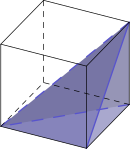
La altura de este tetraedro es y la base tiene un área de Esto hace que el volumen sea
Ahora debemos aplicar las restricciones del enunciado. Necesitamos hallar la región donde
A partir de la condición de orden que impusimos, estas desigualdades se reducen a
Estas dos restricciones forman otro tetraedro como se muestra a continuación.
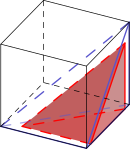
Observa que en el nuevo tetraedro, todas las dimensiones se han reducido en Esto hace la altura y la base
El volumen es entonces
La probabilidad buscada es entonces
Sustituyendo todas las opciones de respuesta, obtenemos que el menor valor tal que esta fracción es mayor que es
Por lo tanto, D es la respuesta correcta.
This problem lends itself to geometric probability since we can view the interval as a range on an axis.
WLOG, let
Then we have that the points which satisfy this restriction form a tetrahedron.
The height of this tetrahedron is and the base has an area of This makes the volume
Now we have to apply the restrictions from the problem statement. We need to find the region where
From our ordering condition that we imposed, these inequalities reduce to
These two restrictions form another tetrahedron as shown below.
Note that in the new tetrahedron, all the dimensions have been reduced by This makes the height and the base
The volume is then
The desired probability is then
Plugging in all the answer choices, we get that the smallest value such that this fraction is greater than is
Thus, D is the correct answer.