2022 AMC 10A Problema 25

A continuación está la solución en video y solución preparada profesionalmente para el Problema 25 del 2022 AMC 10A, de LIVE by Po-Shen Loh. También puedes intentar el examen cronometrado completo, ver todas las soluciones del 2022 AMC 10A, o revisar la clave de respuestas.

Todos los problemas se usan con el permiso legal oficial de la Mathematical Association of America (MAA).

Conceptos:punto reticulararitmética modularoptimización

Nivel de dificultad: 2600

25.

Sean R,R, S,S, y TT cuadrados que tienen sus vértices en puntos reticulares (es decir, puntos cuyas coordenadas son ambas enteras) en el plano de coordenadas, junto con sus interiores.

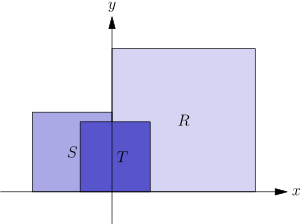
El borde inferior de cada cuadrado está sobre el eje xx. El borde izquierdo de RR y el borde derecho de SS están sobre el eje yy, y RR contiene 94\dfrac{9}{4} veces tantos puntos reticulares como S.S. Los dos vértices superiores de TT están en RS,R \cup S, y TT contiene 14\dfrac{1}{4} de los puntos reticulares contenidos en RS.R \cup S. Ve la figura (no está dibujada a escala).

La fracción de puntos reticulares en SS que están en STS \cap T es 2727 veces la fracción de puntos reticulares en RR que están en RT.R \cap T. ¿Cuál es el valor mínimo posible de la longitud de arista de RR más la longitud de arista de SS más la longitud de arista de TT?

Let R,R, S,S, and TT be squares that have vertices at lattice points (i.e., points whose coordinates are both integers) in the coordinate plane, together with their interiors.

The bottom edge of each square is on the xx-axis. The left edge of RR and the right edge of SS are on the yy-axis, and RR contains 94\dfrac{9}{4} as many lattice points as does S.S. The top two vertices of TT are in RS,R \cup S, and TT contains 14\dfrac{1}{4} of the lattice points contained in RS.R \cup S. See the figure (not drawn to scale).

The fraction of lattice points in SS that are in STS \cap T is 2727 times the fraction of lattice points in RR that are in RT.R \cap T. What is the minimum possible value of the edge length of RR plus the edge length of SS plus the edge length of T?T?

336336

337337

338338

339339

340340

Solución en video:
Miniatura del video de la solución
Play video

Click to load, then click again to play

Solución escrita:

Sea rr el número de puntos reticulares sobre el lado de R.R. Análogamente define ss para SS y tt para T.T. Nota que el número de puntos reticulares en un rectángulo es el producto del número de puntos reticulares a lo largo de su ancho y del número de puntos reticulares a lo largo de su largo.

La primera condición nos da que r2=94s2 r^2 = \dfrac{9}{4} \cdot s^2 r=32s(1)r = \dfrac{3}{2} \cdot s \tag*{(1)}

El número de puntos reticulares en RSR \cup S es la suma de los puntos reticulares de cada una de las regiones, pero hay solapamiento a lo largo del eje yy donde SS lo toca.

La segunda condición, por lo tanto, da t2=14(r2+s2s) t^2 = \dfrac{1}{4}(r^2 + s^2 - s) t2=14(94s2+s2s) t^2 = \dfrac{1}{4}(\dfrac{9}{4} \cdot s^2 + s^2 - s) t2=1413s24s4 t^2 = \dfrac{1}{4} \cdot \dfrac{13s^2 - 4s}{4} 16t2=s(13s4). 16t^2 = s(13s - 4). Por (1),(1), obtenemos que ss es múltiplo de 2.2. Podemos sustituir ss por 2j2j para obtener 16t2=2j(26j4) 16t^2 = 2j(26j - 4) 4t2=j(13j2). 4t^2 = j(13j - 2). Para que el producto sea divisible entre 4,4, jj debe ser divisible entre 2.2. Podemos sustituir de nuevo jj por 2k2k para obtener 4t2=2k(26k2) 4t^2 = 2k(26k - 2) t2=k(13k1)(2) t^2 = k(13k - 1) \tag*{(2)}

Sea xx el número de puntos reticulares a lo largo de la base del rectángulo formado por STS \cap T y yy el número de puntos reticulares a lo largo de la base del rectángulo formado por RT.R \cap T.

Usando estas variables, obtenemos que el número de puntos reticulares en STS \cap T es xtxt y en RTR \cap T es yt.yt.

La tercera condición nos da que xts2=27ytr2 \dfrac{xt}{s^2} = 27 \cdot \dfrac{yt}{r^2} xs2=27y94s2 \dfrac{x}{s^2} = 27 \cdot \dfrac{y}{\dfrac{9}{4} s^2} x=12y. x = 12y.

También sabemos que t=x+y1t = x + y - 1 (teniendo en cuenta el solapamiento), y esto da t=13y1(3) t = 13y - 1 \tag*{(3)}

(3)(3) nos da que t1(mod13),t21(mod13). \begin{gathered} t \equiv -1 \pmod{13}, \\ t^2 \equiv 1 \pmod{13}. \end{gathered}

Sin embargo, por (2),(2), obtenemos que t2k(mod13) t^2 \equiv -k \pmod{13} k1(mod13). k \equiv -1 \pmod{13}.

Por (2),(2), también obtenemos que kk es un cuadrado perfecto, ya que es primo relativo con 13k1,13k - 1, y su producto debe ser un cuadrado perfecto.

Por lo tanto, kk debe ser un cuadrado perfecto que satisface k1(mod13)k\equiv-1\pmod{13}. Los cuadrados positivos más pequeños 1,4,9,161,4,9,16 no satisfacen esta congruencia, mientras que k=25k=25 sí, así que 2525 es el menor valor posible.

A partir de este valor de k,k, obtenemos que j=225=50,j = 2 \cdot 25 = 50, s=250=100,s = 2 \cdot 50 = 100, y r=32100=150.r = \dfrac{3}{2} \cdot 100 = 150. También podemos hallar que t2=25(13251)=25324 t^2 = 25(13 \cdot 25 - 1) = 25 \cdot 324 t=518=90. t = 5 \cdot 18 = 90. Por lo tanto, r+s+t=340. r + s + t = 340. Sin embargo, la pregunta pedía la suma de las longitudes de los lados. Las longitudes de los lados de los cuadrados son 11 menos que el número de puntos reticulares sobre el lado, así que hay que restar 3.3.

Por lo tanto, la respuesta buscada es 3403=337.340 - 3 = 337.

Por lo tanto, B es la respuesta correcta.

Let rr be the number of lattice points on the side length of R.R. Similarly define ss for SS and tt for T.T. Note that the number of lattice points in a rectangle is the product of the number of lattice points along its width and the number of lattice points along its length.

The first conditions gives us that r2=94s2 r^2 = \dfrac{9}{4} \cdot s^2 r=32s(1)r = \dfrac{3}{2} \cdot s \tag*{(1)}

The number of lattice points in RSR \cup S is the sum of the lattice points in each of the regions, but there is overlap along the yy-axis where SS touches it.

The second condition, therefore, yields t2=14(r2+s2s) t^2 = \dfrac{1}{4}(r^2 + s^2 - s) t2=14(94s2+s2s) t^2 = \dfrac{1}{4}(\dfrac{9}{4} \cdot s^2 + s^2 - s) t2=1413s24s4 t^2 = \dfrac{1}{4} \cdot \dfrac{13s^2 - 4s}{4} 16t2=s(13s4). 16t^2 = s(13s - 4). From (1),(1), we get that ss is a multiple of 2.2. We can substitute ss with 2j2j to get 16t2=2j(26j4) 16t^2 = 2j(26j - 4) 4t2=j(13j2). 4t^2 = j(13j - 2). For the product to be divisible by 4,4, jj must be divisible by 2.2. We can again substitute jj with 2k2k to get 4t2=2k(26k2) 4t^2 = 2k(26k - 2) t2=k(13k1)(2) t^2 = k(13k - 1) \tag*{(2)}

Let xx be the number of lattice points along the bottom of the rectangle formed by STS \cap T and yy be the number of lattice points along the bottom of the rectangle formed by RT.R \cap T.

Using these variable, we get that the number of lattice points in STS \cap T is xtxt and in RTR \cap T is yt.yt.

The third condition gives us that xts2=27ytr2 \dfrac{xt}{s^2} = 27 \cdot \dfrac{yt}{r^2} xs2=27y94s2 \dfrac{x}{s^2} = 27 \cdot \dfrac{y}{\dfrac{9}{4} s^2} x=12y. x = 12y.

We also know that t=x+y1t = x + y - 1 (accounting for overlap), and this yields t=13y1(3) t = 13y - 1 \tag*{(3)}

(3)(3) gives us that t1(mod13),t21(mod13). \begin{gathered} t \equiv -1 \pmod{13}, \\ t^2 \equiv 1 \pmod{13}. \end{gathered}

However, by (2),(2), we get that t2k(mod13) t^2 \equiv -k \pmod{13} k1(mod13). k \equiv -1 \pmod{13}.

By (2),(2), we also get that kk is a perfect square since it is relatively prime to 13k1,13k - 1, and they must multiply to a perfect square.

Thus kk must be a perfect square satisfying k1(mod13)k\equiv-1\pmod{13}. The smaller positive squares 1,4,9,161,4,9,16 do not satisfy this congruence, while k=25k=25 does, so 2525 is the least possible value.

From this value of k,k, we get that j=225=50,j = 2 \cdot 25 = 50, s=250=100,s = 2 \cdot 50 = 100, and r=32100=150.r = \dfrac{3}{2} \cdot 100 = 150. We can also find that t2=25(13251)=25324 t^2 = 25(13 \cdot 25 - 1) = 25 \cdot 324 t=518=90. t = 5 \cdot 18 = 90. Therefore, r+s+t=340. r + s + t = 340. The question, however, asked for the sum of the side lengths. The side lengths of the squares are 11 less than the number of lattice points on the side, so we have to subtract 3.3.

Therefore, the desired answer is 3403=337.340 - 3 = 337.

Thus, B is the correct answer.

← Problema 24#24Examen completo

El Problema 25 en otros años