2000 AMC 10 Problema 7

Intenta el Problema 7 del 2000 AMC 10 a continuación y luego compara tu respuesta con la solución preparada profesionalmente de LIVE by Po-Shen Loh. También puedes intentar el examen cronometrado completo, ver todas las soluciones del 2000 AMC 10, o revisar la clave de respuestas.

Todos los problemas se usan con el permiso legal oficial de la Mathematical Association of America (MAA).

7.
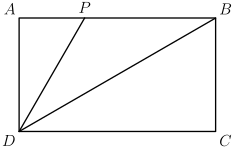
En el rectángulo ABCD,ABCD, AD=1,AD = 1, PP está sobre AB‾,\overline{AB}, y DB‾\overline{DB} y DP‾\overline{DP} trisecan ∠ADC.\angle ADC. ¿Cuál es el perímetro del △BDP\triangle BDP?
In rectangle ABCD,ABCD, AD=1,AD = 1, PP is on AB‾,\overline{AB}, and DB‾\overline{DB} and DP‾\overline{DP} trisect ∠ADC.\angle ADC. What is the perimeter of △BDP?\triangle BDP?
3+333 + \dfrac{\sqrt3}{3}
2+4332 + \dfrac{4\sqrt3}{3}
2+222 + 2\sqrt2
3+352\dfrac{3 + 3\sqrt5}{2}
2+5332 + \dfrac{5\sqrt3}{3}
Respuesta: B
Conceptos:triángulo rectángulo especialrectánguloperímetro
Nivel de dificultad: 1390
Pista pequeña:
El ángulo ADC=90∘ADC = 90^\circ se divide en tres ángulos de 30∘30^\circ.
Angle ADC=90∘ADC = 90^\circ is split into three 30∘30^\circ angles
Pista grande:
Los triángulos ADPADP y ADBADB son ambos triángulos rectángulos 3030-6060-9090 con cateto AD=1AD = 1.
Triangles ADPADP and ADBADB are both 3030-6060-9090 right triangles with leg AD=1AD = 1
Solución:
El ángulo recto ∠ADC=90∘\angle ADC = 90^\circ se triseca en tres ángulos de 30∘30^\circ, por lo que ∠ADP=30∘\angle ADP = 30^\circ y ∠ADB=60∘.\angle ADB = 60^\circ.
En el triángulo rectángulo ADP,ADP, con AD=1,AD = 1, se obtiene DP=1cos⁡30∘=233DP = \dfrac{1}{\cos 30^\circ} = \dfrac{2\sqrt3}{3} y AP=tan⁡30∘=33.AP = \tan 30^\circ = \dfrac{\sqrt3}{3}.
En el triángulo rectángulo ADB,ADB, con AD=1,AD = 1, se obtiene DB=1cos⁡60∘=2DB = \dfrac{1}{\cos 60^\circ} = 2 y AB=tan⁡60∘=3.AB = \tan 60^\circ = \sqrt3.
Entonces PB=AB−AP=3−33=233. \begin{aligned} PB = AB - AP &= \sqrt3 - \dfrac{\sqrt3}{3} \\ &= \dfrac{2\sqrt3}{3}. \end{aligned}
El perímetro del △BDP\triangle BDP es DP+PB+DB=233+233+2=2+433. \begin{gathered} DP + PB + DB \\ = \dfrac{2\sqrt3}{3} + \dfrac{2\sqrt3}{3} + 2 \\ = 2 + \dfrac{4\sqrt3}{3}. \end{gathered}
Por lo tanto, la respuesta correcta es B.
The right angle ∠ADC=90∘\angle ADC = 90^\circ is trisected into three 30∘30^\circ angles, so ∠ADP=30∘\angle ADP = 30^\circ and ∠ADB=60∘.\angle ADB = 60^\circ.
In right triangle ADP,ADP, with AD=1,AD = 1, we get DP=1cos⁡30∘=233DP = \dfrac{1}{\cos 30^\circ} = \dfrac{2\sqrt3}{3} and AP=tan⁡30∘=33.AP = \tan 30^\circ = \dfrac{\sqrt3}{3}.
In right triangle ADB,ADB, with AD=1,AD = 1, we get DB=1cos⁡60∘=2DB = \dfrac{1}{\cos 60^\circ} = 2 and AB=tan⁡60∘=3.AB = \tan 60^\circ = \sqrt3.
Then PB=AB−AP=3−33=233. \begin{aligned} PB = AB - AP &= \sqrt3 - \dfrac{\sqrt3}{3} \\ &= \dfrac{2\sqrt3}{3}. \end{aligned}
The perimeter of △BDP\triangle BDP is DP+PB+DB=233+233+2=2+433. \begin{gathered} DP + PB + DB \\ = \dfrac{2\sqrt3}{3} + \dfrac{2\sqrt3}{3} + 2 \\ = 2 + \dfrac{4\sqrt3}{3}. \end{gathered}
Thus, the correct answer is B.
Problema 6#6
Examen completo

El Problema 7 en otros años