
Problemas del 2000 AMC 10
¡Desplázate hacia abajo y presiona Iniciar para intentar el examen! O ve al PDF imprimible, la clave de respuestas, o las soluciones profesionales preparadas por LIVE by Po-Shen Loh.
Todos los problemas se usan con el permiso legal oficial de la Mathematical Association of America (MAA).
O salta directamente a un solo problema con su solución: 1 · 2 · 3 · 4 · 5 · 6 · 7 · 8 · 9 · 10 · 11 · 12 · 13 · 14 · 15 · 16 · 17 · 18 · 19 · 20 · 21 · 22 · 23 · 24 · 25
¿Quieres aprender de forma profesional con clases interactivas en video?
Con tiempo
1:15:00
1.
En el año Estados Unidos será sede de la Olimpiada Internacional de Matemáticas. Sean y enteros positivos distintos tales que el producto ¿Cuál es el mayor valor posible de la suma ?
In the year the United States will host the International Mathematical Olympiad. Let and be distinct positive integers such that the product What is the largest possible value of the sum
Respuesta: E
Pista pequeña:
Descompón en factores primos.
Factor into primes
Pista grande:
Para que la suma sea grande, mantén un factor lo más pequeño posible para que otro pueda ser lo más grande posible.
To make the sum large, keep one factor as small as possible so another can be as large as possible
Solución:
Al factorizar se obtiene
Si un factor es las parejas posibles para los otros dos son y Sus sumas correspondientes con son y (La pareja repetiría el factor )
Si ningún factor es los tres factores primos deben repartirse entre los tres enteros, lo que solo da y una suma mucho menor. Por tanto, la mayor suma posible es
Por lo tanto, la respuesta correcta es E.
Factoring gives
If one factor is the possible pairs for the other two factors are and Their corresponding sums with are and (The pair would repeat the factor )
If no factor is all three prime factors must be split among the three integers, giving only and a much smaller sum. Therefore, the largest possible sum is
Thus, the correct answer is E.
2.
¿Cuál de las siguientes opciones es igual a ?
Which of the following is equal to
Respuesta: A
Pista pequeña:
Escribe el inicial como .
Write the leading as
Pista grande:
Al multiplicar potencias con la misma base se suman los exponentes.
Multiplying powers with the same base adds the exponents
Solución:
Escribe el factor como Entonces
Cada una de las otras opciones es mayor que
Por lo tanto, la respuesta correcta es A.
Write the factor as Then
Each of the other options is larger than
Thus, the correct answer is A.
3.
Cada día, Jenny comía el de las gomitas que había en su frasco al comienzo de ese día. Al final del segundo día quedaban . ¿Cuántas gomitas había originalmente en el frasco?
Each day, Jenny ate of the jellybeans that were in her jar at the beginning of that day. At the end of the second day, remained. How many jellybeans were in the jar originally?
Respuesta: B
Pista pequeña:
Comer el deja el de las gomitas al final de cada día.
Eating leaves of the jellybeans at the end of each day
Pista grande:
Si es la cantidad original, entonces .
If is the original amount, then
Solución:
Como Jenny come el cada día, al final de cada día queda el .
Si es la cantidad original, entonces de modo que
Por lo tanto, la respuesta correcta es B.
Since Jenny eats each day, remain at the end of each day.
If is the original number, then so
Thus, the correct answer is B.
4.
Chandra paga a un proveedor de servicios en línea una cuota mensual fija más un cargo por hora por el tiempo de conexión. Su factura de diciembre fue de pero en enero su factura fue de porque usó el doble de tiempo de conexión que en diciembre. ¿Cuál es la cuota mensual fija?
Chandra pays an on-line service provider a fixed monthly fee plus an hourly charge for connect time. Her December bill was but in January her bill was because she used twice as much connect time as in December. What is the fixed monthly fee?
Respuesta: D
Pista pequeña:
El cargo adicional de enero proviene por completo de una cantidad extra de tiempo de conexión equivalente a la de diciembre.
The extra charge in January comes entirely from one additional December’s worth of connect time
Pista grande:
La diferencia es igual al costo del tiempo de conexión de diciembre.
The difference equals December’s connect-time cost
Solución:
En enero solo se duplicó el tiempo de conexión, así que el aumento es igual al costo del tiempo de conexión de diciembre.
Por lo tanto, la cuota mensual fija es
Por lo tanto, la respuesta correcta es D.
January doubled only the connect time, so the increase equals December’s connect-time cost.
The fixed monthly fee is therefore
Thus, the correct answer is D.
5.
Los puntos y son los puntos medios de los lados y del A medida que se mueve a lo largo de una recta paralela al lado ¿cuántas de las cuatro cantidades que se enumeran a continuación cambian?
(a) la longitud del segmento (b) el perímetro del (c) el área del (d) el área del trapecio
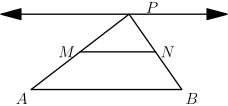
Points and are the midpoints of sides and of As moves along a line that is parallel to side how many of the four quantities listed below change?
(a) the length of the segment (b) the perimeter of (c) the area of (d) the area of trapezoid
Respuesta: B
Pista pequeña:
es una base media del triángulo, por lo que .
is a midsegment of the triangle, so
Pista grande:
Como permanece sobre una recta paralela a la altura desde hasta nunca cambia.
Since stays on a line parallel to the height from to never changes
Solución:
Como es una base media, que es fijo.
La base y la altura desde hasta son ambas constantes mientras se desliza a lo largo de la recta paralela, por lo que el área del no cambia. El trapecio es el triángulo menos el y las áreas de ambos son constantes, así que su área tampoco cambia.
Solo el perímetro cambia, ya que y varían al moverse . Así que exactamente una cantidad cambia.
Por lo tanto, la respuesta correcta es B.
Since is a midsegment, which is fixed.
The base and the height from to are both constant as slides along the parallel line, so the area of does not change. The trapezoid is the triangle minus both of whose areas are constant, so its area does not change either.
Only the perimeter changes, since and vary as moves. So exactly one quantity changes.
Thus, the correct answer is B.
6.
La sucesión de Fibonacci comienza con dos , y cada término posterior es la suma de sus dos predecesores. ¿Cuál de los diez dígitos es el último en aparecer en la posición de las unidades de un número de la sucesión de Fibonacci?
The Fibonacci sequence starts with two s, and each term afterwards is the sum of its two predecessors. Which one of the ten digits is the last to appear in the units position of a number in the Fibonacci sequence?
Respuesta: C
Pista pequeña:
Sigue solo el dígito de las unidades de cada término, sumando los dos dígitos de las unidades anteriores módulo .
Track only the units digit of each term, adding the two previous units digits modulo
Pista grande:
Enumera los dígitos de las unidades y observa cuál dígito tarda más en aparecer por primera vez.
List the units digits and note which digit is slowest to first appear
Solución:
Registrando solo los dígitos de las unidades se obtiene la sucesión
Al buscar la primera aparición de cada dígito, el dígito es el último de los diez dígitos en aparecer.
Por lo tanto, la respuesta correcta es C.
Recording only the units digits gives the sequence
Scanning for the first appearance of each digit, the digit is the last of the ten digits to show up.
Thus, the correct answer is C.
7.
En el rectángulo está sobre y y trisecan ¿Cuál es el perímetro del ?
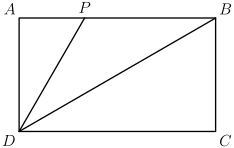
In rectangle is on and and trisect What is the perimeter of
Respuesta: B
Pista pequeña:
El ángulo se divide en tres ángulos de .
Angle is split into three angles
Pista grande:
Los triángulos y son ambos triángulos rectángulos -- con cateto .
Triangles and are both -- right triangles with leg
Solución:
El ángulo recto se triseca en tres ángulos de , por lo que y
En el triángulo rectángulo con se obtiene y
En el triángulo rectángulo con se obtiene y
Entonces
El perímetro del es
Por lo tanto, la respuesta correcta es B.
The right angle is trisected into three angles, so and
In right triangle with we get and
In right triangle with we get and
Then
The perimeter of is
Thus, the correct answer is B.
8.
En la Escuela Secundaria Olympic, de los estudiantes de primer año y de los de segundo año presentaron el AMC Dado que el número de participantes de primer año y de segundo año fue el mismo, ¿cuál de las siguientes afirmaciones debe ser verdadera?
At Olympic High School, of the freshmen and of the sophomores took the AMC Given that the number of freshmen and sophomore contestants was the same, which of the following must be true?
Hay cinco veces más estudiantes de segundo año que de primer
año.
There are five times as many sophomores as freshmen.
Hay el doble de estudiantes de segundo año que de primer
año.
There are twice as many sophomores as freshmen.
Hay tantos estudiantes de primer año como de segundo año.
There are as many freshmen as sophomores.
Hay el doble de estudiantes de primer año que
de segundo año.
There are twice as many freshmen as
sophomores.
Hay cinco veces más estudiantes de primer año que de segundo
año.
There are five times as many freshmen as sophomores.
Respuesta: D
Pista pequeña:
Sean y los números de estudiantes de primer y segundo año, e iguala los dos conteos de participantes.
Let and be the numbers of freshmen and sophomores, and set the two contestant counts equal
Pista grande:
Resuelve para en términos de .
Solve for in terms of
Solución:
Sean y los números de estudiantes de primer y segundo año. Los conteos de participantes son iguales, así que
Multiplicando por se obtiene de modo que Hay el doble de estudiantes de primer año que de segundo año.
Por lo tanto, la respuesta correcta es D.
Let and be the numbers of freshmen and sophomores. The contestant counts are equal, so
Multiplying by gives so There are twice as many freshmen as sophomores.
Thus, the correct answer is D.
9.
Si donde entonces
If where then
Respuesta: C
Pista pequeña:
Como la cantidad es negativa, así que .
Since the quantity is negative, so
Pista grande:
Resuelve para y luego sustituye en .
Solve for then substitute into
Solución:
Como tenemos de modo que
Entonces
Por lo tanto, la respuesta correcta es C.
Because we have so
Then
Thus, the correct answer is C.
10.
Los lados de un triángulo de área positiva tienen longitudes y Los lados de un segundo triángulo de área positiva tienen longitudes y ¿Cuál es el menor número positivo que no es un valor posible de ?
The sides of a triangle with positive area have lengths and The sides of a second triangle with positive area have lengths and What is the smallest positive number that is not a possible value of
Respuesta: D
Pista pequeña:
La desigualdad triangular obliga a que cada uno de y esté estrictamente entre y .
The triangle inequality forces each of and to lie strictly between and
Pista grande:
Halla el rango de cuando y recorren cada uno ese intervalo abierto.
Find the range of when and each range over that open interval
Solución:
Por la desigualdad triangular, cada uno de y puede ser cualquier número estrictamente entre y
Entonces puede tomar cualquier valor con
El menor número positivo que no se puede alcanzar es
Por lo tanto, la respuesta correcta es D.
By the triangle inequality, each of and can be any number strictly between and
Then can take any value with
The smallest positive number not attainable is
Thus, the correct answer is D.
11.
Se eligen dos números primos diferentes entre y . Cuando su suma se resta de su producto, ¿cuál de los siguientes números se podría obtener?
Two different prime numbers between and are chosen. When their sum is subtracted from their product, which of the following numbers could be obtained?
Respuesta: C
Pista pequeña:
Los primos entre y son todos impares.
The primes between and are all odd
Pista grande:
Observa que que es impar y aumenta con y .
Note that which is odd and increases with and
Solución:
Los primos entre y son y El producto de dos de ellos es impar y la suma es par, así que es impar.
Como aumenta al crecer cualquiera de los primos, el resultado va desde hasta
La única opción impar en es
Por lo tanto, la respuesta correcta es C.
The primes between and are and The product of two of them is odd and the sum is even, so is odd.
Since increases as either prime increases, the result ranges from up to
The only odd option in is
Thus, the correct answer is C.
12.
Las figuras y constan de y cuadrados unitarios que no se superponen, respectivamente. Si el patrón continuara, ¿cuántos cuadrados unitarios que no se superponen habría en la figura ?
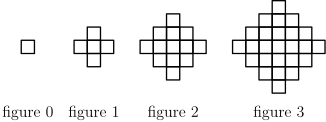
Figures and consist of and nonoverlapping unit squares, respectively. If the pattern were continued, how many nonoverlapping unit squares would there be in figure
Respuesta: C
Pista pequeña:
Los valores aumentan sucesivamente en .
The differences grow by
Pista grande:
La figura tiene cuadrados unitarios.
Figure has unit squares
Solución:
La figura se puede dividir en la suma de los primeros números impares y los primeros números impares, lo que da cuadrados unitarios.
Para la figura esto es
Por lo tanto, la respuesta correcta es C.
Figure can be split into the sum of the first odd numbers and the first odd numbers, giving unit squares.
For figure this is
Thus, the correct answer is C.
13.
Hay clavijas amarillas, clavijas rojas, clavijas verdes, clavijas azules y clavija naranja que se deben colocar en un tablero triangular de clavijas. ¿De cuántas maneras se pueden colocar las clavijas de modo que ninguna fila (horizontal) ni columna (vertical) contenga dos clavijas del mismo color?
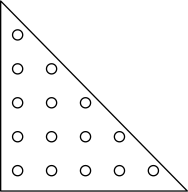
There are yellow pegs, red pegs, green pegs, blue pegs, and orange peg to be placed on a triangular peg board. In how many ways can the pegs be placed so that no (horizontal) row or (vertical) column contains two pegs of the same color?
Respuesta: B
Pista pequeña:
Hay exactamente cinco filas y cinco columnas, y cinco clavijas amarillas.
There are exactly five rows and five columns, and five yellow pegs
Pista grande:
Cada color que tiene tantas clavijas como líneas disponibles debe ocupar exactamente una clavija en cada una de esas líneas, lo que fuerza sus posiciones.
Each color that has as many pegs as available lines must occupy exactly one peg in each such line, forcing its positions
Solución:
El tablero tiene cinco filas y cinco columnas. Para evitar dos clavijas amarillas en una fila o columna, debe haber exactamente una clavija amarilla en cada fila, lo que obliga a las clavijas amarillas a ubicarse en la diagonal larga.
Las cuatro clavijas rojas deben ir entonces en las filas a y las únicas posiciones que quedan también las obligan a formar una sola diagonal. Continuando con verde, azul y naranja, cada color queda forzado a una posición única.
Por lo tanto, hay exactamente una disposición válida.
Por lo tanto, la respuesta correcta es B.
The board has five rows and five columns. To avoid two yellow pegs in a row or column, there must be exactly one yellow peg in each row, forcing the yellow pegs onto the long diagonal.
The four red pegs must then each go in rows through and the only positions left force them into a single diagonal as well. Continuing with green, blue, and orange, every color is forced into a unique position.
Hence there is exactly one valid arrangement.
Thus, the correct answer is B.
14.
La señora Walter aplicó un examen en una clase de matemáticas de cinco estudiantes. Ingresó las calificaciones en orden aleatorio en una hoja de cálculo, que recalculaba el promedio de la clase después de ingresar cada calificación. La señora Walter notó que, después de ingresar cada calificación, el promedio siempre era un entero. Las calificaciones (en orden ascendente) eran y ¿Cuál fue la última calificación que ingresó la señora Walter?
Mrs. Walter gave an exam in a mathematics class of five students. She entered the scores in random order into a spreadsheet, which recalculated the class average after each score was entered. Mrs. Walter noticed that after each score was entered, the average was always an integer. The scores (listed in ascending order) were and What was the last score Mrs. Walter entered?
Respuesta: C
Pista pequeña:
La suma de las primeras calificaciones ingresadas debe ser divisible por .
The sum of the first entered scores must be divisible by
Pista grande:
Usa los residuos de las calificaciones módulo para determinar cuáles tres podrían ingresarse primero.
Use the residues of the scores modulo to pin down which three could be entered first
Solución:
Los residuos de módulo son La suma de las primeras tres calificaciones debe ser divisible por y el único triple así es por lo que la tercera calificación ingresada es y las dos primeras son y
Como es uno más que un múltiplo de la cuarta calificación debe ser tres más que un múltiplo de lo cual solo cumple . Eso deja como la quinta y última calificación.
En efecto, son divisibles por
Por lo tanto, la respuesta correcta es C.
The residues of modulo are The sum of the first three scores must be divisible by and the only such triple is so the third score entered is and the first two are and
Since is one more than a multiple of the fourth score must be three more than a multiple of which only satisfies. That leaves as the fifth and last score.
Indeed are divisible by
Thus, the correct answer is C.
15.
Dos números reales no nulos, y satisfacen Halla un valor posible de
Two non-zero real numbers, and satisfy Find a possible value of
Respuesta: E
Pista pequeña:
Combina sobre el denominador común .
Combine over the common denominator
Pista grande:
Reemplaza por dentro de .
Replace with inside
Solución:
Sobre el denominador común
Sustituyendo se obtiene
Por lo tanto, la respuesta correcta es E.
Over the common denominator
Substituting gives
Thus, the correct answer is E.
16.
El diagrama muestra puntos reticulares, cada uno a una unidad de sus vecinos más cercanos. El segmento corta al segmento en Halla la longitud del segmento
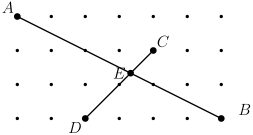
The diagram shows lattice points, each one unit from its nearest neighbors. Segment meets segment at Find the length of segment
Respuesta: B
Pista pequeña:
Asigna coordenadas .
Assign coordinates
Pista grande:
Halla las ecuaciones de las rectas y y resuelve para su intersección .
Find the equations of lines and and solve for their intersection
Solución:
Coloca los puntos en
La recta es y la recta es Resolviendo simultáneamente se obtiene
Entonces
Por lo tanto, la respuesta correcta es B.
Place the points at
Line is and line is Solving simultaneously gives
Then
Thus, the correct answer is B.
17.
Boris tiene una increíble máquina para cambiar monedas. Cuando introduce una moneda de veinticinco centavos, devuelve cinco monedas de cinco centavos; cuando introduce una de cinco centavos, devuelve cinco monedas de un centavo; y cuando introduce una moneda de un centavo, devuelve cinco de veinticinco centavos. Boris comienza con una sola moneda de un centavo. ¿Cuál de las siguientes cantidades podría tener Boris después de usar la máquina repetidamente?
Boris has an incredible coin changing machine. When he puts in a quarter, it returns five nickels; when he puts in a nickel, it returns five pennies; and when he puts in a penny, it returns five quarters. Boris starts with just one penny. Which of the following amounts could Boris have after using the machine repeatedly?
Respuesta: D
Pista pequeña:
Cambiar una moneda de veinticinco centavos por cinco de cinco centavos, y una de cinco centavos por cinco de un centavo, dejan el valor total sin cambios.
A quarter for five nickels and a nickel for five pennies each leave the total value unchanged
Pista grande:
Solo el cambio de un centavo por cinco monedas de veinticinco centavos altera el total, y siempre agrega .
Only the penny-for-five-quarters trade changes the total, always adding
Solución:
Cambiar una moneda de veinticinco centavos por cinco de cinco centavos, o una de cinco centavos por cinco de un centavo, no cambia el valor total. Solo cambiar un centavo por cinco monedas de veinticinco centavos lo cambia, agregando centavos.
Partiendo de centavo, Boris siempre tiene centavos para algún entero no negativo
Solo tiene esta forma, ya que
Por lo tanto, la respuesta correcta es D.
Trading a quarter for five nickels or a nickel for five pennies does not change the total value. Only trading a penny for five quarters changes it, adding cents.
Starting from cent, Boris always has cents for some nonnegative integer
Only has this form, since
Thus, the correct answer is D.
18.
Charlyn camina completamente alrededor del borde de un cuadrado cuyos lados miden cada uno km. Desde cualquier punto de su trayecto puede ver exactamente km horizontalmente en todas las direcciones. ¿Cuál es el área de la región formada por todos los puntos que Charlyn puede ver durante su caminata, expresada en kilómetros cuadrados y redondeada al entero más cercano?
Charlyn walks completely around the boundary of a square whose sides are each km long. From any point on her path she can see exactly km horizontally in all directions. What is the area of the region consisting of all points Charlyn can see during her walk, expressed in square kilometers and rounded to the nearest whole number?
Respuesta: C
Pista pequeña:
Divide la región visible en la parte dentro del cuadrado y la parte fuera de él.
Split the visible region into the part inside the square and the part outside it
Pista grande:
Fuera, la región consta de cuatro rectángulos de más cuatro cuartos de círculo de radio .
Outside, the region is four rectangles plus four quarter circles of radius
Solución:
Dentro del cuadrado, Charlyn ve todo excepto un cuadrado central de lado un área de kilómetros cuadrados.
Fuera del cuadrado, la región consta de cuatro rectángulos de cada uno más cuatro cuartos de círculo de radio un área de kilómetros cuadrados.
El área total es kilómetros cuadrados.
Por lo tanto, la respuesta correcta es C.
Inside the square, Charlyn sees everything except a central square of side an area of square kilometers.
Outside the square, the region is four rectangles each plus four quarter circles of radius an area of square kilometers.
The total area is square kilometers.
Thus, the correct answer is C.
19.
Por un punto de la hipotenusa de un triángulo rectángulo se trazan rectas paralelas a los catetos del triángulo, de modo que el triángulo queda dividido en un cuadrado y dos triángulos rectángulos más pequeños. El área de uno de los dos triángulos rectángulos pequeños es veces el área del cuadrado. La razón entre el área del otro triángulo rectángulo pequeño y el área del cuadrado es
Through a point on the hypotenuse of a right triangle, lines are drawn parallel to the legs of the triangle so that the triangle is divided into a square and two smaller right triangles. The area of one of the two small right triangles is times the area of the square. The ratio of the area of the other small right triangle to the area of the square is
Respuesta: D
Pista pequeña:
Sea el cuadrado de lado y sean los dos triángulos pequeños con catetos que coinciden con los lados del cuadrado.
Let the square have side and let the two small triangles have legs matching the square’s sides
Pista grande:
Los dos triángulos pequeños son semejantes, por lo que las longitudes de sus catetos son recíprocas.
The two small triangles are similar, so their leg lengths are reciprocals
Solución:
Sea el cuadrado de lado Un triángulo pequeño tiene catetos y con área de modo que
Los dos triángulos pequeños son semejantes, así que el otro tiene catetos y con área
Como el cuadrado tiene área la razón buscada es
Por lo tanto, la respuesta correcta es D.
Let the square have side One small triangle has legs and with area so
The two small triangles are similar, so the other has legs and with area
Since the square has area the desired ratio is
Thus, the correct answer is D.
20.
Sean y enteros no negativos tales que ¿Cuál es el valor máximo de
Let and be nonnegative integers such that What is the maximum value of
Respuesta: C
Pista pequeña:
Suma a cada variable y desarrolla .
Add to each variable and expand
Pista grande:
La expresión es igual a así que hay que maximizar el producto de tres enteros positivos cuya suma es .
The expression equals so maximize a product of three positive integers summing to
Solución:
Observa que
Maximizamos un producto de tres enteros positivos cuya suma es La partición más equilibrada es que da
El máximo es
Por lo tanto, la respuesta correcta es C.
Notice that
We maximize a product of three positive integers summing to The most balanced split is giving
The maximum is
Thus, the correct answer is C.
21.
Si todos los caimanes son criaturas feroces y algunos bichos rastreros son caimanes, ¿cuáles afirmaciones deben ser verdaderas?
I. Todos los caimanes son bichos rastreros.
II. Algunas criaturas feroces son bichos rastreros.
III. Algunos caimanes no son bichos rastreros.
If all alligators are ferocious creatures and some creepy crawlers are alligators, which statement(s) must be true?
I. All alligators are creepy crawlers.
II. Some ferocious creatures are creepy crawlers.
III. Some alligators are not creepy crawlers.
Solo
only
Solo
only
Solo
only
Solo y
and only
Ninguna debe ser verdadera
None must be true
Respuesta: B
Pista pequeña:
Algunos bichos rastreros son caimanes, y todo caimán es feroz.
Some creepy crawlers are alligators, and every alligator is ferocious
Pista grande:
Comprueba las afirmaciones I y III dibujando un diagrama en el que los caimanes queden completamente dentro de los bichos rastreros.
Test statements I and III by drawing a diagram where alligators sit entirely inside the creepy crawlers
Solución:
Algunos bichos rastreros son caimanes, y todos los caimanes son feroces, así que esas criaturas son a la vez bichos rastreros y feroces. Por lo tanto, algunas criaturas feroces son bichos rastreros, lo que hace verdadera la II.
La afirmación I falla porque no todo caimán tiene que ser un bicho rastrero, y la III falla porque es posible que todos los caimanes sean bichos rastreros. Solo la II debe cumplirse.
Por lo tanto, la respuesta correcta es B.
Some creepy crawlers are alligators, and all alligators are ferocious, so those creatures are both creepy crawlers and ferocious. Hence some ferocious creatures are creepy crawlers, making II true.
Statement I fails because not every alligator need be a creepy crawler, and III fails because it is possible that all alligators are creepy crawlers. Only II must hold.
Thus, the correct answer is B.
22.
Una mañana, cada miembro de la familia de Angela bebió una mezcla de onzas de café con leche. Las cantidades de café y leche variaban de taza en taza, pero nunca eran cero. Angela bebió un cuarto de la cantidad total de leche y un sexto de la cantidad total de café. ¿Cuántas personas hay en la familia?
One morning each member of Angela’s family drank an -ounce mixture of coffee with milk. The amounts of coffee and milk varied from cup to cup, but were never zero. Angela drank a quarter of the total amount of milk and a sixth of the total amount of coffee. How many people are in the family?
Respuesta: C
Pista pequeña:
La taza de Angela es una fracción de la bebida total de todos.
Angela’s cup is a fraction of everyone’s total drink
Pista grande:
Su taza es una mezcla de de la leche y del café, así que está estrictamente entre y .
Her cup is a mix of of the milk and of the coffee, so lies strictly between and
Solución:
Supongamos que hay personas, que beben onzas en total, repartidas en leche y café Angela bebió una taza, así que
El lado izquierdo es un promedio ponderado de y así que está estrictamente entre y Eso obliga a de modo que
Por lo tanto, la respuesta correcta es C.
Let there be people, drinking ounces total, split into milk and coffee Angela drank one cup, so
The left side is a weighted average of and so lies strictly between and That forces so
Thus, the correct answer is C.
23.
Cuando la media, la mediana y la moda de la lista se ordenan de manera creciente, forman una progresión aritmética no constante. ¿Cuál es la suma de todos los valores reales posibles de ?
When the mean, median, and mode of the list are arranged in increasing order, they form a non-constant arithmetic progression. What is the sum of all possible real values of
Respuesta: E
Pista pequeña:
La moda es y la media es la mediana depende de dónde caiga .
The mode is and the mean is the median depends on where falls
Pista grande:
Divide en casos según el tamaño de y exige que los tres valores ordenados estén igualmente espaciados.
Split into cases by the size of and require the three ordered values to be equally spaced
Solución:
La moda siempre es y la media es
Si la mediana también es Dos valores iguales no pueden pertenecer a una progresión aritmética no constante de tres términos, así que este caso no da soluciones.
Si los valores aparecen en el orden Forman una progresión aritmética exactamente cuando Al sustituir se obtiene cuya solución es
Si la mediana es y Por tanto, la condición es así que y
Los dos valores posibles son y cuya suma es
Así, la respuesta correcta es E.
The mode is always and the mean is
If the median is also Two equal values cannot belong to a non-constant three-term arithmetic progression, so this case gives no solutions.
If the values occur in the order They form an arithmetic progression exactly when Substituting for gives whose solution is
If the median is and Thus the condition is so and
The two possible values are therefore and whose sum is
Thus, the correct answer is E.
24.
Sea una función para la cual Halla la suma de todos los valores de para los cuales
Let be a function for which Find the sum of all values of for which
Respuesta: B
Pista pequeña:
Para lograr toma .
To make set
Pista grande:
Esto da una ecuación cuadrática en usa la fórmula de la suma de raíces .
This gives a quadratic in use the sum-of-roots formula
Solución:
Para evaluar toma de modo que Entonces
Igualando esto a se obtiene
Por la fórmula de la suma de raíces, la suma de los valores de es
Por lo tanto, la respuesta correcta es B.
To evaluate set so Then
Setting this equal to gives
By the sum-of-roots formula, the sum of the values of is
Thus, the correct answer is B.
25.
En el año el día del año es martes. En el año el día también es martes. ¿En qué día de la semana cayó el día del año ?
In year the th day of the year is a Tuesday. In year the th day is also a Tuesday. On what day of the week did the th day of year occur?
jueves
Thursday
viernes
Friday
sábado
Saturday
domingo
Sunday
lunes
Monday
Respuesta: A
Pista pequeña:
Dos fechas caen en el mismo día de la semana exactamente cuando el número de días entre ellas es un múltiplo de .
Two dates fall on the same weekday exactly when the number of days between them is a multiple of
Pista grande:
Cuenta los días desde el día del año hasta el día del año para decidir si es un año bisiesto.
Count the days from day of year to day of year to decide whether is a leap year
Solución:
Desde el día del año hasta el día del año hay días, donde es la duración del año Si no fuera bisiesto, esto es lo que daría un lunes, no un martes. Así que el año es bisiesto, y el conteo es consistente con un martes.
Entonces los años y no son bisiestos.
El día del año precede al martes (día del año ) por días. Como ese día está días antes en la semana que el martes, es decir, un jueves.
Por lo tanto, la respuesta correcta es A.
From day of year to day of year is days, where is the length of year If were not a leap year, this is giving a Monday, not a Tuesday. So year is a leap year, and the count is consistent with Tuesday.
Then years and are not leap years.
The th day of year precedes the Tuesday (day of year ) by days. Since that day is days earlier in the week than Tuesday, which is a Thursday.
Thus, the correct answer is A.