2013 AMC 10B Problema 22

A continuación está la solución preparada profesionalmente para el Problema 22 del 2013 AMC 10B, de LIVE by Po-Shen Loh. También puedes intentar el examen cronometrado completo, ver todas las soluciones del 2013 AMC 10B, o revisar la clave de respuestas.

Todos los problemas se usan con el permiso legal oficial de la Mathematical Association of America (MAA).

Conceptos:cuadrado mágicoaritmética modularemparejamiento y agrupaciónprincipio de multiplicación

Nivel de dificultad: 2060

22.

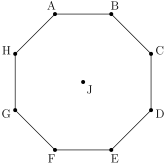
El octágono regular ABCDEFGHABCDEFGH tiene su centro en J.J. Cada uno de los vértices y el centro se deben asociar con uno de los dígitos 11 al 9,9, usando cada dígito una vez, de tal manera que las sumas de los números en las líneas AJE,AJE, BJF,BJF, CJG,CJG, y DJHDJH sean todas iguales. ¿De cuántas maneras se puede hacer esto?

The regular octagon ABCDEFGHABCDEFGH has its center at J.J. Each of the vertices and the center are to be associated with one of the digits 11 through 9,9, with each digit used once, in such a way that the sums of the numbers on the lines AJE,AJE, BJF,BJF, CJG,CJG, and DJHDJH are all equal. In how many ways can this be done?

384 384

576 576

1152 1152

1680 1680

3456 3456

Solución:

Sea SS definida como: S=A+J+E=B+J+F=C+J+G=D+J+H \begin{aligned} S &= A+J+E \\ &=B+J+F \\ &=C+J+G \\ &=D+J+H \end{aligned} 4S=A+B+C+D+E+F+G+H+4J \begin{aligned} 4S &= A+B+C+D+E \\ &\quad+F+G+H+4J \end{aligned} 4S=45+3J4S = 45+3J 45+3J0mod445+3J \equiv 0 \mod 4 3J3mod43J \equiv 3 \mod 4 J1mod4J \equiv 1 \mod 4

Esto significa que J=1,5,9.J=1,5,9. A partir de aquí, supongamos que J=1.J=1. Veremos que los otros casos son lo bastante similares como para omitirlos.

Si J=1,J=1, entonces sabemos que los pares de números que satisfacen la igualdad anterior son: 2+9=3+8=4+7=5+62+9 = 3+8 = 4+7 = 5+6 Hay 4!4! formas de distribuir los pares en los cuatro grupos, y luego 242^4 formas de que estos grupos intercambien elementos (es decir, 2+9    9+22+9\iff 9+2).

Ahora, si observamos los casos J=5J=5 y J=9J=9, vemos un patrón similar en el número de agrupaciones e intercambios. Así, tenemos: 34!24=11523\cdot 4! \cdot 2^4 = 1152 posibilidades.

Por lo tanto, la respuesta correcta es C.

Let SS be defined as: S=A+J+E=B+J+F=C+J+G=D+J+H \begin{aligned} S &= A+J+E \\ &=B+J+F \\ &=C+J+G \\ &=D+J+H \end{aligned} 4S=A+B+C+D+E+F+G+H+4J \begin{aligned} 4S &= A+B+C+D+E \\ &\quad+F+G+H+4J \end{aligned} 4S=45+3J4S = 45+3J 45+3J0mod445+3J \equiv 0 \mod 4 3J3mod43J \equiv 3 \mod 4 J1mod4J \equiv 1 \mod 4

This means that J=1,5,9.J=1,5,9. From here, let's assume J=1.J=1. We will see that the other cases are similar enough to omit.

If J=1,J=1, then we know that the pairs of numbers that satisfy the equality above are: 2+9=3+8=4+7=5+62+9 = 3+8 = 4+7 = 5+6 There are 4!4! ways to distribute the pairs over the four groups, and then 242^4 ways for these groups to swap elements (i.e. 2+9    9+22+9\iff 9+2).

Now, if we look at the J=5J=5 and J=9J=9 cases, we see a similar pattern in the number of groupings and swaps. As such, we have: 34!24=11523\cdot 4! \cdot 2^4 = 1152 possibilities.

Thus, the correct answer is C .

← Problema 21#21Examen completoProblema 23#23 →

El Problema 22 en otros años