2013 AMC 10B Problema 23

A continuación está la solución preparada profesionalmente para el Problema 23 del 2013 AMC 10B, de LIVE by Po-Shen Loh. También puedes intentar el examen cronometrado completo, ver todas las soluciones del 2013 AMC 10B, o revisar la clave de respuestas.

Todos los problemas se usan con el permiso legal oficial de la Mathematical Association of America (MAA).

Conceptos:cuadrilátero cíclicoTeorema de Ptolomeoalturasemejanza

Nivel de dificultad: 2300

23.

En el ABC,\triangle ABC, AB=13,AB=13, BC=14,BC=14, y CA=15.CA=15. Los puntos distintos D,D, E,E, y FF están en los segmentos BC,\overline{BC}, CA,\overline{CA}, y DE,\overline{DE}, respectivamente, de modo que ADBC,\overline{AD}\perp\overline{BC}, DEAC,\overline{DE}\perp\overline{AC}, y AFBF.\overline{AF}\perp\overline{BF}. La longitud del segmento DF\overline{DF} se puede escribir como mn,\frac{m}{n}, donde mm y nn son enteros positivos coprimos. ¿Cuánto vale m+nm+n?

In triangle ABC,\triangle ABC, AB=13,AB=13, BC=14,BC=14, and CA=15.CA=15. Distinct points D,D, E,E, and FF lie on segments BC,\overline{BC}, CA,\overline{CA}, and DE,\overline{DE}, respectively, such that ADBC,\overline{AD}\perp\overline{BC}, DEAC,\overline{DE}\perp\overline{AC}, and AFBF.\overline{AF}\perp\overline{BF}. The length of segment DF\overline{DF} can be written as mn,\frac{m}{n}, where mm and nn are relatively prime positive integers. What is m+n?m+n?

18 18

21 21

24 24

27 27

30 30

Solución:

Primero, podemos deducir que BD=5,AD=12,CD=9BD =5, AD = 12, CD = 9 inspeccionando ternas pitagóricas.

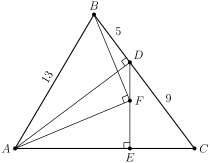
Esto produce el siguiente diagrama:

Luego, obtenemos ADE=ACD\angle ADE = \angle ACD por la semejanza de ADC\triangle ADC y AED.\triangle AED . Como ABF\triangle ABF y ADF\triangle ADF son ambos triángulos rectángulos, ambos tienen circunferencias circunscritas con diámetro AB,AB, lo que hace que ABDFABDF sea cíclico. Así, ABF=ADF=ACD,\angle ABF = \angle ADF = \angle ACD, lo que da cos(ABF)=35,\cos (\angle ABF) = \dfrac 35,sin(ABF)=45. \sin (\angle ABF) = \dfrac 45 . Por lo tanto, AF=3513,AF = \dfrac 35 \cdot 13, BF=4513. BF = \dfrac 45 \cdot 13.

Por el teorema de Ptolomeo, obtenemos ABDF+DBAF=BFAD. \begin{aligned} &AB \cdot DF + DB \cdot AF \\ &= BF\cdot AD . \end{aligned} Por lo tanto, 13DF+51345=121335.13\cdot DF + 5\cdot 13\dfrac 45 =12 \cdot 13\dfrac 35 .

Esto se simplifica a DF+545=1235,DF + 5\cdot \dfrac 45 = 12 \cdot \dfrac 35 , es decir DF+4=365.DF + 4 = \dfrac {36}5. Por lo tanto, DF=165,DF=\dfrac {16}5, lo que da m+n=21.m+n=21.

Por lo tanto, la respuesta correcta es B.

First, we can deduce that BD=5,AD=12,CD=9BD =5, AD = 12, CD = 9 by inspecting Pythagorean triples.

This yields the following diagram:

Then, we get ADE=ACD\angle ADE = \angle ACD by the similarity of ADC\triangle ADC and AED.\triangle AED . Since ABF\triangle ABF and ADF\triangle ADF are both right triangles, they both have circumcircles with diameter AB,AB, making ABDFABDF cyclic. Thus, ABF=ADF=ACD,\angle ABF = \angle ADF = \angle ACD, making cos(ABF)=35,\cos (\angle ABF) = \dfrac 35,sin(ABF)=45. \sin (\angle ABF) = \dfrac 45 . As such, AF=3513,AF = \dfrac 35 \cdot 13, BF=4513. BF = \dfrac 45 \cdot 13.

By Ptolemy's Theorem, we get ABDF+DBAF=BFAD. \begin{aligned} &AB \cdot DF + DB \cdot AF \\ &= BF\cdot AD . \end{aligned} Therefore, 13DF+51345=121335.13\cdot DF + 5\cdot 13\dfrac 45 =12 \cdot 13\dfrac 35 .

This makes DF+545=1235,DF + 5\cdot \dfrac 45 = 12 \cdot \dfrac 35 , so DF+4=365.DF + 4 = \dfrac {36}5. As such, DF=165,DF=\dfrac {16}5, making m+n=21.m+n=21.

Thus, the correct answer is B .

← Problema 22#22Examen completoProblema 24#24 →

El Problema 23 en otros años