2025 AIME II Problema 5

A continuación está la solución preparada profesionalmente para el Problema 5 del 2025 AIME II, de LIVE by Po-Shen Loh. También puedes intentar el examen cronometrado completo, ver todas las soluciones del 2025 AIME II, o revisar la clave de respuestas.

Todos los problemas se usan con el permiso legal oficial de la Mathematical Association of America (MAA).

Conceptos:ángulo inscritopersecución de ángulostriángulo isósceles

Nivel de dificultad: 2720

5.

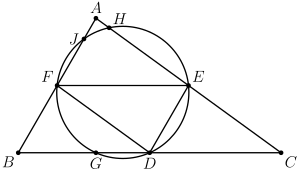
Supongamos que ABC\triangle ABC tiene ángulos BAC=84,\angle BAC = 84^\circ, ABC=60,\angle ABC = 60^\circ, y ACB=36.\angle ACB = 36^\circ. Sean D,D, E,E, y FF los puntos medios de los lados BC,\overline{BC}, AC,\overline{AC}, y AB,\overline{AB}, respectivamente. La circunferencia circunscrita de DEF\triangle DEF corta a BD,\overline{BD}, AE,\overline{AE}, y AF\overline{AF} en los puntos G,G, H,H, y J,J, respectivamente. Los puntos G,G, D,D, E,E, H,H, J,J, y FF dividen la circunferencia circunscrita de DEF\triangle DEF en seis arcos menores, como se muestra. Halla DE^+2HJ^+3FG^,\widehat{DE} + 2 \cdot \widehat{HJ} + 3 \cdot \widehat{FG}, donde los arcos se miden en grados.

Suppose ABC\triangle ABC has angles BAC=84,\angle BAC = 84^\circ, ABC=60,\angle ABC = 60^\circ, and ACB=36.\angle ACB = 36^\circ. Let D,D, E,E, and FF be the midpoints of sides BC,\overline{BC}, AC,\overline{AC}, and AB,\overline{AB}, respectively. The circumcircle of DEF\triangle DEF intersects BD,\overline{BD}, AE,\overline{AE}, and AF\overline{AF} at points G,G, H,H, and J,J, respectively. The points G,G, D,D, E,E, H,H, J,J, and FF divide the circumcircle of DEF\triangle DEF into six minor arcs, as shown. Find DE^+2HJ^+3FG^,\widehat{DE} + 2 \cdot \widehat{HJ} + 3 \cdot \widehat{FG}, where the arcs are measured in degrees.

Solución:

El triángulo medial DEFDEF tiene lados paralelos a los de ABC,ABC, así que FDE=84,\angle FDE = 84^\circ, DEF=60,\angle DEF = 60^\circ, y DFE=36.\angle DFE = 36^\circ. Su circunferencia circunscrita es la circunferencia de los nueve puntos, cuyas segundas intersecciones con los lados de ABCABC son los pies de las alturas: GG es el pie desde A,A, HH el pie desde B,B, y JJ el pie desde C.C. Por el teorema del ángulo inscrito, DE^=2DFE=72.\widehat{DE} = 2\angle DFE = 72^\circ.

Para FG^:\widehat{FG}: como DFCA\overline{DF} \parallel \overline{CA} y GG está sobre el rayo DB,DB, el ángulo FDG\angle FDG es igual al ángulo entre las rectas CACA y CB,CB, que es 36,36^\circ, así que FG^=236=72.\widehat{FG} = 2 \cdot 36^\circ = 72^\circ. Para HJ^:\widehat{HJ}: como BJC=BHC=90,\angle BJC = \angle BHC = 90^\circ, tanto HH como JJ están sobre la circunferencia de diámetro BC\overline{BC} centrada en D,D, así que DJ=DBDJ = DB y DH=DC.DH = DC. El triángulo isósceles BDJBDJ da JDB=180260=60,\angle JDB = 180^\circ - 2 \cdot 60^\circ = 60^\circ, y el triángulo isósceles CDHCDH da HDC=180236=108.\angle HDC = 180^\circ - 2 \cdot 36^\circ = 108^\circ. Por lo tanto JDH=18060\angle JDH = 180^\circ - 60^\circ 108=12- 108^\circ = 12^\circ y HJ^=24.\widehat{HJ} = 24^\circ.

Por lo tanto DE^+2HJ^\widehat{DE} + 2 \cdot \widehat{HJ} +3FG^+ 3 \cdot \widehat{FG} =72+48+216=336.= 72 + 48 + 216 = 336.

The medial triangle DEFDEF has sides parallel to those of ABC,ABC, so FDE=84,\angle FDE = 84^\circ, DEF=60,\angle DEF = 60^\circ, and DFE=36.\angle DFE = 36^\circ. Its circumcircle is the nine-point circle, whose second intersections with the sides of ABCABC are the feet of the altitudes: GG is the foot from A,A, HH the foot from B,B, and JJ the foot from C.C. By the inscribed angle theorem, DE^=2DFE=72.\widehat{DE} = 2\angle DFE = 72^\circ.

For FG^:\widehat{FG}: since DFCA\overline{DF} \parallel \overline{CA} and GG lies on ray DB,DB, the angle FDG\angle FDG equals the angle between lines CACA and CB,CB, which is 36,36^\circ, so FG^=236=72.\widehat{FG} = 2 \cdot 36^\circ = 72^\circ. For HJ^:\widehat{HJ}: because BJC=BHC=90,\angle BJC = \angle BHC = 90^\circ, both HH and JJ lie on the circle with diameter BC\overline{BC} centered at D,D, so DJ=DBDJ = DB and DH=DC.DH = DC. Isosceles triangle BDJBDJ gives JDB=180260=60,\angle JDB = 180^\circ - 2 \cdot 60^\circ = 60^\circ, and isosceles triangle CDHCDH gives HDC=180236=108.\angle HDC = 180^\circ - 2 \cdot 36^\circ = 108^\circ. Hence JDH=18060\angle JDH = 180^\circ - 60^\circ 108=12- 108^\circ = 12^\circ and HJ^=24.\widehat{HJ} = 24^\circ.

Therefore DE^+2HJ^\widehat{DE} + 2 \cdot \widehat{HJ} +3FG^+ 3 \cdot \widehat{FG} =72+48+216=336.= 72 + 48 + 216 = 336.

← Problema 4#4Examen completoProblema 6#6 →

El Problema 5 en otros años