2010 AMC 10B Problema 20

A continuación está la solución preparada profesionalmente para el Problema 20 del 2010 AMC 10B, de LIVE by Po-Shen Loh. También puedes intentar el examen cronometrado completo, ver todas las soluciones del 2010 AMC 10B, o revisar la clave de respuestas.

Todos los problemas se usan con el permiso legal oficial de la Mathematical Association of America (MAA).

Conceptos:polígono regularrecta tangentetriángulo rectángulo especialrazón de áreas

Nivel de dificultad: 1960

20.

Dos circunferencias están fuera del hexágono regular ABCDEF.ABCDEF. La primera es tangente a AB,\overline{AB}, y la segunda es tangente a DE.\overline{DE}. Ambas son tangentes a las rectas BCBC y FA.FA. ¿Cuál es la razón entre el área de la segunda circunferencia y la de la primera?

Two circles lie outside regular hexagon ABCDEF.ABCDEF. The first is tangent to AB,\overline{AB}, and the second is tangent to DE.\overline{DE}. Both are tangent to lines BCBC and FA.FA. What is the ratio of the area of the second circle to that of the first circle?

1818

2727

3636

8181

108108

Solución:

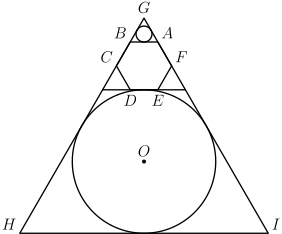
Considera el siguiente diagrama:

Supongamos que el hexágono regular tiene lado 1.1. La circunferencia más pequeña está inscrita en un triángulo equilátero de lado 1.1.

El inradio de este triángulo equilátero es 36.\dfrac{\sqrt3}{6}. El área de la circunferencia es entonces π(36)2=π12. \pi \cdot \left(\dfrac{\sqrt3}{6}\right)^2 = \dfrac{\pi}{12}.

Sea OO el centro de la circunferencia más grande. Traza la perpendicular desde OO hacia GH\overline{GH} con pie en J.J. Traza OG.\overline{OG}.

Tenemos que OJG\triangle OJG es rectángulo. Como HGI=60,\angle HGI = 60^{\circ}, también tenemos que OJG\triangle OJG es un triángulo 30609030-60-90.

Sea OJ=r.OJ = r. Entonces OG=2r.OG = 2r. También tenemos que OGOG es la suma de la altura del hexágono, la del triángulo equilátero y el radio de la circunferencia.

Entonces OG=32+3+r. OG = \dfrac{\sqrt3}{2} + \sqrt3 + r.

Sustituyendo OG,OG, obtenemos 2r=32+3+r. 2r = \dfrac{\sqrt3}{2} + \sqrt3 + r. Simplificando obtenemos r=332. r = \dfrac{3\sqrt3}{2}.

El área de la circunferencia más grande es entonces π(332)2=274π. \pi \cdot \left(\dfrac{3\sqrt3}{2}\right)^2 = \dfrac{27}{4}\pi.

La razón buscada es entonces 27π4π12=81. \dfrac{\frac{27\pi}{4}}{\frac{\pi}{12}} = 81.

Por lo tanto, D es la respuesta correcta.

Consider the following diagram:

Assume the regular hexagon has side length 1.1. The smaller circle is inscribed in an equilateral triangle of side length 1.1.

The inradius of this equilateral triangle is 36.\dfrac{\sqrt3}{6}. The area of the circle is then π(36)2=π12. \pi \cdot \left(\dfrac{\sqrt3}{6}\right)^2 = \dfrac{\pi}{12}.

Let OO be the center of the larger circle. Drop the perpendicular from OO to GH\overline{GH} at J.J. Draw OG.\overline{OG}.

We have that OJG\triangle OJG is right. Since HGI=60,\angle HGI = 60^{\circ}, we also have that OJG\triangle OJG is a 30609030-60-90 triangle.

Let OJ=r.OJ = r. Then OG=2r.OG = 2r. We also have that OGOG is the sum of the height of the hexagon, equilateral triangle, and radius of the circle.

Then OG=32+3+r. OG = \dfrac{\sqrt3}{2} + \sqrt3 + r.

Substituting in OG,OG, we get 2r=32+3+r. 2r = \dfrac{\sqrt3}{2} + \sqrt3 + r. Simplifying gives us r=332. r = \dfrac{3\sqrt3}{2}.

The area of the larger circle is then π(332)2=274π. \pi \cdot \left(\dfrac{3\sqrt3}{2}\right)^2 = \dfrac{27}{4}\pi.

The desired ratio is then 27π4π12=81. \dfrac{\frac{27\pi}{4}}{\frac{\pi}{12}} = 81.

Thus, D is the correct answer.

← Problema 19#19Examen completoProblema 21#21 →

El Problema 20 en otros años