
Problemas del 2010 AMC 10B
25 problemas · 75 minutos
¡Desplázate hacia abajo y presiona Iniciar para intentar el examen! O ve al PDF imprimible, la clave de respuestas, o las soluciones profesionales preparadas por LIVE by Po-Shen Loh.
O salta directamente a un solo problema con su solución: 1 · 2 · 3 · 4 · 5 · 6 · 7 · 8 · 9 · 10 · 11 · 12 · 13 · 14 · 15 · 16 · 17 · 18 · 19 · 20 · 21 · 22 · 23 · 24 · 25
Todos los problemas se usan con el permiso legal oficial de la Mathematical Association of America (MAA).
¿Quieres aprender de forma profesional con clases interactivas en video?
Aprende con LIVECon tiempo
1:15:00
1.
¿Cuál es el valor de la siguiente expresión?
What is the value of the following expression?
Respuesta: C
Pista pequeña:
Desarrolla ambos términos antes de restar.
Expand both terms before subtracting
Pista grande:
La mayoría de los términos de se cancelan.
Most of the terms cancel
Solución:
Tenemos que y
Por lo tanto, su diferencia es:
Por lo tanto, C es la respuesta correcta.
We have that and
As such, their difference is:
Thus, C is the correct answer.
2.
Makayla asistió a dos reuniones durante su jornada laboral de horas. La primera reunión duró minutos y la segunda duró el doble. ¿Qué porcentaje de su jornada laboral dedicó a asistir a reuniones?
Makayla attended two meetings during her -hour work day. The first meeting took minutes and the second meeting took twice as long. What percent of her work day was spent attending meetings?
Respuesta: C
Pista pequeña:
Convierte los tiempos de las reuniones a las mismas unidades.
Convert the meeting times to the same units
Pista grande:
Las reuniones duran minutos de un total de horas.
The meetings last minutes out of hours
Solución:
Observa que minutos son horas. La segunda reunión dura entonces horas. Así, ambas reuniones toman en total horas. El porcentaje de la jornada laboral de Makayla dedicado a las reuniones es
Por lo tanto, C es la respuesta correcta.
Note that minutes is hours. The second meeting is then hours. Both meetings take a total of hours then. The percent of Makayla’s work day spent attending meetings is
Thus, C is the correct answer.
3.
Un cajón contiene calcetines rojos, verdes, azules y blancos, con al menos de cada color. ¿Cuál es el número mínimo de calcetines que se deben sacar del cajón para garantizar un par del mismo color?
A drawer contains red, green, blue, and white socks with at least of each color. What is the minimum number of socks that must be pulled from the drawer to guarantee a matching pair?
Respuesta: C
Pista pequeña:
Considera el peor caso antes de que aparezca un par.
Use the worst case before a pair appears
Pista grande:
Puedes sacar primero un calcetín de cada uno de los cuatro colores.
You can draw one sock of each of the four colors first
Solución:
Para maximizar el número de calcetines, queremos sacar tantos calcetines sueltos como sea posible antes de obtener un par.
Hay colores, lo que significa que podemos sacar un calcetín de cada color antes de sacar un par.
Esto significa que se deben sacar al menos calcetines para garantizar un par.
Por lo tanto, C es la respuesta correcta.
To maximize the number of socks, we want to grab as many single socks as possible before getting a pair.
There are colors, which means that we can draw one sock of each color before drawing a pair.
This means that it takes at least socks to be drawn before a pair is guaranteed.
Thus, C is the correct answer.
4.
Para un número real define como el promedio de y ¿Cuál es el valor de la siguiente expresión?
For a real number define to be the average of and What is the value of the following expression?
Respuesta: C
Pista pequeña:
Calcula por separado .
Evaluate separately
Pista grande:
.
Solución:
Tenemos y
Entonces
Por lo tanto, C es la respuesta correcta.
We have and
Then
Thus, C is the correct answer.
5.
Un mes con días tiene el mismo número de lunes y de miércoles. ¿Cuántos de los siete días de la semana podrían ser el primer día de este mes?
A month with days has the same number of Mondays and Wednesdays. How many of the seven days of the week could be the first day of this month?
Respuesta: B
Pista pequeña:
En días, tres días de la semana ocurren una vez más.
In days, three weekdays occur one extra time
Pista grande:
El lunes y el miércoles deben ser ambos días extra o ninguno de los dos serlo.
Monday and Wednesday must either both be extra days or both not be extra days
Solución:
Observa que días dejan un residuo de al dividir entre
Esto significa que si el mes empieza en sábado, domingo, martes o miércoles, habrá un número desigual de lunes y de miércoles.
Entonces el mes solo puede empezar en lunes, jueves o viernes.
Por lo tanto, B es la respuesta correcta.
Note that days leaves a remainder of when divided by
This means that if the month starts on a Saturday, Sunday, Tuesday, or Wednesday, there will be an uneven number of Mondays and Wednesdays.
Then the month can only start on a Monday, Thursday, or Friday.
Thus, B is the correct answer.
6.
Una circunferencia tiene centro es un diámetro y es un punto en la circunferencia con ¿Cuál es la medida en grados de ?
A circle is centered at is a diameter and is a point on the circle with What is the degree measure of
Respuesta: B
Pista pequeña:
Relaciona con .
Relate to
Pista grande:
, así que es isósceles.
, so is isosceles
Solución:
Considera el siguiente diagrama:
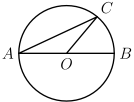
Tenemos que
Como es isósceles, tenemos que
Como tenemos que
Por lo tanto, B es la respuesta correcta.
Consider the following diagram:
We have that
Since is isosceles, we have that
Since we have that
Thus, B is the correct answer.
7.
Un triángulo tiene lados de longitudes y Un rectángulo tiene ancho y área igual al área del triángulo. ¿Cuál es el perímetro de este rectángulo?
A triangle has side lengths and A rectangle has width and area equal to the area of the triangle. What is the perimeter of this rectangle?
Respuesta: D
Pista pequeña:
Traza la altura hacia el lado de longitud .
Drop the altitude to the side of length
Pista grande:
La altura divide el triángulo en dos triángulos --.
The altitude splits the triangle into two -- triangles
Solución:
Para hallar el área del triángulo, podemos trazar la altura hacia el lado de longitud
Entonces tenemos un triángulo rectángulo con un cateto e hipotenusa
El otro cateto tiene longitud
El área del triángulo es entonces
El largo del rectángulo es entonces Su perímetro es
Por lo tanto, D es la respuesta correcta.
To find the area of the triangle, we can drop the altitude to the side of length
Then we have a right triangle with one leg and hypotenuse
The other leg has length
The area of the triangle is then
The length of the rectangle is then Its perimeter is
Thus, D is the correct answer.
8.
Una entrada para una obra escolar cuesta dólares, donde es un número entero. Un grupo de estudiantes de º grado compra entradas por un total de y un grupo de estudiantes de º grado compra entradas por un total de ¿Cuántos valores de son posibles?
A ticket to a school play costs dollars, where is a whole number. A group of th graders buys tickets costing a total of and a group of th graders buys tickets costing a total of How many values for are possible?
Respuesta: E
Pista pequeña:
El precio de la entrada debe dividir ambos totales.
The ticket price must divide both totals
Pista grande:
Cuenta los divisores positivos de .
Count the positive divisors of
Solución:
Observa que debe dividir tanto como lo que significa que debe dividir su máximo común divisor.
El máximo común divisor de y es lo que significa que divide a
tiene factores, a saber, todas las potencias de hasta
Por lo tanto, E es la respuesta correcta.
Note that must divide both and which means that it must divide their greatest common divisor.
The greatest common divisor of and is which means divides
has factors, namely all the powers of up to
Thus, E is the correct answer.
9.
El profesor del afortunado Larry le pidió sustituir números por y en la expresión y evaluar el resultado. Larry ignoró los paréntesis pero sumó y restó correctamente, y obtuvo el resultado correcto por coincidencia. Los números que Larry sustituyó por y fueron y respectivamente. ¿Qué número sustituyó Larry por ?
Lucky Larry’s teacher asked him to substitute numbers for and in the expression and evaluate the result. Larry ignored the parentheses but added and subtracted correctly and obtained the correct result by coincidence. The numbers Larry substituted for and were and respectively. What number did Larry substitute for
Respuesta: D
Pista pequeña:
Compara el valor que Larry obtuvo al ignorar los paréntesis con el valor correcto.
Compare Larry’s ignored-parentheses value to the correct value
Pista grande:
Evaluada correctamente, la expresión es .
Correctly evaluated, the expression is
Solución:
Ignorando los paréntesis, Larry obtendría
Evaluando con los paréntesis, se obtendría
Ambos valores son iguales, por lo que
Por lo tanto, D es la respuesta correcta.
Ignoring the parentheses, Larry would get
Evaluating with the parentheses, one would get
Both of these values are the same, so
Thus, D is the correct answer.
10.
Shelby conduce su scooter a una velocidad de millas por hora si no llueve, y millas por hora si llueve. Hoy condujo bajo el sol por la mañana y bajo la lluvia por la tarde, recorriendo un total de millas en minutos. ¿Cuántos minutos condujo bajo la lluvia?
Shelby drives her scooter at a speed of miles per hour if it is not raining, and miles per hour if it is raining. Today she drove in the sun in the morning and in the rain in the evening, for a total of miles in minutes. How many minutes did she drive in the rain?
Respuesta: C
Pista pequeña:
Sea el tiempo bajo la lluvia en minutos.
Let be the rain time in minutes
Pista grande:
Usa .
Use
Solución:
Observa que minutos son de hora. Supongamos que Shelby conduce horas bajo el sol.
Entonces conduce horas bajo la lluvia, lo que significa que recorre un total de millas. Esto es igual a así que
Entonces Shelby conduce minutos bajo la lluvia.
Por lo tanto, C es la respuesta correcta.
Note that minutes is hours. Let Shelby drive hours in the sun.
Then she drives hours in the rain, which means she travels a total of miles. We have this equals so
Then Shelby drives minutes in the rain.
Thus, C is the correct answer.
11.
Un comprador planea adquirir un artículo cuyo precio de lista es mayor que y puede usar cualquiera de los tres cupones. El cupón A da de descuento sobre el precio de lista, el cupón B da de descuento sobre el precio de lista, y el cupón C da de descuento sobre la cantidad en que el precio de lista excede
Sean e el menor y el mayor precio, respectivamente, para los cuales el cupón A ahorra al menos tantos dólares como el cupón B o C. ¿Cuánto vale ?
A shopper plans to purchase an item that has a listed price greater than and can use any one of the three coupons. Coupon A gives off the listed price, Coupon B gives off the listed price, and Coupon C gives off the amount by which the listed price exceeds
Let and be the smallest and largest prices, respectively, for which Coupon A saves at least as many dollars as Coupon B or C. What is
Respuesta: A
Pista pequeña:
Expresa el ahorro de cada cupón en términos del precio de lista.
Write each coupon’s savings in terms of the listed price
Pista grande:
El cupón A debe superar tanto como .
Coupon A must beat both and
Solución:
Sea el precio del artículo. Entonces el cupón A ahorra El cupón B ahorra
El cupón C ahorrará
Debemos tener y
Esto muestra que e Por lo tanto
Por lo tanto, A es la respuesta correcta.
Let be the price of the item. Then coupon A saves Coupon B saves
Coupon C will save
We must have that and
This shows that and Therefore
Thus, A is the correct answer.
12.
Al comienzo del año escolar, de todos los estudiantes de la clase de matemáticas del Sr. Wells respondieron «Sí» a la pregunta «¿Amas las matemáticas?», y respondieron «No». Al final del año escolar, respondieron «Sí» y respondieron «No». En total, de los estudiantes dieron una respuesta diferente al comienzo y al final del año escolar. ¿Cuál es la diferencia entre el valor máximo y el mínimo posible de ?
At the beginning of the school year, of all students in Mr. Wells’ math class answered “Yes” to the question “Do you love math”, and answered “No.” At the end of the school year, answered “Yes” and answered “No.” Altogether, of the students gave a different answer at the beginning and end of the school year. What is the difference between the maximum and the minimum possible values of
Respuesta: D
Pista pequeña:
Piensa en estudiantes.
Think of students
Pista grande:
Minimiza o maximiza el número de quienes cambian de respuesta.
Minimize or maximize the number who switch answers
Solución:
Para minimizar queremos que la mayor cantidad posible de estudiantes mantenga su respuesta.
Entonces necesitamos que al menos el por ciento de los estudiantes cambien su respuesta.
Para maximizar podemos hacer que todos los que respondieron no cambien su respuesta, pero algunos de los que respondieron sí deben seguir respondiendo sí.
Necesitamos que el por ciento de quienes dijeron sí sigan diciendo sí, lo que significa que solo el por ciento puede cambiar.
Esto hace que el porcentaje máximo de estudiantes que pueden cambiar sea el por ciento. La diferencia es entonces
Por lo tanto, D es la respuesta correcta.
To minimize we want to have as many kids as possible maintain their answer.
We then need at least percent of the students to change their answer.
To maximize we can have everybody that answered no change their answer, but some who answered yes must stay yes.
We need percent of the people who said yes to stay yes, which means only percent can switch.
This makes the maximum percent of students that can switch percent. The difference is then
Thus, D is the correct answer.
13.
¿Cuál es la suma de todas las soluciones de la siguiente ecuación?
What is the sum of all the solutions of the equation below?
Respuesta: C
Pista pequeña:
Separa en casos según el signo de .
Split cases based on the sign of
Pista grande:
Después de resolver el valor absoluto interior, resuelve las ecuaciones con valor absoluto resultantes.
After resolving the inner absolute value, solve the resulting absolute-value equations
Solución:
Primero nos ocupamos del valor absoluto exterior. Tenemos o
Estas ecuaciones se simplifican a y
Tenemos casos para cada ecuación. Para la primera, tenemos y
Resolviendo ambas obtenemos y
Para la otra ecuación, tenemos y
Resolviendo de nuevo ambas, tenemos y Observa que no puede ser negativo, ya que el lado derecho de la ecuación original es no negativo.
Sumando todas las soluciones obtenemos
Por lo tanto, C es la respuesta correcta.
We first take care of the outer absolute value. We have either or
These simplify to and
We have cases for each equation. For the first one, we have and
Solving both gives us and
For the other equation, we have and
Again solving both, we have and Note that cannot be negative since the right side of the original equation is nonnegative.
Adding up all the solutions gives us
Thus, C is the correct answer.
14.
El promedio de los números y es ¿Cuánto vale ?
The average of the numbers and is What is
Respuesta: B
Pista pequeña:
Usa la suma .
Use the sum
Pista grande:
Plantea .
Set
Solución:
Recuerda que la suma de los primeros enteros es
Entonces, tenemos lo que se simplifica a por diferencia de cuadrados. Al dividir obtenemos
Por lo tanto, B es la respuesta correcta.
Recall that the sum of the first integers is
Then, we have that which simplifies to by difference of squares. Dividing gives us
Thus, B is the correct answer.
15.
En un concurso de matemáticas de opción múltiple de preguntas, los estudiantes reciben puntos por una respuesta correcta, puntos por una respuesta en blanco y punto por una respuesta incorrecta. La puntuación total de Jesse en el concurso fue ¿Cuál es el número máximo de preguntas que Jesse pudo haber respondido correctamente?
On a -question multiple choice math contest, students receive points for a correct answer, points for an answer left blank, and point for an incorrect answer. Jesse’s total score on the contest was What is the maximum number of questions that Jesse could have answered correctly?
Respuesta: C
Pista pequeña:
Sea el número de respuestas correctas y el de incorrectas.
Let be correct answers and wrong answers
Pista grande:
Usa y .
Use and
Solución:
Sea el número de preguntas que Jesse respondió correctamente e el número que respondió incorrectamente.
Entonces y
Tenemos que
Al reorganizar y simplificar obtenemos que Como es un entero, su valor máximo es
Por lo tanto, C es la respuesta correcta.
Let be the number of questions Jesse answered correctly and be the number he answered incorrectly.
Then and
We have that
Rearranging and simplifying tells us that Since is an integer, its maximum value is
Thus, C is the correct answer.
16.
Un cuadrado de lado y una circunferencia de radio comparten el mismo centro. ¿Cuál es el área dentro de la circunferencia pero fuera del cuadrado?
A square of side length and a circle of radius share the same center. What is the area inside the circle, but outside the square?
Respuesta: B
Pista pequeña:
Encuentra dónde la circunferencia corta uno de los lados del cuadrado.
Find where the circle cuts one side of the square
Pista grande:
Un lado aporta un segmento circular fuera del cuadrado.
One side contributes a circular segment outside the square
Solución:
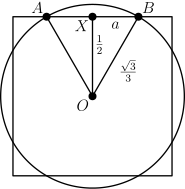
Traza la altura desde hacia con pie en
Observando las longitudes de los lados, vemos que es un triángulo .
Esto significa que el área del sector es
También tenemos que el área de es
El área del sector fuera del cuadrado y dentro de la circunferencia es entonces
Hay de estas regiones, lo que nos da un área total de
Por lo tanto, B es la respuesta correcta.
Drop the altitude from to at
Looking at the side lengths, we see that is a triangle.
This means that the area of sector is
We also have that the area of is
The area of the sector outside the square and inside the circle is then
There are of these regions, which gives us a total area of
Thus, B is the correct answer.
17.
Cada escuela secundaria de la ciudad de Euclid envió un equipo de estudiantes a un concurso de matemáticas. Cada participante del concurso obtuvo una puntuación diferente. La puntuación de Andrea fue la mediana entre todos los estudiantes, y fue la más alta de su equipo. Las compañeras de Andrea, Beth y Carla, quedaron en los lugares y , respectivamente. ¿Cuántas escuelas hay en la ciudad?
Every high school in the city of Euclid sent a team of students to a math contest. Each participant in the contest received a different score. Andrea’s score was the median among all students, and hers was the highest score on her team. Andrea’s teammates Beth and Carla placed th and th, respectively. How many schools are in the city?
Respuesta: B
Pista pequeña:
Si hay escuelas, hay concursantes.
If there are schools, there are contestants
Pista grande:
El lugar mediano de Andrea es .
Andrea’s median place is
Solución:
Sean escuelas. Entonces hay participantes en el concurso.
Como la mediana es la puntuación de un estudiante, es impar y, por tanto, es impar. El puesto de Carla exige así que el entero impar es al menos
El puesto mediano de Andrea es Como obtuvo la mayor puntuación de su equipo, terminó por delante de Beth, así que Esto da y por tanto el entero impar es como máximo
Así, hay escuelas.
Por lo tanto, B es la respuesta correcta.
Let there be schools. Then there are participants in the contest.
Because the median is one student’s score, is odd, so is odd. Carla’s th place requires and hence the odd integer is at least
Andrea’s median place is Because she had the highest score on her team, she finished ahead of Beth, so This gives and therefore the odd integer is at most
Thus there are schools.
Thus, B is the correct answer.
18.
Los enteros positivos y se seleccionan de forma aleatoria e independiente, con reemplazo, del conjunto
¿Cuál es la probabilidad de que sea divisible entre ?
Positive integers and are randomly and independently selected with replacement from the set
What is the probability that is divisible by
Respuesta: E
Pista pequeña:
Factoriza la expresión como .
Factor the expression as
Pista grande:
Si no es divisible por , trabaja módulo con .
If is not divisible by , work modulo with
Solución:
Observa que Esto significa que si es divisible entre toda la expresión también lo es.
Como es divisible entre tenemos que es divisible entre con probabilidad
Ahora consideremos no divisible entre Para que la expresión sea divisible entre debemos tener que es divisible entre
Esto significa que
La única posibilidad para esto es que uno de los factores sea módulo y el otro sea módulo
Para cada uno de los dos casos, hay una probabilidad de de que cada uno de los factores tenga el residuo deseado, para una probabilidad de
Hay dos casos, lo que significa que esto ocurre con una probabilidad de .
La probabilidad total es entonces
Por lo tanto, E es la respuesta correcta.
Note that This means that if is divisible by the whole expression is as well.
Since is divisible by we have that is divisible by with probability
Now consider not divisible by For the expression to be divisible by we must have that is divisible by
This means that
The only possibility for this is that one of the factors is mod and the other is mod
For each of the two cases, there is a chance that each of the factors is the desired modulus, for a probability of
There are two cases, which means that this happens with a probability.
The total probability is then
Thus, E is the correct answer.
19.
Una circunferencia con centro tiene área El triángulo es equilátero, es una cuerda de la circunferencia, y el punto está fuera del ¿Cuál es la longitud del lado del ?
A circle with center has area Triangle is equilateral, is a chord on the circle, and point is outside What is the side length of
Respuesta: B
Pista pequeña:
Sea la longitud del lado y traza la altura desde .
Let be the side length and drop the altitude from
Pista grande:
Usa el radio de la circunferencia y la altura del triángulo equilátero.
Use the circle radius and the equilateral triangle altitude
Solución:
Considera el siguiente diagrama:
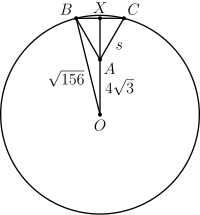
Usando la fórmula del área de una circunferencia, tenemos que por ser un radio.
Extiende hasta cortar en Sea la longitud del lado del
Entonces tenemos y
Tenemos que es rectángulo, lo que significa que podemos aplicar el Teorema de Pitágoras. Esto nos da
Simplificando, obtenemos
Como es positivo, debemos tener que
Por lo tanto, B es la respuesta correcta.
Consider the following diagram:
Using the formula for the area of a circle, we have that since it is a radius.
Extend to intersect at Let be the side length of
Then we have that and
We have that is right, which means that we can apply the Pythagorean Theorem. This gives us
Simplifying, we get
Since is positive, we must have that
Thus, B is the correct answer.
20.
Dos circunferencias están fuera del hexágono regular La primera es tangente a y la segunda es tangente a Ambas son tangentes a las rectas y ¿Cuál es la razón entre el área de la segunda circunferencia y la de la primera?
Two circles lie outside regular hexagon The first is tangent to and the second is tangent to Both are tangent to lines and What is the ratio of the area of the second circle to that of the first circle?
Respuesta: D
Pista pequeña:
Compara los radios de las dos circunferencias.
Compare the two circle radii
Pista grande:
El radio mayor proviene de un triángulo --.
The larger radius comes from a -- triangle
Solución:
Considera el siguiente diagrama:
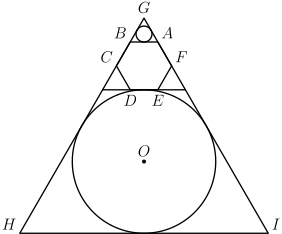
Supongamos que el hexágono regular tiene lado La circunferencia más pequeña está inscrita en un triángulo equilátero de lado
El inradio de este triángulo equilátero es El área de la circunferencia es entonces
Sea el centro de la circunferencia más grande. Traza la perpendicular desde hacia con pie en Traza
Tenemos que es rectángulo. Como también tenemos que es un triángulo .
Sea Entonces También tenemos que es la suma de la altura del hexágono, la del triángulo equilátero y el radio de la circunferencia.
Entonces
Sustituyendo obtenemos Simplificando obtenemos
El área de la circunferencia más grande es entonces
La razón buscada es entonces
Por lo tanto, D es la respuesta correcta.
Consider the following diagram:
Assume the regular hexagon has side length The smaller circle is inscribed in an equilateral triangle of side length
The inradius of this equilateral triangle is The area of the circle is then
Let be the center of the larger circle. Drop the perpendicular from to at Draw
We have that is right. Since we also have that is a triangle.
Let Then We also have that is the sum of the height of the hexagon, equilateral triangle, and radius of the circle.
Then
Substituting in we get Simplifying gives us
The area of the larger circle is then
The desired ratio is then
Thus, D is the correct answer.
21.
Se elige al azar un palíndromo entre y . ¿Cuál es la probabilidad de que sea divisible entre ?
A palindrome between and is chosen at random. What is the probability that it is divisible by
Respuesta: E
Pista pequeña:
Escribe un palíndromo de cuatro dígitos como .
Write a four-digit palindrome as
Pista grande:
Su valor es , y es divisible entre .
The value is , and is divisible by
Solución:
Podemos expresar cualquier número de dígitos como Su forma desarrollada es En un palíndromo, y Por lo tanto, la expresión se simplifica a Como es divisible entre también debe ser divisible entre
La única forma de que esto ocurra es que sea o , ya que no es divisible entre
Hay opciones para y opciones para para un total de palíndromos.
El número total de palíndromos es , ya que hay opciones para el dígito de los millares y opciones para el dígito de las centenas.
La probabilidad buscada es entonces
Por lo tanto, E es la respuesta correcta.
Note that we can express any digit number as This can be expressed in long form as Since in a palindrome, we have that and We can simplify this to get Note that is divisible by This means that must also be divisible by
The only way for this to happen is if is or since is not divisible by
There are options for and options for for a total of palindromes.
The total number of palindromes is since there are options for the thousands digit and options for the hundreds digit.
The desired probability is then
Thus, E is the correct answer.
22.
Siete piezas distintas de dulce se van a repartir entre tres bolsas. La bolsa roja y la bolsa azul deben recibir cada una al menos una pieza de dulce; la bolsa blanca puede quedar vacía. ¿Cuántas distribuciones son posibles?
Seven distinct pieces of candy are to be distributed among three bags. The red bag and the blue bag must each receive at least one piece of candy; the white bag may remain empty. How many arrangements are possible?
Respuesta: C
Pista pequeña:
Primero cuenta todas las distribuciones.
Count all distributions first
Pista grande:
Resta los casos en que la bolsa roja o la azul están vacías, y luego vuelve a sumar la superposición.
Subtract cases with the red or blue bag empty, then add back the overlap
Solución:
Podemos contar esto con conteo complementario. El número total de maneras de repartir los dulces sin restricciones es
Para hallar el número de distribuciones inválidas, debemos contar las maneras en que la bolsa roja o la azul quedan vacías.
Para el caso en que la bolsa roja queda vacía, cada dulce tiene opciones de bolsa a la que puede ir. Hay entonces distribuciones para este caso. De forma similar, hay distribuciones para el caso en que la bolsa azul queda vacía.
Hay una superposición de un caso en que ambas bolsas quedan vacías. La respuesta final es entonces
Por lo tanto, C es la respuesta correcta.
We can count this with complementary counting. The total number of ways to distribute the candies with no restrictions is
To find the number of invalid arrangements, we have to count the number of ways where either the red or blue bag is empty.
For the case where the red bag is empty, each candy has options for the bag that goes into. There are then arrangements for this case. Similarly, there are arrangements for the case where the blue bag is empty.
There is an overlap of one case where both bags are empty. The final answer is then
Thus, C is the correct answer.
23.
Las entradas de un arreglo incluyen todos los dígitos del al dispuestos de modo que las entradas de cada fila y cada columna estén en orden creciente. ¿Cuántos arreglos de este tipo hay?
The entries in a array include all the digits from through arranged so that the entries in every row and column are in increasing order. How many such arrays are there?
Respuesta: D
Pista pequeña:
La entrada central solo puede ser o .
The center entry can only be or
Pista grande:
Analiza por casos según la entrada central y usa las restricciones de crecimiento por filas y columnas.
Case on the center and use the row-column increasing constraints
Solución:
Sea la entrada de la fila y la columna Las condiciones de crecimiento obligan a que y que sea o
Si entonces Elegimos cuáles dos de y van en el par inferior izquierdo los otros dos van en el par superior derecho Cada par tiene entonces un único orden creciente. Hay arreglos: dos órdenes para alrededor de la esquina superior izquierda y elecciones para el par inferior izquierdo. Al invertir los dígitos y rotar el arreglo, también hay arreglos con centro
Si elegimos las tres entradas de las posiciones y Pueden ser cualesquiera tres de , salvo o esas dos elecciones pondrían las tres entradas pequeñas o las tres grandes a un solo lado y violarían una comparación necesaria con el centro. Cualquier otra elección determina de manera única las entradas restantes y sus órdenes crecientes. Esto da arreglos.
El total es
Por lo tanto, D es la respuesta correcta.
Let be the entry in row and column The increasing conditions force and to be or
If then Choose which two of and go in the bottom-left pair the other two go in the top-right pair Each pair then has only one increasing order. There are arrays: two orders for around the upper-left corner and choices for the bottom-left pair. By reversing the digits and rotating the array, there are also arrays with center
If choose the three entries in positions and They can be any three of except or those two choices would put all three small or all three large entries on one side and violate a required comparison with the center. Every other choice uniquely determines the remaining entries and their increasing orders. This gives arrays.
The total is
Thus, D is the correct answer.
24.
Un partido de baloncesto de secundaria entre los Raiders y los Wildcats estaba empatado al final del primer cuarto. El número de puntos anotados por los Raiders en cada uno de los cuatro cuartos formó una sucesión geométrica creciente, y el número de puntos anotados por los Wildcats en cada uno de los cuatro cuartos formó una sucesión aritmética creciente. Al final del cuarto período, los Raiders habían ganado por un punto. Ninguno de los dos equipos anotó más de puntos. ¿Cuál fue el número total de puntos anotados por los dos equipos en la primera mitad?
A high school basketball game between the Raiders and Wildcats was tied at the end of the first quarter. The number of points scored by the Raiders in each of the four quarters formed an increasing geometric sequence, and the number of points scored by the Wildcats in each of the four quarters formed an increasing arithmetic sequence. At the end of the fourth quarter, the Raiders had won by one point. Neither team scored more than points. What was the total number of points scored by the two teams in the first half?
Respuesta: E
Pista pequeña:
Sea la puntuación empatada del primer cuarto.
Let the tied first-quarter score be
Pista grande:
Usa los puntajes totales geométrico y aritmético y el margen final de un punto.
Use the geometric and arithmetic total scores and the one-point final margin
Solución:
La puntuación del primer cuarto de cada equipo es Los Raiders tienen razón común y los Wildcats tienen diferencia común
Escribe en su forma más simple. Como las puntuaciones de los cuatro cuartos de los Raiders son enteras, para algún entero positivo , y su total es . Por lo tanto, las únicas razones posibles son .
Para o , los únicos totales posibles de los Raiders dan totales de los Wildcats que no son de la forma . Para , la ecuación es imposible módulo .
Para , la ecuación es , así que . La única solución positiva con total a lo sumo es .
El total de la primera mitad es
Por lo tanto, E es la respuesta correcta.
Let the first-quarter score for each team be Let the Raiders have common ratio and let the Wildcats have common difference
Write in lowest terms. Since the Raiders’ four quarter scores are integers, for some positive integer , and their total is . Thus the only possible ratios are .
For or , the only possible Raiders totals give Wildcats totals that are not of the form . For , the equation is impossible modulo .
For , the equation is , so . The only positive solution with total at most is .
The first-half total is
Thus, E is the correct answer.
25.
Sea y sea un polinomio con coeficientes enteros tal que y ¿Cuál es el menor valor posible de ?
Let and let be a polynomial with integer coefficients such that and What is the smallest possible value of
Respuesta: B
Pista pequeña:
Usa las raíces de .
Use the roots of
Pista grande:
Sustituye y en la forma factorizada para forzar la divisibilidad de .
Plug and into the factored form to force divisibility of
Solución:
Como y son raíces de , escribe , donde tiene coeficientes enteros.
Sustituyendo y por , obtenemos . Por lo tanto, debe ser un múltiplo de .
Esta cota inferior es alcanzable: toma y define . Este polinomio tiene coeficientes enteros y satisface los valores requeridos.
Por lo tanto, B es la respuesta correcta.
Because and are roots of , write , where has integer coefficients.
Substituting and for gives . Hence must be a multiple of .
This lower bound is attainable: take and define . This polynomial has integer coefficients and satisfies the required values.
Thus, B is the correct answer.