2022 AMC 10B Problema 20

Intenta el Problema 20 del 2022 AMC 10B a continuación y luego compara tu respuesta con la solución preparada profesionalmente de LIVE by Po-Shen Loh. También puedes intentar el examen cronometrado completo, ver todas las soluciones del 2022 AMC 10B, o revisar la clave de respuestas.

Todos los problemas se usan con el permiso legal oficial de la Mathematical Association of America (MAA).

20.

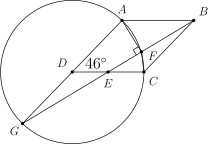
Sea ABCDABCD un rombo con ∠ADC=46∘.\angle ADC = 46^\circ. Sea EE el punto medio de CD‾,\overline{CD}, y sea FF el punto sobre BE‾\overline{BE} tal que AF‾\overline{AF} es perpendicular a BE‾.\overline{BE}. ¿Cuál es la medida en grados de ∠BFC\angle BFC?
Let ABCDABCD be a rhombus with ∠ADC=46∘.\angle ADC = 46^\circ. Let EE be the midpoint of CD‾,\overline{CD}, and let FF be the point on BE‾\overline{BE} such that AF‾\overline{AF} is perpendicular to BE‾.\overline{BE}. What is the degree measure of ∠BFC?\angle BFC?
 110 \ 110
 111 \ 111
 112 \ 112
 113 \ 113
 114 \ 114
Respuesta: D
Conceptos:persecución de ánguloscuadrilátero cíclicoángulo inscrito
Nivel de dificultad: 2150
Pista pequeña:
Demuestra que DD es el punto medio de AG‾,\overline{AG}, de modo que AGAG es un diámetro
Show that DD is the midpoint of AG‾,\overline{AG}, making AGAG a diameter
Pista grande:
Prolonga BE‾\overline{BE} hasta cortar la recta ADAD en GG
Extend BE‾\overline{BE} to meet line ADAD at GG
Solución:
Prolonguemos BE‾\overline{BE} hasta cortar la recta ADAD en G.G. Como AD∥BC,AD\parallel BC, tenemos ∠GDE=∠ECB,\angle GDE=\angle ECB, y ∠GED=∠BEC\angle GED=\angle BEC son ángulos opuestos por el vértice. Además, DE=EC,DE=EC, así que △GDE≅△BCE.\triangle GDE\cong\triangle BCE. Por tanto, DG=BC=AD.DG=BC=AD.
Entonces DD es el punto medio de AG‾.\overline{AG}. El círculo con centro DD que pasa por AA también pasa por CC y G.G. Como AF⊥FG,AF\perp FG, el teorema de Tales coloca también a FF en este círculo.
Como DGDG es opuesto a DA,DA, ∠GDC=180∘−∠ADC=134∘.\begin{aligned}\angle GDC&=180^\circ-\angle ADC\\&=134^\circ.\end{aligned} El ángulo inscrito ∠GFC\angle GFC, que subtiende el arco GCGC, mide entonces 67∘.67^\circ. Finalmente, B,F,GB,F,G son colineales, así que ∠BFC=180∘−67∘=113∘.\angle BFC=180^\circ-67^\circ=113^\circ.
Por lo tanto, la respuesta es D.
Extend BE‾\overline{BE} to meet line ADAD at G.G. Because AD∥BC,AD\parallel BC, we have ∠GDE=∠ECB,\angle GDE=\angle ECB, and ∠GED=∠BEC\angle GED=\angle BEC are vertical angles. Also DE=EC,DE=EC, so △GDE≅△BCE.\triangle GDE\cong\triangle BCE. Hence DG=BC=AD.DG=BC=AD.
Thus DD is the midpoint of AG‾.\overline{AG}. The circle centered at DD through AA also passes through CC and G.G. Since AF⊥FG,AF\perp FG, Thales’ theorem places FF on this circle as well.
Because DGDG is opposite DA,DA, ∠GDC=180∘−∠ADC=134∘.\begin{aligned}\angle GDC&=180^\circ-\angle ADC\\&=134^\circ.\end{aligned} The inscribed angle ∠GFC\angle GFC subtending arc GCGC is therefore 67∘.67^\circ. Finally, B,F,GB,F,G are collinear, so ∠BFC=180∘−67∘=113∘.\angle BFC=180^\circ-67^\circ=113^\circ.
Thus, the answer is D .
Problema 19#19
Examen completo

El Problema 20 en otros años