2022 AMC 10B Problema 19

A continuación está la solución preparada profesionalmente para el Problema 19 del 2022 AMC 10B, de LIVE by Po-Shen Loh. También puedes intentar el examen cronometrado completo, ver todas las soluciones del 2022 AMC 10B, o revisar la clave de respuestas.

Todos los problemas se usan con el permiso legal oficial de la Mathematical Association of America (MAA).

Conceptos:simulación de procesosanálisis por casossimetría

Nivel de dificultad: 2390

19.

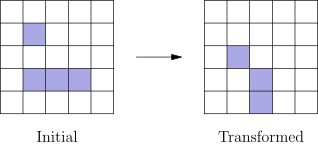
Cada casilla de una cuadrícula de 5×55 \times 5 está llena o vacía, y tiene hasta ocho casillas vecinas adyacentes, donde las casillas vecinas comparten un lado o una esquina. La cuadrícula se transforma según las siguientes reglas:

• Cualquier casilla llena con dos o tres vecinas llenas permanece llena.

• Cualquier casilla vacía con exactamente tres vecinas llenas se convierte en una casilla llena.

• Todas las demás casillas permanecen vacías o se vuelven vacías. En la figura de abajo se muestra un ejemplo de transformación.

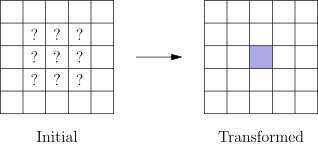
Supón que la cuadrícula de 5×55 \times 5 tiene un borde de casillas vacías que rodea una subcuadrícula de 3×33 \times 3. ¿Cuántas configuraciones iniciales llevarán a una cuadrícula transformada que consiste en una sola casilla llena en el centro después de una única transformación? (Las rotaciones y reflexiones de la misma configuración se consideran diferentes.)

Each square in a 5×55 \times 5 grid is either filled or empty, and has up to eight adjacent neighboring squares, where neighboring squares share either a side or a corner. The grid is transformed by the following rules:

• Any filled square with two or three filled neighbors remains filled.

• Any empty square with exactly three filled neighbors becomes a filled square.

• All other squares remain empty or become empty. A sample transformation is shown in the figure below.

Suppose the 5×55 \times 5 grid has a border of empty squares surrounding a 3×33 \times 3 subgrid. How many initial configurations will lead to a transformed grid consisting of a single filled square in the center after a single transformation? (Rotations and reflections of the same configuration are considered different.)

 14 \ 14

 18 \ 18

 22 \ 22

 26 \ 26

 30 \ 30

Solución:

Supón que el centro está inicialmente lleno. Entonces, hay 22 o 33 otras casillas llenas, cada una de las cuales no puede tener 22 o 33 vecinas llenas.

Esto significa que hay a lo sumo 44 casillas llenas, así que cada casilla tiene a lo sumo 33 vecinas. Como no tienen 22 o 33 vecinas, deben tener a lo sumo 11 vecina. La casilla central es una vecina, así que no pueden tener ninguna otra vecina.

Supón que tengo una casilla llena en un borde. Como hay alguna casilla llena que no es vecina de esa casilla, podemos examinar los dos bordes que son vecinos del borde lleno. Si tengo un borde lleno en la esquina, el borde del mismo lado que la esquina tendría tres vecinas. Si elijo el borde opuesto, los bordes adyacentes tendrían tres vecinas.

Supón que elijo una esquina. Entonces, necesito elegir otra esquina. Si elijo la esquina adyacente, entonces el borde entre ellas tendría tres vecinas, haciéndolo lleno. Por lo tanto, debe ser la esquina opuesta. Esto da 22 configuraciones.

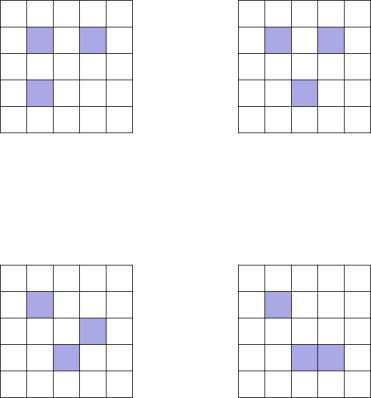
Supón que el centro está inicialmente vacío. Entonces, hay 33 vecinas llenas del centro, cada una con a lo sumo 11 vecina. Esto significa que ninguna casilla tiene dos vecinas llenas. Esto hace que solo sea posible de las siguientes maneras:

Las primeras tres se pueden rotar dando 44 configuraciones, y la última se puede rotar y reflejar dando 88 configuraciones. Hay 2020 configuraciones con el centro vacío. Esto significa que hay 20+2=2220+2=22 configuraciones diferentes.

Así, la respuesta es C.

Suppose the center is initially filled. Then, there are either either 22 or 33 other filled squares, each of which can't have 22 or 33 filled neighbors.

This means that there are at most 44 filled squares, so each square has at most 33 neighbors. Since they don't have 22 or 33 neighbors, they must have at most 11 neighbor. The center square is a neighbor, so they can't have any other neighbor.

Suppose I have a filled square on an edge. Since there is some filled square that isn't a neighbor of the square, we can examine the two edges which are neighbors of the filled edge. If I have a filled edge on the corner, the edge on the same side as the corner would have three neighbors. If I choose the opposite edge, the adjacent edges would have three neighbors.

Suppose I choose a corner. Then, I need to choose another corner. If I choose the adjacent corner, then the edge between would have three neighbors, making it filled. Therefore, it must be the opposite corner. This has 22 configurations.

Suppose the center is initially empty. Then, there are 33 filled neighbors of the center, each with at most 11 neighbors. This means no square has two filled neighbors. This makes it only possible to do in the following ways:

The first three can rotated making 44 configurations, and the last one can be rotated and reflected making 88 configurations. There are 2020 configurations with the center being empty. This means there are 20+2=2220+2=22 different configurations.

Thus, the answer is C .

← Problema 18#18Examen completoProblema 20#20 →

El Problema 19 en otros años