2022 AMC 10A Problema 15

Intenta el Problema 15 del 2022 AMC 10A a continuación y luego compara tu respuesta con la solución preparada profesionalmente de LIVE by Po-Shen Loh. También puedes intentar el examen cronometrado completo, ver todas las soluciones del 2022 AMC 10A, o revisar la clave de respuestas.

Todos los problemas se usan con el permiso legal oficial de la Mathematical Association of America (MAA).

15.

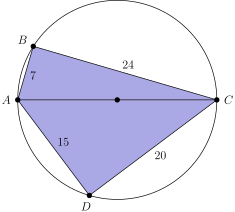
El cuadrilátero ABCDABCD con lados AB=7,AB = 7, BC=24,BC = 24, CD=20,CD = 20, DA=15DA = 15 está inscrito en un círculo. El área interior al círculo pero exterior al cuadrilátero puede escribirse en la forma aπ−bc,\dfrac{a \pi - b}{c}, donde a,a, b,b, y cc son enteros positivos tales que aa y cc no tienen factor primo común. ¿Cuánto vale a+b+ca + b + c?
Quadrilateral ABCDABCD with side lengths AB=7,AB = 7, BC=24,BC = 24, CD=20,CD = 20, DA=15DA = 15 is inscribed in a circle. The area interior to the circle but exterior to the quadrilateral can be written in the form aπ−bc,\dfrac{a \pi - b}{c}, where a,a, b,b, and cc are positive integers such that aa and cc have no common prime factor. What is a+b+c?a + b + c?
260260
855855
12351235
15651565
19971997
Respuesta: D
Conceptos:cuadrilátero cíclicoTerna pitagóricaárea del círculo
Nivel de dificultad: 1950
Pista pequeña:
Verifica si los dos triángulos formados por una diagonal son triángulos rectángulos.
Check whether the two triangles formed by a diagonal are right triangles
Pista grande:
Usa la hipotenusa común como diámetro del círculo.
Use the common hypotenuse as the circle diameter
Solución:
Observemos que 72+2427^2 + 24^2 y 152+20215^2 + 20^2 son iguales. Esto obliga a que AC=25AC = 25, pues de lo contrario ∠B\angle B y ∠D\angle D serían ambos agudos o ambos obtusos, contradiciendo que su suma es 180∘.180^{\circ}.
Además, como ∠B\angle B es recto, ACAC es un diámetro del círculo. El área del círculo es 6254π.\dfrac{625}{4} \pi.
Para hallar el área del cuadrilátero, sumamos las áreas de los dos triángulos: 12(7⋅24+20⋅15)= \dfrac{1}{2}(7 \cdot 24 + 20 \cdot 15) = 84+150=234. 84 + 150 = 234.
El área exterior al cuadrilátero es 6254π−234=625π−9364. \dfrac{625}{4} \pi - 234 = \dfrac{625 \pi - 936}{4}.
Por tanto, a+b+c=625+936+4 a + b + c = 625 + 936 + 4 =1565. = 1565.
Por lo tanto, D es la respuesta correcta.
Notice that 72+2427^2 + 24^2 and 152+20215^2 + 20^2 are both the same. This forces AC=25AC = 25 since otherwise ∠B\angle B and ∠D\angle D would both be acute or obtuse, violating the fact that their sum is 180∘.180^{\circ}.
Also since ∠B\angle B is right, we know that ACAC is the diameter of the circle. The area of the circle is then 6254π.\dfrac{625}{4} \pi.
To find the area of the quadrilateral, we can find the area of each of the triangles, which is 12(7⋅24+20⋅15)= \dfrac{1}{2}(7 \cdot 24 + 20 \cdot 15) = 84+150=234. 84 + 150 = 234.
To find the area outside the quadrilateral, we subtract to get 6254π−234=625π−9364. \dfrac{625}{4} \pi - 234 = \dfrac{625 \pi - 936}{4}.
Therefore, a+b+c=625+936+4 a + b + c = 625 + 936 + 4 =1565. = 1565.
Thus, D is the correct answer.
Problema 14#14
Examen completo

El Problema 15 en otros años