2022 AIME II Problema 9

A continuación está la solución preparada profesionalmente para el Problema 9 del 2022 AIME II, de LIVE by Po-Shen Loh. También puedes intentar el examen cronometrado completo, ver todas las soluciones del 2022 AIME II, o revisar la clave de respuestas.

Todos los problemas se usan con el permiso legal oficial de la Mathematical Association of America (MAA).

Conceptos:conteo de regionesFórmula de los poliedros de Eulerteoría de grafosconteo de intersecciones

Nivel de dificultad: 2840

9.

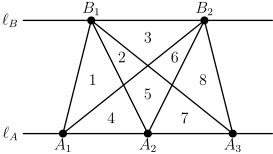
Sean A\ell_A y B\ell_B dos rectas paralelas distintas. Para enteros positivos mm y n,n, puntos distintos A1,A2,A3,,AmA_1, A_2, A_3, \ldots, A_m están sobre A,\ell_A, y puntos distintos B1,B2,B3,,BnB_1, B_2, B_3, \ldots, B_n están sobre B.\ell_B. Además, cuando se trazan los segmentos AiBj\overline{A_iB_j} para todos los i=1,2,3,,mi = 1, 2, 3, \ldots, m y j=1,2,3,,n,j = 1, 2, 3, \ldots, n, ningún punto estrictamente entre A\ell_A y B\ell_B está en más de dos de los segmentos. Halla el número de regiones acotadas en las que esta figura divide el plano cuando m=7m = 7 y n=5.n = 5. La figura muestra que hay 88 regiones cuando m=3m = 3 y n=2.n = 2.

Let A\ell_A and B\ell_B be two distinct parallel lines. For positive integers mm and n,n, distinct points A1,A2,A3,,AmA_1, A_2, A_3, \ldots, A_m lie on A,\ell_A, and distinct points B1,B2,B3,,BnB_1, B_2, B_3, \ldots, B_n lie on B.\ell_B. Additionally, when segments AiBj\overline{A_iB_j} are drawn for all i=1,2,3,,mi = 1, 2, 3, \ldots, m and j=1,2,3,,n,j = 1, 2, 3, \ldots, n, no point strictly between A\ell_A and B\ell_B lies on more than two of the segments. Find the number of bounded regions into which this figure divides the plane when m=7m = 7 and n=5.n = 5. The figure shows that there are 88 regions when m=3m = 3 and n=2.n = 2.

Solución:

Dos segmentos AiBj\overline{A_iB_j} y AkBl\overline{A_kB_l} se cruzan estrictamente entre las rectas exactamente cuando uno de los puntos AA va primero y el BB del otro va primero, lo cual ocurre para exactamente un emparejamiento de cualesquiera dos puntos AA con cualesquiera dos puntos BB. Por la hipótesis de posición general estos cruces son distintos, así que hay X=(m2)(n2)X = \binom{m}{2}\binom{n}{2} de ellos.

Recorta las dos rectas a segmentos largos y aplica la fórmula de Euler. Los vértices son los m+nm + n puntos marcados, los XX cruces, y los 44 extremos recortados de las rectas, así que V=m+n+X+4.V = m + n + X + 4. La recta A\ell_A queda dividida en m+1m + 1 aristas y B\ell_B en n+1;n + 1; cada cruce parte dos segmentos, así que los segmentos trazados aportan mn+2Xmn + 2X aristas, dando E=mn+m+n+2X+2.E = mn + m + n + 2X + 2. Entonces F=EV+2=mn+X,F = E - V + 2 = mn + X, de las cuales una cara es no acotada, así que hay mn+X1mn + X - 1 regiones acotadas. Para m=3,m = 3, n=2n = 2 esto da 6+31=8,6 + 3 - 1 = 8, coincidiendo con la figura.

Para m=7m = 7 y n=5:n = 5: 35+(72)(52)135 + \binom{7}{2}\binom{5}{2} - 1 =35+21101= 35 + 21 \cdot 10 - 1 =244.= 244.

Two segments AiBj\overline{A_iB_j} and AkBl\overline{A_kB_l} cross strictly between the lines exactly when one of the AA's comes first and the other's BB comes first, which happens for exactly one pairing of any two AA's with any two BB's. By the general-position hypothesis these crossings are distinct, so there are X=(m2)(n2)X = \binom{m}{2}\binom{n}{2} of them.

Clip the two lines to long segments and apply Euler's formula. The vertices are the m+nm + n marked points, the XX crossings, and the 44 clipped line ends, so V=m+n+X+4.V = m + n + X + 4. Line A\ell_A is divided into m+1m + 1 edges and B\ell_B into n+1;n + 1; each crossing splits two segments, so the drawn segments contribute mn+2Xmn + 2X edges, giving E=mn+m+n+2X+2.E = mn + m + n + 2X + 2. Then F=EV+2=mn+X,F = E - V + 2 = mn + X, of which one face is unbounded, so there are mn+X1mn + X - 1 bounded regions. For m=3,m = 3, n=2n = 2 this gives 6+31=8,6 + 3 - 1 = 8, matching the figure.

For m=7m = 7 and n=5:n = 5: 35+(72)(52)135 + \binom{7}{2}\binom{5}{2} - 1 =35+21101= 35 + 21 \cdot 10 - 1 =244.= 244.

← Problema 8#8Examen completoProblema 10#10 →

El Problema 9 en otros años