2018 AIME II Problema 9

A continuación está la solución preparada profesionalmente para el Problema 9 del 2018 AIME II, de LIVE by Po-Shen Loh. También puedes intentar el examen cronometrado completo, ver todas las soluciones del 2018 AIME II, o revisar la clave de respuestas.

Todos los problemas se usan con el permiso legal oficial de la Mathematical Association of America (MAA).

Conceptos:baricentrohomoteciageometría analíticadescomposición de áreas

Nivel de dificultad: 2920

9.

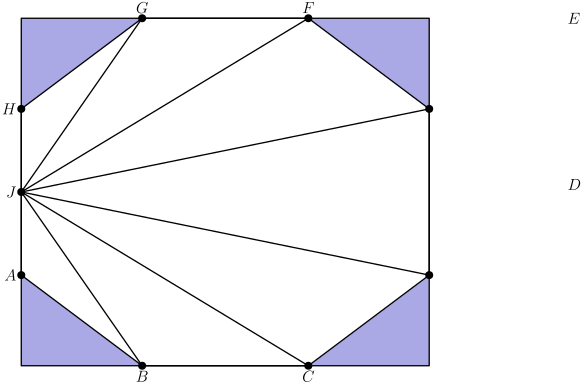
El octágono ABCDEFGHABCDEFGH con lados AB=CD=EF=GH=10AB = CD = EF = GH = 10 y BC=DE=FG=HA=11BC = DE = FG = HA = 11 se forma quitando cuatro triángulos 66-88-1010 de las esquinas de un rectángulo 23×2723 \times 27 con el lado AH\overline{AH} sobre un lado corto del rectángulo, como se muestra. Sea JJ el punto medio de AH,\overline{AH}, y divide el octágono en 77 triángulos trazando los segmentos JB,\overline{JB}, JC,\overline{JC}, JD,\overline{JD}, JE,\overline{JE}, JF,\overline{JF}, y JG.\overline{JG}. Halla el área del polígono convexo cuyos vértices son los baricentros de estos 77 triángulos.

Octagon ABCDEFGHABCDEFGH with side lengths AB=CD=EF=GH=10AB = CD = EF = GH = 10 and BC=DE=FG=HA=11BC = DE = FG = HA = 11 is formed by removing four 66-88-1010 triangles from the corners of a 23×2723 \times 27 rectangle with side AH\overline{AH} on a short side of the rectangle, as shown. Let JJ be the midpoint of AH,\overline{AH}, and partition the octagon into 77 triangles by drawing segments JB,\overline{JB}, JC,\overline{JC}, JD,\overline{JD}, JE,\overline{JE}, JF,\overline{JF}, and JG.\overline{JG}. Find the area of the convex polygon whose vertices are the centroids of these 77 triangles.

Solución:

Cada uno de los 77 triángulos tiene a JJ como vértice, y el baricentro de un triángulo JVWJVW está sobre el segmento que va de JJ al punto medio de VW,\overline{VW}, a dos tercios del recorrido. Así que el heptágono de los baricentros es la imagen del heptágono SS formado por los puntos medios de AB,BC,,GH\overline{AB}, \overline{BC}, \ldots, \overline{GH} bajo una homotecia centrada en JJ de razón 23,\frac{2}{3}, y su área es 49[S].\frac{4}{9}[S].

Coloca el rectángulo con A=(0,6),A = (0, 6), B=(8,0),B = (8, 0), C=(19,0),C = (19, 0), D=(27,6),D = (27, 6), E=(27,17),E = (27, 17), F=(19,23),F = (19, 23), G=(8,23),G = (8, 23), H=(0,17),H = (0, 17), de modo que J=(0,232).J = (0, \tfrac{23}{2}). Los puntos medios son (4,3),(4, 3), (272,0),(\tfrac{27}{2}, 0), (23,3),(23, 3), (27,232),(27, \tfrac{23}{2}), (23,20),(23, 20), (272,23),(\tfrac{27}{2}, 23), (4,20).(4, 20). Los segmentos verticales en x=4,x = 4, x=272,x = \tfrac{27}{2}, y x=23x = 23 tienen longitudes 17,17, 23,23, y 17,17, lo que corta SS en dos trapecios de altura 192\tfrac{19}{2} y un triángulo de altura 4:4: [S]=217+232192+1742=380+34=414. \begin{aligned} [S] &= 2 \cdot \frac{17 + 23}{2} \cdot \frac{19}{2} \\ &\quad {}+ \frac{17 \cdot 4}{2} \\ &= 380 + 34 = 414. \end{aligned}

El área pedida es 49414=184.\frac{4}{9} \cdot 414 = 184.

Each of the 77 triangles has JJ as a vertex, and the centroid of a triangle JVWJVW lies on the segment from JJ to the midpoint of VW,\overline{VW}, two-thirds of the way out. So the centroid heptagon is the image of the heptagon SS formed by the midpoints of AB,BC,,GH\overline{AB}, \overline{BC}, \ldots, \overline{GH} under a dilation centered at JJ with ratio 23,\frac{2}{3}, and its area is 49[S].\frac{4}{9}[S].

Place the rectangle with A=(0,6),A = (0, 6), B=(8,0),B = (8, 0), C=(19,0),C = (19, 0), D=(27,6),D = (27, 6), E=(27,17),E = (27, 17), F=(19,23),F = (19, 23), G=(8,23),G = (8, 23), H=(0,17),H = (0, 17), so J=(0,232).J = (0, \tfrac{23}{2}). The midpoints are (4,3),(4, 3), (272,0),(\tfrac{27}{2}, 0), (23,3),(23, 3), (27,232),(27, \tfrac{23}{2}), (23,20),(23, 20), (272,23),(\tfrac{27}{2}, 23), (4,20).(4, 20). The vertical segments at x=4,x = 4, x=272,x = \tfrac{27}{2}, and x=23x = 23 have lengths 17,17, 23,23, and 17,17, cutting SS into two trapezoids of height 192\tfrac{19}{2} and a triangle of height 4:4: [S]=217+232192+1742=380+34=414. \begin{aligned} [S] &= 2 \cdot \frac{17 + 23}{2} \cdot \frac{19}{2} \\ &\quad {}+ \frac{17 \cdot 4}{2} \\ &= 380 + 34 = 414. \end{aligned}

The requested area is 49414=184.\frac{4}{9} \cdot 414 = 184.

← Problema 8#8Examen completoProblema 10#10 →

El Problema 9 en otros años