2013 AIME I Problema 9

A continuación está la solución preparada profesionalmente para el Problema 9 del 2013 AIME I, de LIVE by Po-Shen Loh. También puedes intentar el examen cronometrado completo, ver todas las soluciones del 2013 AIME I, o revisar la clave de respuestas.

Todos los problemas se usan con el permiso legal oficial de la Mathematical Association of America (MAA).

Conceptos:plegado de papelley de los cosenostriángulo equilátero

Nivel de dificultad: 2920

9.

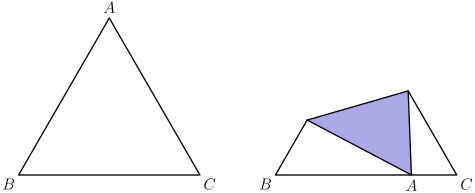
Un triángulo equilátero de papel ABCABC tiene lado 12.12. El triángulo de papel se dobla de modo que el vértice AA toca un punto sobre el lado BC\overline{BC} a una distancia 99 del punto B.B. La longitud del segmento a lo largo del cual se dobla el triángulo puede escribirse como mpn,\frac{m\sqrt{p}}{n}, donde m,m, n,n, y pp son enteros positivos, mm y nn son primos entre sí, y pp no es divisible por el cuadrado de ningún primo. Halla m+n+p.m + n + p.

A paper equilateral triangle ABCABC has side length 12.12. The paper triangle is folded so that vertex AA touches a point on side BC\overline{BC} a distance 99 from point B.B. The length of the line segment along which the triangle is folded can be written as mpn,\frac{m\sqrt{p}}{n}, where m,m, n,n, and pp are positive integers, mm and nn are relatively prime, and pp is not divisible by the square of any prime. Find m+n+p.m + n + p.

Solución:

Sea AA' el punto de aterrizaje, con BA=9BA' = 9 y CA=3,CA' = 3, y sea el pliegue el que corta a AB\overline{AB} en PP y a AC\overline{AC} en Q.Q. El doblez preserva las distancias, así que PA=PA=xPA' = PA = x y QA=QA=y.QA' = QA = y. En el triángulo PBA,PBA', con PB=12xPB = 12 - x y B=60,\angle B = 60^\circ, la ley de los cosenos da x2=(12x)2+819(12x), \begin{aligned} x^2 &= (12 - x)^2 + 81 \\ &\quad {}- 9(12 - x), \end{aligned} que se simplifica a 15x=117,15x = 117, así que x=395.x = \frac{39}{5}. De manera similar, en el triángulo QCA,QCA', y2=(12y)2+93(12y)y^2 = (12 - y)^2 + 9 - 3(12 - y) da 21y=117,21y = 117, así que y=397.y = \frac{39}{7}.

Finalmente, en el triángulo APQAPQ con A=60,\angle A = 60^\circ, PQ2=x2+y2xy=392(125+149135)=39249+25351225=3931225, \begin{aligned} PQ^2 &= x^2 + y^2 - xy \\ &= 39^2\left(\frac{1}{25} + \frac{1}{49} - \frac{1}{35}\right) \\ &= 39^2 \cdot \frac{49 + 25 - 35}{1225} \\ &= \frac{39^3}{1225}, \end{aligned} así que PQ=393935.PQ = \frac{39\sqrt{39}}{35}. Por lo tanto m+n+p=39+35+39m + n + p = 39 + 35 + 39 =113.= 113.

Let AA' be the landing point, with BA=9BA' = 9 and CA=3,CA' = 3, and let the crease meet AB\overline{AB} at PP and AC\overline{AC} at Q.Q. Folding preserves distances, so PA=PA=xPA' = PA = x and QA=QA=y.QA' = QA = y. In triangle PBA,PBA', with PB=12xPB = 12 - x and B=60,\angle B = 60^\circ, the law of cosines gives x2=(12x)2+819(12x), \begin{aligned} x^2 &= (12 - x)^2 + 81 \\ &\quad {}- 9(12 - x), \end{aligned} which simplifies to 15x=117,15x = 117, so x=395.x = \frac{39}{5}. Similarly, in triangle QCA,QCA', y2=(12y)2+93(12y)y^2 = (12 - y)^2 + 9 - 3(12 - y) gives 21y=117,21y = 117, so y=397.y = \frac{39}{7}.

Finally, in triangle APQAPQ with A=60,\angle A = 60^\circ, PQ2=x2+y2xy=392(125+149135)=39249+25351225=3931225, \begin{aligned} PQ^2 &= x^2 + y^2 - xy \\ &= 39^2\left(\frac{1}{25} + \frac{1}{49} - \frac{1}{35}\right) \\ &= 39^2 \cdot \frac{49 + 25 - 35}{1225} \\ &= \frac{39^3}{1225}, \end{aligned} so PQ=393935.PQ = \frac{39\sqrt{39}}{35}. Thus m+n+p=39+35+39m + n + p = 39 + 35 + 39 =113.= 113.

← Problema 8#8Examen completoProblema 10#10 →

El Problema 9 en otros años