
Soluciones del 2013 AIME I
Desplázate hacia abajo para ver las soluciones preparadas profesionalmente de LIVE by Po-Shen Loh, imprime las soluciones en PDF, consulta la clave de respuestas, o haz el examen cronometrado completo.
Todos los problemas se usan con el permiso legal oficial de la Mathematical Association of America (MAA).
1.
El triatlón AIME consta de un nado de media milla, un recorrido en bicicleta de millas y una carrera de ocho millas. Tom nada, pedalea y corre a ritmos constantes. Corre cinco veces más rápido de lo que nada, y pedalea el doble de rápido de lo que corre. Tom completa el triatlón AIME en cuatro horas y cuarto. ¿Cuántos minutos dedica a pedalear?
The AIME Triathlon consists of a half-mile swim, a -mile bicycle ride, and an eight-mile run. Tom swims, bicycles, and runs at constant rates. He runs five times as fast as he swims, and he bicycles twice as fast as he runs. Tom completes the AIME Triathlon in four and a quarter hours. How many minutes does he spend bicycling?
Pista pequeña:
Tom corre veces más rápido de lo que nada y pedalea veces más rápido, así que expresa el tiempo de cada tramo usando solo su velocidad de nado.
Tom runs times as fast as he swims and bicycles times as fast, so write each leg’s time using only his swimming speed
Pista grande:
El tiempo total es horas; despeja la velocidad de nado .
The total time is hours; solve for the swimming speed
Solución:
Sea la velocidad de nado de Tom en millas por hora. Entonces corre a y pedalea a El tiempo total en horas es de modo que millas por hora.
Pedalea a millas por hora, así que el recorrido dura horas, es decir, minutos.
Let Tom’s swimming speed be miles per hour. Then he runs at and bicycles at The total time in hours is so miles per hour.
He bicycles at miles per hour, so the ride takes hours, which is minutes.
2.
Halla la cantidad de enteros positivos de cinco cifras, que cumplen las siguientes condiciones:
• el número es divisible por
• la primera y la última cifra de son iguales, y
• la suma de las cifras de es divisible por
Find the number of five-digit positive integers, that satisfy the following conditions:
• the number is divisible by
• the first and last digits of are equal, and
• the sum of the digits of is divisible by
Pista pequeña:
La divisibilidad por hace que la última cifra sea o y la primera cifra no puede ser .
Divisibility by makes the last digit or and the first digit cannot be
Pista grande:
Con ambas cifras de los extremos iguales a elige libremente la segunda y la tercera cifra; exactamente valores de la cuarta cifra hacen que la suma de las cifras sea múltiplo de .
With both outer digits pick the second and third digits freely; exactly values of the fourth digit make the digit sum a multiple of
Solución:
Como es divisible por su última cifra es o como la primera cifra es igual a la última y no puede ser ambas valen Las cifras de los extremos aportan a la suma de las cifras, así que las tres cifras centrales también deben sumar un múltiplo de
Elige libremente la segunda y la tercera cifra, de maneras. Sea cual sea su suma, la cuarta cifra debe caer en una clase de residuos prescrita módulo y exactamente de las cifras del al están en cada clase. El conteo es
Since is divisible by its last digit is or since the first digit equals the last digit and cannot be both are The outer digits contribute to the digit sum, so the three middle digits must also sum to a multiple of
Choose the second and third digits freely, in ways. Whatever their sum is, the fourth digit must land in a prescribed residue class modulo and exactly of the digits through lie in each class. The count is
3.
Sea un cuadrado, y sean y puntos sobre y respectivamente. La recta que pasa por paralela a y la recta que pasa por paralela a dividen en dos cuadrados y dos rectángulos no cuadrados. La suma de las áreas de los dos cuadrados es del área del cuadrado Halla
Let be a square, and let and be points on and respectively. The line through parallel to and the line through parallel to divide into two squares and two nonsquare rectangles. The sum of the areas of the two squares is of the area of square Find
Pista pequeña:
Sea y los dos cuadrados tienen entonces lados y y tiene lado .
Let and the two squares then have sides and and has side
Pista grande:
Desarrolla y observa que la cantidad pedida es igual a .
Expand and notice that the requested quantity equals
Solución:
Sea y de modo que el cuadrado grande tiene lado y los dos cuadrados menores tienen lados y La condición dice Multiplicando por y desarrollando, así que
Dividiendo por se obtiene
Let and so the square has side and the two smaller squares have sides and The condition says Multiplying by and expanding, so
Dividing by gives
4.
En el arreglo de cuadrados que se muestra abajo, cuadrados se colorean de rojo, y los cuadrados restantes se colorean de azul. Si se elige al azar uno de todos los coloreados posibles, la probabilidad de que el arreglo coloreado elegido se vea igual al rotarlo alrededor del cuadrado central es donde es un entero positivo. Halla
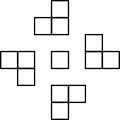
In the array of squares shown below, squares are colored red, and the remaining squares are colored blue. If one of all possible such colorings is chosen at random, the probability that the chosen colored array appears the same when rotated around the central square is where is a positive integer. Find
Pista pequeña:
Un coloreado que no cambia con la rotación queda determinado por un solo brazo en forma de L: los cuatro brazos deben colorearse de manera idéntica.
A coloring unchanged by the rotation is determined by one L-shaped arm: the four arms must be colored identically
Pista grande:
Para obtener rojos y azules, el centro debe ser azul y cada brazo necesita rojos y azul; compara con el total de coloreados.
To get red and blue, the center must be blue and each arm needs red and blue; compare with total colorings
Solución:
La rotación permuta cíclicamente los cuatro brazos en forma de L, así que un coloreado simétrico colorea los cuatro brazos de manera idéntica, y los cuadrados exteriores contienen copias de lo que muestre el brazo. Por lo tanto, la cantidad de cuadrados rojos entre los doce exteriores es múltiplo de Como en total hay cuadrados rojos, el centro debe ser azul y cada brazo debe contener exactamente cuadrados rojos y cuadrado azul.
El cuadrado azul dentro del brazo puede elegirse de maneras, así que exactamente de los coloreados equiprobables son simétricos. La probabilidad es por lo que
The rotation cycles the four L-shaped arms, so a symmetric coloring colors all four arms identically, and the outer squares contain copies of whatever the arm shows. The number of red squares among the outer twelve is therefore a multiple of Since there are red squares in all, the center must be blue and each arm must contain exactly red squares and blue square.
The blue square within the arm can be chosen in ways, so exactly of the equally likely colorings are symmetric. The probability is so
5.
La raíz real de la ecuación puede escribirse en la forma donde y son enteros positivos. Halla
The real root of the equation can be written in the form where and are positive integers. Find
Pista pequeña:
Pasa a un lado: la ecuación se vuelve .
Move to one side: the equation becomes
Pista grande:
Extrae raíces cúbicas para obtener luego racionaliza usando .
Take cube roots to get then rationalize using
Solución:
Reescribe la ecuación como Tomando raíces cúbicas reales, así que
Multiplica numerador y denominador por el denominador se convierte en así que Por lo tanto
Rewrite the equation as Taking real cube roots, so
Multiply numerator and denominator by the denominator becomes so Thus
6.
Melinda tiene tres cajas vacías y libros de texto, tres de los cuales son de matemáticas. Una caja contendrá tres cualesquiera de sus libros, otra contendrá cuatro cualesquiera, y otra contendrá cinco cualesquiera. Si Melinda empaca sus libros en estas cajas en orden aleatorio, la probabilidad de que los tres libros de matemáticas terminen en la misma caja puede escribirse como donde y son enteros positivos primos entre sí. Halla
Melinda has three empty boxes and textbooks, three of which are mathematics textbooks. One box will hold any three of her textbooks, one will hold any four of her textbooks, and one will hold any five of her textbooks. If Melinda packs her textbooks into these boxes in random order, the probability that all three mathematics textbooks end up in the same box can be written as where and are relatively prime positive integers. Find
Pista pequeña:
Calcula por separado la probabilidad de que los tres libros de matemáticas caigan en la caja de , la de y la de .
Compute separately the probability that all three math books land in the -box, the -box, and the -box
Pista grande:
Para la caja que contiene libros, esa probabilidad es suma las tres fracciones.
For the box holding books, that probability is add the three fractions
Solución:
Concéntrate en una caja a la vez. La caja de libros recibe un subconjunto de elementos elegido uniformemente al azar entre los libros, así que la probabilidad de que contenga los tres libros de matemáticas es Para y esto da y
Los eventos son disjuntos, así que la probabilidad total es y
Focus on one box at a time. The box of books receives a uniformly random -subset of the books, so the probability that it contains all three math books is For and this gives and
The events are disjoint, so the total probability is and
7.
Una caja rectangular tiene ancho pulgadas, largo pulgadas y altura pulgadas, donde y son enteros positivos primos entre sí. Tres caras de la caja se encuentran en un vértice de la caja. Los puntos centrales de esas tres caras son los vértices de un triángulo con área de pulgadas cuadradas. Halla
A rectangular box has width inches, length inches, and height inches, where and are relatively prime positive integers. Three faces of the box meet at a corner of the box. The center points of those three faces are the vertices of a triangle with an area of square inches. Find
Pista pequeña:
Coloca el vértice en el origen de modo que la caja sea y escribe los tres centros de las caras.
Place the corner at the origin so the box is and write down the three face centers
Pista grande:
Los centros son un producto vectorial da el área del triángulo como .
The centers are a cross product gives the triangle’s area as
Solución:
Sea la altura y coloca el vértice en el origen, de modo que la caja sea Las tres caras que se encuentran en el origen tienen centros y
Entonces y cuyo producto vectorial es El área es así que y
Por lo tanto
Let the height be and place the corner at the origin, so the box is The three faces meeting at the origin have centers and
Then and whose cross product is The area is so and
Therefore
8.
El dominio de la función es un intervalo cerrado de longitud donde y son enteros positivos y Halla el residuo cuando la menor suma posible se divide entre
The domain of the function is a closed interval of length where and are positive integers and Find the remainder when the smallest possible sum is divided by
Pista pequeña:
El dominio requiere así que recorre que tiene longitud .
The domain requires so runs over which has length
Pista grande:
Entonces Como debe dividir a y el menor minimiza la suma.
Then Since must divide and the smallest minimizes the sum.
Solución:
La función está definida cuando es decir así que el dominio es con longitud Por lo tanto Como es coprimo con debe dividir a
Como la suma crece con así que toma el menor factor entonces y
El residuo al dividir entre es
The function is defined when that is so the domain is with length Hence Since is relatively prime to must divide
Because the sum grows with so take the smallest factor then and
The remainder upon division by is
9.
Un triángulo equilátero de papel tiene lado El triángulo de papel se dobla de modo que el vértice toca un punto sobre el lado a una distancia del punto La longitud del segmento a lo largo del cual se dobla el triángulo puede escribirse como donde y son enteros positivos, y son primos entre sí, y no es divisible por el cuadrado de ningún primo. Halla
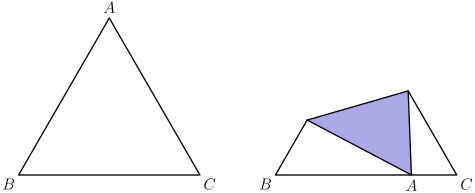
A paper equilateral triangle has side length The paper triangle is folded so that vertex touches a point on side a distance from point The length of the line segment along which the triangle is folded can be written as where and are positive integers, and are relatively prime, and is not divisible by the square of any prime. Find
Pista pequeña:
El doblez preserva las distancias: si el pliegue corta a en entonces equidista de y del punto de aterrizaje sobre .
Folding preserves distances: if the crease meets at then is equidistant from and from the landing point on
Pista grande:
La ley de los cosenos en los triángulos de esquina de en y localiza los dos extremos del pliegue; luego aplica la ley de los cosenos una vez más en .
The law of cosines in the corner triangles at and locates both crease endpoints; then apply the law of cosines once more at
Solución:
Sea el punto de aterrizaje, con y y supongamos que el pliegue corta a en y a en El doblez preserva las distancias, así que y En el triángulo con y la ley de los cosenos da que se simplifica a así que De manera similar, en el triángulo da así que
Finalmente, en el triángulo con así que Por lo tanto
Let be the landing point, with and and let the crease meet at and at Folding preserves distances, so and In triangle with and the law of cosines gives which simplifies to so Similarly, in triangle gives so
Finally, in triangle with so Thus
10.
Existen enteros no nulos y tales que el número complejo es un cero del polinomio Para cada combinación posible de y sea la suma de los ceros de Halla la suma de los sobre todas las combinaciones posibles de y
There are nonzero integers and such that the complex number is a zero of the polynomial For each possible combination of and let be the sum of the zeros of Find the sum of the ’s for all possible combinations of and
Pista pequeña:
Los coeficientes reales obligan a que los ceros sean y un número real con .
Real coefficients force the zeros to be and a real with
Pista grande:
Enumera las formas en que un factor de es suma de dos cuadrados no nulos; para cada una, las elecciones se cancelan en la suma, dejando solo los .
List the ways a factor of is a sum of two nonzero squares; for each, the choices cancel in the sum, leaving only the ’s
Solución:
Como tiene coeficientes reales, también es cero, y el tercer cero es real. La suma de los ceros es así que es un entero no nulo. Su producto es de modo que es un factor de Con y no nulos, las posibilidades son (con ), (con ), y (con ).
Para cada representación el cero puede tener o lo que da polinomios distintos (el signo de no cambia el polinomio). La suma de los ceros es y entre las cuatro opciones los términos se cancelan, dejando por cada representación.
El total es
Since has real coefficients, is also a zero, and the third zero is real. The sum of the zeros is so is a nonzero integer. Their product is so is a factor of With and nonzero, the possibilities are (with ), (with ), and (with ).
For each representation the zero can have or giving distinct polynomials (the sign of changes nothing). The sum of the zeros is and over the four choices the terms cancel, leaving from each representation.
The total is
11.
La clase de kínder de la Sra. Math tiene estudiantes inscritos. El salón tiene una cantidad muy grande, de bloques de juego que cumple las condiciones:
• Si en la clase están presentes o estudiantes, entonces en cada caso todos los bloques pueden repartirse en cantidades iguales a cada estudiante, y
• Existen tres enteros tales que cuando están presentes o estudiantes y los bloques se reparten en cantidades iguales a cada estudiante, sobran exactamente tres bloques.
Halla la suma de los divisores primos distintos del menor valor posible de que satisface las condiciones anteriores.
Ms. Math’s kindergarten class has registered students. The classroom has a very large number, of play blocks which satisfies the conditions:
• If or students are present in the class, then in each case all the blocks can be distributed in equal numbers to each student, and
• There are three integers such that when or students are present and the blocks are distributed in equal numbers to each student, there are exactly three blocks left over.
Find the sum of the distinct prime divisors of the least possible value of satisfying the above conditions.
Pista pequeña:
es múltiplo de y todo entero positivo menor que salvo divide a .
is a multiple of and every positive integer below except and divides
Pista grande:
Así que y deben ser y resuelve módulo y mediante el teorema chino del resto.
So and must be and solve modulo and by the Chinese remainder theorem
Solución:
La divisibilidad por y significa que donde Todo entero positivo menor que divide a salvo y y un divisor de deja residuo no Así que necesariamente y necesitamos módulo cada uno de
Como la primera congruencia es es decir Como necesitamos es decir Como necesitamos Por el teorema chino del resto, estas congruencias se combinan en así que el menor es
Entonces y como es primo, la suma de los divisores primos distintos es
Divisibility by and means where Every positive integer less than divides except and and a divisor of leaves remainder not So necessarily and we need modulo each of
Since the first congruence is i.e. Since we need i.e. Since we need By the Chinese remainder theorem these combine to so the least is
Then and since is prime, the sum of the distinct prime divisors is
12.
Sea un triángulo con y Se dibuja un hexágono regular de lado dentro de de modo que el lado esté sobre el lado esté sobre y uno de los vértices restantes esté sobre Existen enteros positivos y tales que el área de puede expresarse en la forma donde y son primos entre sí, y no es divisible por el cuadrado de ningún primo. Halla
Let be a triangle with and A regular hexagon with side length is drawn inside so that side lies on side lies on and one of the remaining vertices lies on There are positive integers and such that the area of can be expressed in the form where and are relatively prime, and is not divisible by the square of any prime. Find
Pista pequeña:
Los ángulos de del hexágono hacen que el triángulo de esquina en sea equilátero, así que establece coordenadas con en el origen y sobre el eje .
The hexagon’s angles make the corner triangle at equilateral, so set up coordinates with at the origin and along the -axis
Pista grande:
El vértice está directamente encima de a altura y la recta de que pasa por da .
Vertex sits directly above at height and the line through gives
Solución:
Nota que Como los ángulos interiores del hexágono son el segmento recorta un triángulo de esquina en con dos ángulos de así que el triángulo es equilátero y Coloca en el origen con sobre el semieje positivo del eje . Entonces y los vértices del hexágono son
Como la recta tiene pendiente Si pasara por sería lo que deja a (con ) fuera del triángulo; así que el vértice sobre es y es la recta Corta al eje en y a la recta (recta ) donde dando la altura de
El área es así que
Note Because the hexagon’s interior angles are segment cuts off a corner triangle at with two base angles, so triangle is equilateral and Put at the origin with along the positive -axis. Then and the hexagon’s vertices are
Since line has slope If it passed through it would be which puts (with ) outside the triangle; so the vertex on is and is the line It meets the -axis at and the line (line ) where giving height
The area is so
13.
El triángulo tiene lados y Para cada entero positivo los puntos y se ubican sobre y respectivamente, creando tres triángulos semejantes El área de la unión de todos los triángulos para puede expresarse como donde y son enteros positivos primos entre sí. Halla
Triangle has side lengths and For each positive integer points and are located on and respectively, creating three similar triangles The area of the union of all triangles for can be expressed as where and are relatively prime positive integers. Find
Pista pequeña:
Empareja los lados correspondientes: tiene razón .
Match up corresponding sides: has ratio
Pista grande:
Con el triángulo tiene razón así que las áreas de los triángulos disjuntos forman una serie geométrica con primer término y razón .
With triangle has ratio so the disjoint triangles’ areas form a geometric series with first term and ratio
Solución:
Por la fórmula de Herón con el área de es En la semejanza el lado corresponde a así que la razón es y (que corresponde a ) es igual a Por lo tanto que es la razón de semejanza de respecto a
Los segmentos y dividen en las tres piezas, así que Cada etapa sucesiva repite la construcción dentro de escalando todas las áreas por y los triángulos tienen interiores disjuntos.
El área de la unión es la serie geométrica Como no comparte factor con la respuesta es
By Heron’s formula with the area of is In the similarity side corresponds to so the ratio is and (corresponding to ) equals Hence which is the similarity ratio of to
Segments and split into the three pieces, so Each successive stage repeats the construction inside scaling all areas by and the triangles have disjoint interiors.
The union’s area is the geometric series Since shares no factor with the answer is
14.
Para sea y sea de modo que Entonces donde y son enteros positivos primos entre sí. Halla
For let and so that Then where and are relatively prime positive integers. Find
Pista pequeña:
Combina las dos series como los términos se convierten en una serie geométrica de razón .
Combine the two series as the terms become a geometric series with ratio
Pista grande:
Sumando se obtiene Iguálalo a eleva al cuadrado, y conserva la raíz con
Summing gives Set it equal to square, and keep the root with
Solución:
Los signos y la alternancia entre senos y cosenos sugieren potencias de en efecto Como multiplicando por el conjugado se obtiene así que
Poniendo y elevando al cuadrado, que se reordena como
Como obliga a obtenemos (y entonces consistente con la razón positiva). Por lo tanto
The signs and the alternation between sines and cosines suggest powers of indeed Since multiplying by the conjugate gives so
Setting and squaring, which rearranges to
Since forces we get (and then consistent with the positive ratio). Thus
15.
Sea el número de ternas ordenadas de enteros que satisfacen las condiciones:
•
• existen enteros y y un primo donde
• divide a y y
• cada terna ordenada y cada terna ordenada forman sucesiones aritméticas.
Halla
Let be the number of ordered triples of integers satisfying the conditions
•
• there exist integers and and prime where
• divides and and
• each ordered triple and each ordered triple form arithmetic sequences.
Find
Pista pequeña:
Si y son las diferencias comunes de y entonces módulo se cumple a la vez y así que es divisible por .
If and are the common differences of and then mod both and so is divisible by
Pista grande:
Como eso obliga a y cuenta las ternas con .
Since that forces and count triples with
Solución:
Sea la diferencia común de de modo que y de donde Sea la diferencia común de Reduciendo módulo obtenemos y así que es divisible por Como el primo no puede dividir a así que entonces da y
Así que las ternas válidas son exactamente las progresiones aritméticas crecientes en con Escribe con la diferencia satisface así que con La restricción es es decir y todo par de este tipo funciona.
Para cada hay elecciones de así que
Let be the common difference of so and whence Let be the common difference of Reducing mod we get and so is divisible by Since the prime cannot divide so then gives and
So the valid triples are exactly the increasing arithmetic progressions in with Write with the difference satisfies so with The constraint is i.e. and every such pair works.
For each there are choices of so