2015 AIME I Problema 6

A continuación está la solución preparada profesionalmente para el Problema 6 del 2015 AIME I, de LIVE by Po-Shen Loh. También puedes intentar el examen cronometrado completo, ver todas las soluciones del 2015 AIME I, o revisar la clave de respuestas.

Todos los problemas se usan con el permiso legal oficial de la Mathematical Association of America (MAA).

Conceptos:ángulo inscritoarcopersecución de ángulos

Nivel de dificultad: 2720

6.

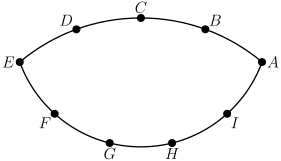
Los puntos A,A, B,B, C,C, D,D, y EE están igualmente espaciados sobre un arco menor de un círculo. Los puntos E,E, F,F, G,G, H,H, I,I, y AA están igualmente espaciados sobre un arco menor de un segundo círculo con centro CC como se muestra en la figura de abajo. El ángulo ABD\angle ABD excede a AHG\angle AHG en 12.12^\circ. Halla la medida en grados de BAG.\angle BAG.

Points A,A, B,B, C,C, D,D, and EE are equally spaced on a minor arc of a circle. Points E,E, F,F, G,G, H,H, I,I, and AA are equally spaced on a minor arc of a second circle with center CC as shown in the figure below. The angle ABD\angle ABD exceeds AHG\angle AHG by 12.12^\circ. Find the degree measure of BAG.\angle BAG.

Solución:

Sea α=ECF\alpha = \angle ECF =FCG= \angle FCG =GCH= \angle GCH =HCI= \angle HCI =ICA,= \angle ICA, el ángulo central común del segundo círculo, así que ACE=5α.\angle ACE = 5\alpha. Como CC también está en el primer círculo, ACE\angle ACE es allí un ángulo inscrito, por lo que el arco AEAE que no contiene a CC mide 10α,10\alpha, y cada uno de los cuatro arcos iguales AB,AB, BC,BC, CD,CD, DEDE mide 36010α4=905α2.\frac{360^\circ - 10\alpha}{4} = 90^\circ - \frac{5\alpha}{2}.

El ángulo ABDABD subtiende el arco ADAD que no contiene a B,B, que es 3603(905α2),360^\circ - 3\left(90^\circ - \frac{5\alpha}{2}\right), así que ABD=45+15α4.\angle ABD = 45^\circ + \frac{15\alpha}{4}. El ángulo AHGAHG subtiende el arco AGAG del segundo círculo que no contiene a H,H, que es 3603α,360^\circ - 3\alpha, así que AHG=1803α2.\angle AHG = 180^\circ - \frac{3\alpha}{2}. La condición dada se lee (45+15α4)(1803α2)=21α4135=12, \begin{aligned} &\left(45^\circ + \frac{15\alpha}{4}\right) - \left(180^\circ - \frac{3\alpha}{2}\right) \\ &= \frac{21\alpha}{4} - 135^\circ = 12^\circ, \end{aligned} así que α=28.\alpha = 28^\circ.

Finalmente, BAE\angle BAE subtiende el arco BCDE=3(905α2)=60BCDE = 3\left(90^\circ - \frac{5\alpha}{2}\right) = 60^\circ del primer círculo, dando BAE=30,\angle BAE = 30^\circ, y EAG\angle EAG subtiende el arco EFG=2αEFG = 2\alpha del segundo círculo, dando EAG=28.\angle EAG = 28^\circ. Por lo tanto BAG=BAE+EAG\angle BAG = \angle BAE + \angle EAG =30+28=58.= 30^\circ + 28^\circ = 58^\circ.

Let α=ECF\alpha = \angle ECF =FCG= \angle FCG =GCH= \angle GCH =HCI= \angle HCI =ICA,= \angle ICA, the common central angle of the second circle, so ACE=5α.\angle ACE = 5\alpha. Since CC also lies on the first circle, ACE\angle ACE is an inscribed angle there, so the arc AEAE not containing CC measures 10α,10\alpha, and each of the four equal arcs AB,AB, BC,BC, CD,CD, DEDE measures 36010α4=905α2.\frac{360^\circ - 10\alpha}{4} = 90^\circ - \frac{5\alpha}{2}.

Angle ABDABD subtends the arc ADAD not containing B,B, which is 3603(905α2),360^\circ - 3\left(90^\circ - \frac{5\alpha}{2}\right), so ABD=45+15α4.\angle ABD = 45^\circ + \frac{15\alpha}{4}. Angle AHGAHG subtends the second circle's arc AGAG not containing H,H, which is 3603α,360^\circ - 3\alpha, so AHG=1803α2.\angle AHG = 180^\circ - \frac{3\alpha}{2}. The given condition reads (45+15α4)(1803α2)=21α4135=12, \begin{aligned} &\left(45^\circ + \frac{15\alpha}{4}\right) - \left(180^\circ - \frac{3\alpha}{2}\right) \\ &= \frac{21\alpha}{4} - 135^\circ = 12^\circ, \end{aligned} so α=28.\alpha = 28^\circ.

Finally, BAE\angle BAE subtends the first circle's arc BCDE=3(905α2)=60,BCDE = 3\left(90^\circ - \frac{5\alpha}{2}\right) = 60^\circ, giving BAE=30,\angle BAE = 30^\circ, and EAG\angle EAG subtends the second circle's arc EFG=2α,EFG = 2\alpha, giving EAG=28.\angle EAG = 28^\circ. Hence BAG=BAE+EAG\angle BAG = \angle BAE + \angle EAG =30+28=58.= 30^\circ + 28^\circ = 58^\circ.

← Problema 5#5Examen completoProblema 7#7 →

El Problema 6 en otros años