
Problemas del 2015 AIME I
¡Desplázate hacia abajo y presiona Iniciar para intentar el examen! O ve al PDF imprimible, la clave de respuestas, o las soluciones profesionales preparadas por LIVE by Po-Shen Loh.
Todos los problemas se usan con el permiso legal oficial de la Mathematical Association of America (MAA).
O salta directamente a un solo problema con su solución: 1 · 2 · 3 · 4 · 5 · 6 · 7 · 8 · 9 · 10 · 11 · 12 · 13 · 14 · 15
¿Quieres aprender de forma profesional con clases interactivas en video?
Con tiempo
3:00:00
1.
Las expresiones y se obtienen escribiendo los operadores de multiplicación y suma en un patrón alternado entre enteros sucesivos. Halla la diferencia positiva entre los enteros y
The expressions and are obtained by writing multiplication and addition operators in an alternating pattern between successive integers. Find the positive difference between integers and
Respuesta: 722
Pista pequeña:
Calcula emparejando cada producto de con el producto de que comparte su factor par
Compute by pairing each product in with the product in that shares its even factor
Pista grande:
Cada par aporta y los términos sobrantes son y
Each pair contributes and the leftover terms are and
Solución:
Resta término a término: Cada diferencia entre paréntesis tiene la forma para
Por lo tanto
Subtract term by term: Each parenthesized difference has the form for
Therefore
2.
Los nueve delegados de la Conferencia de Cooperación Económica incluyen funcionarios de México, funcionarios de Canadá y funcionarios de los Estados Unidos. Durante la sesión inaugural, tres de los delegados se quedan dormidos. Suponiendo que los tres delegados que se durmieron fueron elegidos al azar, la probabilidad de que exactamente dos de ellos sean del mismo país es donde y son enteros positivos primos entre sí. Halla
The nine delegates to the Economic Cooperation Conference include officials from Mexico, officials from Canada, and officials from the United States. During the opening session, three of the delegates fall asleep. Assuming that the three sleepers were determined randomly, the probability that exactly two of the sleepers are from the same country is where and are relatively prime positive integers. Find
Respuesta: 139
Pista pequeña:
Todos los grupos de tres delegados dormidos son igualmente probables; cuenta los favorables según qué país aporta la pareja
All sleeper triples are equally likely; count the favorable ones by which country supplies the pair
Pista grande:
Exactamente dos de un país con delegados significa opciones para la pareja por opciones para el tercer delegado
Exactly two from a country of size means choices for the pair times choices for the third sleeper
Solución:
Hay conjuntos igualmente probables de tres delegados dormidos. Exactamente dos provienen del mismo país cuando un país aporta exactamente dos de ellos y el tercer delegado proviene de un país distinto: maneras con la pareja de los Estados Unidos, con la pareja de Canadá y con la pareja de México.
La probabilidad es ya en su forma más simple, así que
There are equally likely sets of three sleepers. Exactly two sleepers come from the same country when one country supplies exactly two of them and the third sleeper comes from a different country: ways with the pair from the United States, with the pair from Canada, and with the pair from Mexico.
The probability is already in lowest terms, so
3.
Existe un número primo tal que es el cubo de un entero positivo. Halla
There is a prime number such that is the cube of a positive integer. Find
Respuesta: 307
Pista pequeña:
Escribe y factoriza
Write and factor
Pista grande:
siempre es impar, así que el factor debe provenir por completo de la primalidad obliga entonces a
is always odd, so the factor must come entirely from primality then forces
Solución:
Escribe de modo que Como es impar, es impar, y también es impar. Por lo tanto los cuatro factores de deben dividir a escribe lo que da Para que sea primo necesitamos así que
Entonces que efectivamente es primo, y
Write so Since is odd, is odd, and is odd as well. Therefore all four factors of must divide write which gives For to be prime we need so
Then which is indeed prime, and
4.
El punto está sobre el segmento con y Los puntos y están del mismo lado de la recta formando triángulos equiláteros y Sea el punto medio de y sea el punto medio de El área de es Halla
Point lies on line segment with and Points and lie on the same side of line forming equilateral triangles and Let be the midpoint of and be the midpoint of The area of is Find
Respuesta: 507
Pista pequeña:
Coloca en el origen con y y escribe y usando las alturas de los triángulos equiláteros
Put at the origin with and and write and using equilateral-triangle altitudes
Pista grande:
Calcula los puntos medios y y las tres distancias el triángulo resulta ser equilátero
Compute the midpoints and and the three distances triangle turns out equilateral
Solución:
Coloca y Cada triángulo equilátero tiene su vértice superior encima del punto medio de su base a una altura de veces el lado, así que y Los puntos medios son y
Ahora y así que es equilátero con lado Su área es de modo que
Place and Each equilateral triangle has its apex above the midpoint of its base at height times the side, so and The midpoints are and
Now and so is equilateral with side Its area is so
5.
En un cajón Sandy tiene pares de calcetines, cada par de un color distinto. El lunes Sandy elige al azar dos calcetines individuales de los calcetines del cajón. El martes Sandy elige al azar de los calcetines restantes y el miércoles dos de los calcetines restantes al azar. La probabilidad de que el miércoles sea el primer día en que Sandy elige dos calcetines del mismo color es donde y son enteros positivos primos entre sí. Halla
In a drawer Sandy has pairs of socks, each pair a different color. On Monday Sandy selects two individual socks at random from the socks in the drawer. On Tuesday Sandy selects of the remaining socks at random and on Wednesday two of the remaining socks at random. The probability that Wednesday is the first day Sandy selects matching socks is where and are relatively prime positive integers. Find
Respuesta: 341
Pista pequeña:
Dividir los calcetines en una secuencia de pares diarios es simétrico: cualquier reordenamiento de los días es igualmente probable
Splitting the socks into a sequence of daily pairs is symmetric: any reordering of the days is equally likely
Pista grande:
Así que calcula en su lugar la probabilidad de elegir dos calcetines del mismo color el lunes y luego dos de colores distintos el martes y el miércoles, siguiendo cuántos pares completos quedan cada día
So compute instead the probability of a match on Monday and then no match on Tuesday or Wednesday, tracking how many complete pairs remain each day
Solución:
Imagina repartir los diez calcetines de dos en dos durante cinco días; cada asignación de pares no ordenados a los días es igualmente probable, y permutar los días no cambia esta distribución. Intercambiar el lunes y el miércoles muestra entonces que la probabilidad buscada (colores distintos, colores distintos, mismo color) es igual a la probabilidad de elegir dos calcetines del mismo color el lunes y de colores distintos el martes y el miércoles.
Ese patrón es fácil de calcular en orden. El lunes se eligen dos calcetines del mismo color con probabilidad (el segundo calcetín debe ser la pareja del primero). Los calcetines restantes forman entonces pares completos, así que el martes se eligen colores distintos con probabilidad Elegir colores distintos el martes deshace dos pares, dejando pares completos entre los calcetines restantes, así que el miércoles se eligen colores distintos con probabilidad
La probabilidad es así que
Imagine dealing all ten socks out two per day for five days; every assignment of unordered pairs to days is equally likely, and permuting the days does not change this distribution. Swapping Monday and Wednesday therefore shows that the desired probability (mismatch, mismatch, match) equals the probability of a match on Monday followed by mismatches on Tuesday and Wednesday.
That pattern is easy to compute in order. Monday matches with probability (the second sock must be the first sock’s mate). The remaining socks then form complete pairs, so Tuesday mismatches with probability Tuesday’s mismatch breaks two pairs, leaving complete pairs among the remaining socks, so Wednesday mismatches with probability
The probability is so
6.
Los puntos y están igualmente espaciados sobre un arco menor de un círculo. Los puntos y están igualmente espaciados sobre un arco menor de un segundo círculo con centro como se muestra en la figura de abajo. El ángulo excede a en Halla la medida en grados de
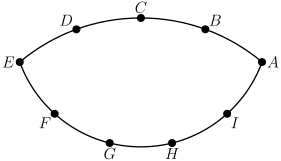
Points and are equally spaced on a minor arc of a circle. Points and are equally spaced on a minor arc of a second circle with center as shown in the figure below. The angle exceeds by Find the degree measure of
Respuesta: 58
Pista pequeña:
Sea el ángulo central común en del segundo círculo; entonces es simultáneamente un ángulo inscrito del primer círculo
Let be the common central angle at in the second circle; then is simultaneously an inscribed angle of the first circle
Pista grande:
Expresa cada arco de ambos círculos en términos de la condición determina
Express every arc of both circles in terms of the condition pins down
Solución:
Sea el ángulo central común del segundo círculo, así que Como también está en el primer círculo, es allí un ángulo inscrito, por lo que el arco que no contiene a mide y cada uno de los cuatro arcos iguales mide
El ángulo subtiende el arco que no contiene a que es así que El ángulo subtiende el arco del segundo círculo que no contiene a que es así que La condición dada se lee así que
Finalmente, subtiende el arco del primer círculo, dando y subtiende el arco del segundo círculo, dando Por lo tanto
Let the common central angle of the second circle, so Since also lies on the first circle, is an inscribed angle there, so the arc not containing measures and each of the four equal arcs measures
Angle subtends the arc not containing which is so Angle subtends the second circle’s arc not containing which is so The given condition reads so
Finally, subtends the first circle’s arc giving and subtends the second circle’s arc giving Hence
7.
En el diagrama de abajo, es un cuadrado. El punto es el punto medio de Los puntos y están sobre y y están sobre y respectivamente, de modo que es un cuadrado. Los puntos y están sobre y y están sobre y respectivamente, de modo que es un cuadrado. El área de es Halla el área de
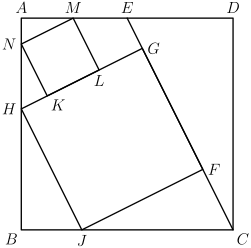
In the diagram below, is a square. Point is the midpoint of Points and lie on and and lie on and respectively, so that is a square. Points and lie on and and lie on and respectively, so that is a square. The area of is Find the area of
Respuesta: 539
Pista pequeña:
Cada triángulo rectángulo recortado por los cuadrados inclinados ( ) es semejante a con catetos en razón
Every right triangle cut off by the tilted squares ( ) is similar to with legs in ratio
Pista grande:
Escribe para obtener el lado de a partir de luego da el lado de exactamente de la misma manera
Write to get ’s side from then gives ’s side in exactly the same way
Solución:
Sea de modo que el cuadrado grande tiene lado y Los triángulos rectángulos y son todos semejantes, con catetos en razón Sea el lado de En la hipotenusa es así que y en el cateto más largo es así que la hipotenusa es Entonces así que
Luego, La descomposición idéntica a lo largo de para el cuadrado de lado da Dividiendo las dos ecuaciones,
Por lo tanto las áreas están en razón así que el área de es
Let so the big square has side and The right triangles and are all similar, with legs in ratio Let be the side of In the hypotenuse is so and in the longer leg is so the hypotenuse is Then so
Next, The identical decomposition along for the square of side gives Dividing the two equations,
The areas are therefore in ratio so the area of is
8.
Para un entero positivo sea la suma de los dígitos de Halla el menor entero positivo que satisface
For positive integer let denote the sum of the digits of Find the smallest positive integer satisfying
Respuesta: 695
Pista pequeña:
Cada acarreo en una suma reduce la suma de dígitos en así que donde cuenta los acarreos
Each carry in an addition lowers the digit sum by so where counts the carries
Pista grande:
Deben ocurrir exactamente dos acarreos, y la posición de las centenas siempre acarrea, así que prueba cada elección de la segunda posición que acarrea y minimiza el dígito de las centenas
Exactly two carries must occur, and the hundreds place always carries, so try each choice of the second carrying place and minimize the hundreds digit
Solución:
Cada acarreo en una suma reemplaza en una posición por en la siguiente, reduciendo la suma de dígitos en Por lo tanto donde es el número de acarreos, y obliga a Para un candidato de tres dígitos con dígitos que suman como tenemos así que la posición de las centenas siempre acarrea (), y exactamente una de las posiciones de las unidades y las decenas acarrea.
Si las unidades acarrean y las decenas no, el cálculo de las decenas debe quedar por debajo de así que entonces forzando Si las decenas acarrean y las unidades no, entonces da así que y funciona:
En efecto y con así que el menor de este tipo es
Each carry in an addition replaces in one place by in the next, lowering the digit sum by Hence where is the number of carries, and forces For a three-digit candidate with digits summing to since we have so the hundreds place always carries (), and exactly one of the units and tens places carries.
If the units carry and the tens do not, the tens computation must stay below so then forcing If the tens carry and the units do not, then gives so and works:
Indeed and with so the smallest such is
9.
Sea el conjunto de todas las ternas ordenadas de enteros con Cada terna ordenada de genera una sucesión según la regla para Halla el número de tales sucesiones para las que para algún
Let be the set of all ordered triples of integers with Each ordered triple in generates a sequence according to the rule for Find the number of such sequences for which for some
Respuesta: 494
Pista pequeña:
Si dos términos consecutivos llegan a ser iguales, la sucesión alcanza dos pasos después; si difieren en alcanza dentro de cuatro pasos
If two consecutive terms are ever equal, the sequence hits two steps later; if they differ by it hits within four steps
Pista grande:
Cuenta las ternas cuyas entradas consecutivas son iguales o difieren en corrigiendo los solapamientos, luego verifica qué ocurre cuando una diferencia de se encuentra con un
Count triples whose consecutive entries are equal or differ by correcting for overlaps, then check what happens when a difference of meets a
Solución:
Si entonces y si entonces así que Por lo tanto toda terna de una de las formas produce un Estas formas contienen ternas, pero las ternas que encajan en dos formas se cuentan dos veces: las de la forma las en cada una de las seis familias (signos coincidentes), y las en cada una de y Eso deja ternas.
Algunas otras ternas también funcionan: si entonces y así que Estas ternas incluyen y que ya fueron contadas, así que añaden nuevas, para
Ninguna otra terna llega a si ambas diferencias consecutivas son al menos y entonces y así que por inducción los términos crecen para siempre y ningún factor se anula jamás. Si en cambio con entonces y y el mismo crecimiento se impone. El conteo es
If then and if then so Hence every triple of one of the forms produces a These forms contain triples, but triples fitting two forms are counted twice: the of the form the in each of the six families (matching signs), and the in each of and That leaves triples.
A few other triples also work: if then and so These triples include and which were already counted, so they add new ones, for
No other triple reaches if both consecutive differences are at least and then and so inductively the terms grow forever and no factor ever vanishes. If instead with then and and the same growth takes over. The count is
10.
Sea un polinomio de tercer grado con coeficientes reales que satisface Halla
Let be a third-degree polynomial with real coefficients satisfying Find
Respuesta: 72
Pista pequeña:
Cada uno de y es un polinomio cúbico, así que cada uno tiene exactamente tres de como raíces
Each of and is a cubic, so each has exactly three of as roots
Pista grande:
Las dos cúbicas difieren en una constante, así que las dos ternas de raíces tienen sumas iguales y sumas iguales de productos por pares; solo una partición funciona
The two cubics differ by a constant, so the two root triples have equal sums and equal pairwise-product sums; only one split works
Solución:
Cada uno de y es una cúbica, así que cada una se anula en exactamente tres de Escribiéndolas como y las dos cúbicas difieren en la constante así que sus coeficientes de y coinciden: las ternas de raíces tienen sumas iguales y sumas iguales de productos por pares. La única partición de en dos ternas de igual suma es y (cada una sumando ), y en efecto ambas tienen suma de productos por pares
Reemplazando por si es necesario (lo que no cambia ), tenemos Poniendo se obtiene así que y Por lo tanto
Each of and is a cubic, so each vanishes at exactly three of Writing them as and the two cubics differ by the constant so their and coefficients agree: the root triples have equal sums and equal sums of pairwise products. The only partition of into two triples of equal sum is and (each summing to ), and indeed both have pairwise-product sum
Replacing by if necessary (which does not change ), we have Setting gives so and Thus
11.
El triángulo tiene lados de longitud entera positiva con Sea la intersección de las bisectrices de y Supón que Halla el menor perímetro posible de
Triangle has positive integer side lengths with Let be the intersection of the bisectors of and Suppose Find the smallest possible perimeter of
Respuesta: 108
Pista pequeña:
Sea el punto medio de los triángulos rectángulos en dan y
Let be the midpoint of right triangles at give and
Pista grande:
Como es la mitad de la fórmula del ángulo doble relaciona con la integralidad y dejan solo unos pocos casos por probar
Since is half of the double-angle formula relates to integrality and leave only a few cases to test
Solución:
Sea el punto medio de por simetría y son colineales con Con y los triángulos rectángulos e dan y Como bisecta la fórmula del ángulo doble da así que
Escribiendo esto se convierte en Necesitamos así que mientras que obliga a Probando solo hace que sea entero, a saber
El triángulo con lados satisface todas las condiciones, y su perímetro es
Let be the midpoint of by symmetry and are collinear with With and right triangles and give and Since bisects the double-angle formula yields so
Writing this becomes We need so while forces Testing only makes an integer, namely
The triangle with sides satisfies all the conditions, and its perimeter is
12.
Considera todos los subconjuntos de elementos del conjunto De cada uno de tales subconjuntos elige el elemento menor. La media aritmética de todos estos elementos menores es donde y son enteros positivos primos entre sí. Halla
Consider all -element subsets of the set From each such subset choose the least element. The arithmetic mean of all of these least elements is where and are relatively prime positive integers. Find
Respuesta: 431
Pista pequeña:
Exactamente de los subconjuntos tienen a como elemento menor
Exactly of the subsets have least element
Pista grande:
Interpreta como el conteo de los subconjuntos de elementos de un conjunto de elementos según su segundo elemento más pequeño
Interpret as counting -element subsets of a -element set by their second-smallest element
Solución:
Un subconjunto de elementos tiene a como elemento menor exactamente cuando contiene junto con elementos mayores, así que de los subconjuntos tienen a como elemento menor. Por lo tanto la media es
El numerador cuenta algo concreto: para construir un subconjunto de elementos de cuyo segundo elemento más pequeño sea elige su elemento más pequeño de ( maneras) y sus elementos mayores de Al sumar sobre se cuenta cada subconjunto de elementos exactamente una vez, así que
Por lo tanto la media es que está en su forma más simple, y
A -element subset has least element exactly when it contains together with larger elements, so of the subsets have least element The mean is therefore
The numerator counts something concrete: to build a -element subset of whose second-smallest element is choose its smallest element from ( ways) and its top elements from Summing over produces every -element subset exactly once, so
Hence the mean is which is in lowest terms, and
13.
Con todos los ángulos medidos en grados, el producto donde y son enteros mayores que Halla
With all angles measured in degrees, the product where and are integers greater than Find
Respuesta: 91
Pista pequeña:
Sean y los productos de los senos de los ángulos impares y pares, respectivamente, hasta empareja con
Let and be the products of the sines of the odd and even degree angles up to pair with
Pista grande:
Entonces duplicar cada factor convierte el producto de nuevo en dejando solo una potencia de
Then doubling every factor turns the product into again, leaving only a power of
Solución:
Sea y de modo que el producto buscado es Entonces y multiplicando esto por sí mismo en orden inverso, usando da
Multiplica por y usa ya que y convierte la segunda mitad también en
Como se sigue que así que Como es primo, la única representación con es y
Let and so the desired product is Then and multiplying this by itself in reverse order, using gives
Multiply by and use since and turns the second half into as well.
Because it follows that so Since is prime, the only representation with is and
14.
Para cada entero sea el área de la región del plano coordenado definida por las desigualdades y donde es el mayor entero que no excede a Halla el número de valores de con para los que es un entero.
For each integer let be the area of the region in the coordinate plane defined by the inequalities and where is the greatest integer not exceeding Find the number of values of with for which is an integer.
Respuesta: 483
Pista pequeña:
En con la franja es un trapecio de área , un entero exactamente cuando es par
Over with the strip is a trapezoid of area — an integer exactly when is even
Pista grande:
Así que la integralidad de persiste mientras es par y alterna mientras es impar; sigue los bloques según
So integrality of persists while is even and alternates while is odd; track the blocks according to
Solución:
En la franja tenemos así que la parte de la región en esa franja es un trapecio bajo con área un entero cuando es par, un semientero cuando es impar. Por lo tanto a medida que crece en la integralidad de no cambia mientras es par y se invierte en cada paso mientras es impar.
Considera el bloque de valores Partiendo de los estados de se repiten con periodo entero para y no entero para (un bloque impar invierte el estado un número impar de veces, un bloque par lo conserva). Contando los valores enteros de dentro de cada bloque: para el bloque alterna, empezando y terminando con no enteros, dando para cada valor es no entero, dando para alterna, empezando y terminando con enteros, dando para los valores son todos enteros.
Para cubriendo los cuatro bloques aportan enteros, sumando en total Luego el bloque aporta enteros para el bloque no aporta ninguno, y para la alternancia sobre empieza con un entero en y da más. El total es
On the strip we have so the region above it is a trapezoid under with area an integer when is even, a half-integer when is odd. Hence as grows by the integrality of is unchanged while is even and flips at every step while is odd.
Consider the block of values Starting from the statuses of cycle with period integer for and non-integer for (an odd block flips the status an odd number of times, an even block preserves it). Counting integer values of inside each block: for the block alternates, beginning and ending with non-integers, giving for every value is a non-integer, giving for it alternates, beginning and ending with integers, giving for all values are integers.
For covering the four blocks contribute integers, totaling Then the block contributes integers for the block contributes none, and for the alternation over begins with an integer at and gives more. The total is
15.
Un bloque de madera tiene la forma de un cilindro circular recto con radio y altura y toda su superficie ha sido pintada de azul. Los puntos y se eligen en el borde de una de las caras circulares del cilindro de modo que el arco en esa cara mide Luego el bloque se corta por la mitad a lo largo del plano que pasa por el punto el punto y el centro del cilindro, revelando una cara plana sin pintar en cada mitad. El área de una de estas caras sin pintar es donde y son enteros y no es divisible por el cuadrado de ningún primo. Halla
A block of wood has the shape of a right circular cylinder with radius and height and its entire surface has been painted blue. Points and are chosen on the edge of one of the circular faces of the cylinder so that arc on that face measures The block is then sliced in half along the plane that passes through point point and the center of the cylinder, revealing a flat, unpainted face on each half. The area of one of these unpainted faces is where and are integers and is not divisible by the square of any prime. Find
Respuesta: 53
Pista pequeña:
Proyecta la cara cortada verticalmente hacia abajo sobre la cara circular que contiene a y la imagen es el disco menos dos segmentos circulares de
Project the cut face straight down onto the circular face containing and the image is the disk minus two circular segments
Pista grande:
Con el centro del cilindro, el centro de la cara, y el punto medio de la inclinación satisface divide el área proyectada entre
With the cylinder’s center, the face center, and the midpoint of the tilt satisfies divide the projected area by
Solución:
Coloca el bloque de pie sobre la cara que contiene a y y sea el centro de esa cara, el punto medio de y el centro del cilindro. El plano de corte encuentra la cara inferior en la cuerda y, por simetría respecto a encuentra la cara superior en la cuerda reflejada, así que la cara cortada se proyecta verticalmente sobre la región entre la cuerda y su imagen especular respecto a (sombreada abajo). Cada segmento circular de recortado tiene área así que tiene área
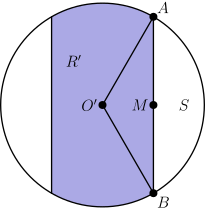
Como el triángulo da y así que La cara cortada es plana e inclinada respecto a la horizontal solo en la dirección de con el ángulo tal que Deshacer la proyección multiplica por lo tanto las áreas por así que la cara sin pintar tiene área Por lo tanto
Stand the block on the face containing and and let be the center of that face, the midpoint of and the center of the cylinder. The cutting plane meets the bottom face in chord and, by symmetry through meets the top face in the reflected chord, so the cut face projects vertically onto the region between chord and its mirror image through (shaded below). Each circular segment cut off has area so has area
Since triangle gives and so The cut face is planar and tilted from the horizontal only in the direction of at the angle with Undoing the projection therefore multiplies areas by so the unpainted face has area Thus