
2012 AMC 10B Problema 25
Intenta el Problema 25 del 2012 AMC 10B a continuación y luego compara tu respuesta con la solución preparada profesionalmente de LIVE by Po-Shen Loh. También puedes intentar el examen cronometrado completo, ver todas las soluciones del 2012 AMC 10B, o revisar la clave de respuestas.
Todos los problemas se usan con el permiso legal oficial de la Mathematical Association of America (MAA).
25.
Un insecto viaja de a a lo largo de los segmentos de la retícula hexagonal que se muestra abajo. Los segmentos marcados con una flecha solo pueden recorrerse en la dirección de la flecha, y el insecto nunca recorre el mismo segmento más de una vez. ¿Cuántos caminos diferentes hay?
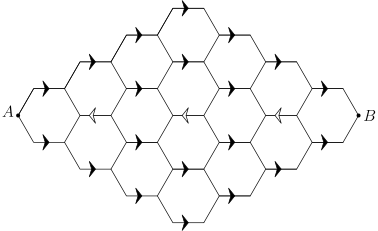
A bug travels from to along the segments in the hexagonal lattice pictured below. The segments marked with an arrow can be traveled only in the direction of the arrow, and the bug never travels the same segment more than once. How many different paths are there?
Respuesta: E
Pista pequeña:
Clasifica los caminos según qué flechas hacia atrás usan.
Classify paths by which backward arrows they use
Pista grande:
Sin flechas hacia atrás, el número de opciones por columna es .
The no-backward-arrow case has choices by column
Solución:
Clasifica un camino según el conjunto de flechas hacia atrás que usa. Si , el camino queda determinado al elegir una flecha hacia adelante en cada columna, lo que da caminos.
Si usa solo la flecha hacia atrás izquierda, hay caminos, y por simetría lo mismo si usa solo la derecha. Si usa ambas flechas exteriores hacia atrás pero no la del medio, hay caminos.
Si usa solo la flecha hacia atrás del medio, hay caminos. Si usa la flecha del medio y exactamente una flecha exterior hacia atrás, hay caminos por cada elección de flecha exterior. Si usa las tres flechas hacia atrás, hay caminos.
El total es .
Por lo tanto, E es la respuesta correcta.
Classify a path by the set of backward arrows it uses. If , the path is determined by choosing one forward arrow in each column, giving paths.
If uses only the left backward arrow, there are paths, and by symmetry the same for only the right backward arrow. If it uses both outer backward arrows but not the middle one, there are paths.
If uses only the middle backward arrow, there are paths. If it uses the middle arrow and exactly one outer backward arrow, there are paths for each choice of outer arrow. If it uses all three backward arrows, there are paths.
The total is .
Thus, E is the correct answer.
El Problema 25 en otros años
2000 AMC 10 · 2001 AMC 10 · 2002 AMC 10A · 2002 AMC 10B · 2003 AMC 10A · 2003 AMC 10B · 2004 AMC 10A · 2004 AMC 10B · 2005 AMC 10A · 2005 AMC 10B · 2006 AMC 10A · 2006 AMC 10B · 2007 AMC 10A · 2007 AMC 10B · 2008 AMC 10A · 2008 AMC 10B · 2009 AMC 10A · 2009 AMC 10B · 2010 AMC 10A · 2010 AMC 10B · 2011 AMC 10A · 2011 AMC 10B · 2012 AMC 10A · 2013 AMC 10A · 2013 AMC 10B · 2014 AMC 10A · 2014 AMC 10B · 2015 AMC 10A · 2015 AMC 10B · 2016 AMC 10A · 2016 AMC 10B · 2017 AMC 10A · 2017 AMC 10B · 2018 AMC 10A · 2018 AMC 10B · 2019 AMC 10A · 2019 AMC 10B · 2020 AMC 10A · 2020 AMC 10B · 2021 AMC 10A Spring · 2021 AMC 10B Spring · 2021 AMC 10A Fall · 2021 AMC 10B Fall · 2022 AMC 10A · 2022 AMC 10B · 2023 AMC 10A · 2023 AMC 10B · 2024 AMC 10A · 2024 AMC 10B · 2025 AMC 10A · 2025 AMC 10B