
Problemas del 2012 AMC 10B
¡Desplázate hacia abajo y presiona Iniciar para intentar el examen! O ve al PDF imprimible, la clave de respuestas, o las soluciones profesionales preparadas por LIVE by Po-Shen Loh.
Todos los problemas se usan con el permiso legal oficial de la Mathematical Association of America (MAA).
O salta directamente a un solo problema con su solución: 1 · 2 · 3 · 4 · 5 · 6 · 7 · 8 · 9 · 10 · 11 · 12 · 13 · 14 · 15 · 16 · 17 · 18 · 19 · 20 · 21 · 22 · 23 · 24 · 25
¿Quieres aprender de forma profesional con clases interactivas en video?
Con tiempo
1:15:00
1.
Cada aula de tercer grado de la Escuela Primaria Pearl Creek tiene estudiantes y conejos como mascotas. ¿Cuántos estudiantes más que conejos hay en total en las aulas de tercer grado?
Each third-grade classroom at Pearl Creek Elementary has students and pet rabbits. How many more students than rabbits are there in all of the third-grade classrooms?
Respuesta: C
Pista pequeña:
Primero halla la diferencia entre estudiantes y conejos en un aula.
Find the student-rabbit difference in one classroom first
Pista grande:
Multiplica esa diferencia por las aulas.
Multiply that difference by classrooms
Solución:
Cada aula tiene estudiantes más que conejos.
En las aulas, la diferencia es .
Por lo tanto, C es la respuesta correcta.
Each classroom has more students than rabbits.
Across classrooms, the difference is .
Thus, C is the correct answer.
2.
Un círculo de radio está inscrito en un rectángulo como se muestra. La razón entre el largo del rectángulo y su ancho es ¿Cuál es el área del rectángulo?

A circle of radius is inscribed in a rectangle as shown. The ratio of the length of the rectangle to its width is What is the area of the rectangle?
Respuesta: E
Pista pequeña:
El ancho del rectángulo es el diámetro del círculo.
The rectangle width is the circle diameter
Pista grande:
Usa la razón largo a ancho después de hallar el ancho.
Use the length-to-width ratio after finding the width
Solución:
El lado menor del rectángulo es igual al diámetro, que es
Debido a la razón , el lado largo es
Por lo tanto, el área es
Por lo tanto, la respuesta correcta es E.
The smaller side of the rectangle is equal to the diameter, which is
Due to the ratio, the long side is
Therefore, the area is
Thus, the correct answer is E .
3.
El punto del plano con coordenadas se refleja respecto a la recta ¿Cuáles son las coordenadas del punto reflejado?
The point in the -plane with coordinates is reflected across the line What are the coordinates of the reflected point?
Respuesta: B
Pista pequeña:
La recta de reflexión es horizontal.
The reflecting line is horizontal
Pista grande:
El punto está unidades por encima de .
The point is units above
Solución:
Observa que la recta en cuestión es perfectamente horizontal. Esto significa que si construimos un segmento perpendicular desde el punto hasta la recta, para hallar las coordenadas reflejadas basta con duplicar la distancia a lo largo de ese segmento.
El segmento desde hasta tiene longitud así que el punto reflejado está sobre este mismo segmento, pero a una distancia de del otro lado de la recta horizontal. Esto da
Por lo tanto, la respuesta correcta es B.
Notice that the line in question is perfectly horizontal. This means that if we were to construct a perpendicular line segment from the point to the line, to find the reflected coordinates of the point, we simply double the distance along that line segment.
The line segment from to is of length so the reflected point is along this same line segment, but a distance of on the other side of the horizontal line. This yields
Thus, the correct answer is B .
4.
Cuando Ringo coloca sus canicas en bolsas con canicas por bolsa, le sobran canicas. Cuando Paul hace lo mismo con las suyas, le sobran canicas. Ringo y Paul juntan sus canicas y las colocan en tantas bolsas como sea posible, con canicas por bolsa. ¿Cuántas canicas sobrarán?
When Ringo places his marbles into bags with marbles per bag, he has marbles left over. When Paul does the same with his marbles, he has marbles left over. Ringo and Paul pool their marbles and place them into as many bags as possible, with marbles per bag. How many marbles will be left over?
Respuesta: A
Pista pequeña:
Suma los dos residuos módulo .
Add the two remainders modulo
Pista grande:
deja residuo al dividir entre .
leaves remainder when divided by
Solución:
Como las canicas de Ringo, al dividirse entre dejan residuo concluimos que tiene canicas para algún
Con la misma lógica, también concluimos que Paul tiene canicas para algún
Por lo tanto, el número total de canicas es que, al dividirse entre deja residuo .
Por lo tanto, la respuesta correcta es A.
As we know that when Ringo’s marbles are divided by we have a remainder of we conclude that he has marbles for some
Using the same logic, we can also conclude that Paul has marbles for some
Therefore, the total number of marbles is which, when divided by only leaves left over.
Thus, the correct answer is A .
5.
Anna disfruta de una cena en un restaurante de Washington, D.C., donde el impuesto a las ventas sobre las comidas es del Ella deja una propina del sobre el precio de su comida antes de añadir el impuesto, y el impuesto se calcula sobre el importe anterior a la propina. En total gasta en la cena. ¿Cuál es el costo de su cena sin impuesto ni propina, en dólares?
Anna enjoys dinner at a restaurant in Washington, D.C., where the sales tax on meals is She leaves a tip on the price of her meal before the sales tax is added, and the tax is calculated on the pre-tip amount. She spends a total of for dinner. What is the cost of her dinner without tax or tip?
Respuesta: D
Pista pequeña:
El impuesto y la propina son ambos porcentajes del precio de la comida antes de impuestos.
Tax and tip are both percentages of the pre-tax meal price
Pista grande:
La cuenta total es el del precio de la comida.
The total bill is of the meal price
Solución:
Supongamos que el precio original es Entonces, el impuesto es y la propina es El pago total es Por lo tanto,
Por lo tanto, la respuesta correcta es D.
Suppose the original price is Then, the tax is and the tip is This makes the total payment equal to: Therefore,
Thus, the correct answer is D .
6.
Para estimar el valor de , donde e son números reales con Xiaoli redondeó hacia arriba una pequeña cantidad, redondeó hacia abajo la misma cantidad, y luego restó sus valores redondeados.
¿Cuál de las siguientes afirmaciones es necesariamente correcta?
In order to estimate the value of where and are real numbers with Xiaoli rounded up by a small amount, rounded down by the same amount, and then subtracted her rounded values.
Which of the following statements is necessarily correct?
Su estimación es mayor que .
Her estimate is larger than
Su estimación es menor que .
Her estimate is smaller than
Su estimación es igual a .
Her estimate equals
Su estimación es igual a .
Her estimate equals
Su estimación es .
Her estimate is
Respuesta: A
Pista pequeña:
Redondear hacia arriba lo mueve más a la derecha en la recta numérica.
Rounding up moves it farther right on the number line
Pista grande:
Redondear hacia abajo lo mueve más a la izquierda.
Rounding down moves it farther left
Solución:
Sea la pequeña cantidad de redondeo. Xiaoli sustituye por y por Por lo tanto, su estimación es que es mayor que
Así, la respuesta correcta es A.
Let the small rounding amount be Xiaoli replaces by and by Her estimate is therefore which is larger than
Thus, the correct answer is A .
7.
Para un proyecto de ciencias, Sammy observó a una ardilla listada y a una ardilla común guardando bellotas en hoyos. La ardilla listada escondió bellotas en cada uno de los hoyos que cavó. La ardilla común escondió bellotas en cada uno de los hoyos que cavó. Cada una escondió el mismo número de bellotas, aunque la ardilla común necesitó hoyos menos. ¿Cuántas bellotas escondió la ardilla listada?
For a science project, Sammy observed a chipmunk and a squirrel stashing acorns in holes. The chipmunk hid acorns in each of the holes it dug. The squirrel hid acorns in each of the holes it dug. They each hid the same number of acorns, although the squirrel needed fewer holes. How many acorns did the chipmunk hide?
Respuesta: D
Pista pequeña:
Supón que la ardilla listada cava hoyos.
Let the chipmunk dig holes
Pista grande:
Compara bellotas con bellotas.
Compare acorns with acorns
Solución:
Supón que cada una escondió Entonces la ardilla listada usó hoyos y la ardilla común usó
La diferencia entre las cantidades de hoyos es cuatro, así que de donde
Por lo tanto, la respuesta correcta es D.
Let the number of acorns they each hid be Then, the number of holes from the chipmunk is and the number of holes from the squirrel is
This means Therefore,
Thus, the correct answer is D .
8.
¿Cuál es la suma de todas las soluciones enteras de la siguiente desigualdad?
What is the sum of all integer solutions to the following inequality?
Respuesta: B
Pista pequeña:
Interpreta la condición como la distancia de la incógnita a .
Solve by distance from
Pista grande:
Las soluciones enteras cumplen .
Integer solutions have
Solución:
Si es una solución, entonces también lo es, ya que La suma de estas dos soluciones es Por lo tanto, la suma de todas las soluciones enteras es cuatro veces la cantidad de valores positivos de que funcionan.
El valor positivo debe cumplir lo que da valores, a saber
Por lo tanto, la suma total es
Por lo tanto, la respuesta correcta es B.
Suppose we have as a solution. Then, would also be a solution as The sum of these two solutions would be Thus, the sum of all integer solutions to the above equation is four times the number of positive ’s that work.
To find the number of ’s, we need to find the number of positive solutions to: which would be as
Therefore, the sum of all the solutions is
Thus, the correct answer is B .
9.
Dos enteros suman Al agregar otros dos enteros a los dos primeros, la suma es Finalmente, al agregar otros dos enteros a la suma de los cuatro anteriores, la suma es ¿Cuál es el número mínimo de enteros pares entre los enteros?
Two integers have a sum of When two more integers are added to the first two integers the sum is Finally when two more integers are added to the sum of the previous four integers the sum is What is the minimum number of even integers among the integers?
Respuesta: A
Pista pequeña:
Fíjate en la paridad de cada par que se suma.
Look at the parity of each added pair
Pista grande:
El par intermedio tiene suma impar, así que debe contener un entero par y uno impar.
The middle pair has odd sum, so it must contain one even and one odd integer
Solución:
La suma de los dos primeros enteros, , es par, así que ambos pueden ser impares. Los dos siguientes suman .
Esta suma es impar, así que ese par debe tener un entero par y uno impar. Los dos últimos suman , así que ambos pueden ser impares. Por lo tanto, al menos un entero debe ser par, y ese mínimo se puede alcanzar.
Por lo tanto, A es la respuesta correcta.
The first two integers have even sum , so they can both be odd. The next two integers have sum , which is odd, so one of them must be even and one odd.
The last two integers have sum , so they can both be odd. Therefore at least one integer must be even, and one is attainable.
Thus, A is the correct answer.
10.
¿Cuántos pares ordenados de enteros positivos satisfacen la ecuación
How many ordered pairs of positive integers satisfy the equation
Respuesta: D
Pista pequeña:
Multiplica en cruz la ecuación.
Cross-multiply the equation
Pista grande:
Cuenta los divisores positivos de .
Count the positive divisors of
Solución:
Al multiplicar en cruz obtenemos Así, podemos tomar como cualquier divisor de y luego determinar a partir de él.
Como hay valores posibles para cada uno de los cuales determina un único
Por lo tanto, la respuesta correcta es D.
By cross multiplying, we can see that Thus, we can make any factor of and then determine from it.
Since we have possible choices for each of which also determine a unique
Thus, the correct answer is D .
11.
Un chef de postres prepara el postre para cada día de una semana que comienza en domingo. El postre de cada día es pastel, tarta, helado o pudín. No se puede servir el mismo postre dos días seguidos. El viernes debe haber pastel por un cumpleaños. ¿Cuántos menús de postres distintos son posibles para la semana?
A dessert chef prepares the dessert for every day of a week starting with Sunday. The dessert each day is either cake, pie, ice cream, or pudding. The same dessert may not be served two days in a row. There must be cake on Friday because of a birthday. How many different dessert menus for the week are possible?
Respuesta: A
Pista pequeña:
Trabaja hacia atrás desde el viernes.
Work backward from Friday
Pista grande:
Una vez fijado el día siguiente, cada día vecino tiene opciones.
Each neighboring day has choices once the next day is fixed
Solución:
Sabemos que el viernes debe servirse pastel, así que el sábado no puede haber pastel. Por lo tanto, hay opciones para el postre del sábado.
Además, para cada uno de los días anteriores podemos retroceder y tener opciones cada día, de modo que el número total de menús es
Por lo tanto, la respuesta correcta es A.
We know that there must be cake served on Friday, and as such, on Saturday, we cannot have cake. Therefore, we have choices for Saturday’s menu.
Furthermore, for each of the previous days, we could go backwards and have choices on each day, making the total number of choices
Thus, the correct answer is A .
12.
El punto está justo al este del punto El punto está justo al norte del punto La distancia entre los puntos y es metros, y El punto está metros justo al norte del punto ¿Entre qué dos enteros está la distancia ?
Point is due east of point Point is due north of point The distance between points and is meters, and Point is meters due north of point The distance is between which two integers?
y
and
y
and
y
and
y
and
y
and
Respuesta: B
Pista pequeña:
El triángulo es --.
Triangle is --
Pista grande:
Halla y , y luego usa el teorema de Pitágoras.
Find and , then use the Pythagorean Theorem
Solución:
Como y son perpendiculares, Además, como sabemos que es un triángulo rectángulo isósceles, así que de donde Por lo tanto,
En consecuencia, Por el teorema de Pitágoras, Y como tenemos
Por lo tanto, la respuesta correcta es B.
We know and are perpendicular, so Also, as we know that is an isosceles right triangle, so making Thus,
As such, we know that Thus, by the Pythagorean Theorem, we have that Thus, since we have
Thus, the correct answer is B .
13.
A Clea le toma segundos bajar caminando por una escalera mecánica cuando no está funcionando, y solo segundos bajar caminando cuando sí está funcionando. ¿Cuántos segundos tarda Clea en bajar por la escalera mecánica en funcionamiento cuando simplemente se queda quieta sobre ella?
It takes Clea seconds to walk down an escalator when it is not operating, and only seconds to walk down the escalator when it is operating. How many seconds does it take Clea to ride down the operating escalator when she just stands on it?
Respuesta: B
Pista pequeña:
Cuando la escalera funciona, la velocidad al caminar y la de la escalera se suman.
Let walking speed and escalator speed add when the escalator runs
Pista grande:
Usa la misma longitud de escalera en los recorridos de segundos y de segundos.
Use the same escalator length in the -second and -second trips
Solución:
Sea la longitud de la escalera, sea la velocidad de Clea al caminar por la escalera detenida, y sea la velocidad de la escalera en funcionamiento cuando ella está quieta. Como la velocidad es distancia sobre tiempo, sabemos que y Por lo tanto, lo que significa que Clea tarda segundos en bajar por la escalera simplemente quedándose quieta.
Por lo tanto, la respuesta correcta es B.
Let be the escalator’s length, and let represent Clea’s speed walking down the non-operational escalator. Similarly, let represent Clea’s speed standing still on the operational escalator. Then, as speed is equal to distance over time, we know that and Therefore, meaning that Clea takes seconds to descend the escalator by simply standing still.
Thus, the correct answer is B .
14.
Dos triángulos equiláteros están contenidos en un cuadrado cuyo lado mide Las bases de estos triángulos son lados opuestos del cuadrado, y su intersección es un rombo. ¿Cuál es el área del rombo?
Two equilateral triangles are contained in a square whose side length is The bases of these triangles are opposite sides of the square, and their intersection is a rhombus. What is the area of the rhombus?
Respuesta: D
Pista pequeña:
Usa un triángulo -- cerca de una esquina del cuadrado.
Use a -- triangle near one corner of the square
Pista grande:
Halla un triángulo pequeño fuera del rombo y multiplica su área por .
Find one small triangle outside the rhombus and multiply its area by
Solución:
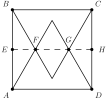
Este rombo se forma con dos triángulos equiláteros congruentes. La longitud del lado es Entonces el área de uno de ellos es de modo que el área total es
El lado del triángulo equilátero mayor es Su altura es , ya que la altura es igual a
La mitad del cuadrado es así que la altura del triángulo menor es Por lo tanto, la razón entre y es
En consecuencia,
Por lo tanto, el área combinada es
Por lo tanto, la respuesta correcta es D.
This rhombus is created by placing two congruent equilateral triangles. Let the side length of it be Then, the area of one of them is making the total area
The side length of the larger equilateral triangle is The height of it is since the height is equal to
Half of the square is so the height of the smaller triangle is Thus, the ratio between and is
As such,
Therefore, the combined area is
Thus, the correct answer is D .
15.
En un torneo de todos contra todos con equipos, cada equipo juega un partido contra cada uno de los demás, y cada partido resulta en un equipo ganador y uno perdedor. Al final del torneo, los equipos se clasifican por el número de partidos ganados. ¿Cuál es el máximo número de equipos que podrían quedar empatados con la mayor cantidad de victorias al final del torneo?
In a round-robin tournament with teams, each team plays one game against each other team, and each game results in one team winning and one team losing. At the end of the tournament, the teams are ranked by the number of games won. What is the maximum number of teams that could be tied for the most wins at the end of the tournament?
Respuesta: D
Pista pequeña:
Los seis equipos no pueden empatar todos, porque partidos no es divisible entre .
Six teams cannot all tie because games is not divisible by
Pista grande:
Intenta que un equipo pierda todos sus partidos y que los otros cinco se repartan las victorias por igual.
Try making one team lose every game and the other five split games evenly
Solución:
Tendrían que repartirse victorias.
Esto significa que no puede haber un empate de equipos, ya que eso serían victorias por equipo.
Si hubiera un empate de equipos, cada uno podría tener victorias, lo cual es posible si un equipo pierde todos sus partidos y, entre los equipos ganadores, cada uno se reparte sus partidos.
Etiquetemos los equipos del al y designemos que el equipo pierda todos sus partidos. Para lograr un empate de , hacemos que cada equipo venza al equipo y al equipo además del equipo
Por lo tanto, la respuesta correcta es D.
They would have to share wins.
This means we cannot have a way tie as that would be wins per team.
If we had a way tie, each team could have wins, which is possible if one team loses all of its games, and out of the winning teams, they each split their games.
If we label the teams from to and designate team to lose all their games. To get a way tie, we could have each team beat team and team as well as team
Thus, the correct answer is D .
16.
Tres círculos de radio son mutuamente tangentes. ¿Cuál es el área total de los círculos y de la región limitada por ellos, como se muestra en la figura?

Three circles with radius are mutually tangent. What is the total area of the circles and the region bounded by them, as shown in the figure?
Respuesta: A
Pista pequeña:
Conecta los tres centros de los círculos.
Connect the three circle centers
Pista grande:
El área buscada consta de tres sectores de más un triángulo equilátero.
The desired area is three sectors plus an equilateral triangle
Solución:

Conecta los centros de los tres círculos. Esto forma un triángulo equilátero de lado , con área .
La parte incluida de cada círculo es un sector de , cuya área es .
El área total es .
Por lo tanto, A es la respuesta correcta.
Connect the centers of the three circles. This forms an equilateral triangle of side , with area .
The included part of each circle is a sector, whose area is .
The total area is .
Thus, A is the correct answer.
17.
Jesse corta un disco de papel circular de radio a lo largo de dos radios para formar dos sectores, el menor con un ángulo central de grados. Hace dos conos circulares, usando cada sector para formar la superficie lateral de un cono. ¿Cuál es la razón entre el volumen del cono menor y el del mayor?
Jesse cuts a circular paper disk of radius along two radii to form two sectors, the smaller having a central angle of degrees. He makes two circular cones, using each sector to form the lateral surface of a cone. What is the ratio of the volume of the smaller cone to that of the larger?
Respuesta: C
Pista pequeña:
Cada cono tiene generatriz .
Each cone has slant height
Pista grande:
La longitud del arco del sector se convierte en la circunferencia de la base del cono.
The sector arc length becomes the base circumference of the cone
Solución:
Cada sector forma un cono con generatriz . El sector menor tiene ángulo , así que la longitud de su arco es , lo que da radio de la base . La altura de su cono es .
El sector mayor tiene longitud de arco , lo que da radio de la base . La altura de su cono es .
La razón de volúmenes es
Por lo tanto, C es la respuesta correcta.
Each sector forms a cone with slant height . The smaller sector has angle , so its arc length is , giving base radius . Its cone height is .
The larger sector has arc length , giving base radius . Its cone height is .
The volume ratio is
Thus, C is the correct answer.
18.
Supongamos que una de cada personas de cierta población tiene una enfermedad particular que no presenta síntomas. Existe un análisis de sangre para detectar esta enfermedad. Para una persona que tiene la enfermedad, el resultado siempre es positivo.
Sin embargo, para una persona que no tiene la enfermedad, hay una tasa de falsos positivos del . Es decir, para tales personas, el de las veces el resultado será negativo, pero el de las veces será positivo e indicará incorrectamente que la persona tiene la enfermedad.
Sea la probabilidad de que una persona elegida al azar de esta población y que obtiene un resultado positivo realmente tenga la enfermedad. ¿Cuál de las siguientes opciones es la más cercana a ?
Suppose that one of every people in a certain population has a particular disease, which displays no symptoms. A blood test is available for screening for this disease. For a person who has this disease, the test always turns out positive.
For a person who does not have the disease, however, there is a false positive rate. In other words, for such people, of the time the test will turn out negative, but of the time the test will turn out positive and will incorrectly indicate that the person has the disease.
Let be the probability that a person who is chosen at random from this population and gets a positive test result actually has the disease. Which of the following is closest to
Respuesta: C
Pista pequeña:
De cada personas, aproximadamente es verdadero positivo y son falsos positivos.
Out of people, about true positive and false positives occur
Pista grande:
Condiciona sobre que el resultado sea positivo.
Condition on the test being positive
Solución:
Entre personas, aproximadamente tiene la enfermedad y da positivo. De las personas restantes, cerca del da un falso positivo, lo que equivale a unas personas.
Así, entre aproximadamente resultados positivos, solo cerca de es un verdadero positivo. La probabilidad es la más cercana a .
Por lo tanto, C es la respuesta correcta.
Among people, about person has the disease and tests positive. Of the remaining people, about test falsely positive, which is about people.
So among about positive tests, only about is a true positive. The probability is closest to .
Thus, C is the correct answer.
19.
En el rectángulo y es el punto medio de El segmento se extiende unidades más allá de hasta el punto y es la intersección de y ¿Cuál es el área del cuadrilátero ?
In rectangle and is the midpoint of Segment is extended units beyond to point and is the intersection of and What is the area of quadrilateral
Pista pequeña:
Usa los triángulos semejantes y .
Use similar triangles and
Pista grande:
El cuadrilátero es un trapecio de altura .
Quadrilateral is a trapezoid with height
Solución:
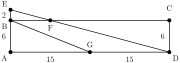
El polígono es un trapecio con bases y y altura Además, como es el punto medio entre y tenemos
Vemos que así que
Esto hace que el área de sea
Por lo tanto, la respuesta correcta es C.
The polygon is a trapezoid with bases and and height Also, since is the midpoint between and we have
We can see that so
This makes the area of equal to
Thus, the correct answer is C .
20.
Bernardo y Silvia juegan el siguiente juego. Se selecciona un entero entre y inclusive y se le da a Bernardo. Cada vez que Bernardo recibe un número, lo duplica y pasa el resultado a Silvia. Cada vez que Silvia recibe un número, le suma y pasa el resultado a Bernardo. El ganador es la última persona que produce un número menor que
Sea el menor número inicial que produce una victoria para Bernardo. ¿Cuál es la suma de los dígitos de ?
Bernardo and Silvia play the following game. An integer between and inclusive is selected and given to Bernardo. Whenever Bernardo receives a number, he doubles it and passes the result to Silvia. Whenever Silvia receives a number, she adds to it and passes the result to Bernardo. The winner is the last person who produces a number less than
Let be the smallest initial number that results in a win for Bernardo. What is the sum of the digits of
Respuesta: A
Pista pequeña:
Trabaja hacia atrás desde el menor número inicial que hace ganar a Bernardo.
Work backward from the smallest initial number that makes Bernardo win
Pista grande:
Los umbrales sucesivos se hallan comparando con el umbral anterior.
Repeated thresholds are found by solving against the previous threshold
Solución:
Si el número inicial es las salidas sucesivas de Bernardo son La salida de Silvia después de cada una de estas es mayor. Bernardo gana en un turno exactamente cuando su salida es menor que , pero la siguiente salida de Silvia es por lo menos
Para los primeros cuatro turnos de Bernardo, el menor entero que satisface ambas desigualdades es, respectivamente, y Una quinta salida de Bernardo ya es por lo menos Por tanto, el menor número inicial ganador es cuya suma de cifras es
Así, la respuesta correcta es A.
If the initial number is Bernardo’s successive outputs are Silvia’s output after each of these is larger. Bernardo wins on a given turn exactly when his output is below but the following output from Silvia is at least
For the first four Bernardo turns, the smallest integer satisfying those two inequalities is, respectively, and A fifth Bernardo output is already at least Thus the smallest winning initial number is whose digit sum is
Thus, the correct answer is A .
21.
Cuatro puntos distintos están dispuestos en un plano de modo que los segmentos que los conectan tienen longitudes y ¿Cuál es la razón de a ?
Four distinct points are arranged in a plane so that the segments connecting them have lengths and What is the ratio of to
Respuesta: A
Pista pequeña:
Tres de las cuatro aristas de longitud forman un triángulo equilátero.
Three of the four length- edges form an equilateral triangle
Pista grande:
El punto restante forma un triángulo rectángulo con hipotenusa y un cateto .
The remaining point creates a right triangle with hypotenuse and one leg
Solución:
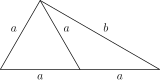
Consideremos los cuatro segmentos de longitud como aristas de un grafo sobre los cuatro puntos. Si no contuvieran un triángulo, formarían un ciclo de vértices. El segmento de longitud sería entonces una de sus diagonales. Cada uno de los otros dos puntos daría un camino de dos aristas, de longitud total , entre los extremos de la diagonal. La igualdad en la desigualdad triangular obligaría a que ambos puntos intermedios fueran el punto medio de esa diagonal, lo que contradice que los cuatro puntos sean distintos. Por tanto, tres puntos forman un triángulo equilátero de lado llamémoslos
El cuarto punto está a distancia de uno de ellos, digamos y a distancia de otro, digamos Como los puntos son colineales y es el punto medio de Así, es un diámetro del círculo que pasa por y tiene centro en por lo que es rectángulo.
Así, , de modo que .
Por lo tanto, A es la respuesta correcta.
Regard the four length- segments as edges of a graph on the four points. If they contained no triangle, they would form a -cycle. The length- segment would then be one of its diagonals. Each of the other two points gives a two-edge path of total length between the diagonal’s endpoints. Equality in the triangle inequality would force both intermediate points to be the midpoint of that diagonal, contradicting that the four points are distinct. Therefore three points do form an equilateral triangle of side call them
The fourth point is distance from one of these points, say and distance from another, say Because the points are collinear and is the midpoint of Thus is a diameter of the circle through centered at so is right.
Thus , so .
Thus, A is the correct answer.
22.
Sea una lista de los primeros enteros positivos tal que, para cada , o , o ambos, aparece antes que en la lista. ¿Cuántas listas de este tipo hay?
Let be a list of the first positive integers such that for each either or or both appear somewhere before in the list. How many such lists are there?
Respuesta: B
Pista pequeña:
Al retroceder en cada paso, elimina el menor o el mayor de los números restantes.
At each reverse step, remove either the smallest or largest remaining number
Pista grande:
Hay opciones hasta que el número final queda forzado.
There are choices until the final number is forced
Solución:
Cada prefijo debe formar un intervalo de enteros consecutivos: cada término nuevo debe ser uno más o uno menos que algún término ya presente. En particular, el conjunto completo es el intervalo
Leamos la lista al revés. En cada paso, el término eliminado debe ser el menor o el mayor entero del intervalo actual; eliminar un término interior dejaría ese término sin un predecesor adyacente en la lista original. Recíprocamente, toda sucesión de eliminaciones de extremos produce una lista válida. Hay dos opciones para cada uno de y después queda determinado. Por lo tanto, hay listas.
Así, la respuesta correcta es B.
Every prefix must form an interval of consecutive integers: each new term is required to be one more or one less than a term already present. In particular, the full set is the interval
Read the list backward. At each step, the term removed must be either the smallest or the largest integer in the current interval; removing an interior term would leave that term with no adjacent predecessor in the forward list. Conversely, every sequence of endpoint removals produces a valid list. There are two choices for each of after which is forced. Hence there are lists.
Thus, the correct answer is B .
23.
A un cubo unitario sólido de madera se le corta un tetraedro sólido mediante un plano que pasa por dos vértices no adyacentes de una cara y por un vértice de la cara opuesta que no es adyacente a ninguno de los dos primeros. El tetraedro se descarta y la porción restante del cubo se coloca sobre una mesa con la superficie del corte hacia abajo. ¿Cuál es la altura de este objeto?
A solid tetrahedron is sliced off a solid wooden unit cube by a plane passing through two nonadjacent vertices on one face and one vertex on the opposite face not adjacent to either of the first two vertices. The tetrahedron is discarded and the remaining portion of the cube is placed on a table with the cut surface face down. What is the height of this object?
Respuesta: D
Pista pequeña:
Calcula la altura del tetraedro descartado de otra manera.
Compute the discarded tetrahedron height another way
Pista grande:
Usa la fórmula del volumen con la cara triangular equilátera del corte como base.
Use its volume with the equilateral triangular cut face as the base
Solución:
El tetraedro descartado tiene como una base un triángulo rectángulo isósceles de cateto y altura , así que su volumen es .
La cara del corte es un triángulo equilátero de lado , así que su área es . Si es la altura desde el vértice opuesto hasta esta cara, entonces , de donde .
La diagonal completa del cubo tiene longitud . Después de quitar el tetraedro y colocar la cara del corte hacia abajo, la altura es .
Por lo tanto, D es la respuesta correcta.
The discarded tetrahedron has a right isosceles triangle of leg as one base and height , so its volume is .
The cut face is an equilateral triangle of side , so its area is . If is the height from the opposite vertex to this cut face, then , so .
The full cube diagonal has length . After the tetrahedron is removed and the cut face is placed down, the height is .
Thus, D is the correct answer.
24.
Amy, Beth y Jo escuchan cuatro canciones diferentes y comentan cuáles les gustan. Ninguna canción les gusta a las tres. Además, para cada uno de los tres pares de chicas, hay al menos una canción que les gusta a esas dos pero no a la tercera. ¿De cuántas maneras diferentes es esto posible?
Amy, Beth, and Jo listen to four different songs and discuss which ones they like. No song is liked by all three. Furthermore, for each of the three pairs of the girls, there is at least one song liked by those two girls but disliked by the third. In how many different ways is this possible?
Respuesta: B
Pista pequeña:
Clasifica según si algún par de chicas comparte dos canciones.
Case on whether one pair of girls shares two songs
Pista grande:
Si cada par comparte exactamente una canción, la cuarta canción puede gustarle a una chica o a ninguna.
The fourth song in the first case can be liked by one girl or by none
Solución:
Hay dos casos: cada par comparte exactamente una canción que les gusta, o algún par comparte canciones que les gustan. Esto se debe a que cada par debe compartir al menos canción, y cualquier coincidencia adicional a las de estos casos requeriría canciones.
Caso Cada par tiene exactamente una canción que les gusta en común
Hay formas de elegir la canción que le gusta a un par, formas de elegir la del segundo par y formas de elegir la del tercer par si fijamos algún orden para ellos. Luego, para la última canción, a uno de ellos podría gustarle, lo que da casos, o a ninguno le gusta, que es otro caso. Así, el número de soluciones en este caso es
Caso Algún par tiene canciones que les gustan en común
Hay formas de elegir el par que comparte canciones que les gustan. Luego hay formas de elegir cuáles dos canciones les gustan. Finalmente, hay formas de asignar las dos canciones restantes a los otros dos pares. Así, el número de soluciones en este caso es
Entonces el total es
Por lo tanto, la respuesta correcta es B.
There are two cases: Each pair has exactly one liked song in common, or some pair has liked songs in common. This is because each pair must have at least liked song in common, and any more pairs than in the cases would result in songs.
Case Each pair has exactly one liked song in common
There are ways to choose the song that one pair likes, ways to choose the song that the second pair likes, and ways to choose the song the third pair likes if we choose some order for them. Then, for the last song, one of them could like it which has cases or none of them likes it which is another case. Thus, the number of solutions in this case is
Case Some pair has liked songs in common
There are ways to choose the pair that has liked songs in common. Then, there are ways to choose which two songs they like. Finally, there are ways to assign the two remaining songs to the other two pairs. Thus, the number of solutions in this case is
The total amount is then
Thus, the correct answer is B .
25.
Un insecto viaja de a a lo largo de los segmentos de la retícula hexagonal que se muestra abajo. Los segmentos marcados con una flecha solo pueden recorrerse en la dirección de la flecha, y el insecto nunca recorre el mismo segmento más de una vez. ¿Cuántos caminos diferentes hay?
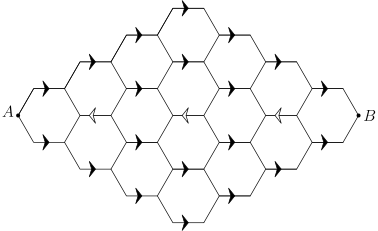
A bug travels from to along the segments in the hexagonal lattice pictured below. The segments marked with an arrow can be traveled only in the direction of the arrow, and the bug never travels the same segment more than once. How many different paths are there?
Respuesta: E
Pista pequeña:
Clasifica los caminos según qué flechas hacia atrás usan.
Classify paths by which backward arrows they use
Pista grande:
Sin flechas hacia atrás, el número de opciones por columna es .
The no-backward-arrow case has choices by column
Solución:
Clasifica un camino según el conjunto de flechas hacia atrás que usa. Si , el camino queda determinado al elegir una flecha hacia adelante en cada columna, lo que da caminos.
Si usa solo la flecha hacia atrás izquierda, hay caminos, y por simetría lo mismo si usa solo la derecha. Si usa ambas flechas exteriores hacia atrás pero no la del medio, hay caminos.
Si usa solo la flecha hacia atrás del medio, hay caminos. Si usa la flecha del medio y exactamente una flecha exterior hacia atrás, hay caminos por cada elección de flecha exterior. Si usa las tres flechas hacia atrás, hay caminos.
El total es .
Por lo tanto, E es la respuesta correcta.
Classify a path by the set of backward arrows it uses. If , the path is determined by choosing one forward arrow in each column, giving paths.
If uses only the left backward arrow, there are paths, and by symmetry the same for only the right backward arrow. If it uses both outer backward arrows but not the middle one, there are paths.
If uses only the middle backward arrow, there are paths. If it uses the middle arrow and exactly one outer backward arrow, there are paths for each choice of outer arrow. If it uses all three backward arrows, there are paths.
The total is .
Thus, E is the correct answer.