2012 AIME I Problema 7

A continuación está la solución preparada profesionalmente para el Problema 7 del 2012 AIME I, de LIVE by Po-Shen Loh. También puedes intentar el examen cronometrado completo, ver todas las soluciones del 2012 AIME I, o revisar la clave de respuestas.

Todos los problemas se usan con el permiso legal oficial de la Mathematical Association of America (MAA).

Conceptos:sistema de ecuacionessimetría

Nivel de dificultad: 2600

7.

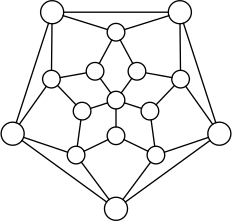
En cada uno de los dieciséis círculos de la red de abajo hay un estudiante. Un total de 33603360 monedas se reparten entre los dieciséis estudiantes. Todos a la vez, todos los estudiantes regalan todas sus monedas repartiendo un número igual de monedas a cada uno de sus vecinos en la red. Después del intercambio, todos los estudiantes tienen el mismo número de monedas con el que empezaron. Halla el número de monedas que tenía originalmente el estudiante situado en el círculo central.

At each of the sixteen circles in the network below stands a student. A total of 33603360 coins are distributed among the sixteen students. All at once, all students give away all their coins by passing an equal number of coins to each of their neighbors in the network. After the trade, all students have the same number of coins as they started with. Find the number of coins the student standing at the center circle had originally.

Solución:

Agrupa los dieciséis círculos en anillos: el centro, el anillo interno de cinco, el anillo intermedio de cinco y el anillo externo de cinco, que contienen en total p,p, q,q, r,r, y ss monedas, respectivamente. El centro tiene 55 vecinos (el anillo interno); cada estudiante interno tiene 33 (el centro y dos estudiantes intermedios); cada estudiante intermedio tiene 44 (dos internos y dos externos); cada estudiante externo tiene 44 (dos intermedios y dos externos). Un estudiante con kk vecinos envía 1k\frac{1}{k} de sus monedas a cada vecino.

Sumando los intercambios en cada anillo (por ejemplo, el anillo externo recibe un cuarto de las monedas de cada estudiante intermedio dos veces, lo que totaliza r2\frac{r}{2}) se obtiene p=q3,q=p+r2,r=2q3+s2,s=r2+s2. \begin{aligned} p &= \frac{q}{3}, \\ q &= p + \frac{r}{2}, \\ r &= \frac{2q}{3} + \frac{s}{2}, \\ s &= \frac{r}{2} + \frac{s}{2}. \end{aligned}

La primera ecuación da q=3p,q = 3p, la segunda da entonces r=2(qp)=4p,r = 2(q - p) = 4p, y la última da s=r=4p.s = r = 4p. El total es p+3p+4p+4p=12p=3360,p + 3p + 4p + 4p = 12p = 3360, así que el estudiante del centro tenía p=280p = 280 monedas.

Group the sixteen circles into rings: the center, the inner ring of five, the middle ring of five, and the outer ring of five, holding p,p, q,q, r,r, and ss coins in total, respectively. The center has 55 neighbors (the inner ring); each inner student has 33 (the center and two middle students); each middle student has 44 (two inner and two outer); each outer student has 44 (two middle and two outer). A student with kk neighbors sends 1k\frac{1}{k} of their coins to each neighbor.

Summing the trades over each ring (for example, the outer ring receives a quarter of each middle student's coins twice over, which totals r2\frac{r}{2}) gives p=q3,q=p+r2,r=2q3+s2,s=r2+s2. \begin{aligned} p &= \frac{q}{3}, \\ q &= p + \frac{r}{2}, \\ r &= \frac{2q}{3} + \frac{s}{2}, \\ s &= \frac{r}{2} + \frac{s}{2}. \end{aligned}

The first equation gives q=3p,q = 3p, the second then gives r=2(qp)=4p,r = 2(q - p) = 4p, and the last gives s=r=4p.s = r = 4p. The total is p+3p+4p+4p=12p=3360,p + 3p + 4p + 4p = 12p = 3360, so the center student had p=280p = 280 coins.

← Problema 6#6Examen completoProblema 8#8 →

El Problema 7 en otros años