2006 AIME I Problema 7

A continuación está la solución preparada profesionalmente para el Problema 7 del 2006 AIME I, de LIVE by Po-Shen Loh. También puedes intentar el examen cronometrado completo, ver todas las soluciones del 2006 AIME I, o revisar la clave de respuestas.

Todos los problemas se usan con el permiso legal oficial de la Mathematical Association of America (MAA).

Conceptos:semejanzarazón de áreasdiferencia de cuadrados

Nivel de dificultad: 2500

7.

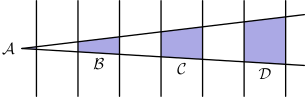
Se dibuja un ángulo sobre un conjunto de rectas paralelas igualmente espaciadas, como se muestra. La razón entre el área de la región sombreada C\mathcal{C} y el área de la región sombreada B\mathcal{B} es 115.\frac{11}{5}. Halla la razón entre el área de la región sombreada D\mathcal{D} y el área de la región sombreada A.\mathcal{A}.

An angle is drawn on a set of equally spaced parallel lines as shown. The ratio of the area of shaded region C\mathcal{C} to the area of shaded region B\mathcal{B} is 115.\frac{11}{5}. Find the ratio of the area of shaded region D\mathcal{D} to the area of shaded region A.\mathcal{A}.

Solución:

Toma el espaciado entre rectas consecutivas como la unidad, y sea xx la distancia del vértice del ángulo a la primera recta. El triángulo recortado por la jj-ésima recta es semejante al triángulo A\mathcal{A} con razón x+j1x,\frac{x + j - 1}{x}, así que su área es proporcional a (x+j1)2,(x + j - 1)^2, y la franja entre las rectas jj y j+1j + 1 tiene área proporcional a (x+j)2(x + j)^2 (x+j1)2=2x+2j1.- (x + j - 1)^2 = 2x + 2j - 1.

Las regiones B,\mathcal{B}, C,\mathcal{C}, y D\mathcal{D} son las franjas que comienzan en las rectas 2,2, 4,4, y 6,6, con áreas proporcionales a 2x+3,2x + 3, 2x+7,2x + 7, y 2x+11.2x + 11. La razón dada produce 2x+72x+3=115,\frac{2x+7}{2x+3} = \frac{11}{5}, así que 10x+35=22x+3310x + 35 = 22x + 33 y x=16.x = \frac{1}{6}.

Como A\mathcal{A} tiene área proporcional a x2,x^2, la razón pedida es 2x+11x2=34/31/36=408.\frac{2x + 11}{x^2} = \frac{34/3}{1/36} = 408.

Take the spacing between consecutive lines as the unit, and let xx be the distance from the vertex of the angle to the first line. The triangle cut off by the jjth line is similar to triangle A\mathcal{A} with ratio x+j1x,\frac{x + j - 1}{x}, so its area is proportional to (x+j1)2,(x + j - 1)^2, and the strip between lines jj and j+1j + 1 has area proportional to (x+j)2(x + j)^2 (x+j1)2=2x+2j1.- (x + j - 1)^2 = 2x + 2j - 1.

Regions B,\mathcal{B}, C,\mathcal{C}, and D\mathcal{D} are the strips beginning at lines 2,2, 4,4, and 6,6, with areas proportional to 2x+3,2x + 3, 2x+7,2x + 7, and 2x+11.2x + 11. The given ratio yields 2x+72x+3=115,\frac{2x+7}{2x+3} = \frac{11}{5}, so 10x+35=22x+3310x + 35 = 22x + 33 and x=16.x = \frac{1}{6}.

Since A\mathcal{A} has area proportional to x2,x^2, the requested ratio is 2x+11x2=34/31/36=408.\frac{2x + 11}{x^2} = \frac{34/3}{1/36} = 408.

← Problema 6#6Examen completoProblema 8#8 →

El Problema 7 en otros años