
Soluciones del 2006 AIME I
Desplázate hacia abajo para ver las soluciones preparadas profesionalmente de LIVE by Po-Shen Loh, imprime las soluciones en PDF, consulta la clave de respuestas, o haz el examen cronometrado completo.
Todos los problemas se usan con el permiso legal oficial de la Mathematical Association of America (MAA).
1.
En el cuadrilátero es un ángulo recto, la diagonal es perpendicular a y Halla el perímetro de
In quadrilateral is a right angle, diagonal is perpendicular to and Find the perimeter of
Pista pequeña:
La diagonal divide el cuadrilátero en dos triángulos rectángulos que comparten
Diagonal splits the quadrilateral into two right triangles that share
Pista grande:
Aplica el teorema de Pitágoras dos veces:
Apply the Pythagorean theorem twice:
Solución:
El triángulo tiene un ángulo recto en así que El triángulo tiene un ángulo recto en así que de donde
El perímetro es
Triangle is right-angled at so Triangle is right-angled at so giving
The perimeter is
2.
Sea un subconjunto de elementos de y sea la suma de los elementos de Halla el número de valores posibles de
Let set be a -element subset of and let be the sum of the elements of Find the number of possible values of
Pista pequeña:
Halla la menor y la mayor suma posibles, luego muestra que todo valor entre ellas se alcanza
Find the smallest and largest possible sums, then show every value between them occurs
Pista grande:
Si la suma no es máxima, algún elemento de cumple reemplazar por aumenta la suma exactamente en
If the sum is not maximal, some element of has replacing by raises the sum by exactly
Solución:
La menor suma posible es y la mayor es
Todo entero intermedio también se alcanza. Supón que tiene suma y sea el menor elemento de con Si fuera entonces sería un bloque de enteros consecutivos que termina en es decir cuya suma supera Por tanto y reemplazar por produce un subconjunto de elementos con suma
Por lo tanto toma todos los valores desde hasta lo que da valores posibles.
The smallest possible sum is and the largest is
Every integer in between also occurs. Suppose has sum and let be the smallest element of with If were then would be a block of consecutive integers ending at namely whose sum exceeds So and replacing by produces a -element subset with sum
Hence takes every value from to for possible values.
3.
Halla el menor entero positivo tal que, al borrar su dígito más a la izquierda, el entero resultante sea del entero original.
Find the least positive integer such that when its leftmost digit is deleted, the resulting integer is of the original integer.
Pista pequeña:
Si el dígito más a la izquierda ocupa la posición y queda tras borrarlo, entonces
If the leftmost digit sits in the place and remains after deleting it, then
Pista grande:
obliga a que sea divisible por así que y
forces to be divisible by so and
Solución:
Sea el dígito más a la izquierda y el entero que queda tras borrarlo, de modo que el entero original es para algún entero positivo La condición dice que así que
Como es divisible por pero no lo es, el dígito debe ser múltiplo de así que Entonces lo que da que requiere El caso más pequeño es
El menor entero de este tipo es y en efecto
Let be the leftmost digit and the integer that remains after deleting it, so the original integer is for some positive integer The condition says so
Since is divisible by but is not, the digit must be a multiple of so Then giving which requires The smallest case is
The least such integer is and indeed
4.
Sea el número de dígitos consecutivos al final de la representación decimal del producto Halla el residuo cuando se divide entre
Let be the number of consecutive ’s at the right end of the decimal representation of the product Find the remainder when is divided by
Pista pequeña:
Cuenta los factores de el entero aparece como factor en exactamente de los factoriales
Count factors of the integer appears as a factor in exactly of the factorials
Pista grande:
Suma sobre todos los múltiplos de luego añade la misma suma sobre los múltiplos de por su segundo factor de
Sum over all multiples of then add the same sum over multiples of for their second factor of
Solución:
Los factores de abundan, así que es el exponente de en el producto. Cada entero con aparece como factor en exactamente de los factoriales, a saber
Cada múltiplo de aporta un factor de por cada aparición, y cada múltiplo de aporta uno más. Sobre las apariciones suman y sobre suman
Por lo tanto y el residuo al dividir entre es
Factors of are plentiful, so is the exponent of in the product. Each integer with appears as a factor in exactly of the factorials, namely
Every multiple of contributes one factor of per appearance, and every multiple of contributes one more. Over the appearances total and over they total
Hence and the remainder upon division by is
5.
El número puede escribirse como donde y son enteros positivos. Halla
The number can be written as where and are positive integers. Find
Pista pequeña:
Eleva al cuadrado e iguala los coeficientes de y
Square and match the coefficients of and
Pista grande:
así que nunca necesitas por separado
so you never need individually
Solución:
Elevar al cuadrado da Igualar coeficientes produce es decir junto con
Entonces así que Como comprobación, y como se requería.
Por lo tanto
Squaring gives Matching coefficients yields that is along with
Then so As a check, and as required.
Therefore
6.
Sea el conjunto de números reales que pueden representarse como decimales periódicos de la forma donde son dígitos distintos. Halla la suma de los elementos de
Let be the set of real numbers that can be represented as repeating decimals of the form where are distinct digits. Find the sum of the elements of
Pista pequeña:
y hay elementos que sumar
and there are elements to add
Pista grande:
Por simetría, cada dígito de a aparece exactamente veces en cada una de las tres posiciones
By symmetry each digit through appears exactly times in each of the three positions
Solución:
Cada elemento es igual a y hay ternas ordenadas de dígitos distintos. Por simetría, cada dígito de a aparece en cada una de las tres posiciones exactamente veces.
Por lo tanto los numeradores suman así que la suma de los elementos es
Each element equals and there are ordered triples of distinct digits. By symmetry, each digit through appears in each of the three positions exactly times.
The numerators therefore total so the sum of the elements is
7.
Se dibuja un ángulo sobre un conjunto de rectas paralelas igualmente espaciadas, como se muestra. La razón entre el área de la región sombreada y el área de la región sombreada es Halla la razón entre el área de la región sombreada y el área de la región sombreada
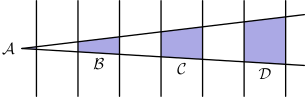
An angle is drawn on a set of equally spaced parallel lines as shown. The ratio of the area of shaded region to the area of shaded region is Find the ratio of the area of shaded region to the area of shaded region
Pista pequeña:
Con espaciado unitario, cada región es una diferencia de triángulos semejantes, así que las áreas escalan como los cuadrados de las distancias al vértice
With unit spacing, every region is a difference of similar triangles, so areas scale as squares of distances from the vertex
Pista grande:
Si es la distancia del vértice a la primera recta, entonces determina
If is the vertex’s distance to the first line, then determines
Solución:
Toma el espaciado entre rectas consecutivas como la unidad, y sea la distancia del vértice del ángulo a la primera recta. El triángulo recortado por la -ésima recta es semejante al triángulo con razón así que su área es proporcional a y la franja entre las rectas y tiene área proporcional a
Las regiones y son las franjas que comienzan en las rectas y con áreas proporcionales a y La razón dada produce así que y
Como tiene área proporcional a la razón pedida es
Take the spacing between consecutive lines as the unit, and let be the distance from the vertex of the angle to the first line. The triangle cut off by the th line is similar to triangle with ratio so its area is proportional to and the strip between lines and has area proportional to
Regions and are the strips beginning at lines and with areas proportional to and The given ratio yields so and
Since has area proportional to the requested ratio is
8.
El hexágono está dividido en cinco rombos, y como se muestra. Los rombos y son congruentes, y cada uno tiene área Sea el área del rombo Dado que es un entero positivo, halla el número de valores posibles de
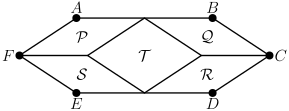
Hexagon is divided into five rhombuses, and as shown. Rhombuses and are congruent, and each has area Let be the area of rhombus Given that is a positive integer, find the number of possible values for
Pista pequeña:
Los cinco rombos comparten la misma longitud de lado, y los tres ángulos que se encuentran a lo largo de suman
All five rhombuses share the same side length, and the three angles meeting along add to
Pista grande:
Si cada rombo congruente tiene área entonces halla a qué enteros positivos puede ser igual
If each congruent rhombus has area then find which positive integers this can equal
Solución:
Como comparte un lado con cada uno de los otros rombos, los cinco tienen la misma longitud de lado Sea el vértice de sobre y sea el ángulo de en Entonces cada rombo congruente tiene área Los ángulos de y en están sobre la recta y por simetría el ángulo de allí también es igual a así que el ángulo de es Por lo tanto
Cuando recorre el valor toma todos los valores en así que toma todos los valores en Como los valores enteros positivos posibles son hay de ellos.
Since shares a side with each of the other rhombuses, all five have the same side length Let be the vertex of on and let be the angle of at Then each congruent rhombus has area The angles of and at lie along the line and by symmetry ’s angle there also equals so ’s angle is Hence
As ranges over the value takes every value in so takes every value in Since the possible positive integer values are there are of them.
9.
La sucesión es geométrica con y razón común donde y son enteros positivos. Dado que halla el número de pares ordenados posibles
The sequence is geometric with and common ratio where and are positive integers. Given that find the number of possible ordered pairs
Pista pequeña:
Combina los logaritmos: el producto de los doce términos es que debe ser igual a
Combine the logs: the product of the twelve terms is which must equal
Pista grande:
Escribe y cuenta las soluciones no negativas de la paridad obliga a que sea impar
Write and count nonnegative solutions of parity forces odd
Solución:
La suma de los logaritmos es así que lo que da
Así, y son potencias de escribe y con enteros y Como es par y es impar, debe ser impar, digamos con Entonces exactamente cuando
Cada da un par, así que hay pares ordenados
The sum of the logarithms is so which gives
Thus and are powers of write and with integers and Since is even and is odd, must be odd, say for Then exactly when
Each gives one pair, so there are ordered pairs
10.
Ocho círculos de diámetro están empaquetados en el primer cuadrante del plano coordenado, como se muestra. Sea la unión de las ocho regiones circulares. La recta de pendiente divide en dos regiones de igual área. La ecuación de la recta puede expresarse en la forma donde y son enteros positivos cuyo máximo común divisor es Halla
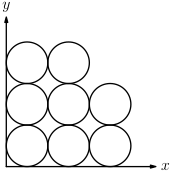
Eight circles of diameter are packed in the first quadrant of the coordinate plane as shown. Let region be the union of the eight circular regions. Line with slope divides into two regions of equal area. Line ’s equation can be expressed in the form where and are positive integers whose greatest common divisor is Find
Pista pequeña:
Cualquier recta que pase por el punto donde dos círculos congruentes se tocan divide el área de ese par en partes iguales
Any line through the point where two congruent circles touch splits that pair’s area evenly
Pista grande:
La recta que pasa por y tiene pendiente y deja dos círculos completos a cada lado
The line through and has slope and leaves two whole circles on each side
Solución:
Los círculos tienen radio y centros en y El par de círculos tangentes en es simétrico respecto de así que cualquier recta que pase por biseca el área de ese par; de forma similar para el par tangente en La recta tiene pendiente
La recta no toca los cuatro círculos restantes, y exactamente dos de ellos quedan a cada lado, así que divide en dos regiones de igual área. Al trasladar paralelamente una recta de pendiente , el área pasa estrictamente de un lado al otro, por lo que debe ser esta recta.
Su ecuación es es decir, Como la respuesta es
The circles have radius and centers at and The pair of circles tangent at is symmetric about so any line through bisects that pair’s area; similarly for the pair tangent at The line has slope
Line misses the remaining four circles entirely, and exactly two of them lie on each side of it, so it divides into two regions of equal area. Sliding a slope- line strictly shifts area from one side to the other, so must be this line.
Its equation is that is, With the answer is
11.
Una colección de cubos consta de un cubo de arista para cada entero Se va a construir una torre usando los cubos según las reglas:
• Cualquier cubo puede ser el cubo de la base de la torre.
• El cubo que se coloca inmediatamente encima de un cubo de arista debe tener arista a lo sumo
Sea el número de torres diferentes que se pueden construir. ¿Cuál es el residuo cuando se divide entre ?
A collection of cubes consists of one cube with edge-length for each integer A tower is to be built using all cubes according to the rules:
• Any cube may be the bottom cube in the tower.
• The cube immediately on top of a cube with edge-length must have edge-length at most
Let be the number of different towers that can be constructed. What is the remainder when is divided by
Pista pequeña:
Construye torres de los cubos insertando el cubo más grande en una torre legal de los más pequeños
Build towers of the cubes by inserting the largest cube into a legal tower of the smaller ones
Pista grande:
Para el cubo puede ir en la base, sobre el cubo o sobre el cubo y el conteo se triplica en cada paso
For cube can go on the bottom, on cube or on cube — the count triples at each step
Solución:
Sea el número de torres legales que usan los cubos de aristas Dada una torre legal de cubos, el cubo puede insertarse en exactamente tres lugares: en la base, inmediatamente encima del cubo o inmediatamente encima del cubo (en cualquier otro lugar quedaría apoyado sobre un cubo de arista a lo sumo violando la regla). Cada inserción sigue siendo legal, porque el cubo que termina encima del cubo tiene arista a lo sumo Recíprocamente, borrar el cubo de una torre legal de cubos deja una torre legal: el cubo que estaba encima de él, de arista a lo sumo cae sobre un cubo de arista al menos
Por lo tanto para Como (cualquiera de los dos cubos puede quedar arriba), obtenemos y el residuo es
Let be the number of legal towers using the cubes of edge-lengths Given a legal tower of cubes, cube can be inserted in exactly three places: at the bottom, immediately on top of cube or immediately on top of cube (anywhere else it would rest on a cube of edge-length at most violating the rule). Each insertion stays legal, because the cube that ends up on top of cube has edge-length at most Conversely, deleting cube from a legal tower of cubes leaves a legal tower: the cube that was above it, of edge-length at most lands on a cube of edge-length at least
Hence for Since (either of the two cubes may be on top), we get and the remainder is
12.
Halla la suma de los valores de tales que donde se mide en grados y
Find the sum of the values of such that where is measured in degrees and
Pista pequeña:
Producto a suma: así que la ecuación queda
Product-to-sum: so the equation reads
Pista grande:
así que uno de debe anularse
so one of must vanish
Solución:
Por la identidad de producto a suma, así que el lado derecho es Tomando y la ecuación se convierte en y como se cumple exactamente cuando o
Para en grados: da da da y no da soluciones en el intervalo.
La suma es
By the product-to-sum identity, so the right side is Setting and the equation becomes and since it holds exactly when or
For in degrees: gives gives gives and gives no solutions in the interval.
The sum is
13.
Para cada entero positivo par sea la mayor potencia de que divide a Por ejemplo, y Para cada entero positivo sea Halla el mayor entero menor que tal que sea un cuadrado perfecto.
For each even positive integer let denote the greatest power of that divides For example, and For each positive integer let Find the greatest integer less than such that is a perfect square.
Pista pequeña:
suma sobre exactamente de estos números tienen
sums over exactly of these numbers have
Pista grande:
así que debe ser impar y debe ser un cuadrado perfecto
so must be odd and must be a perfect square
Solución:
es la suma de sobre los números pares Entre estos números, exactamente son divisibles por pero no por (así que tienen ) para cada y el único número tiene Por lo tanto
Si es par, entonces es impar y el exponente es impar, así que tiene un número impar de factores de y no puede ser un cuadrado perfecto. Si es impar, entonces ya es un cuadrado perfecto, así que es un cuadrado perfecto exactamente cuando lo es.
Para impar, el número es par, y el mayor cuadrado perfecto par que no supera es Así, el mayor válido es
is the sum of over the even numbers Among these numbers, exactly are divisible by but not (so have ) for each and the single number has Hence
If is even, then is odd and the exponent is odd, so has an odd number of factors of and cannot be a perfect square. If is odd, then is already a perfect square, so is a perfect square exactly when is.
For odd the number is even, and the greatest even perfect square at most is Thus the greatest valid is
14.
Un trípode tiene tres patas, cada una de longitud pies. Cuando el trípode se arma, el ángulo entre cualquier par de patas es igual al ángulo entre cualquier otro par, y la parte superior del trípode está a pies del suelo. Al armar el trípode, el tramo inferior de pie de una pata se rompe y se desprende. Sea la altura en pies de la parte superior del trípode respecto del suelo cuando el trípode roto se arma. Entonces puede escribirse en la forma donde y son enteros positivos y no es divisible por el cuadrado de ningún primo. Halla (La notación denota el mayor entero que es menor o igual que )
A tripod has three legs each of length feet. When the tripod is set up, the angle between any pair of legs is equal to the angle between any other pair, and the top of the tripod is feet from the ground. In setting up the tripod, the lower foot of one leg breaks off. Let be the height in feet of the top of the tripod from the ground when the broken tripod is set up. Then can be written in the form where and are positive integers and is not divisible by the square of any prime. Find (The notation denotes the greatest integer that is less than or equal to )
Pista pequeña:
Fija coordenadas: la parte superior en y los pies a del origen; la pata rota termina ahora a del camino desde la parte superior hasta el pie antiguo
Set coordinates: top at and feet from the origin; the broken leg now ends of the way from top to old foot
Pista grande:
Por simetría, es una distancia en el plano : desde hasta la recta que pasa por el extremo roto y el punto medio de los otros dos pies
By symmetry is a 2D distance in the -plane: from to the line through the broken tip and the midpoint of the other two feet
Solución:
Coloca la parte superior en Cada pata tiene longitud así que cada pie está a del origen: La pata rota tiene longitud así que su extremo es y el trípode ahora se apoya sobre el plano con igual a la distancia de a ese plano.
El plano contiene que es paralelo al eje y pasa por el punto medio así que su distancia a puede medirse en el plano : es la distancia desde hasta la recta que pasa por y cuya ecuación es Por lo tanto
Aquí y no tiene factores cuadrados. Como obtenemos
Place the top at Each leg has length so each foot is from the origin: The broken leg has length so its tip is and the tripod now stands on the plane with equal to the distance from to that plane.
The plane contains which is parallel to the -axis and passes through the midpoint so its distance from can be measured in the -plane: it is the distance from to the line through and whose equation is Therefore
Here and is squarefree. Since we get
15.
Dado que una sucesión satisface y para todos los enteros halla el mínimo valor posible de
Given that a sequence satisfies and for all integers find the minimum possible value of
Pista pequeña:
Eleva al cuadrado la recurrencia: La suma respecto de se telescopa y produce una fórmula para
Square the recurrence: Summing over telescopes into a formula for
Pista grande:
Cada es múltiplo de con la paridad de así que elige con cuadrado lo más cercano posible a
Each is a multiple of with the parity of so choose with square as close as possible to
Solución:
Elevar al cuadrado la recurrencia da Sumar para hasta se telescopa: así que con
La inducción muestra que cada es múltiplo de cuya paridad coincide con la de así que es un múltiplo impar de Para minimizar toma el múltiplo impar de cuyo cuadrado sea el más cercano a es decir con lo que da (los vecinos y dan y ).
Este valor se alcanza: toma para y a partir de ahí alterna para par y para impar; entonces y la suma es Así que el mínimo es
Squaring the recurrence gives Summing for to telescopes: so with
Induction shows each is a multiple of whose parity matches that of so is an odd multiple of To minimize take the odd multiple of whose square is nearest that is with giving (the neighbors and give and ).
This value is attained: take for and thereafter alternate for even and for odd then and the sum is So the minimum is