
Soluciones del 2012 AIME I
Desplázate hacia abajo para ver las soluciones preparadas profesionalmente de LIVE by Po-Shen Loh, imprime las soluciones en PDF, consulta la clave de respuestas, o haz el examen cronometrado completo.
Todos los problemas se usan con el permiso legal oficial de la Mathematical Association of America (MAA).
1.
Halla el número de enteros positivos de tres dígitos, no necesariamente distintos, con y , tales que tanto como sean múltiplos de
Find the number of positive integers with three not necessarily distinct digits, with and such that both and are multiples of
Pista pequeña:
La divisibilidad entre depende solo de los dos últimos dígitos, así que debe dividir tanto a como a
Divisibility by depends only on the last two digits, so must divide both and
Pista grande:
Al restar se obtiene que es divisible por con y pares, así que ambos están en o ambos en luego determina la paridad de
Subtracting shows is divisible by with and even, so both lie in or both in then forces the parity of
Solución:
Un entero es múltiplo de exactamente cuando sus dos últimos dígitos forman un múltiplo de así que necesitamos que y sean divisibles por En particular, y son pares, y al restar las dos condiciones se obtiene que es divisible por Los dígitos pares no nulos se dividen según su residuo módulo en y así que y deben provenir del mismo conjunto: pares ordenados de cada uno.
Si entonces exige que sea impar ( opciones), y la condición sobre se cumple automáticamente ya que Si entonces debe ser par ( opciones).
El total es
An integer is a multiple of exactly when its last two digits form a multiple of so we need and to be divisible by In particular and are even, and subtracting the two conditions shows is divisible by The even nonzero digits split by remainder mod into and so and must both come from the same one of these sets: ordered pairs from each.
If then requires odd ( choices), and the condition on holds automatically since If then must be even ( choices).
The count is
2.
Los términos de una progresión aritmética suman El primer término de la progresión se incrementa en el segundo término se incrementa en el tercer término se incrementa en y, en general, el -ésimo término se incrementa en el -ésimo entero positivo impar. Los términos de la nueva progresión suman Halla la suma del primer término, el último y el término central de la progresión original.
The terms of an arithmetic sequence add to The first term of the sequence is increased by the second term is increased by the third term is increased by and in general, the th term is increased by the th odd positive integer. The terms of the new sequence add to Find the sum of the first, last, and middle terms of the original sequence.
Pista pequeña:
Si la progresión tiene términos, las cantidades añadidas suman
If the sequence has terms, the amounts added total
Pista grande:
En una progresión aritmética el término central es igual al promedio de todos los términos, y el primero y el último suman el doble de ese promedio
In an arithmetic sequence the middle term equals the average of all the terms, and the first and last terms add to twice that average
Solución:
Si la progresión tiene términos, las cantidades añadidas son los primeros números impares, cuya suma es Por lo tanto así que
El promedio de los términos es que coincide con el término central (el sexto) de la progresión aritmética. El primero y el último también promedian así que suman
La suma pedida es
If the sequence has terms, the amounts added are the first odd numbers, whose sum is Thus so
The average of the terms is which equals the middle (sixth) term of the arithmetic sequence. The first and last terms also average to so they add to
The requested sum is
3.
Nueve personas se sientan a cenar y hay tres opciones de comida. Tres personas piden el plato de res, tres piden el plato de pollo y tres piden el plato de pescado. El camarero sirve los nueve platos en orden aleatorio. Halla el número de maneras en que el camarero podría servir los tipos de plato a las nueve personas de modo que exactamente una persona reciba el tipo de plato que pidió.
Nine people sit down for dinner where there are three choices of meals. Three people order the beef meal, three order the chicken meal, and three order the fish meal. The waiter serves the nine meals in random order. Find the number of ways in which the waiter could serve the meal types to the nine people so that exactly one person receives the type of meal ordered by that person.
Pista pequeña:
Elige a la única persona servida correctamente ( maneras), y luego cuenta las formas de servir a las ocho personas restantes sin ninguna coincidencia
Pick the one correctly served person ( ways), then count servings of the remaining eight people with no matches
Pista grande:
Sigue los dos platos sobrantes del tipo de la persona correcta: van a un solo grupo o a ambos, y casi todo lo demás queda entonces forzado
Follow the two leftover meals of the correct person’s type: they go into one other group or into both, and almost everything else is then forced
Solución:
Elige a la única persona servida correctamente ( maneras); por simetría, supongamos que pidió res. Los platos restantes, de res, de pollo y de pescado, deben ir a las otras personas ( que pidieron res, pollo y pescado) sin que nadie coincida. Sigue a dónde van los platos de res sobrantes: a quienes pidieron pollo o pescado.
Si ambos van al mismo grupo, digamos a dos de los tres que pidieron pollo ( maneras contando ambos grupos), entonces el tercer comensal de pollo debe recibir pescado, los tres de pescado deben tomar los tres platos de pollo, y los dos de res toman el pescado restante: todo queda forzado. Si uno va a un comensal de pollo y otro a uno de pescado ( maneras), los otros dos de pollo deben tomar pescado y los otros dos de pescado deben tomar pollo, dejando un plato de pollo y uno de pescado para repartir entre los dos comensales de res ( maneras).
El total es
Choose the one person served correctly ( ways); by symmetry say they ordered beef. The remaining meals — beef, chicken, and fish — must go to the other people ( beef, chicken, and fish orderers) with nobody matched. Track where the leftover beef meals go: to chicken or fish orderers.
If both go to the same group, say to two of the three chicken orderers ( ways counting both groups), then the third chicken orderer must receive fish, the three fish orderers must take the three chicken meals, and the two beef orderers take the remaining fish: everything is forced. If one goes to a chicken orderer and one to a fish orderer ( ways), the other two chicken orderers must take fish and the other two fish orderers must take chicken, leaving one chicken and one fish meal to split between the two beef orderers ( ways).
The total is
4.
Butch y Sundance necesitan salir de Dodge. Para avanzar lo más rápido posible, cada uno alterna caminar y montar su único caballo, Sparky, de la siguiente manera. Butch empieza caminando mientras Sundance monta. Cuando Sundance llega al primero de los postes de amarre, convenientemente ubicados a intervalos de una milla a lo largo de su ruta, ata a Sparky al poste y empieza a caminar. Cuando Butch alcanza a Sparky, monta hasta que rebasa a Sundance, luego deja a Sparky en el siguiente poste de amarre y reanuda la caminata, y continúan de esta manera. Sparky, Butch y Sundance caminan a y millas por hora, respectivamente. La primera vez que Butch y Sundance se encuentran en un hito de milla, están a millas de Dodge, y han estado viajando durante minutos. Halla
Butch and Sundance need to get out of Dodge. To travel as quickly as possible, each alternates walking and riding their only horse, Sparky, as follows. Butch begins by walking while Sundance rides. When Sundance reaches the first of the hitching posts that are conveniently located at one-mile intervals along their route, he ties Sparky to the post and begins walking. When Butch reaches Sparky, he rides until he passes Sundance, then leaves Sparky at the next hitching post and resumes walking, and they continue in this manner. Sparky, Butch, and Sundance walk at and miles per hour, respectively. The first time Butch and Sundance meet at a milepost, they are miles from Dodge, and they have been traveling for minutes. Find
Pista pequeña:
Cada milla de la ruta la recorre montando exactamente uno de los dos hombres, así que si Butch camina de las millas, monta y Sundance monta
Each mile of the route is ridden by exactly one of the two men, so if Butch walks of the miles, he rides and Sundance rides
Pista grande:
Una milla toma minutos caminada por Butch, caminada por Sundance y montada. Igualar sus tiempos de viaje da
A mile takes minutes walked by Butch, walked by Sundance, and ridden. Setting their travel times equal gives
Solución:
Caminar una milla le toma a Sparky minutos, a Butch y a Sundance El caballo avanza por la misma ruta que los hombres y en cada milla lo monta exactamente uno de ellos, así que si Butch camina de las millas y monta las otras entonces Sundance monta esas millas y camina las restantes
Cuando se encuentran en un hito de milla, han estado viajando durante el mismo tiempo, así que lo cual se simplifica a Como los relevos ocurren en los postes, y son enteros, y la menor solución positiva es
Entonces minutos, así que
Walking a mile takes Sparky minutes, Butch and Sundance The horse advances along the same route as the men and is ridden over each mile by exactly one of them, so if Butch walks of the miles and rides the other then Sundance rides those miles and walks the remaining
When they meet at a milepost they have been traveling for the same amount of time, so which simplifies to Since the handoffs happen at mileposts, and are integers, and the smallest positive solution is
Then minutes, so
5.
Sea el conjunto de todos los enteros binarios que pueden escribirse usando exactamente ceros y unos, donde se permiten ceros a la izquierda. Si se realizan todas las restas posibles en las que un elemento de se resta de otro, halla el número de veces que se obtiene el resultado .
Let be the set of all binary integers that can be written using exactly zeros and ones where leading zeros are allowed. If all possible subtractions are performed in which one element of is subtracted from another, find the number of times the answer is obtained.
Pista pequeña:
Cuenta los pares y que están ambos en Sumar convierte un bloque final en
Count pairs and that are both in Adding turns a trailing block into
Pista grande:
El número de unos no cambia solo cuando termina en los otros once dígitos son comunes y contienen siete unos y cuatro ceros
The number of ones is unchanged only when ends in the other eleven digits are shared and contain seven ones and four zeros
Solución:
Debemos contar los pares de elementos de que difieren en digamos y Sumar a un número binario convierte su bloque final (un cero seguido de unos) en cambiando el número de unos en Ambos números tienen exactamente ocho unos precisamente cuando termina en termina en y los dos números coinciden en todo lo demás.
Los primeros once dígitos comunes constan entonces de los siete unos y cuatro ceros restantes, y como se permiten ceros a la izquierda, cada disposición da un par válido: Cada par produce el resultado exactamente una vez, así que el total es
We must count pairs of elements of differing by say and Adding to a binary number turns its trailing block (a zero followed by ones) into changing the number of ones by Both numbers have exactly eight ones precisely when ends in ends in and the two numbers agree everywhere else.
The shared first eleven digits then consist of the remaining seven ones and four zeros, and since leading zeros are allowed, every arrangement gives a valid pair: Each pair produces the answer exactly once, so the count is
6.
Los números complejos y satisfacen y la parte imaginaria de es para enteros positivos primos entre sí y con Halla
The complex numbers and satisfy and the imaginary part of is for relatively prime positive integers and with Find
Pista pequeña:
Sustituir una ecuación en la otra da así que es una raíz -ésima de la unidad
Substituting one equation into the other gives so is a nd root of unity
Pista grande:
Escribe y reduce la fracción del ángulo a su forma más simple
Write and reduce the fraction in the angle to lowest terms
Solución:
Como la parte imaginaria dada es positiva, por lo que Sustituyendo, y por tanto Recíprocamente, cualquier raíz -ésima de la unidad funciona con ya que entonces
Por lo tanto para algún entero y la parte imaginaria de es El seno dado en el problema es positivo, así que podemos tomar Como es primo, la fracción ya está en su forma más simple, coincidiendo con la forma requerida con Así,
Because the specified imaginary part is positive, so Substituting, and hence Conversely, any nd root of unity works with since then
Hence for some integer and the imaginary part of is The sine specified in the problem is positive, so we may take Since is prime, is already in lowest terms, matching the required form with Thus
7.
En cada uno de los dieciséis círculos de la red de abajo hay un estudiante. Un total de monedas se reparten entre los dieciséis estudiantes. Simultáneamente, los estudiantes entregan todas sus monedas, repartiendo la misma cantidad a cada uno de sus vecinos en la red. Después del intercambio, todos los estudiantes tienen el mismo número de monedas con el que empezaron. Halla el número de monedas que tenía originalmente el estudiante situado en el círculo central.
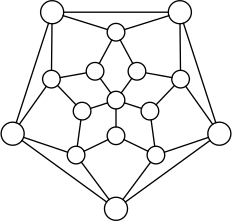
At each of the sixteen circles in the network below stands a student. A total of coins are distributed among the sixteen students. All at once, all students give away all their coins by passing an equal number of coins to each of their neighbors in the network. After the trade, all students have the same number of coins as they started with. Find the number of coins the student standing at the center circle had originally.
Pista pequeña:
Agrupa los círculos en anillos (centro, cinco internos, cinco intermedios, cinco externos) y sigue el número total de monedas en cada anillo
Group the circles into rings (center, inner five, middle five, outer five) and track the total number of coins in each ring
Pista grande:
Un estudiante con vecinos envía a cada vecino de sus monedas, así que los cuatro totales de los anillos satisfacen un pequeño sistema lineal
A student with neighbors sends each neighbor of their coins, so the four ring totals satisfy a small linear system
Solución:
Agrupa los dieciséis círculos en anillos: el centro, el anillo interno de cinco, el anillo intermedio de cinco y el anillo externo de cinco, que contienen en total y monedas, respectivamente. El centro tiene vecinos (el anillo interno); cada estudiante interno tiene (el centro y dos estudiantes intermedios); cada estudiante intermedio tiene (dos internos y dos externos); cada estudiante externo tiene (dos intermedios y dos externos). Un estudiante con vecinos envía de sus monedas a cada vecino.
Sumando los intercambios en cada anillo (por ejemplo, el anillo externo recibe un cuarto de las monedas de cada estudiante intermedio dos veces, lo que totaliza ) se obtiene
La primera ecuación da la segunda da entonces y la última da El total es así que el estudiante del centro tenía monedas.
Group the sixteen circles into rings: the center, the inner ring of five, the middle ring of five, and the outer ring of five, holding and coins in total, respectively. The center has neighbors (the inner ring); each inner student has (the center and two middle students); each middle student has (two inner and two outer); each outer student has (two middle and two outer). A student with neighbors sends of their coins to each neighbor.
Summing the trades over each ring (for example, the outer ring receives a quarter of each middle student’s coins twice over, which totals ) gives
The first equation gives the second then gives and the last gives The total is so the center student had coins.
8.
El cubo etiquetado como se muestra abajo, tiene arista de longitud y es cortado por un plano que pasa por el vértice y los puntos medios y de y respectivamente. El plano divide el cubo en dos sólidos. El volumen del mayor de los dos sólidos puede escribirse en la forma donde y son enteros positivos primos entre sí. Halla
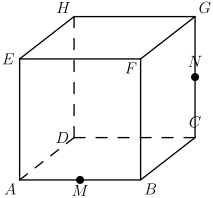
Cube labeled as shown below, has edge length and is cut by a plane passing through vertex and the midpoints and of and respectively. The plane divides the cube into two solids. The volume of the larger of the two solids can be written in the form where and are relatively prime positive integers. Find
Pista pequeña:
Extiende el plano de corte hasta que corte la recta más allá de en como y el punto es el punto medio de
Extend the cutting plane to meet line beyond at since and point is the midpoint of
Pista grande:
La pieza más pequeña es la pirámide menos la pirámide que es semejante a ella con razón
The smaller piece is pyramid minus pyramid which is similar to it with ratio
Solución:
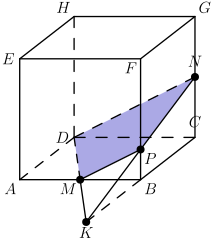
Extiende el plano de corte. En la cara inferior, la recta corta la recta prolongada más allá de en un punto como y el segmento es una paralela media del triángulo así que es el punto medio de y El plano también corta la arista en un punto y la parte del cubo separada más allá del plano es la pirámide con la pequeña pirámide recortada.
La pirámide tiene base un triángulo rectángulo con catetos y y su ápice está a distancia del plano de esa base, así que su volumen es La pirámide es semejante a con razón así que su volumen es
La pieza más pequeña tiene entonces volumen y la pieza más grande tiene volumen lo que da
Extend the cutting plane. In the bottom face, line meets line extended beyond at a point since and segment is a midline of triangle so is the midpoint of and The plane also cuts edge at a point and the piece of the cube cut off past the plane is the pyramid with the small pyramid sliced away.
Pyramid has base a right triangle with legs and and its apex is at distance from the plane of that base, so its volume is Pyramid is similar to with ratio so its volume is
The smaller piece therefore has volume and the larger piece has volume giving
9.
Sean y números reales positivos que satisfacen El valor de puede expresarse en la forma donde y son enteros positivos primos entre sí. Halla
Let and be positive real numbers that satisfy The value of can be expressed in the form where and are relatively prime positive integers. Find
Pista pequeña:
Pon para que cada logaritmo se convierta en un cociente de expresiones lineales en los exponentes
Set so each logarithm becomes a ratio of linear expressions in the exponents
Pista grande:
Si dos cocientes son iguales, también son iguales al cociente entre la suma de sus numeradores y la suma de sus denominadores: Compara eso con el tercer cociente para determinar
Equal ratios also equal their mediant: Compare that with the third ratio to pin down
Solución:
Escribe Entonces y así que la condición es
De las dos primeras, y los cocientes iguales también son iguales al cociente entre la suma de sus numeradores y la suma de sus denominadores. Comparando con la tercera expresión se obtiene El valor común es distinto de cero, así que y por lo tanto lo que da Entonces implica es decir,
Por lo tanto así que
Write Then and so the condition is
From the first two, and equal ratios also equal their mediant Comparing with the third expression gives The common value is nonzero, so and thus giving Then yields that is,
Therefore so
10.
Sea el conjunto de todos los cuadrados perfectos cuyos tres dígitos más a la derecha en base son Sea el conjunto de todos los números de la forma donde está en En otras palabras, es el conjunto de números que resultan al truncar los últimos tres dígitos de cada número de Halla el residuo cuando el décimo elemento más pequeño de se divide entre
Let be the set of all perfect squares whose rightmost three digits in base are Let be the set of all numbers of the form where is in In other words, is the set of numbers that result when the last three digits of each number in are truncated. Find the remainder when the tenth smallest element of is divided by
Pista pequeña:
es divisible por trata por separado las potencias de primos y
is divisible by handle the prime powers and separately
Pista grande:
debe dividir a uno de los dos factores, y es divisible por estos se combinan en
must divide one of the two factors, and is divisible by these combine to
Solución:
Un cuadrado termina en exactamente cuando es divisible por Módulo obliga a que sea divisible por Módulo los factores difieren en así que divide a lo sumo a uno de ellos, y por tanto debe dividir a un único factor: Como es múltiplo de las dos condiciones se combinan en
Así, consta de los números cuyas raíces cuadradas en orden creciente son El décimo elemento más pequeño de es
El elemento correspondiente de es cuyo residuo al dividir entre es
A square ends in exactly when is divisible by Modulo forces to be divisible by Modulo the factors differ by so divides at most one of them, and hence must divide a single factor: Because is a multiple of the two conditions combine to
So consists of the numbers whose square roots in increasing order are The tenth smallest element of is
The corresponding element of is whose remainder upon division by is
11.
Una rana comienza en y realiza una sucesión de saltos según la siguiente regla: desde la rana salta a que puede ser cualquiera de los puntos o Hay puntos con que pueden alcanzarse mediante una sucesión de tales saltos. Halla el residuo cuando se divide entre
A frog begins at and makes a sequence of jumps according to the following rule: from the frog jumps to which may be any of the points or There are points with that can be reached by a sequence of such jumps. Find the remainder when is divided by
Pista pequeña:
Cada salto cambia en o y cambia en o
Each jump changes by or and changes by or
Pista grande:
Los puntos con y requieren que y tengan la misma paridad, y todos ellos son alcanzables. Nota que
Points with and need and of equal parity, and all of them are reachable. Note
Solución:
Cada salto cambia en o y cambia en Partiendo de todo punto alcanzable tiene por tanto y para enteros y además debe ser entero, así que y tienen la misma paridad. Como la condición se convierte en y
Recíprocamente, todo punto así es alcanzable. Repitiendo un salto que cambie en la dirección deseada, primero se alcanza algún punto de cada recta Las combinaciones de dos saltos trasladan en o Dos traslaciones de la primera clase y una de la segunda dan mientras que tres de la primera y dos de la segunda dan de modo que sobre una recta fija cambian en o El valor de alcanzado inicialmente tiene la misma paridad que por lo que estos desplazamientos alcanzan todo par de igual paridad.
Conteo: los pares ( valores) se emparejan con los pares ( valores), y los impares ( valores) con los impares ( valores), así que El residuo es
Each jump changes by or and changes by Starting from every reachable point therefore has and for integers and moreover must be an integer, so and have the same parity. Since the condition becomes and
Conversely, every such point is reachable. Repeating a jump that changes in the desired direction first reaches some point on every line Two-jump combinations translate by or Two of the former plus one of the latter give the shift while three of the former plus two of the latter give so along a fixed line they move by or The initially reached value of has the same parity as so these shifts reach every pair of equal parity.
Counting: even ( values) pairs with even ( values), and odd ( values) with odd ( values), so The remainder is
12.
Sea un triángulo rectángulo con el ángulo recto en Sean y puntos sobre con entre y tales que y trisecan Si entonces puede escribirse como donde y son enteros positivos primos entre sí, y es un entero positivo no divisible por el cuadrado de ningún primo. Halla
Let be a right triangle with right angle at Let and be points on with between and such that and trisect If then can be written as where and are relatively prime positive integers, and is a positive integer not divisible by the square of any prime. Find
Pista pequeña:
En el triángulo el rayo biseca el ángulo que mide así que
In triangle ray bisects angle which measures so
Pista grande:
Toma y la ley de cosenos da y una segunda aplicación da
Take and the Law of Cosines gives and a second application gives
Solución:
Las trisectrices hacen que En el triángulo el rayo biseca el ángulo que mide así que el teorema de la bisectriz da Escala el triángulo de modo que y
Por la ley de cosenos en el triángulo así que Aplicando de nuevo la ley de cosenos en el mismo triángulo, lo que da
Entonces así que y
The trisectors make In triangle ray bisects angle which measures so the angle bisector theorem gives Scale the triangle so that and
By the Law of Cosines in triangle so Applying the Law of Cosines again in the same triangle, which gives
Then so and
13.
Tres círculos concéntricos tienen radios y Un triángulo equilátero con un vértice en cada círculo tiene lado de longitud El área máxima posible del triángulo puede escribirse como donde y son enteros positivos, y son primos entre sí, y no es divisible por el cuadrado de ningún primo. Halla
Three concentric circles have radii and An equilateral triangle with one vertex on each circle has side length The largest possible area of the triangle can be written as where and are positive integers, and are relatively prime, and is not divisible by the square of any prime. Find
Pista pequeña:
Supongamos Rota el plano alrededor de para que caiga sobre y sigue el centro
Say Rotate the plane by about so that lands on and follow the center
Pista grande:
Si es la imagen de el triángulo tiene lados y y el área máxima se obtiene cuando
If is the image of triangle has sides and and the largest triangle comes from
Solución:
Sea el centro común y etiqueta el triángulo con Rota el plano alrededor de para que se transforme en y sea la imagen de Entonces el triángulo es equilátero, así que y la imagen de tiene longitud
El triángulo tiene lados así que En la configuración que da el triángulo más grande, está dentro de y así que por la ley de cosenos (Si está fuera del triángulo, el triángulo cabe en un semidisco de radio así que su altura es a lo sumo y que es menor.)
El área es así que
Let be the common center and label the triangle with Rotate the plane by about so that maps to and let be the image of Then triangle is equilateral, so and the image of has length
Triangle has sides so In the configuration giving the largest triangle, lies inside and so by the Law of Cosines (If lies outside the triangle, the triangle fits in a half-disk of radius so its altitude is at most and which is smaller.)
The area is so
14.
Los números complejos y son los ceros de un polinomio y Los puntos correspondientes a y en el plano complejo son los vértices de un triángulo rectángulo con hipotenusa Halla
Complex numbers and are the zeros of a polynomial and The points corresponding to and in the complex plane are the vertices of a right triangle with hypotenuse Find
Pista pequeña:
No hay término , así que si el ángulo recto está en entonces
There is no term, so if the right angle is at then
Pista grande:
El punto medio de la hipotenusa equidista de los tres vértices; además
The hypotenuse midpoint is equidistant from all three vertices; also
Solución:
Como no tiene término , Supongamos que el ángulo recto está en entonces la hipotenusa une y así que y El punto medio de la hipotenusa es el circuncentro del triángulo rectángulo, así que Como esto da
Por la ley del paralelogramo, y así que
Por lo tanto
Since has no term, Say the right angle is at then the hypotenuse joins and so and The midpoint of the hypotenuse is the circumcenter of the right triangle, so Since this gives
By the parallelogram law, and so
Therefore
15.
Hay matemáticos sentados alrededor de una mesa circular con asientos numerados en sentido horario. Tras un descanso, vuelven a sentarse alrededor de la mesa. Los matemáticos observan que existe un entero positivo tal que:
para cada el matemático que estaba sentado en el asiento antes del descanso queda sentado en el asiento después del descanso (donde el asiento es el asiento );
para cada par de matemáticos, el número de matemáticos sentados entre ellos después del descanso, contando tanto en sentido horario como antihorario, es distinto de cualquiera de los números de matemáticos sentados entre ellos antes del descanso.
Halla el número de valores posibles de con
There are mathematicians seated around a circular table with seats numbered in clockwise order. After a break they again sit around the table. The mathematicians note that there is a positive integer such that
for each the mathematician who was seated in seat before the break is seated in seat after the break (where seat is seat );
for every pair of mathematicians, the number of mathematicians sitting between them after the break, counting in both the clockwise and the counterclockwise directions, is different from either of the number of mathematicians sitting between them before the break.
Find the number of possible values of with
Pista pequeña:
La condición significa que los asientos son distintos dos a dos módulo es decir,
Condition means the seats are pairwise distinct mod i.e.
Pista grande:
La condición obliga a que y también sean coprimos con , y entre tres enteros consecutivos hay múltiplos tanto de como de
Condition forces and to be coprime to as well, and among three consecutive integers there are multiples of both and
Solución:
La condición exige que los asientos sean distintos dos a dos módulo lo cual ocurre si y solo si Para la condición los dos matemáticos de los asientos y tienen conteos de separación antes del descanso determinados por y después del descanso por así que el requisito es para todo De forma equivalente, y para todo residuo no nulo lo cual se cumple exactamente cuando y también son coprimos con
Así, es posible si y solo si algún satisface Tres enteros consecutivos cualesquiera incluyen un múltiplo de y un múltiplo de así que ningún funciona cuando Recíprocamente, si entonces funciona, ya que solo tiene los factores primos y
Los válidos con son los congruentes con es decir, para y hay de ellos.
Condition requires the seats to be pairwise distinct modulo which happens if and only if For condition the two mathematicians from seats and have gap counts before the break determined by and after the break by so the requirement is for all Equivalently, and for every nonzero residue which holds exactly when and are also relatively prime to
So is possible if and only if some satisfies Any three consecutive integers include a multiple of and a multiple of so no works when Conversely, if then works, since has only the prime factors and
The valid with are those congruent to namely for and there are of them.