
Problemas del 1957 AMC 12
¡Desplázate hacia abajo y presiona Iniciar para intentar el examen! O ve al PDF imprimible, la clave de respuestas, o las soluciones profesionales preparadas por LIVE by Po-Shen Loh.
Todos los problemas se usan con el permiso legal oficial de la Mathematical Association of America (MAA).
O salta directamente a un solo problema con su solución: 1 · 2 · 3 · 4 · 5 · 6 · 7 · 8 · 9 · 10 · 11 · 12 · 13 · 14 · 15 · 16 · 17 · 18 · 19 · 20 · 21 · 22 · 23 · 24 · 25 · 26 · 27 · 28 · 29 · 30 · 31 · 32 · 33 · 34 · 35 · 36 · 37 · 38 · 39 · 40 · 41 · 42 · 43 · 44 · 45 · 46 · 47 · 48 · 49 · 50
¿Quieres aprender de forma profesional con clases interactivas en video?
Con tiempo
1:15:00
1.
El número de rectas distintas que representan las alturas, medianas y bisectrices interiores de un triángulo isósceles, pero no equilátero, es:
The number of distinct lines representing the altitudes, medians, and interior angle bisectors of a triangle that is isosceles, but not equilateral, is:
Respuesta: B
Pista pequeña:
Separa la recta trazada desde el vértice principal de las rectas trazadas desde los dos vértices de la base
Separate the line from the apex from the lines drawn from the two base vertices
Pista grande:
En el vértice principal, la altura, la mediana y la bisectriz coinciden; en cada vértice de la base no coinciden
At the apex, the altitude, median, and angle bisector coincide; at either base vertex they do not
Solución:
La altura, la mediana y la bisectriz trazadas desde el vértice principal son la misma recta. En cada uno de los dos vértices de la base, esas tres rectas son distintas. Por tanto, hay rectas distintas.
Por lo tanto, la respuesta correcta es B.
The altitude, median, and angle bisector from the apex are the same line. At each of the two base vertices, those three lines are distinct. Thus there are distinct lines.
Therefore, the correct answer is B.
2.
En la ecuación la suma de las raíces es y su producto es Entonces los valores de y , respectivamente, son:
In the equation the sum of the roots is and the product of the roots is Then and have the values, respectively:
y
and
y
and
y
and
y
and
y
and
Respuesta: E
Pista pequeña:
Aplica las fórmulas de Vieta sin resolver primero la ecuación cuadrática
Apply Vieta’s formulas without first solving the quadratic
Pista grande:
La suma es y el producto es
The sum is and the product is
Solución:
Por las fórmulas de Vieta, la suma y el producto de las raíces son Por consiguiente, y
Por lo tanto, la respuesta correcta es E.
By Vieta’s formulas, the sum and product of the roots are Hence and
Therefore, the correct answer is E.
3.
La forma más simple de es:
The simplest form of is:
si
if
si
if
sin restricción sobre
with no restriction on
si
if
Respuesta: E
Pista pequeña:
Simplifica antes de tomar su recíproco
Combine before taking its reciprocal
Pista grande:
Conserva todas las restricciones impuestas por los denominadores originales
Retain every restriction imposed by the original denominator
Solución:
La expresión original exige Para tal Por lo tanto, la expresión es Se mantiene la restricción .
Por lo tanto, la respuesta correcta es E.
The original expression requires For such Therefore the expression is The restriction remains.
Thus, the correct answer is E.
4.
El primer paso para hallar el producto usando la propiedad distributiva en la forma es:
The first step in finding the product by use of the distributive property in the form is:
Respuesta: C
Pista pequeña:
Haz corresponder el segundo factor con en la forma indicada
Match the second factor with in the stated form
Pista grande:
Toma y
Take and
Solución:
Usando la propiedad exactamente en la forma indicada, tomamos y Entonces
Por lo tanto, la respuesta correcta es C.
Using the property in precisely the stated form, set and Then
Thus, the correct answer is C.
5.
Mediante las propiedades de los logaritmos, se puede reducir a:
Through the use of theorems on logarithms, can be reduced to:
Respuesta: B
Pista pequeña:
Combina los tres primeros logaritmos multiplicando sus argumentos
Combine the first three logarithms by multiplying their arguments
Pista grande:
El producto se simplifica a
The product telescopes to
Solución:
Al combinar los logaritmos se obtiene
Por lo tanto, la respuesta correcta es B.
Combining the logarithms gives
Therefore, the correct answer is B.
6.
Se construye una caja abierta a partir de una lámina rectangular de metal de por pulgadas, cortando de cada esquina un cuadrado de lado pulgadas. Las partes resultantes se doblan hacia arriba y se sueldan las uniones. El volumen de la caja resultante es:
An open box is constructed by starting with a rectangular sheet of metal in. by in. and cutting a square of side inches from each corner. The resulting projections are folded up and the seams welded. The volume of the resulting box is:
ninguna de las anteriores
none of these
Respuesta: A
Pista pequeña:
Después de doblar, la altura es y cada dimensión de la base disminuye en
After folding, the height is and each base dimension loses
Pista grande:
Escribe el volumen como
Write the volume as
Solución:
La caja tiene altura y dimensiones de la base y Por tanto,
Por lo tanto, la respuesta correcta es A.
The box has height and base dimensions and Hence
Thus, the correct answer is A.
7.
El área de un círculo inscrito en un triángulo equilátero es El perímetro del triángulo es:
The area of a circle inscribed in an equilateral triangle is The perimeter of this triangle is:
Respuesta: E
Pista pequeña:
Usa para hallar el inradio
Use to find the inradius
Pista grande:
Para un triángulo equilátero de lado el inradio es
For an equilateral triangle of side the inradius is
Solución:
El inradio satisface por lo que Si es el lado, entonces de donde El perímetro es
Por lo tanto, la respuesta correcta es E.
The inradius satisfies so If is the side length, then which gives The perimeter is
Thus, the correct answer is E.
8.
Los números son proporcionales a La suma de y es El número está dado por la ecuación Entonces es:
The numbers are proportional to The sum of and is The number is given by the equation Then is:
Respuesta: A
Pista pequeña:
Escribe como
Write as
Pista grande:
Su suma determina ; después sustituye y en la ecuación dada
Their sum determines , after which substitute and into the given equation
Solución:
Sea y Como obtenemos de modo que y Así, y
Por lo tanto, la respuesta correcta es A.
Let and Since we get so and Thus and
Therefore, the correct answer is A.
9.
El valor de cuando y es:
The value of when and is:
Respuesta: B
Pista pequeña:
Evalúa el exponente antes de calcular la potencia
Evaluate the exponent before the power
Pista grande:
El término elevado a una potencia es , no
The powered term is , not
Solución:
Aquí Por lo tanto,
Por lo tanto, la respuesta correcta es B.
Here Therefore
Thus, the correct answer is B.
10.
La gráfica de tiene:
The graph of has its:
su punto más bajo en
lowest point at
su punto más bajo en
lowest point at
su punto más bajo en
lowest point at
su punto más alto en
highest point at
su punto más alto en
highest point at
Respuesta: C
Pista pequeña:
Completa el cuadrado en
Complete the square in
Pista grande:
Como el coeficiente del cuadrado es positivo, el vértice es un mínimo
Because the coefficient of the square is positive, the vertex is a minimum
Solución:
Al completar el cuadrado, El término cuadrado es no negativo, por lo que la gráfica tiene su punto más bajo en
Por lo tanto, la respuesta correcta es C.
Completing the square, The squared term is nonnegative, so the graph has its lowest point at
Thus, the correct answer is C.
11.
El ángulo formado por las manecillas de un reloj a las es:
The angle formed by the hands of a clock at is:
ninguna de las anteriores
none of these
Respuesta: E
Pista pequeña:
A las el minutero está a de las doce
At the minute hand is at from twelve
Pista grande:
La manecilla horaria ha avanzado un cuarto del intervalo de entre las dos y las tres
The hour hand has advanced one quarter of the interval from two to three
Solución:
El minutero está a en sentido horario desde las doce. La manecilla horaria está a de las doce. El ángulo menor entre ambas es que no aparece en las opciones.
Por lo tanto, la respuesta correcta es E.
The minute hand is clockwise from twelve. The hour hand is from twelve. Their smaller angle is which is not listed.
Therefore, the correct answer is E.
12.
Al comparar los números y podemos decir:
Comparing the numbers and we may say:
el primero excede al segundo en
the first exceeds the second by
el primero excede al segundo en
the first exceeds the second by
el primero excede al segundo en
the first exceeds the second by
el segundo es cinco veces el primero
the second is five times the first
el primero excede al segundo en
the first exceeds the second by
Respuesta: C
Pista pequeña:
Expresa ambos números con la misma potencia de diez
Express both numbers with the same power of ten
Pista grande:
Reescribe como
Rewrite as
Solución:
Usando una potencia de diez común,
Por lo tanto, la respuesta correcta es C.
Using a common power of ten,
Thus, the correct answer is C.
13.
Un número racional entre y es:
A rational number between and is:
Respuesta: C
Pista pequeña:
Compara las opciones decimales con y
Compare the decimal choices with and
Pista grande:
Las expresiones con radicales de las dos primeras opciones son irracionales
The radical expressions in the first two choices are irrational
Solución:
Como el número racional se encuentra entre los dos radicales.
Por lo tanto, la respuesta correcta es C.
Since the rational number lies between the two radicals.
Therefore, the correct answer is C.
14.
Si entonces es:
If then is:
ninguna de las anteriores
none of these
Respuesta: D
Pista pequeña:
Factoriza cada radicando como un cuadrado perfecto
Factor each radicand as a perfect square
Pista grande:
Para real,
For real
Solución:
Los dos radicandos son y Por tanto,
Por lo tanto, la respuesta correcta es D.
The two radicands are and Hence
Thus, the correct answer is D.
15.
La tabla siguiente muestra la distancia , en pies, que recorre una pelota al rodar por un plano inclinado durante segundos.
La distancia para es:
The table below shows the distance in feet a ball rolls down an inclined plane in seconds.
The distance for is:
Respuesta: B
Pista pequeña:
Compara cada valor de de la tabla con el cuadrado de su valor de
Compare each listed -value with the square of its -value
Pista grande:
La tabla sigue la regla
The table follows
Solución:
Los valores siguen la regla Así, para
Por lo tanto, la respuesta correcta es B.
The entries follow Thus, at
Therefore, the correct answer is B.
16.
Los peces dorados se venden a centavos cada uno. La gráfica en coordenadas rectangulares que muestra el costo de a peces es:
Goldfish are sold at cents each. The rectangular coordinate graph showing the cost of to goldfish is:
un segmento de recta
a straight line segment
un conjunto de segmentos horizontales paralelos
a set of horizontal parallel line segments
un conjunto de segmentos verticales paralelos
a set of vertical parallel line segments
un conjunto finito de puntos distintos
a finite set of distinct points
una recta
a straight line
Respuesta: D
Pista pequeña:
Decide si el número de peces varía continuamente o solo toma valores enteros
Decide whether the number of fish varies continuously or only through whole numbers
Pista grande:
Hay un punto de costo para cada cantidad entera desde hasta
There is one cost point for each integer count from through
Solución:
La regla es lineal, pero el número de peces solo puede ser uno de los doce enteros Por tanto, la gráfica consta de doce puntos distintos, no de una recta ni de un segmento completo.
Por lo tanto, la respuesta correcta es D.
The rule is linear, but the number of goldfish can only be one of the twelve integers The graph therefore consists of twelve distinct points, not an entire line or segment.
Thus, the correct answer is D.
17.
Se construye un cubo soldando correctamente en sus vértices doce trozos de alambre de pulgadas. Si una mosca se posa en uno de los vértices y luego camina por las aristas, la mayor distancia que podría recorrer antes de llegar por segunda vez a algún vértice, sin volver a recorrer ningún tramo, es:
A cube is made by soldering twelve -inch lengths of wire properly at the vertices of the cube. If a fly alights at one of the vertices and then walks along the edges, the greatest distance it could travel before coming to any vertex a second time, without retracing any distance, is:
pulgadas
in.
pulgadas
in.
pulgadas
in.
pulgadas
in.
pulgadas
in.
Respuesta: A
Pista pequeña:
Un camino que no repite ningún vértice puede visitar como máximo los ocho vértices del cubo
A path that never returns to a vertex can visit at most all eight cube vertices
Pista grande:
Construye un camino que pase por los ocho vértices; usa siete aristas antes de que el siguiente paso regrese al vértice inicial
Exhibit a path through all eight vertices, which uses seven edges before the next step returns to the starting vertex
Solución:
El cubo tiene ocho vértices. Un camino puede visitar los ocho una vez usando siete aristas y después recorrer la arista desde el último vértice hasta el inicial; ese regreso es el primer vértice repetido. Por tanto, el recorrido máximo permitido usa ocho aristas. Su longitud es pulgadas.
Por lo tanto, la respuesta correcta es A.
The cube has eight vertices. A path can visit all eight once, using seven edges, and then traverse the edge from its last vertex back to its starting vertex; the return is the first repeated vertex. Thus the greatest permitted walk uses eight edges. Its length is inches.
Therefore, the correct answer is A.
18.
El círculo tiene los diámetros y , perpendiculares entre sí. es una cuerda cualquiera que corta a en Entonces es igual a:
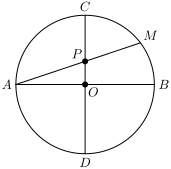
Circle has diameters and perpendicular to each other. is any chord intersecting at Then is equal to:
Pista pequeña:
Como es un diámetro, el ángulo es recto
Because is a diameter, angle is a right angle
Pista grande:
Compara los triángulos rectángulos y
Compare right triangles and
Solución:
Los ángulos y son rectos, y los dos triángulos comparten el ángulo Por lo tanto, los triángulos y son semejantes. Los lados correspondientes dan De aquí,
Por lo tanto, la respuesta correcta es B.
Angles and are both right angles, and the two triangles share angle Therefore triangles and are similar. Corresponding sides give Hence
Thus, the correct answer is B.
19.
La base del sistema decimal es diez, lo que significa, por ejemplo, que En el sistema binario, cuya base es dos, los primeros cinco enteros positivos son Entonces el numeral del sistema binario se escribe en el sistema decimal como:
The base of the decimal number system is ten, meaning, for example, that In the binary system, which has base two, the first five positive integers are The numeral in the binary system would then be written in the decimal system as:
Respuesta: A
Pista pequeña:
Asigna las potencias a las cinco posiciones binarias
Assign powers to the five binary places
Pista grande:
Solo los dígitos primero, cuarto y quinto son distintos de cero
Only the first, fourth, and fifth digits are nonzero
Solución:
Al desarrollar según el valor posicional binario,
Por lo tanto, la respuesta correcta es A.
Expanding by binary place value,
Therefore, the correct answer is A.
20.
Un hombre hace un viaje en automóvil a una velocidad media de millas por hora. Regresa por la misma ruta a una velocidad media de millas por hora. Su velocidad media durante todo el viaje es:
A man makes a trip by automobile at an average speed of mph. He returns over the same route at an average speed of mph. His average speed for the entire trip is:
millas por hora
mph
millas por hora
mph
millas por hora
mph
millas por hora
mph
ninguna de las anteriores
none of these
Respuesta: A
Pista pequeña:
Usa una distancia de ida conveniente y divide la distancia total entre el tiempo total
Use a convenient one-way distance and divide total distance by total time
Pista grande:
Para distancias iguales, la media aritmética de las dos velocidades no es la velocidad media
For equal distances the arithmetic mean of the two speeds is not the average speed
Solución:
Sea la distancia de cada tramo. La velocidad media, en millas por hora, es
Por lo tanto, la respuesta correcta es A.
Let each leg have distance The average speed, in miles per hour, is
Thus, the correct answer is A.
21.
Partimos del teorema «Si dos ángulos de un triángulo son iguales, el triángulo es isósceles» y de las cuatro afirmaciones siguientes:
Si dos ángulos de un triángulo no son iguales, el triángulo no es isósceles.
Los ángulos de la base de un triángulo isósceles son iguales.
Si un triángulo no es isósceles, entonces dos de sus ángulos no son iguales.
Una condición necesaria para que dos ángulos de un triángulo sean iguales es que el triángulo sea isósceles.
¿Qué combinación contiene solo las afirmaciones lógicamente equivalentes al teorema dado?
Start with the theorem “If two angles of a triangle are equal, the triangle is isosceles,” and the following four statements:
If two angles of a triangle are not equal, the triangle is not isosceles.
The base angles of an isosceles triangle are equal.
If a triangle is not isosceles, then two of its angles are not equal.
A necessary condition that two angles of a triangle be equal is that the triangle be isosceles.
Which combination of statements contains only those which are logically equivalent to the given theorem?
Respuesta: E
Pista pequeña:
Escribe el teorema como y compara cada afirmación con su inversa, recíproca o contrapositiva
Write the theorem as and compare each statement with its inverse, converse, or contrapositive
Pista grande:
Una afirmación siempre equivale a su contrapositiva, pero en general no a su recíproca ni a su inversa
A statement is always equivalent to its contrapositive, but not generally to its converse or inverse
Solución:
Sea la afirmación de que dos ángulos son iguales y la de que el triángulo es isósceles. La afirmación es la contrapositiva por lo que equivale a La afirmación dice que es necesaria para que es otra manera de expresar Las afirmaciones y son la inversa y la recíproca.
Así, solo las afirmaciones y son equivalentes, por lo que la respuesta correcta es E.
Let mean that two angles are equal and that the triangle is isosceles. Statement is the contrapositive so it is equivalent to Statement says that is necessary for which is another wording of Statements and are the inverse and converse.
Thus only statements and are equivalent, so the correct answer is E.
22.
Si entonces es igual a:
If then equals:
ningún valor real
no real value
Respuesta: A
Pista pequeña:
Reordena para obtener
Rearrange to
Pista grande:
Después de elevar al cuadrado una vez, aísla
After squaring once, isolate
Solución:
Reordenamos y elevamos al cuadrado: Así, de modo que y Este valor satisface la ecuación original. Por lo tanto,
Por lo tanto, la respuesta correcta es A.
Rearrange and square: Thus so and This value satisfies the original equation. Therefore
Thus, the correct answer is A.
23.
La gráfica de y la de se cortan en dos puntos. La distancia entre esos puntos es:
The graph of and the graph of meet in two points. The distance between these two points is:
menor que
less than
mayor que
more than
Respuesta: C
Pista pequeña:
Iguala las dos expresiones de
Set the two expressions for equal
Pista grande:
La ecuación resultante es
The resulting equation is
Solución:
En una intersección, por lo que o Los puntos son y Su distancia es
Por lo tanto, la respuesta correcta es C.
At an intersection, so or The points are and Their distance is
Therefore, the correct answer is C.
24.
Si del cuadrado de un número de dos cifras se resta el cuadrado del número formado al invertir las cifras, el resultado no siempre es divisible entre:
If the square of a number of two digits is decreased by the square of the number formed by reversing the digits, then the result is not always divisible by:
el producto de las cifras
the product of the digits
la suma de las cifras
the sum of the digits
la diferencia de las cifras
the difference of the digits
Respuesta: B
Pista pequeña:
Representa el número como y su inversión como
Represent the number as and its reversal as
Pista grande:
Factoriza por completo la diferencia de sus cuadrados
Factor the difference of their squares completely
Solución:
Si las cifras son entonces Esto siempre es divisible entre la suma de las cifras y su diferencia. No tiene por qué ser divisible entre el producto de las cifras; por ejemplo, no es divisible entre
Por lo tanto, la respuesta correcta es B.
If the digits are then This is always divisible by the digit sum, and the digit difference. It need not be divisible by the digit product; for example, is not divisible by
Thus, the correct answer is B.
25.
Los vértices del triángulo tienen coordenadas donde y son positivos. El origen y el punto están en lados opuestos de El área del triángulo se puede hallar mediante la expresión:
The vertices of triangle have coordinates as follows: where and are positive. The origin and point lie on opposite sides of The area of triangle may be found from the expression:
Respuesta: B
Pista pequeña:
Usa la fórmula del determinante para hallar el área de un triángulo a partir de sus coordenadas
Use the determinant formula for the area of a triangle from its coordinates
Pista grande:
La condición de estar en lados opuestos determina el signo dentro del valor absoluto
The opposite-side condition determines the sign inside the absolute value
Solución:
El área doble con signo es La recta tiene ecuación Como el origen da un valor menor que y está en el lado opuesto, Por tanto, el área es
Por lo tanto, la respuesta correcta es B.
The signed doubled area is The line has equation Since the origin gives a value below and is on the opposite side, Thus the area is
Therefore, the correct answer is B.
26.
Desde un punto interior de un triángulo se trazan segmentos hasta los vértices. Una condición necesaria y suficiente para que los tres triángulos así formados tengan áreas iguales es que el punto sea:
From a point within a triangle, line segments are drawn to the vertices. A necessary and sufficient condition that the three triangles thus formed have equal areas is that the point be:
el centro del círculo inscrito
the center of the inscribed circle
el centro del círculo circunscrito
the center of the circumscribed circle
tal que los tres ángulos formados en el punto midan
such that the three angles formed at the point each be
la intersección de las alturas del triángulo
the intersection of the altitudes of the triangle
la intersección de las medianas del triángulo
the intersection of the medians of the triangle
Respuesta: E
Pista pequeña:
Recuerda cómo dividen las medianas el área de un triángulo
Recall how the medians partition a triangle’s area
Pista grande:
La intersección de las medianas divide el triángulo en seis triángulos pequeños que se agrupan de dos en dos en tres regiones de igual área
The intersection of the medians divides the triangle into six small triangles paired into three equal-area regions
Solución:
Las tres medianas se cortan en el centroide y dividen el triángulo en seis triángulos pequeños de igual área. Cada uno de los tres triángulos que tienen al centroide y a un lado del triángulo original consta de dos de esos triángulos pequeños, por lo que sus áreas son iguales. Recíprocamente, áreas iguales producen coordenadas baricéntricas iguales, que determinan de manera única el centroide.
Así, el punto necesario y suficiente es la intersección de las medianas, y la respuesta correcta es E.
The three medians meet at the centroid and divide the triangle into six small triangles of equal area. Each of the three triangles having the centroid and one side of the original triangle consists of two of those small triangles, so their areas are equal. Conversely, equal areas give equal barycentric coordinates, which uniquely locate the centroid.
Thus, the necessary and sufficient point is the intersection of the medians, and the correct answer is E.
27.
La suma de los recíprocos de las raíces de la ecuación es:
The sum of the reciprocals of the roots of the equation is:
Respuesta: A
Pista pequeña:
Llama y a las raíces, y combina
Call the roots and , and combine
Pista grande:
Usa y
Use and
Solución:
Si las raíces son las fórmulas de Vieta dan y Por lo tanto,
Por lo tanto, la respuesta correcta es A.
If the roots are then Vieta’s formulas give and Therefore
Thus, the correct answer is A.
28.
Si y son positivos y entonces el valor de :
If and are positive and then the value of is:
depende de
dependent upon
depende de
dependent upon
depende de y
dependent upon and
es cero
zero
es uno
one
Pista pequeña:
Usa la relación inversa entre el logaritmo en base y la exponenciación de base
Use the inverse relationship between a base- logarithm and exponentiation by
Pista grande:
Si entonces
If then
Solución:
Por la definición de logaritmo, Así, el valor depende de no de la elección de la base admisible
Por lo tanto, la respuesta correcta es B.
By the definition of a logarithm, Thus the value depends on not on the choice of admissible base
Therefore, the correct answer is B.
29.
La relación es cierta solo para:
Aquí significa que puede tomar todos los valores mayores que y también el valor igual a mientras que tiene el significado correspondiente con «menor que».
The relation is true only for:
Here means that can take on all values greater than and the value equal to while has a corresponding meaning with “less than.”
Respuesta: D
Pista pequeña:
El factor es positivo salvo cuando
The factor is positive except at
Pista grande:
Fuera de cero, el signo está determinado por
Away from zero, the sign is controlled by
Solución:
Cuando el producto es cero. Para el factor es positivo, por lo que el producto es no negativo exactamente cuando es decir, cuando o Al incluir el valor aislado , se obtiene el conjunto de la opción D.
Por lo tanto, la respuesta correcta es D.
At the product is zero. For the factor is positive, so the product is nonnegative exactly when or or Including the isolated value gives the set in choice D.
Thus, the correct answer is D.
30.
La suma de los cuadrados de los primeros enteros positivos está dada por si y son, respectivamente:
The sum of the squares of the first positive integers is given by the expression if and are, respectively:
y
and
y
and
y
and
y
and
y
and
Respuesta: D
Pista pequeña:
Compara la expresión con la fórmula estándar de la suma de cuadrados
Compare the expression with the standard sum-of-squares formula
Pista grande:
Como alternativa, sustituye y para obtener dos ecuaciones
Alternatively, substitute and to obtain two equations
Solución:
La fórmula estándar es Por lo tanto, y
Por lo tanto, la respuesta correcta es D.
The standard formula is Therefore and
Thus, the correct answer is D.
31.
Se forma un octágono regular cortando triángulos rectángulos isósceles congruentes de las esquinas de un cuadrado. Si el cuadrado tiene lados de una unidad, la longitud de cada cateto de esos triángulos es:
A regular octagon is to be formed by cutting equal isosceles right triangles from the corners of a square. If the square has sides of one unit, the leg of each of the triangles has length:
Respuesta: B
Pista pequeña:
Si cada cateto recortado mide un lado horizontal no recortado del octágono mide
If each cut-off leg is an uncut horizontal octagon side has length
Pista grande:
Un lado inclinado del octágono es la hipotenusa , y la regularidad obliga a que estas longitudes sean iguales
A slanted octagon side is the hypotenuse , and regularity makes these equal
Solución:
Sea un cateto de cada triángulo de las esquinas. Los lados horizontales y verticales del octágono miden mientras que los cuatro lados inclinados miden Así, por lo que
Por lo tanto, la respuesta correcta es B.
Let be a leg of each corner triangle. The horizontal and vertical octagon sides have length while the four slanted sides have length Thus so
Therefore, the correct answer is B.
32.
El mayor de los siguientes enteros que divide a cada término de la sucesión es:
The largest of the following integers which divides each of the numbers of the sequence is:
Respuesta: E
Pista pequeña:
Demuestra que siempre es divisible entre y
Show is always divisible by and
Pista grande:
Usa factores consecutivos para y y residuos módulo para el factor restante
Use consecutive factors for and and residues modulo for the remaining factor
Solución:
Factorizamos Entre tres enteros consecutivos, uno es divisible entre y al menos uno es par, por lo que la expresión es divisible entre Además, para todo entero así que es divisible entre Por consiguiente, cada término es divisible entre Al tomar se obtiene por lo que ningún entero mayor de la lista puede dividir a todos los términos.
Por lo tanto, la respuesta correcta es E.
Factor Among three consecutive integers, one is divisible by and at least one is even, so the expression is divisible by Also for every integer so it is divisible by Hence every term is divisible by Taking gives so no larger listed integer can divide every term.
Thus, the correct answer is E.
33.
Si entonces el valor de es:
If then the value of is:
Respuesta: E
Pista pequeña:
Reescribe como
Rewrite as
Pista grande:
Después de reducir términos semejantes, expresa como una potencia de
After collecting like terms, express as a power of
Solución:
Al sacar como factor común, por lo que y Como tenemos
Por lo tanto, la respuesta correcta es E.
Factoring so and Since we have
Therefore, the correct answer is E.
34.
Los puntos que satisfacen el sistema donde el símbolo «» significa «menor que», forman el conjunto:
The points that satisfy the system where the symbol “” means “less than,” constitute the following set:
solo dos puntos
only two points
un arco de circunferencia
an arc of a circle
un segmento de recta que no incluye sus extremos
a straight line segment not including the end-points
un segmento de recta que incluye sus extremos
a straight line segment including the end-points
un solo punto
a single point
Respuesta: C
Pista pequeña:
Interpreta como el interior de un círculo
Interpret as the interior of a circle
Pista grande:
Interseca ese disco abierto con la recta
Intersect that open disk with the line
Solución:
La desigualdad describe el disco abierto dentro del círculo de radio centrado en el origen. La recta corta al círculo en dos puntos. La parte de la recta dentro del disco es el segmento entre esos puntos, pero la desigualdad estricta excluye los extremos.
Por lo tanto, la respuesta correcta es C.
The inequality describes the open disk inside the circle of radius centered at the origin. The line crosses the circle in two points. Its portion inside the disk is the segment between those points, but the strict inequality excludes the endpoints.
Thus, the correct answer is C.
35.
El lado del triángulo rectángulo se divide en partes iguales. Desde los puntos de división se trazan siete segmentos paralelos a hasta . Si entonces la suma de las longitudes de los siete segmentos:
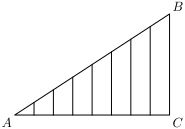
Side of right triangle is divided into equal parts. Seven line segments parallel to are drawn to from the points of division. If then the sum of the lengths of the seven line segments:
no se puede hallar con la información dada
cannot be found from the given information
es
is
es
is
es
is
es
is
Respuesta: D
Pista pequeña:
Cada triángulo pequeño con vértice es semejante al triángulo
Each small triangle with vertex is similar to triangle
Pista grande:
Las siete longitudes paralelas son
The seven parallel lengths are
Solución:
Por semejanza, el segmento en el -ésimo punto de división mide para Su suma es
Por lo tanto, la respuesta correcta es D.
By similarity, the segment at the th division point has length for Their sum is
Therefore, the correct answer is D.
36.
Si entonces el mayor valor de es:
If then the largest value of is:
un número irracional cercano a
an irrational number about
Respuesta: D
Pista pequeña:
Sustituye en el producto
Substitute into the product
Pista grande:
Completa el cuadrado en
Complete the square in
Solución:
Tenemos El término cuadrado es no negativo, por lo que el mayor producto posible es
Por lo tanto, la respuesta correcta es D.
We have The squared term is nonnegative, so the largest possible product is
Thus, the correct answer is D.
37.
En el triángulo rectángulo y está sobre Si la mitad del perímetro del rectángulo entonces:
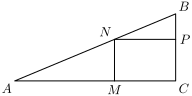
In right triangle and is on If one-half the perimeter of rectangle then:
Respuesta: C
Pista pequeña:
Los triángulos y son semejantes
Triangles and are similar
Pista grande:
Usa y
Use and
Solución:
Por semejanza, Además, Por tanto,
Por lo tanto, la respuesta correcta es C.
By similarity, Also Hence
Therefore, the correct answer is C.
38.
De un número de dos cifras restamos el número con las cifras invertidas y obtenemos un cubo perfecto positivo. Entonces:
From a two-digit number we subtract the number with the digits reversed and find that the result is a positive perfect cube. Then:
no puede terminar en
cannot end in
puede terminar en cualquier cifra excepto
can end in any digit other than
no existe
does not exist
hay exactamente valores de
there are exactly values for
hay exactamente valores de
there are exactly values for
Respuesta: D
Pista pequeña:
Si las cifras cumplen la diferencia con el número invertido es
If the digits are the difference from the reversal is
Pista grande:
La diferencia es como máximo así que prueba los cubos positivos no mayores que
The difference is at most so test the positive cubes no larger than
Solución:
Al escribir la diferencia positiva es Es como máximo Entre y solo es divisible entre por lo que Los pares de cifras son y producen exactamente siete valores de
Por lo tanto, la respuesta correcta es D.
Writing the positive difference is It is at most Among and only is divisible by so The digit pairs are giving exactly seven values of
Thus, the correct answer is D.
39.
Dos hombres parten al mismo tiempo desde y separados por millas, y caminan uno hacia el otro. El primero camina a millas por hora. El segundo recorre millas la primera hora, millas la segunda, millas la tercera, y así sucesivamente en progresión aritmética. Entonces se encontrarán:
Two men set out at the same time to walk towards each other from and miles apart. The first man walks at the rate of mph. The second man walks miles the first hour, miles the second hour, miles the third hour, and so on in arithmetic progression. Then the men will meet:
en horas
in hours
en horas
in hours
más cerca de que de
nearer than
más cerca de que de
nearer than
a mitad de camino entre y
midway between and
Respuesta: E
Pista pequeña:
Después de horas completas, suma como progresión aritmética las distancias horarias del segundo hombre
After whole hours, sum the second man’s hourly distances as an arithmetic progression
Pista grande:
Iguala esa suma más a
Set that sum plus equal to
Solución:
En horas, las distancias horarias del segundo hombre forman una progresión aritmética de primer término y último término Su distancia es Entre ambos recorren o La raíz positiva es El primer hombre recorre entonces millas, exactamente la mitad de la distancia original.
Por lo tanto, la respuesta correcta es E.
In hours, the second man’s hourly distances form an arithmetic progression with first term and last term His distance is Together the men cover or The positive root is The first man then walks miles, exactly half the original distance.
Therefore, the correct answer is E.
40.
Si la parábola tiene su vértice sobre el eje , entonces debe ser:
If the parabola has its vertex on the -axis, then must be:
un entero positivo
a positive integer
un número racional positivo o negativo
a positive or a negative rational number
un número racional positivo
a positive rational number
un número irracional positivo o negativo
a positive or a negative irrational number
un número irracional negativo
a negative irrational number
Respuesta: D
Pista pequeña:
Una parábola cuyo vértice está en el eje tiene una raíz doble
A parabola whose vertex lies on the -axis has a repeated root
Pista grande:
Iguala a cero el discriminante de
Set the discriminant of equal to zero
Solución:
El vértice está en el eje exactamente cuando la cuadrática tiene una raíz doble. Su discriminante debe satisfacer Por consiguiente, un número irracional positivo o negativo.
Por lo tanto, la respuesta correcta es D.
The vertex lies on the -axis exactly when the quadratic has one repeated root. Its discriminant must satisfy Hence a positive or negative irrational number.
Thus, the correct answer is D.
41.
Dado el sistema de ecuaciones
¿Para cuál de los siguientes valores de no hay solución para e ?
Given the system of equations
For which one of the following values of is there no solution for and
Respuesta: D
Pista pequeña:
Un sistema puede no tener solución única cuando el determinante de sus coeficientes es cero
A system can fail to have a unique solution when its coefficient determinant is zero
Pista grande:
Calcula
Compute
Solución:
El determinante de coeficientes es Se anula cuando Para cualquiera de los dos valores, las dos filas de coeficientes son proporcionales, pero los dos lados derechos no guardan la misma proporción, por lo que el sistema es incompatible.
Por lo tanto, la respuesta correcta es D.
The coefficient determinant is It vanishes when For either value, the two coefficient rows are proportional but the two right sides are not in the same ratio, so the system is inconsistent.
Thus, the correct answer is D.
42.
Si donde y es un entero, entonces el número total de valores distintos posibles de es:
If where and is an integer, then the total number of possible distinct values for is:
más de
more than
Respuesta: C
Pista pequeña:
Las potencias de se repiten con período cuatro
Powers of repeat with period four
Pista grande:
Revisa un representante de cada clase de residuos de módulo
Check one representative of each residue class of modulo
Solución:
Si es par, es o e igual a su recíproco, por lo que o Si es impar, los dos términos son y en algún orden, por lo que Así, los valores distintos son tres valores.
Por lo tanto, la respuesta correcta es C.
If is even, is or and equals its reciprocal, so or If is odd, the two terms are and in some order, so Thus the distinct values are three values.
Therefore, the correct answer is C.
43.
Definimos un punto de retícula como un punto cuyas coordenadas son enteras, incluido el cero. Entonces el número de puntos de retícula sobre la frontera y dentro de la región limitada por el eje , la recta y la parábola es:
We define a lattice point as a point whose coordinates are integers, zero admitted. Then the number of lattice points on the boundary and inside the region bounded by the -axis, the line and the parabola is:
no finito
not finite
Respuesta: B
Pista pequeña:
Solo aparecen las coordenadas enteras y
Only the integer -coordinates and occur
Pista grande:
Para un entero fijo, cuenta los valores enteros de desde hasta
For a fixed integer count the integer -values from through
Solución:
Para cada entre y hay valores enteros desde hasta Por lo tanto, el número de puntos de retícula es
Por lo tanto, la respuesta correcta es B.
For each among and there are integer values from through Therefore the number of lattice points is
Thus, the correct answer is B.
44.
En el triángulo y Entonces es:
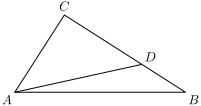
In triangle and Then is:
Respuesta: E
Pista pequeña:
Como el triángulo es isósceles
Because triangle is isosceles
Pista grande:
Expresa usando y
Express using and
Solución:
Sea y Como está sobre por ser un ángulo exterior del triángulo Como el triángulo es isósceles, así que Pero Por tanto, de modo que y
Por lo tanto, la respuesta correcta es E.
Let and Since lies on as an exterior angle of triangle Because triangle is isosceles, so But Hence so and
Thus, the correct answer is E.
45.
Si dos números reales y satisfacen la ecuación entonces:
If two real numbers and satisfy the equation then:
o donde significa que puede tomar cualquier valor mayor que o igual a
or where means that can take any value greater than or equal to
puede ser igual a
can equal
tanto como deben ser irracionales
both and must be irrational
y no pueden ser ambos enteros
and cannot both be integers
tanto como deben ser racionales
both and must be rational
Respuesta: A
Pista pequeña:
Elimina el denominador y considera el resultado como una ecuación cuadrática en
Clear the denominator and regard the result as a quadratic equation in
Pista grande:
Para que sea real, el discriminante debe ser no negativo
Real requires the discriminant to be nonnegative
Solución:
Como al multiplicar por se obtiene o Para que sea real, su discriminante debe satisfacer Así, o
Por lo tanto, la respuesta correcta es A.
Since multiplying by gives or For a real value of its discriminant must satisfy Thus or
Therefore, the correct answer is A.
46.
Dos cuerdas perpendiculares se cortan dentro de un círculo. Los segmentos de una cuerda miden y los de la otra miden y Entonces el diámetro del círculo es:
Two perpendicular chords intersect in a circle. The segments of one chord are and the segments of the other are and Then the diameter of the circle is:
Respuesta: E
Pista pequeña:
Coloca la intersección de las cuerdas en el origen y las cuerdas perpendiculares sobre los ejes coordenados
Place the chord intersection at the origin and the perpendicular chords on the coordinate axes
Pista grande:
El centro del círculo está sobre las mediatrices de ambas cuerdas
The circle’s center lies on both chord perpendicular bisectors
Solución:
Colocamos la intersección en y los extremos en y Las mediatrices de las cuerdas son y por lo que el centro es Usando el extremo Por lo tanto, el diámetro es
Por lo tanto, la respuesta correcta es E.
Place the intersection at with endpoints and The perpendicular bisectors of the chords are and so the center is Using the endpoint Therefore the diameter is
Thus, the correct answer is E.
47.
En el círculo el punto medio del radio es en El semicírculo cuyo diámetro es corta a en La recta corta al círculo en y la recta corta al círculo en Se traza la recta . Entonces, si el radio del círculo es es:
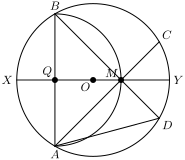
In circle the midpoint of radius is at The semicircle with as diameter intersects in Line intersects circle in and line intersects circle in Line is drawn. Then, if the radius of circle is is:
no es un lado de un polígono regular inscrito
not a side of an inscribed regular polygon
Respuesta: A
Pista pequeña:
Como biseca perpendicularmente a compara y
Since perpendicularly bisects compare and
Pista grande:
Usa el semicírculo para hallar y después que y son colineales
Use the semicircle to find then use that and are collinear
Solución:
La recta es la mediatriz de por lo que Como está en el semicírculo de diámetro Así, el triángulo es rectángulo isósceles y Como son colineales, el ángulo inscrito de modo que el arco que intercepta mide Por lo tanto, la cuerda es un lado de un cuadrado inscrito y tiene longitud
Por lo tanto, la respuesta correcta es A.
Line is the perpendicular bisector of so Since lies on the semicircle with diameter Thus triangle is an isosceles right triangle and Because are collinear, the inscribed angle so its intercepted arc measures Therefore chord is a side of an inscribed square and has length
Thus, the correct answer is A.
48.
Sea un triángulo equilátero inscrito en el círculo El punto está sobre el arco Se trazan las rectas y . Entonces es:
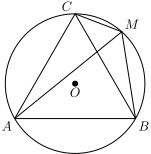
Let be an equilateral triangle inscribed in circle is a point on arc Lines and are drawn. Then is:
igual a
equal to
menor que
less than
mayor que
greater than
igual, menor o mayor que según la posición de
equal to, less than, or greater than depending upon the position of
ninguna de las anteriores
none of these
Respuesta: A
Pista pequeña:
Aplica el teorema de Ptolomeo al cuadrilátero cíclico
Apply Ptolemy’s theorem to cyclic quadrilateral
Pista grande:
Usa para cancelar la longitud común
Use to cancel the common side length
Solución:
En el cuadrilátero cíclico el teorema de Ptolomeo da Como es equilátero, Al dividir entre esta longitud común se obtiene
Por lo tanto, la respuesta correcta es A.
In cyclic quadrilateral Ptolemy’s theorem gives Since is equilateral, Dividing by this common length yields
Therefore, the correct answer is A.
49.
Los lados paralelos de un trapecio miden y Los lados no paralelos miden y Una recta paralela a las bases divide el trapecio en dos trapecios de igual perímetro. La razón en que queda dividido cada lado no paralelo es:
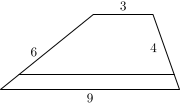
The parallel sides of a trapezoid are and The non-parallel sides are and A line parallel to the bases divides the trapezoid into two trapezoids of equal perimeters. The ratio in which each of the non-parallel sides is divided is:
Respuesta: C
Pista pequeña:
Un segmento paralelo a las bases divide ambos lados no paralelos en la misma proporción
A segment parallel to the bases divides both legs in the same fraction
Pista grande:
Sean y los segmentos superiores de los lados; el segmento divisor común se cancela al igualar los dos perímetros
Let the upper leg segments be and ; the common dividing segment cancels when the two perimeters are equated
Solución:
Sean y respectivamente, las partes superiores de los lados de longitudes y . El segmento divisor aparece una vez en cada perímetro y se cancela. Por tanto, los perímetros iguales dan Así, por lo que Cada lado queda dividido en la razón
Por lo tanto, la respuesta correcta es C.
Let the upper pieces of the legs of lengths and be and respectively. The dividing segment appears once in each perimeter and cancels. Equal perimeters therefore give Hence so Each leg is divided in the ratio
Thus, the correct answer is C.
50.
En el círculo es un punto móvil sobre el diámetro Se traza perpendicular a e igual a Se traza perpendicular a en el mismo lado del diámetro que e igual a Sea el punto medio de Entonces, mientras se mueve de a el punto
In circle is a moving point on diameter is drawn perpendicular to and equal to is drawn perpendicular to on the same side of diameter as and equal to Let be the midpoint of Then, as moves from to point
se mueve sobre una recta paralela a
moves on a straight line parallel to
permanece fijo
remains stationary
se mueve sobre una recta perpendicular a
moves on a straight line perpendicular to
se mueve sobre un círculo pequeño que corta al círculo dado
moves in a small circle intersecting the given circle
sigue una trayectoria que no es ni un círculo ni una recta
follows a path which is neither a circle nor a straight line
Respuesta: B
Pista pequeña:
Coloca y
Place and
Pista grande:
Escribe las coordenadas de y , y luego toma su promedio
Write coordinates for and , then average them
Solución:
Sean y Las construcciones perpendiculares en el mismo lado dan Su punto medio es independiente de Así, permanece fijo.
Por lo tanto, la respuesta correcta es B.
Let and The perpendicular constructions on the same side give Their midpoint is independent of Thus remains stationary.
Therefore, the correct answer is B.