2025 AIME I Problema 10

A continuación está la solución preparada profesionalmente para el Problema 10 del 2025 AIME I, de LIVE by Po-Shen Loh. También puedes intentar el examen cronometrado completo, ver todas las soluciones del 2025 AIME I, o revisar la clave de respuestas.

Todos los problemas se usan con el permiso legal oficial de la Mathematical Association of America (MAA).

Conceptos:arreglos con restriccionesprincipio de multiplicaciónfactorización en primos

Nivel de dificultad: 2990

10.

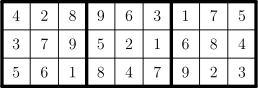
Las 2727 celdas de una cuadrícula 3×93 \times 9 se llenan usando los números 11 a 99 de modo que cada fila contenga 99 números distintos, y que cada uno de los tres bloques 3×33 \times 3 resaltados con contorno grueso en el ejemplo de abajo contenga 99 números distintos, como en las primeras tres filas de un Sudoku.

El número de formas distintas de llenar tal cuadrícula se puede escribir como paqbrcsd,p^a \cdot q^b \cdot r^c \cdot s^d, donde p,p, q,q, r,r, y ss son números primos distintos y a,a, b,b, c,c, dd son enteros positivos. Halle pa+qb+rc+sd.p \cdot a + q \cdot b + r \cdot c + s \cdot d.

The 2727 cells of a 3×93 \times 9 grid are filled in using the numbers 11 through 99 so that each row contains 99 different numbers, and each of the three 3×33 \times 3 blocks heavily outlined in the example below contains 99 different numbers, as in the first three rows of a Sudoku puzzle.

The number of different ways to fill such a grid can be written as paqbrcsd,p^a \cdot q^b \cdot r^c \cdot s^d, where p,p, q,q, r,r, and ss are distinct prime numbers and a,a, b,b, c,c, dd are positive integers. Find pa+qb+rc+sd.p \cdot a + q \cdot b + r \cdot c + s \cdot d.

Solución:

Llene el bloque izquierdo arbitrariamente: 9!9! formas. Sean R1,R2,R3R_1, R_2, R_3 los conjuntos de tres dígitos de sus filas. En el bloque central, la fila ii debe evitar RiR_i (esos dígitos ya aparecen en la fila ii), y las tres filas del bloque deben partir {1,,9}.\{1, \ldots, 9\}. Digamos que su fila superior toma jj dígitos de R2R_2 y 3j3 - j de R3.R_3. Equilibrar las tres filas obliga entonces a la fila central a tomar 3j3 - j dígitos de R1R_1 junto con los jj dígitos restantes de R3,R_3, y la fila inferior queda determinada. El número de elecciones de contenido es j=03(3j)(33j)2=1+27+27+1=56. \begin{gathered} \sum_{j=0}^{3} \binom{3}{j}\binom{3}{3-j}^2 \\ = 1 + 27 + 27 + 1 \\ = 56. \end{gathered}

El contenido de las filas del bloque derecho queda entonces forzado (la fila ii toma lo que falte en la fila ii), y cada una de las seis filas de los bloques central y derecho se puede ordenar internamente de 3!3! formas. El total es 9!5666=(273457)(237)(2636)=2163105172. \begin{gathered} 9! \cdot 56 \cdot 6^6 \\ = (2^7 \cdot 3^4 \cdot 5 \cdot 7)(2^3 \cdot 7)(2^6 \cdot 3^6) \\ = 2^{16} \cdot 3^{10} \cdot 5^1 \cdot 7^2. \end{gathered}

Por lo tanto pa+qb+rc+sdp \cdot a + q \cdot b + r \cdot c + s \cdot d =216+310+51= 2 \cdot 16 + 3 \cdot 10 + 5 \cdot 1 +72=81.+ 7 \cdot 2 = 81.

Fill the left block arbitrarily: 9!9! ways. Let R1,R2,R3R_1, R_2, R_3 be the sets of three digits in its rows. In the middle block, row ii must avoid RiR_i (those digits already appear in row ii), and the block's three rows must partition {1,,9}.\{1, \ldots, 9\}. Say its top row takes jj digits from R2R_2 and 3j3 - j from R3.R_3. Balancing the three rows then forces the middle row to take 3j3 - j digits from R1R_1 together with all jj remaining digits of R3,R_3, and the bottom row is determined. The number of content choices is j=03(3j)(33j)2=1+27+27+1=56. \begin{gathered} \sum_{j=0}^{3} \binom{3}{j}\binom{3}{3-j}^2 \\ = 1 + 27 + 27 + 1 \\ = 56. \end{gathered}

The right block's row contents are then forced (row ii takes whatever is missing from row ii), and each of the six rows of the middle and right blocks can be ordered internally in 3!3! ways. The total is 9!5666=(273457)(237)(2636)=2163105172. \begin{gathered} 9! \cdot 56 \cdot 6^6 \\ = (2^7 \cdot 3^4 \cdot 5 \cdot 7)(2^3 \cdot 7)(2^6 \cdot 3^6) \\ = 2^{16} \cdot 3^{10} \cdot 5^1 \cdot 7^2. \end{gathered}

Therefore pa+qb+rc+sdp \cdot a + q \cdot b + r \cdot c + s \cdot d =216+310+51= 2 \cdot 16 + 3 \cdot 10 + 5 \cdot 1 +72=81.+ 7 \cdot 2 = 81.

← Problema 9#9Examen completoProblema 11#11 →

El Problema 10 en otros años