2008 AIME II Problema 10

A continuación está la solución preparada profesionalmente para el Problema 10 del 2008 AIME II, de LIVE by Po-Shen Loh. También puedes intentar el examen cronometrado completo, ver todas las soluciones del 2008 AIME II, o revisar la clave de respuestas.

Todos los problemas se usan con el permiso legal oficial de la Mathematical Association of America (MAA).

Conceptos:punto reticularfórmula de la distanciaargumento extremalanálisis por casos

Nivel de dificultad: 3060

10.

El diagrama de abajo muestra un arreglo rectangular de puntos de 4×4,4 \times 4, cada uno de los cuales está a 11 unidad de distancia de sus vecinos más cercanos.

Define un camino creciente como una sucesión de puntos distintos del arreglo con la propiedad de que la distancia entre puntos consecutivos de la sucesión es estrictamente creciente. Sea mm el máximo número posible de puntos en un camino creciente, y sea rr el número de caminos crecientes que constan de exactamente mm puntos. Halla mr.mr.

The diagram below shows a 4×44 \times 4 rectangular array of points, each of which is 11 unit away from its nearest neighbors.

Define a growing path to be a sequence of distinct points of the array with the property that the distance between consecutive points of the sequence is strictly increasing. Let mm be the maximum possible number of points in a growing path, and let rr be the number of growing paths consisting of exactly mm points. Find mr.mr.

Solución:

La distancia al cuadrado entre dos puntos del arreglo es a2+b2,a^2 + b^2, donde aa y bb son las diferencias de coordenadas, cada una en {0,1,2,3}\{0, 1, 2, 3\} y no ambas cero. Los valores posibles son 1,2,4,5,8,9,10,13,181, 2, 4, 5, 8, 9, 10, 13, 18, solo 99 valores, así que un camino creciente tiene a lo sumo 1010 puntos, y un camino con 1010 puntos debe usar las nueve distancias en orden creciente. Etiqueta sus puntos P1,,P10P_1, \ldots, P_{10} de modo que P1P2=1P_1 P_2 = 1 y P9P10=18.P_9 P_{10} = \sqrt{18}.

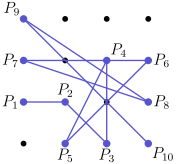
Como 18\sqrt{18} solo se realiza con esquinas opuestas, hay 44 elecciones ordenadas de (P10,P9).(P_{10}, P_9). Luego, P8P9=13P_8 P_9 = \sqrt{13} deja 22 elecciones para P8,P_8, los dos vecinos de P10,P_{10}, simétricos respecto de la diagonal principal. A partir de ahí las distancias 10,3,8,5,2,2\sqrt{10}, 3, \sqrt{8}, \sqrt{5}, 2, \sqrt{2} fuerzan P7,P6,,P2P_7, P_6, \ldots, P_2 de manera única (para P7P_7 la elección de la otra esquina falla porque el punto que se necesitaría después para P6P_6 coincidiría con P9P_9 o P10P_{10}). Finalmente P1P_1 debe estar a distancia 11 de P2,P_2, y 33 de sus vecinos quedan sin usar. Uno de los caminos resultantes se muestra abajo.

Por lo tanto m=10m = 10 y r=423=24,r = 4 \cdot 2 \cdot 3 = 24, así que mr=240.mr = 240.

The squared distance between two points of the array is a2+b2,a^2 + b^2, where aa and bb are the coordinate differences, each in {0,1,2,3}\{0, 1, 2, 3\} and not both zero. The possible values are 1,2,4,5,8,9,10,13,181, 2, 4, 5, 8, 9, 10, 13, 18 — only 99 values — so a growing path has at most 1010 points, and a path with 1010 points must use all nine distances in increasing order. Label its points P1,,P10P_1, \ldots, P_{10} so that P1P2=1P_1 P_2 = 1 and P9P10=18.P_9 P_{10} = \sqrt{18}.

Since 18\sqrt{18} is realized only by opposite corners, there are 44 ordered choices of (P10,P9).(P_{10}, P_9). Next, P8P9=13P_8 P_9 = \sqrt{13} leaves 22 choices for P8,P_8, the two neighbors of P10,P_{10}, symmetric across the main diagonal. From there the distances 10,3,8,5,2,2\sqrt{10}, 3, \sqrt{8}, \sqrt{5}, 2, \sqrt{2} force P7,P6,,P2P_7, P_6, \ldots, P_2 uniquely (for P7P_7 the alternative corner choice fails because the point needed next for P6P_6 would coincide with P9P_9 or P10P_{10}). Finally P1P_1 must be at distance 11 from P2,P_2, and 33 of its neighbors are unused. One of the resulting paths is shown below.

Hence m=10m = 10 and r=423=24,r = 4 \cdot 2 \cdot 3 = 24, so mr=240.mr = 240.

← Problema 9#9Examen completoProblema 11#11 →

El Problema 10 en otros años