
Problemas del 2008 AIME II
¡Desplázate hacia abajo y presiona Iniciar para intentar el examen! O ve al PDF imprimible, la clave de respuestas, o las soluciones profesionales preparadas por LIVE by Po-Shen Loh.
Todos los problemas se usan con el permiso legal oficial de la Mathematical Association of America (MAA).
O salta directamente a un solo problema con su solución: 1 · 2 · 3 · 4 · 5 · 6 · 7 · 8 · 9 · 10 · 11 · 12 · 13 · 14 · 15
¿Quieres aprender de forma profesional con clases interactivas en video?
Con tiempo
3:00:00
1.
Sea donde las sumas y las restas se alternan en pares. Halla el residuo cuando se divide entre
Let where the additions and subtractions alternate in pairs. Find the remainder when is divided by
Respuesta: 100
Pista pequeña:
Empareja cada cuadrado positivo con el cuadrado negativo que está dos posiciones más abajo, y factoriza con
Pair each positive square with the negative square two below it, and factor with
Pista grande:
Agrupa cuatro términos consecutivos a la vez; el bloque que termina en se simplifica a
Group four consecutive terms at a time; the block ending in simplifies to
Solución:
Agrupa los términos de cuatro en cuatro. Para el bloque que termina en es usando la diferencia de cuadrados con dos veces.
Sumando para hasta así que el residuo cuando se divide entre es
Group the terms four at a time. For the block ending at is using the difference of squares with twice.
Summing over to so the remainder when is divided by is
2.
Rudolph pedalea a velocidad constante y se detiene para un descanso de cinco minutos al final de cada milla. Jennifer pedalea a una velocidad constante igual a tres cuartos de la de Rudolph, pero toma un descanso de cinco minutos al final de cada dos millas. Jennifer y Rudolph comienzan a pedalear al mismo tiempo y llegan a la marca de millas exactamente al mismo tiempo. ¿Cuántos minutos les ha tomado?
Rudolph bikes at a constant rate and stops for a five-minute break at the end of every mile. Jennifer bikes at a constant rate which is three-quarters the rate that Rudolph bikes, but Jennifer takes a five-minute break at the end of every two miles. Jennifer and Rudolph begin biking at the same time and arrive at the -mile mark at exactly the same time. How many minutes has it taken them?
Respuesta: 620
Pista pequeña:
Ninguno de los dos ciclistas descansa al llegar, así que Rudolph toma descansos y Jennifer toma
Neither rider takes a break upon arriving, so Rudolph takes breaks and Jennifer takes
Pista grande:
Con la velocidad de Rudolph millas por minuto, iguala y
With Rudolph’s rate miles per minute, equate and
Solución:
Supongamos que Rudolph pedalea a millas por minuto. Descansa después de cada una de las millas a así que su tiempo total es minutos. Jennifer pedalea a millas por minuto y descansa después de cada una de las millas así que su tiempo total es minutos.
Igualando los tiempos se obtiene así que y El tiempo común es minutos.
Let Rudolph bike at miles per minute. He rests after each of miles through so his total time is minutes. Jennifer bikes at miles per minute and rests after each of miles so her total time is minutes.
Setting the times equal gives so and The common time is minutes.
3.
Un bloque de queso con forma de sólido rectangular mide cm por cm por cm. Se cortan diez rebanadas del queso. Cada rebanada tiene un grosor de cm y se corta paralela a una cara del queso. Las rebanadas individuales no son necesariamente paralelas entre sí. ¿Cuál es el máximo volumen posible, en cm cúbicos, del bloque de queso restante después de haber cortado diez rebanadas?
A block of cheese in the shape of a rectangular solid measures cm by cm by cm. Ten slices are cut from the cheese. Each slice has a width of cm and is cut parallel to one face of the cheese. The individual slices are not necessarily parallel to each other. What is the maximum possible volume in cubic cm of the remaining block of cheese after ten slices have been cut off?
Respuesta: 729
Pista pequeña:
Cada rebanada acorta una de las tres dimensiones en cm, así que el bloque restante tiene dimensiones que suman
Each slice shortens one of the three dimensions by cm, so the remaining block has dimensions summing to
Pista grande:
Un producto de números positivos con suma fija es máximo cuando todos los números son iguales
A product of positive numbers with a fixed sum is largest when the numbers are all equal
Solución:
Cada rebanada tiene cm de grosor y es paralela a una cara, así que después de cada corte el queso restante sigue siendo un bloque rectangular, con una dimensión acortada en Si las diez rebanadas acortan las tres dimensiones en y con el bloque restante mide y estas dimensiones suman
Por la desigualdad AM-GM, un producto de números positivos con suma fija es máximo cuando los tres son iguales a lo cual se logra tomando rebanada de la dimensión de cm, de la dimensión de cm y de la dimensión de cm. El volumen máximo es cm cúbicos.
Every slice is cm wide and parallel to a face, so after each cut the remaining cheese is still a rectangular block, with one dimension shortened by If the ten slices shorten the three dimensions by and with the remaining block measures and these dimensions sum to
By the AM-GM inequality, a product of positive numbers with fixed sum is greatest when all three are equal to which is achieved by taking slice from the cm dimension, from the cm dimension, and from the cm dimension. The maximum volume is cubic cm.
4.
Existe una única sucesión de enteros no negativos y una única elección de enteros , donde cada es igual a o , tales que Halla
There exist unique nonnegative integers and unique integers with each either or such that Find
Respuesta: 21
Pista pequeña:
Comienza escribiendo en base
Start by writing in base
Pista grande:
Reemplaza cada dígito usando para que cada coeficiente se convierta en o
Replace each digit using so that every coefficient becomes or
Solución:
En base es decir, Para convertir los dígitos en coeficientes usa Los dos dígitos adyacentes se colapsan limpiamente: y
Por lo tanto que tiene exponentes distintos y coeficientes como se requería. La suma de los exponentes es
In base that is, To convert the digits into coefficients use The two adjacent digits collapse neatly: and
Therefore which has distinct exponents and coefficients as required. The sum of the exponents is
5.
En el trapecio con sea y Sea y sean y los puntos medios de y respectivamente. Halla la longitud
In trapezoid with let and Let and and be the midpoints of and respectively. Find the length
Respuesta: 504
Pista pequeña:
Extiende los lados y hasta que se corten en como el ángulo en es recto
Extend the legs and to meet at since the angle at is right
Pista grande:
La mediana a la hipotenusa de un triángulo rectángulo es la mitad de la hipotenusa, y son colineales
The median to the hypotenuse of a right triangle is half the hypotenuse, and are collinear
Solución:
Extiende los lados y hasta que se corten en un punto Como el triángulo tiene un ángulo recto en Como el triángulo es la imagen del triángulo bajo una homotecia con centro en así que el punto medio de se corresponde con el punto medio de en particular y son colineales.
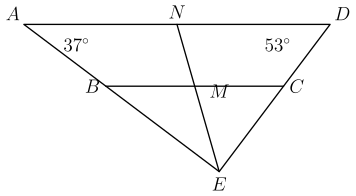
La mediana a la hipotenusa de un triángulo rectángulo es la mitad de la hipotenusa, así que y Por lo tanto
Extend legs and until they meet at a point Since triangle has a right angle at Because triangle is the image of triangle under a homothety centered at so the midpoint of maps to the midpoint of in particular and are collinear.
The median to the hypotenuse of a right triangle is half the hypotenuse, so and Therefore
6.
La sucesión se define por
La sucesión se define por
Halla
The sequence is defined by
The sequence is defined by
Find
Respuesta: 561
Pista pequeña:
Divide la recurrencia entre para ver que el cociente aumenta exactamente en en cada paso
Divide the recurrence by to see that the ratio increases by exactly at each step
Pista grande:
Los cocientes dan y forma el cociente
The ratios give and form the quotient
Solución:
Dividir la recurrencia entre da así que el cociente de términos consecutivos aumenta exactamente en en cada paso. Para el primer cociente es así que y El mismo cálculo se aplica a cuyo primer cociente es así que y
Por lo tanto
Dividing the recurrence by gives so the consecutive-term ratio increases by exactly each step. For the first ratio is so and The same computation applies to whose first ratio is so and
Therefore
7.
Sean y las tres raíces de la ecuación Halla
Let and be the three roots of the equation Find
Respuesta: 753
Pista pequeña:
No hay término , así que y cada uno de es el opuesto de una raíz
There is no term, so and each of is the negative of a root
Pista grande:
Cuando se aplica la identidad ; Vieta da el producto de las raíces a partir del término constante
When the identity applies; Vieta gives the product of the roots from the constant term
Solución:
La cúbica no tiene término , así que por las fórmulas de Vieta. Por lo tanto y y la suma buscada es
Siempre que la identidad da Por las fórmulas de Vieta, así que y la respuesta es
The cubic has no term, so by Vieta’s formulas. Hence and and the desired sum is
Whenever the identity gives By Vieta’s formulas, so and the answer is
8.
Sea Halla el menor entero positivo tal que sea un entero.
Let Find the smallest positive integer such that is an integer.
Respuesta: 251
Pista pequeña:
Aplica la identidad de producto a suma para convertir cada término en una diferencia de dos senos
Apply the product-to-sum identity to turn each term into a difference of two sine terms
Pista grande:
La suma se telescopa a que es un entero exactamente cuando es un múltiplo de
The sum telescopes to which is an integer exactly when is a multiple of
Solución:
Por la identidad de producto a suma, Sumando para hasta los términos se telescopan, quedando
Un seno es un entero solo cuando es o es decir, cuando su argumento es un múltiplo de Así que necesitamos que sea un múltiplo de es decir, es divisible por donde y es primo.
Como y son coprimos, debe dividir a uno de ellos, así que Para el producto no es divisible entre Para el producto es divisible entre El menor de este tipo es
By the product-to-sum identity, Summing over to the terms telescope, leaving
A sine is an integer only when it is or that is, when its argument is a multiple of So we need to be a multiple of i.e. is divisible by where and is prime.
Since and are coprime, must divide one of them, so For the product is not divisible by For the product is divisible by The smallest such is
9.
Una partícula está ubicada en el plano coordenado en Define un movimiento para la partícula como una rotación en sentido antihorario de radianes alrededor del origen seguida de una traslación de unidades en la dirección positiva del eje . Dado que la posición de la partícula después de movimientos es halla el mayor entero menor o igual que
A particle is located on the coordinate plane at Define a move for the particle as a counterclockwise rotation of radians about the origin followed by a translation of units in the positive -direction. Given that the particle’s position after moves is find the greatest integer less than or equal to
Respuesta: 19
Pista pequeña:
En el plano complejo, un movimiento envía a donde
In the complex plane a move sends to where
Pista grande:
Después de iterar, agrupa la suma geométrica resultante en bloques de usando
After iterating, group the resulting geometric sum into blocks of using
Solución:
Identifica el plano con el plano complejo, así que un movimiento envía a con Partiendo de e iterando,
Como y obtenemos En la suma geométrica, cada bloque de potencias consecutivas suma así que los términos se reducen a Por lo tanto
Así, y el mayor entero menor o igual que esto es
Identify the plane with the complex plane, so a move sends to with Starting from and iterating,
Since and we get In the geometric sum, every block of consecutive powers adds to so the terms reduce to Therefore
Thus and the greatest integer less than or equal to this is
10.
El diagrama de abajo muestra un arreglo rectangular de puntos de cada uno de los cuales está a unidad de distancia de sus vecinos más cercanos.

Define un camino creciente como una sucesión de puntos distintos del arreglo con la propiedad de que la distancia entre puntos consecutivos de la sucesión es estrictamente creciente. Sea el máximo número posible de puntos en un camino creciente, y sea el número de caminos crecientes que constan de exactamente puntos. Halla
The diagram below shows a rectangular array of points, each of which is unit away from its nearest neighbors.
Define a growing path to be a sequence of distinct points of the array with the property that the distance between consecutive points of the sequence is strictly increasing. Let be the maximum possible number of points in a growing path, and let be the number of growing paths consisting of exactly points. Find
Respuesta: 240
Pista pequeña:
La distancia al cuadrado entre dos puntos del arreglo es con no ambos cero, lo cual toma solo valores distintos
The squared distance between two array points is with not both zero, which takes only distinct values
Pista grande:
Construye los caminos máximos hacia atrás desde el paso más largo: los dos últimos puntos deben ser esquinas opuestas, y casi todos los puntos anteriores quedan entonces forzados
Build maximal paths backwards from the longest step: the last two points must be opposite corners, and nearly every earlier point is then forced
Solución:
La distancia al cuadrado entre dos puntos del arreglo es donde y son las diferencias de coordenadas, cada una en y no ambas cero. Los valores posibles son , solo valores, así que un camino creciente tiene a lo sumo puntos, y un camino con puntos debe usar las nueve distancias en orden creciente. Etiqueta sus puntos de modo que y
Como solo se realiza con esquinas opuestas, hay elecciones ordenadas de Luego, deja elecciones para los dos vecinos de simétricos respecto de la diagonal principal. A partir de ahí las distancias fuerzan de manera única (para la elección de la otra esquina falla porque el punto que se necesitaría después para coincidiría con o ). Finalmente debe estar a distancia de y de sus vecinos quedan sin usar. Uno de los caminos resultantes se muestra abajo.
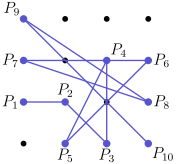
Por lo tanto y así que
The squared distance between two points of the array is where and are the coordinate differences, each in and not both zero. The possible values are — only values — so a growing path has at most points, and a path with points must use all nine distances in increasing order. Label its points so that and
Since is realized only by opposite corners, there are ordered choices of Next, leaves choices for the two neighbors of symmetric across the main diagonal. From there the distances force uniquely (for the alternative corner choice fails because the point needed next for would coincide with or ). Finally must be at distance from and of its neighbors are unused. One of the resulting paths is shown below.
Hence and so
11.
En el triángulo y El círculo tiene radio y es tangente a y El círculo es tangente externamente al círculo y es tangente a y Ningún punto del círculo queda fuera de El radio del círculo puede expresarse en la forma donde y son enteros positivos y es el producto de primos distintos. Halla
In triangle and Circle has radius and is tangent to and Circle is externally tangent to circle and is tangent to and No point of circle lies outside of The radius of circle can be expressed in the form where and are positive integers and is the product of distinct primes. Find
Respuesta: 254
Pista pequeña:
Coloca ambos centros están en las bisectrices de los ángulos, y
Place both centers lie on angle bisectors, and
Pista grande:
Los centros son y iguala la distancia entre ellos a
The centers are and set the distance between them equal to
Solución:
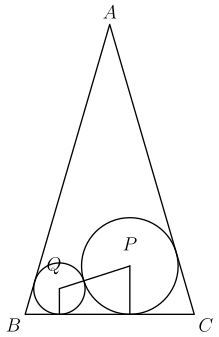
Coloca y la altura desde tiene longitud así que Entonces y Un círculo de radio tangente a y a un lado inclinado tiene su centro en la bisectriz que parte de ese vértice de la base, a altura y a distancia horizontal del vértice. Así y donde es el radio del círculo
La tangencia externa significa que Como esto se convierte en es decir, que se simplifica a así que
La raíz haría que el círculo se extienda fuera del triángulo, así que Aquí y lo que da
Place and the altitude from has length so Then and A circle of radius tangent to and to a slanted side has its center on the bisector from that base vertex, at height and horizontal distance from the vertex. Thus and where is the radius of circle
External tangency means Since this becomes i.e. which simplifies to so
The root would make circle extend outside the triangle, so Here and giving
12.
Hay dos astas de bandera distinguibles, y hay banderas, de las cuales son banderas azules idénticas, y son banderas verdes idénticas. Sea el número de arreglos distinguibles que usan todas las banderas en los que cada asta tiene al menos una bandera y no hay dos banderas verdes adyacentes en ninguna de las astas. Halla el residuo cuando se divide entre
There are two distinguishable flagpoles, and there are flags, of which are identical blue flags, and are identical green flags. Let be the number of distinguishable arrangements using all of the flags in which each flagpole has at least one flag and no two green flags on either pole are adjacent. Find the remainder when is divided by
Respuesta: 310
Pista pequeña:
En un asta con banderas azules y verdes, las verdes deben ocupar espacios distintos entre los espacios determinados por las azules: maneras
On a pole with blue and green flags, the greens must occupy distinct gaps among the gaps determined by the blues: ways
Pista grande:
Suma sobre usando la identidad de Vandermonde, luego resta los arreglos que dejan un asta vacía
Sum over using Vandermonde’s identity, then subtract the arrangements that leave a pole empty
Solución:
Supongamos que la primera asta recibe banderas azules y verdes, la segunda las restantes azules y verdes. En un asta con banderas azules, las banderas verdes deben ocupar espacios distintos entre los espacios alrededor de las azules, de maneras. Ignorando temporalmente el requisito de que cada asta sea no vacía, el total es donde la suma interior se colapsa por la identidad de Vandermonde, ya que
Los arreglos que dejan un asta vacía ponen las banderas en una sola asta, de maneras para cada elección de asta. Por lo tanto y el residuo cuando se divide entre es
Suppose the first pole gets blue and green flags, the second the remaining blue and green. On a pole with blue flags, the green flags must occupy distinct gaps among the gaps around the blues, in ways. Temporarily ignoring the requirement that each pole be nonempty, the total is where the inner sum collapses by Vandermonde’s identity, since
The arrangements that leave a pole empty put all flags on one pole, in ways for each choice of pole. Hence and the remainder when is divided by is
13.
Un hexágono regular con centro en el origen en el plano complejo tiene pares de lados opuestos separados una unidad. Un par de lados es paralelo al eje imaginario. Sea la región fuera del hexágono, y sea Entonces el área de tiene la forma donde y son enteros positivos. Halla
A regular hexagon with center at the origin in the complex plane has opposite pairs of sides one unit apart. One pair of sides is parallel to the imaginary axis. Let be the region outside the hexagon, and let Then the area of has the form where and are positive integers. Find
Respuesta: 29
Pista pequeña:
Escribiendo el semiplano se mapea exactamente sobre el disco de radio centrado en
Writing the half-plane maps exactly onto the disk of radius centered at
Pista grande:
es la unión de seis discos unitarios centrados en las raíces sextas de la unidad; por simetría halla el área dentro de una cuña de como un sector de más dos triángulos
is the union of six unit disks centered at the sixth roots of unity; by symmetry find the area inside one wedge as a sector plus two triangles
Solución:
Los lados del hexágono están a distancia del origen, con un lado sobre la recta así que es la unión de los seis semiplanos obtenidos al rotar por múltiplos de Si entonces es equivalente a es decir, Así que cada semiplano se mapea sobre un disco unitario abierto, y es la unión de seis discos unitarios centrados en las raíces sextas de la unidad.
Divide el plano en seis cuñas de mediante los rayos con ángulos por simetría, dentro de cada cuña coincide con el disco cuyo centro está en esa cuña. Los rayos en cortan al círculo en así que la parte de en esa cuña consta de dos triángulos con vértices en el centro y uno de estos puntos, cada uno isósceles con dos lados y ángulo en el vértice de área , junto con el sector de del disco entre ellos, de área
Cada cuña contribuye por lo tanto y el área total es Así y
The hexagon’s sides lie at distance from the origin, with one side on the line so is the union of the six half-planes obtained by rotating by multiples of If then is equivalent to i.e. So each half-plane maps onto an open unit disk, and is the union of six unit disks centered at the sixth roots of unity.
Cut the plane into six wedges by the rays at angles by symmetry, within each wedge coincides with the disk whose center lies in that wedge. The rays at meet the circle at so the piece of in that wedge consists of two triangles with vertices at the center and one of these points — each isosceles with two sides and apex angle area — together with the sector of the disk between them, area
Each wedge therefore contributes and the total area is Thus and
14.
Sean y números reales positivos con Sea el máximo valor posible de para el cual el sistema de ecuaciones tiene una solución que satisface y Entonces puede expresarse como una fracción donde y son enteros positivos primos entre sí. Halla
Let and be positive real numbers with Let be the maximum possible value of for which the system of equations has a solution satisfying and Then can be expressed as a fraction where and are relatively prime positive integers. Find
Respuesta: 7
Pista pequeña:
Las cantidades iguales son distancias al cuadrado: con en un rectángulo el triángulo es equilátero
The equal quantities are squared distances: with in an rectangle, triangle is equilateral
Pista grande:
Con los lados iguales fuerzan que crece en mientras que limita a
With equal sides force which increases in while caps at
Solución:
Dibuja el rectángulo con vértices y sea sobre y sobre Entonces y así que el sistema dice exactamente que el triángulo es equilátero, con las restricciones que mantienen y sobre esos dos lados.
Sea así que y Como y el ángulo de la esquina en es obtenemos así que y Igualar da que es creciente en El requisito da mientras que fuerza
El máximo se alcanza por lo tanto en donde logrado con y Por lo tanto y
Draw the rectangle with vertices and let on and on Then and so the system says exactly that triangle is equilateral, with the constraints keeping and on those two sides.
Let so and Since and the corner angle at is we get so and Setting gives which is increasing in The requirement gives while forces
The maximum is therefore at where attained with and Hence and
15.
Halla el mayor entero que satisface las siguientes condiciones: puede expresarse como la diferencia de dos cubos consecutivos; es un cuadrado perfecto.
Find the largest integer satisfying the following conditions: can be expressed as the difference of two consecutive cubes; is a perfect square.
Respuesta: 181
Pista pequeña:
La condición dice que se reordena a
Condition says which rearranges to
Pista grande:
Los dos factores son coprimos, y trabajando módulo se muestra que debe ser un cuadrado perfecto; luego produce una diferencia de cuadrados igual a
The two factors are coprime, and working modulo shows must be a perfect square; then yields a difference of squares equal to
Solución:
La condición dice para algún entero Multiplicando por y reordenando, es decir, Los factores de la izquierda son números impares consecutivos, por lo tanto coprimos, así que uno de ellos es un cuadrado perfecto y el otro es veces un cuadrado. Si entonces sería un cuadrado perfecto, lo cual es imposible. Por lo tanto con impar.
Escribir da La condición dice así que Los dos factores tienen la misma paridad, así que ambos son pares: los pares dan de los cuales los valores impares producen (así ) y (así ).
Para en efecto (aquí como se requería), y Así que el mayor de este tipo es
Condition says for some integer Multiplying by and rearranging, i.e. The factors on the left are consecutive odd numbers, hence coprime, so one of them is a perfect square and the other is times a square. If then would be a perfect square, which is impossible. Hence with odd.
Writing gives Condition says so The two factors have the same parity, so both are even: the pairs give of which the odd values yield (so ) and (so ).
For indeed (here as required), and So the largest such is