2016 AIME II Problema 10

A continuación está la solución preparada profesionalmente para el Problema 10 del 2016 AIME II, de LIVE by Po-Shen Loh. También puedes intentar el examen cronometrado completo, ver todas las soluciones del 2016 AIME II, o revisar la clave de respuestas.

Todos los problemas se usan con el permiso legal oficial de la Mathematical Association of America (MAA).

Conceptos:potencia de un puntocuadrilátero cíclicopersecución de ángulossemejanza

Nivel de dificultad: 3060

10.

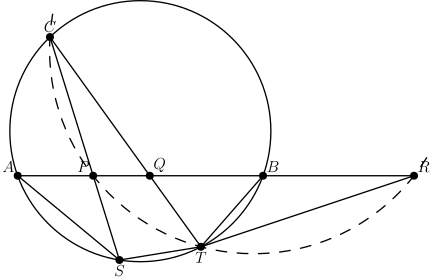
El triángulo ABCABC está inscrito en la circunferencia ω.\omega. Los puntos PP y QQ están sobre el lado AB\overline{AB} con AP<AQ.AP \lt AQ. Los rayos CPCP y CQCQ cortan de nuevo a ω\omega en SS y TT (distintos de CC), respectivamente. Si AP=4,AP = 4, PQ=3,PQ = 3, QB=6,QB = 6, BT=5,BT = 5, y AS=7,AS = 7, entonces ST=mn,ST = \frac{m}{n}, donde mm y nn son enteros positivos primos entre sí. Halla m+n.m + n.

Triangle ABCABC is inscribed in circle ω.\omega. Points PP and QQ are on side AB\overline{AB} with AP<AQ.AP \lt AQ. Rays CPCP and CQCQ meet ω\omega again at SS and TT (other than CC), respectively. If AP=4,AP = 4, PQ=3,PQ = 3, QB=6,QB = 6, BT=5,BT = 5, and AS=7,AS = 7, then ST=mn,ST = \frac{m}{n}, where mm and nn are relatively prime positive integers. Find m+n.m + n.

Solución:

Por la potencia de un punto en QQ respecto a ω,\omega, QCQT=QAQBQC \cdot QT = QA \cdot QB =76=42.= 7 \cdot 6 = 42. Prolonga AB\overline{AB} más allá de BB hasta el punto RR con BR=8,BR = 8, de modo que QR=QB+BR=14QR = QB + BR = 14 y QPQR=314QP \cdot QR = 3 \cdot 14 =42=QCQT.= 42 = QC \cdot QT. Por el recíproco de la potencia de un punto, C,C, P,P, T,T, y RR son concíclicos.

En la circunferencia CPTR,CPTR, BRT=PRT=PCT,\angle BRT = \angle PRT = \angle PCT, y en ω,\omega, PCT=SCT=SAT\angle PCT = \angle SCT = \angle SAT (ambos subtienden el arco STST). Además ASTBASTB es cíclico, así que el ángulo exterior del cuadrilátero en BB es igual al ángulo interior opuesto: RBT=AST.\angle RBT = \angle AST. Por tanto ASTRBT.\triangle AST \sim \triangle RBT.

Por tanto STBT=ASRB,\frac{ST}{BT} = \frac{AS}{RB}, así que ST=578=358,ST = 5 \cdot \frac{7}{8} = \frac{35}{8}, y m+n=35+8=43.m + n = 35 + 8 = 43.

By Power of a Point at QQ in ω,\omega, QCQT=QAQBQC \cdot QT = QA \cdot QB =76=42.= 7 \cdot 6 = 42. Extend AB\overline{AB} beyond BB to the point RR with BR=8,BR = 8, so that QR=QB+BR=14QR = QB + BR = 14 and QPQR=314QP \cdot QR = 3 \cdot 14 =42=QCQT.= 42 = QC \cdot QT. By the converse of Power of a Point, C,C, P,P, T,T, and RR are concyclic.

In circle CPTR,CPTR, BRT=PRT=PCT,\angle BRT = \angle PRT = \angle PCT, and in ω,\omega, PCT=SCT=SAT\angle PCT = \angle SCT = \angle SAT (both subtend arc STST). Also ASTBASTB is cyclic, so the exterior angle of the quadrilateral at BB equals the opposite interior angle: RBT=AST.\angle RBT = \angle AST. Hence ASTRBT.\triangle AST \sim \triangle RBT.

Therefore STBT=ASRB,\frac{ST}{BT} = \frac{AS}{RB}, so ST=578=358,ST = 5 \cdot \frac{7}{8} = \frac{35}{8}, and m+n=35+8=43.m + n = 35 + 8 = 43.

← Problema 9#9Examen completoProblema 11#11 →

El Problema 10 en otros años