
Soluciones del 2016 AIME II
Desplázate hacia abajo para ver las soluciones preparadas profesionalmente de LIVE by Po-Shen Loh, imprime las soluciones en PDF, consulta la clave de respuestas, o haz el examen cronometrado completo.
Todos los problemas se usan con el permiso legal oficial de la Mathematical Association of America (MAA).
1.
Inicialmente Alex, Betty y Charlie tenían en total cacahuetes. Charlie tenía la mayor cantidad de cacahuetes y Alex la menor. Las tres cantidades de cacahuetes que cada persona tenía forman una progresión geométrica. Alex se come de sus cacahuetes, Betty se come de los suyos y Charlie se come de los suyos. Ahora las tres cantidades de cacahuetes que cada persona tiene forman una progresión aritmética. Halla el número de cacahuetes que Alex tenía inicialmente.
Initially Alex, Betty, and Charlie had a total of peanuts. Charlie had the most peanuts, and Alex had the least. The three numbers of peanuts that each person had form a geometric progression. Alex eats of his peanuts, Betty eats of her peanuts, and Charlie eats of his peanuts. Now the three numbers of peanuts that each person has form an arithmetic progression. Find the number of peanuts Alex had initially.
Pista pequeña:
Después de que todos coman, quedan cacahuetes en progresión aritmética, así que la cantidad central es
After everyone eats, peanuts remain in arithmetic progression, so the middle amount is
Pista grande:
Betty empezó con Escribe las cantidades iniciales como y usa el total
Betty began with Write the starting amounts as and use the total
Solución:
Tras comer, quedan cacahuetes, y las tres cantidades forman una progresión aritmética, así que la cantidad central, la de Betty, es Por tanto Betty empezó con cacahuetes.
Las cantidades iniciales forman una progresión geométrica, así que son y con (Charlie tenía la mayor cantidad y Alex la menor). Entonces que se simplifica a con raíces y como tomamos
Así que Alex tenía inicialmente cacahuetes. (Comprobación: tras comer, las cantidades aumentan en cada una.)
After the eating, peanuts remain, and the three amounts form an arithmetic progression, so the middle amount, Betty’s, is Hence Betty started with peanuts.
The starting amounts form a geometric progression, so they are and with (Charlie had the most and Alex the least). Then which simplifies to with roots and since we take
So Alex initially had peanuts. (Check: after eating, the amounts increase by each.)
2.
Hay un de probabilidad de lluvia el sábado y un de probabilidad de lluvia el domingo. Sin embargo, es dos veces más probable que llueva el domingo si llueve el sábado que si no llueve el sábado. La probabilidad de que llueva al menos un día este fin de semana es donde y son enteros positivos primos entre sí. Halla
There is a chance of rain on Saturday and a chance of rain on Sunday. However, it is twice as likely to rain on Sunday if it rains on Saturday than if it does not rain on Saturday. The probability that it rains at least one day this weekend is where and are relatively prime positive integers. Find
Pista pequeña:
Sea la probabilidad de que llueva el domingo cuando el sábado está seco; entonces es cuando el sábado es lluvioso. Usa la probabilidad global del
Let be the chance of Sunday rain when Saturday is dry; then it is when Saturday is rainy. Use the overall
Pista grande:
Una vez conocido , la probabilidad de un fin de semana completamente seco es
Once is known, the chance of a completely dry weekend is
Solución:
Sea la probabilidad de que llueva el domingo dado un sábado seco; dado un sábado lluvioso es La probabilidad global del domingo da así que y
El fin de semana es completamente seco exactamente cuando el sábado está seco y luego el domingo está seco: Así que la probabilidad de que llueva al menos un día es que está en su forma más simple, y
Let be the probability that it rains on Sunday given a dry Saturday; given a rainy Saturday it is The overall Sunday chance gives so and
The weekend is completely dry exactly when Saturday is dry and then Sunday is dry: So the probability of rain on at least one day is which is in lowest terms, and
3.
Sean y números reales que satisfacen el sistema Halla el valor de
Let and be real numbers satisfying the system Find the value of
Pista pequeña:
Deshaz cada logaritmo exterior: las ecuaciones se convierten en
Undo each outer logarithm: the equations become
Pista grande:
Pon etc., y suma las tres ecuaciones: tiene exactamente una solución
Set etc., and add all three equations: has exactly one solution
Solución:
Exponenciar cada ecuación da y análogamente para las demás, así que Escribimos de modo que
Sumar las tres ecuaciones da donde El lado izquierdo es estrictamente creciente en y funciona ya que así que y
Entonces y así que
Exponentiating each equation gives and similarly for the others, so Write so that
Adding the three equations gives where The left side is strictly increasing in and works since so and
Then and so
4.
Una caja rectangular de se construye con cubos unitarios. Cada cubo unitario se colorea de rojo, verde o amarillo. Cada una de las capas de tamaño paralelas a las caras de la caja contiene exactamente cubos rojos, exactamente cubos verdes y algunos cubos amarillos. Cada una de las capas de tamaño paralelas a las caras de la caja contiene exactamente cubos verdes, exactamente cubos amarillos y algunos cubos rojos. Halla el menor volumen posible de la caja.
An rectangular box is built from unit cubes. Each unit cube is colored red, green, or yellow. Each of the layers of size parallel to the -faces of the box contains exactly red cubes, exactly green cubes, and some yellow cubes. Each of the layers of size parallel to the -faces of the box contains exactly green cubes, exactly yellow cubes, and some red cubes. Find the smallest possible volume of the box.
Pista pequeña:
Cuenta cada color en toda la caja usando ambas direcciones de capas; por ejemplo el verde da
Count each color over the whole box using both layer directions; for instance green gives
Pista grande:
Los recuentos obligan a y así que el volumen es con dividiendo tanto a como a
The counts force and so the volume is with dividing both and
Solución:
Cada capa tiene exactamente cubos rojos y verdes, por lo que tiene exactamente amarillos; cada capa tiene exactamente verdes y amarillos, por lo que tiene exactamente rojos. Contar los cubos verdes de toda la caja de ambas maneras da así que Contar los amarillos de ambas maneras da así que Contar los rojos de ambas maneras da y así que
Así y son enteros positivos, así que divide a y el volumen es mínimo cuando volumen con
Esto es alcanzable: colorea cada capa con tres filas idénticas RRRGGGGYYYYY. Entonces cada capa tiene cubos rojos, verdes y amarillos, y cada capa tiene rojos, verdes y amarillos. Así que el menor volumen posible es
Each layer has exactly red and green cubes, hence exactly yellow; each layer has exactly green and yellow, hence exactly red. Counting green cubes in the whole box both ways gives so Counting yellow both ways gives so Counting red both ways gives and so
Thus and are positive integers, so divides and the volume is smallest when volume with
This is achievable: color every layer with three identical rows RRRGGGGYYYYY. Then each layer has red, green, and yellow cubes, and each layer has red, green, and yellow cubes. So the smallest possible volume is
5.
El triángulo tiene un ángulo recto en Sus longitudes de lados son enteros positivos primos entre sí dos a dos, y su perímetro es Sea el pie de la altura a y para sea el pie de la altura a en La suma Halla
Triangle has a right angle at Its side lengths are pairwise relatively prime positive integers, and its perimeter is Let be the foot of the altitude to and for let be the foot of the altitude to in The sum Find
Pista pequeña:
Cada nueva altura crea un triángulo semejante al anterior, así que las longitudes forman una serie geométrica
Each new altitude creates a triangle similar to the one before, so the lengths form a geometric series
Pista grande:
Con catetos hipotenusa la serie suma Factoriza para simplificar.
With legs hypotenuse the series sums to Factor to simplify.
Solución:
Sean y La altura da y con razón Cada altura posterior repite esta construcción en un triángulo reducido por así que los segmentos forman una serie geométrica y
Como obtenemos así que es decir Elevar al cuadrado y usar da por tanto
Como las longitudes de los lados son primas entre sí dos a dos, y así que y en efecto Entonces (y se comprueba).
Let and The altitude gives and with ratio Each later altitude repeats this construction in a triangle scaled by so the segments form a geometric series and
Since we get so that is Squaring and using gives hence
Because the side lengths are pairwise relatively prime, and so and indeed Then (and checks).
6.
Para el polinomio define Entonces donde y son enteros positivos primos entre sí. Halla
For polynomial define Then where and are relatively prime positive integers. Find
Pista pequeña:
Los coeficientes de son todos positivos, y es un producto de tales polinomios
The coefficients of are all positive, and is a product of such polynomials
Pista grande:
Así que es simplemente
So is just
Solución:
Cada una de las potencias sustituidas tiene exponente impar, así que Como tiene solo coeficientes no negativos, también los tiene cada factor y por tanto también el producto El coeficiente de en es así que
Por tanto y
Every substituted power is odd, so Since has only nonnegative coefficients, so does each factor and hence so does the product The coefficient of in is so
Therefore and
7.
Los cuadrados y tienen un centro común y El área de es y el área de es un entero positivo menor. Se construye el cuadrado de modo que cada uno de sus vértices esté sobre un lado de y cada vértice de esté sobre un lado de Halla la diferencia entre el mayor y el menor valor entero posible para el área de
Squares and have a common center and The area of is and the area of is a smaller positive integer. Square is constructed so that each of its vertices lies on a side of and each vertex of lies on a side of Find the difference between the largest and smallest possible integer values for the area of
Pista pequeña:
Un cuadrado con vértices sobre los lados de un cuadrado de lado inclinado un ángulo tiene lado con
A square with vertices on the sides of a square of side tilted by has side with
Pista grande:
La misma relación conecta con así que las áreas forman una progresión geométrica: el área de es donde es el área de
The same relation ties to so the areas form a geometric progression: the area of is where is the area of
Solución:
Si un cuadrado de lado tiene sus vértices sobre los lados de un cuadrado concéntrico de lado y está inclinado un ángulo cada lado del cuadrado exterior se divide en trozos y así que Esto se aplica a (lado ) dentro de (lado ) con algún ángulo Como el cuadrado (lado ) forma el mismo ángulo con así que también
Por tanto así que las tres áreas forman una progresión geométrica: el área de es igual a donde es el área de Cuando recorre el factor toma todos los valores de así que toma todos los valores de ( se excluye porque es menor que ). Para que sea entero, debe dividir a lo que obliga a que divida a
Los múltiplos de en van desde hasta y cada uno se alcanza con un apropiado, siendo entonces el área de un entero positivo menor que La diferencia es
If a square of side has its vertices on the sides of a concentric square of side and is tilted by angle each side of the outer square is split into pieces and so This applies to (side ) in (side ) with some angle Since square (side ) makes the same angle with so also
Hence so the three areas form a geometric progression: the area of equals where is the area of As ranges over the factor takes every value in so takes every value in ( is excluded because is smaller than ). For to be an integer, must divide which forces to divide
The multiples of in run from to and each is attained by an appropriate with the area of then a positive integer less than The difference is
8.
Halla el número de conjuntos de tres enteros positivos distintos con la propiedad de que el producto de y es igual al producto de y
Find the number of sets of three distinct positive integers with the property that the product of and is equal to the product of and
Pista pequeña:
El producto es Primero cuenta las ternas ordenadas distribuyendo cada primo.
The product is First count ordered triples by distributing each prime.
Pista grande:
Un valor que aparece dos veces debe tener su cuadrado dividiendo al producto, así que es o Elimina esas ternas y divide entre
A value that appears twice must have its square divide the product, so it is or Remove those triples and divide by
Solución:
Cuenta las ternas ordenadas con Cada uno de los seis primos aparece una vez y puede ir a cualquiera de los tres valores: maneras. Los dos factores de pueden repartirse entre los tres valores de maneras. Eso da ternas ordenadas.
Si dos de los tres valores fueran iguales, su valor común cumpliría que divide a así que o Esto produce las ternas con valores y cada una en órdenes, para ternas ordenadas en total (que los tres sean iguales es imposible). Las ternas ordenadas restantes tienen entradas distintas, y cada conjunto se cuenta veces.
Así que el número de conjuntos es
Count ordered triples with Each of the six primes appears once and can go to any of the three values: ways. The two factors of can be split among the three values in ways. That gives ordered triples.
If two of the three values were equal, their common value would be such that divides so or This produces the triples with values and each in orders, for ordered triples in all (all three equal is impossible). The remaining ordered triples have distinct entries, and each set is counted times.
So the number of sets is
9.
Las sucesiones de enteros positivos y son una sucesión aritmética creciente y una sucesión geométrica creciente, respectivamente. Sea Existe un entero tal que y Halla
The sequences of positive integers and are an increasing arithmetic sequence and an increasing geometric sequence, respectively. Let There is an integer such that and Find
Pista pequeña:
Escribe y con enteros y convierte los dos valores dados en ecuaciones
Write and with integers and turn the two given values into equations
Pista grande:
Muestra que y luego deben ser múltiplos de con solo quedan seis pares por probar
Show and then must be multiples of with only six pairs remain to test
Solución:
Escribe y con enteros y Como tenemos y las dos condiciones dicen
Restando, El producto de tres enteros consecutivos es divisible por así que divide a por tanto divide a Entonces obliga a que divida a así que divide a Las cotas y dejan solo
Probando cada uno contra y solo da un valor consistente, Entonces
Write and with integers and Since we have and the two conditions read
Subtracting, The product of three consecutive integers is divisible by so divides hence divides Then forces to divide so divides The bounds and leave only
Testing each against and only gives a consistent value, Then
10.
El triángulo está inscrito en la circunferencia Los puntos y están sobre el lado con Los rayos y cortan de nuevo a en y (distintos de ), respectivamente. Si y entonces donde y son enteros positivos primos entre sí. Halla
Triangle is inscribed in circle Points and are on side with Rays and meet again at and (other than ), respectively. If and then where and are relatively prime positive integers. Find
Pista pequeña:
Prolonga más allá de hasta con Entonces así que están en una circunferencia.
Extend past to with Then so lie on a circle.
Pista grande:
Sigue las relaciones entre ángulos en ambas circunferencias para obtener así que
Chase angles through both circles to get so
Solución:
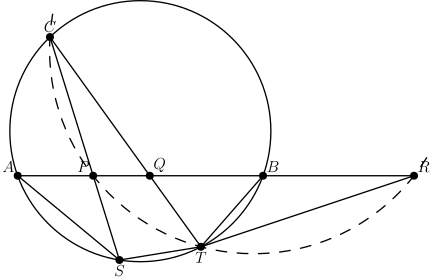
Por la potencia de un punto en respecto a Prolonga más allá de hasta el punto con de modo que y Por el recíproco de la potencia de un punto, y son concíclicos.
En la circunferencia y en (ambos subtienden el arco ). Además es cíclico, así que el ángulo exterior del cuadrilátero en es igual al ángulo interior opuesto: Por tanto
Por tanto así que y
By Power of a Point at in Extend beyond to the point with so that and By the converse of Power of a Point, and are concyclic.
In circle and in (both subtend arc ). Also is cyclic, so the exterior angle of the quadrilateral at equals the opposite interior angle: Hence
Therefore so and
11.
Para enteros positivos y se dice que es -nice si existe un entero positivo tal que tiene exactamente divisores positivos. Halla el número de enteros positivos menores que que no son ni -nice ni -nice.
For positive integers and define to be -nice if there exists a positive integer such that has exactly positive divisors. Find the number of positive integers less than that are neither -nice nor -nice.
Pista pequeña:
Si entonces tiene divisores, que es más que un múltiplo de
If then has divisors, which is more than a multiple of
Pista grande:
Todo también funciona (toma ). Cuenta los residuos módulo y módulo por debajo de por inclusión-exclusión.
Every works too (take ). Count residues mod and mod below by inclusion-exclusion.
Solución:
Si entonces tiene divisores positivos, y cada factor es así que el producto también. Recíprocamente, si entonces da con exactamente divisores. Así que es -nice exactamente cuando
Entre hay enteros (a saber ) y enteros (a saber ). Como hay enteros (a saber ). Por inclusión-exclusión, de ellos son -nice u -nice.
Por tanto enteros positivos menores que no son ninguno de los dos.
If then has positive divisors, and each factor is so the product is too. Conversely, if then gives with exactly divisors. So is -nice exactly when
Among there are integers (namely ) and integers (namely ). Since there are integers (namely ). By inclusion-exclusion, of them are -nice or -nice.
Hence positive integers less than are neither.
12.
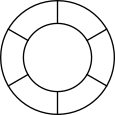
La figura de abajo muestra un anillo formado por seis secciones pequeñas que vas a pintar en una pared. Tienes cuatro colores de pintura disponibles y pintarás cada una de las seis secciones de un color sólido. Halla el número de maneras en que puedes elegir pintar las secciones si no se pueden pintar dos secciones adyacentes del mismo color.
The figure below shows a ring made of six small sections which you are to paint on a wall. You have four paint colors available and will paint each of the six sections a solid color. Find the number of ways you can choose to paint the sections if no two adjacent sections can be painted with the same color.
Pista pequeña:
Una fila de secciones con colores adyacentes distintos puede pintarse de maneras; sepáralas según si los dos colores de los extremos coinciden
A row of sections with adjacent colors different can be painted in ways; split these by whether the two end colors match
Pista grande:
Si cuenta las coloraciones del anillo, entonces partiendo de
If counts ring colorings, then starting from
Solución:
Sea el número de coloraciones válidas de un anillo de secciones. Cortar un anillo entre dos secciones adyacentes muestra que las coloraciones del anillo corresponden exactamente a filas de secciones con colores adyacentes distintos y los dos colores de los extremos distintos. Una fila de secciones con colores adyacentes distintos puede pintarse de maneras, y las filas cuyos colores de los extremos coinciden corresponden, al fusionar las dos secciones extremas en una, a coloraciones de anillo de secciones. Por tanto
Tres secciones mutuamente adyacentes dan así que luego y finalmente
Let be the number of valid paintings of a ring of sections. Cutting a ring open between two adjacent sections shows that ring paintings correspond exactly to rows of sections with adjacent colors different and the two end colors different. A row of sections with adjacent colors different can be painted in ways, and the rows whose end colors match correspond, by merging the two end sections into one, to ring paintings of sections. Hence
Three mutually adjacent sections give so then and finally
13.
Beatrix va a colocar seis torres en un tablero de ajedrez de donde tanto las filas como las columnas están numeradas del al las torres se colocan de modo que no haya dos torres en la misma fila o en la misma columna. El valor de una casilla es la suma de su número de fila y su número de columna. La puntuación de una disposición de torres es el menor valor de cualquier casilla ocupada. La puntuación media sobre todas las configuraciones válidas es donde y son enteros positivos primos entre sí. Halla
Beatrix is going to place six rooks on a chessboard where both the rows and columns are labeled to the rooks are placed so that no two rooks are in the same row or the same column. The value of a square is the sum of its row number and column number. The score of an arrangement of rooks is the least value of any occupied square. The average score over all valid configurations is where and are relatively prime positive integers. Find
Pista pequeña:
Suma las puntuaciones contando las disposiciones con puntuación al menos el total es
Sum the scores by counting the arrangements with score at least the total is
Pista grande:
Una puntuación prohíbe las casillas con fila + columna coloca las torres fila por fila, por ejemplo
Score bans the squares with row + column place rooks row by row, e.g.
Solución:
Hay disposiciones, y toda puntuación está entre y Sea el número de disposiciones con puntuación al menos Como cada puntuación satisface el total de las puntuaciones es
Una puntuación significa que ninguna torre ocupa una casilla con fila + columna Coloca las torres fila por fila. Para solo está prohibida: Para la fila tiene columnas permitidas, luego la fila tiene (se excluyen la columna y la columna ya usada): Análogamente y (todas las torres en la antidiagonal).
El total es así que la media es y
There are arrangements, and every score lies between and Let be the number of arrangements with score at least Since each score satisfies the total of all scores is
Score means no rook occupies a square with row + column Place the rooks row by row. For only is banned: For row has allowed columns, then row has (column and the used column are excluded): Similarly and (all rooks on the anti-diagonal).
The total is so the average is and
14.
El triángulo equilátero tiene lado Los puntos y están fuera del plano de y en lados opuestos del plano. Además, y y los planos de y forman un ángulo diedro de (el ángulo entre los dos planos). Existe un punto cuya distancia a cada uno de y es Halla
Equilateral has side length Points and lie outside the plane of and are on opposite sides of the plane. Furthermore, and and the planes of and form a dihedral angle (the angle between the two planes). There is a point whose distance from each of and is Find
Pista pequeña:
y están todos en la recta que pasa por el centro de perpendicular a su plano, y es el punto medio de
and all lie on the line through the center of perpendicular to its plane, and is the midpoint of
Pista grande:
Como tenemos así que Combina con la fórmula de adición de la tangente en el punto medio de
Since so Combine with the tangent addition formula at the midpoint of
Solución:
Como y tanto como están en la recta que pasa por el centro de perpendicular a su plano, en lados opuestos. Cualquier punto equidistante de también está en esa recta, así que está en ella, y hace de el punto medio de con Sea el punto medio de y entonces y Como y el ángulo diedro es escribimos y así que
Los triángulos rectángulos y dan y así que Como el punto está en la circunferencia de diámetro así que y es el pie de la altura desde a la hipotenusa Por tanto lo que da
Por la fórmula de adición de la tangente, así que Entonces así que
Since and both and lie on the line through the center of perpendicular to its plane, on opposite sides. Any point equidistant from also lies on that line, so is on it, and makes the midpoint of with Let be the midpoint of and then and Since and the dihedral angle is write and so
Right triangles and give and so Since point lies on the circle with diameter so and is the foot of the altitude from to the hypotenuse Thus which gives
By the tangent addition formula, so Then so
15.
Para sea y Sean números reales positivos tales que y El máximo valor posible de donde y son enteros positivos primos entre sí. Halla
For let and Let be positive real numbers such that and The maximum possible value of where and are relatively prime positive integers. Find
Pista pequeña:
Usa para convertir la condición en
Use to turn the condition into
Pista grande:
Como Cauchy-Schwarz lo convierte en un caso de igualdad, forzando que sea proporcional a
Since Cauchy-Schwarz makes this an equality case, forcing proportional to
Solución:
Como tenemos Duplicando la ecuación dada y reordenando, así que
Ahora así que Por la desigualdad de Cauchy-Schwarz,
Se cumple la igualdad, así que es proporcional a forzando El único, y por tanto máximo, valor posible de es y
Since we have Doubling the given equation and rearranging, so
Now so By the Cauchy-Schwarz inequality,
Equality holds, so is proportional to forcing The only, hence maximum, possible value of is and