2007 AIME I Problema 12

Intenta el Problema 12 del 2007 AIME I a continuación y luego compara tu respuesta con la solución preparada profesionalmente de LIVE by Po-Shen Loh. También puedes intentar el examen cronometrado completo, ver todas las soluciones del 2007 AIME I, o revisar la clave de respuestas.

Todos los problemas se usan con el permiso legal oficial de la Mathematical Association of America (MAA).

12.

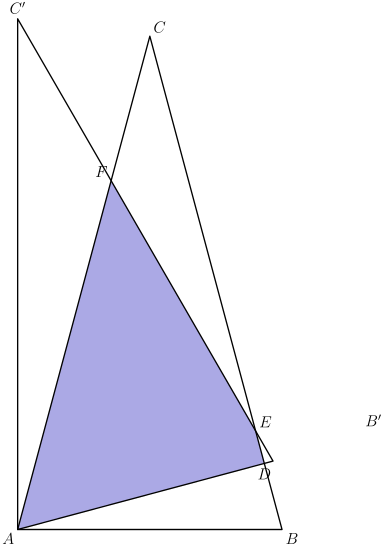
En el triángulo isósceles ABC,ABC, AA está ubicado en el origen y BB está ubicado en (20,0).(20, 0). El punto CC está en el primer cuadrante con AC=BCAC = BC y ∠BAC=75∘.\angle BAC = 75^\circ. Si △ABC\triangle ABC se rota en sentido antihorario alrededor del punto AA hasta que la imagen de CC quede sobre el semieje yy positivo, el área de la región común al triángulo original y al triángulo rotado tiene la forma p2+q3+r6+s,p\sqrt{2} + q\sqrt{3} + r\sqrt{6} + s, donde p,p, q,q, r,r, ss son enteros. Halla p−q+r−s2.\frac{p - q + r - s}{2}.
In isosceles triangle ABC,ABC, AA is located at the origin and BB is located at (20,0).(20, 0). Point CC is in the first quadrant with AC=BCAC = BC and ∠BAC=75∘.\angle BAC = 75^\circ. If △ABC\triangle ABC is rotated counterclockwise about point AA until the image of CC lies on the positive yy-axis, the area of the region common to the original triangle and the rotated triangle is in the form p2+q3+r6+s,p\sqrt{2} + q\sqrt{3} + r\sqrt{6} + s, where p,p, q,q, r,r, ss are integers. Find p−q+r−s2.\frac{p - q + r - s}{2}.
Respuesta: 875
Conceptos:transformaciónley de los senossemejanzadescomposición de áreas
Nivel de dificultad: 3270
Pista pequeña:
La rotación es de 15∘,15^\circ, y como ∠ABC=75∘,\angle ABC = 75^\circ, la imagen AB′AB' de ABAB es perpendicular a BCBC
The rotation is by 15∘,15^\circ, and since ∠ABC=75∘,\angle ABC = 75^\circ, the image AB′AB' of ABAB is perpendicular to BCBC
Pista grande:
El solapamiento es [AB′F]−[EB′D],[AB'F] - [EB'D], donde DD es el pie de AB′AB' sobre BCBC y E,E, FF están sobre B′C′;B'C'; usa la ley de senos y △EB′D∼△ABD\triangle EB'D \sim \triangle ABD
The overlap is [AB′F]−[EB′D],[AB'F] - [EB'D], where DD is the foot of AB′AB' on BCBC and E,E, FF lie on B′C′;B'C'; use the law of sines and △EB′D∼△ABD\triangle EB'D \sim \triangle ABD
Solución:
Como ACAC forma un ángulo de 75∘75^\circ con el semieje xx positivo, la rotación es de 15∘.15^\circ. Sean B′B' y C′C' las imágenes de BB y C.C. Como ∠B′AB=15∘\angle B'AB = 15^\circ y ∠ABC=75∘,\angle ABC = 75^\circ, el segmento AB′AB' es perpendicular a BC;BC; sea DD su intersección, y sean E=BC∩B′C′E = BC \cap B'C' y F=AC∩B′C′.F = AC \cap B'C'. La región común es el cuadrilátero ADEF,ADEF, cuya área es [AB′F]−[EB′D].[AB'F] - [EB'D].
En el triángulo AB′F,AB'F, ∠FAB′=75∘−15∘=60∘\angle FAB' = 75^\circ - 15^\circ = 60^\circ y ∠AB′F=75∘,\angle AB'F = 75^\circ, así que ∠AFB′=45∘,\angle AFB' = 45^\circ, y la ley de senos da B′F=20sin⁡60∘sin⁡45∘B'F = \frac{20\sin 60^\circ}{\sin 45^\circ} =106.= 10\sqrt{6}. Con sin⁡75∘=6+24,\sin 75^\circ = \frac{\sqrt{6} + \sqrt{2}}{4}, [AB′F]=12⋅20⋅106 sin⁡75∘=50(3+3).\begin{aligned} [AB'F] &= \tfrac{1}{2} \cdot 20 \cdot 10\sqrt{6}\,\sin 75^\circ \\ &= 50(3 + \sqrt{3}). \end{aligned}
En el triángulo rectángulo ABD,ABD, AD=20cos⁡15∘AD = 20\cos 15^\circ y BD=20sin⁡15∘,BD = 20\sin 15^\circ, así que [ABD]=200sin⁡15∘cos⁡15∘[ABD] = 200\sin 15^\circ\cos 15^\circ =100sin⁡30∘=50,= 100\sin 30^\circ = 50, y B′D=20(1−cos⁡15∘).B'D = 20(1 - \cos 15^\circ). Los triángulos EB′DEB'D y ABDABD son semejantes (ángulos rectos en D,D, y ∠EB′D=∠ABD=75∘\angle EB'D = \angle ABD = 75^\circ), así que, usando cos⁡15∘=6+24,\cos 15^\circ = \frac{\sqrt{6} + \sqrt{2}}{4}, [EB′D]=50(1−cos⁡15∘sin⁡15∘)2=50⋅(15+83−66−102).\begin{aligned} [EB'D] &= 50\left(\frac{1 - \cos 15^\circ}{\sin 15^\circ}\right)^2 \\ &= 50 \\ &\quad {}\cdot \left(15 + 8\sqrt{3} - 6\sqrt{6} - 10\sqrt{2}\right). \end{aligned} Por lo tanto [ADEF]=50(3+3)−50⋅(15+83−66−102)=5002−3503+3006−600,\begin{aligned} [ADEF] &= 50(3 + \sqrt{3}) \\ &\quad {}- 50 \\ &{}\cdot (15 + 8\sqrt{3} - 6\sqrt{6} - 10\sqrt{2}) \\ &= 500\sqrt{2} - 350\sqrt{3} \\ &\quad {}+ 300\sqrt{6} - 600, \end{aligned} así que (p,q,r,s)(p, q, r, s) =(500,−350,300,−600)= (500, -350, 300, -600) y p−q+r−s2=17502=875.\frac{p - q + r - s}{2} = \frac{1750}{2} = 875.
Since ACAC makes a 75∘75^\circ angle with the positive xx-axis, the rotation is by 15∘.15^\circ. Let B′B' and C′C' be the images of BB and C.C. Because ∠B′AB=15∘\angle B'AB = 15^\circ and ∠ABC=75∘,\angle ABC = 75^\circ, segment AB′AB' is perpendicular to BC;BC; let DD be their intersection, and let E=BC∩B′C′E = BC \cap B'C' and F=AC∩B′C′.F = AC \cap B'C'. The common region is the quadrilateral ADEF,ADEF, whose area is [AB′F]−[EB′D].[AB'F] - [EB'D].
In triangle AB′F,AB'F, ∠FAB′=75∘−15∘=60∘\angle FAB' = 75^\circ - 15^\circ = 60^\circ and ∠AB′F=75∘,\angle AB'F = 75^\circ, so ∠AFB′=45∘,\angle AFB' = 45^\circ, and the law of sines gives B′F=20sin⁡60∘sin⁡45∘B'F = \frac{20\sin 60^\circ}{\sin 45^\circ} =106.= 10\sqrt{6}. With sin⁡75∘=6+24,\sin 75^\circ = \frac{\sqrt{6} + \sqrt{2}}{4}, [AB′F]=12⋅20⋅106 sin⁡75∘=50(3+3).\begin{aligned} [AB'F] &= \tfrac{1}{2} \cdot 20 \cdot 10\sqrt{6}\,\sin 75^\circ \\ &= 50(3 + \sqrt{3}). \end{aligned}
In right triangle ABD,ABD, AD=20cos⁡15∘AD = 20\cos 15^\circ and BD=20sin⁡15∘,BD = 20\sin 15^\circ, so [ABD]=200sin⁡15∘cos⁡15∘[ABD] = 200\sin 15^\circ\cos 15^\circ =100sin⁡30∘=50,= 100\sin 30^\circ = 50, and B′D=20(1−cos⁡15∘).B'D = 20(1 - \cos 15^\circ). Triangles EB′DEB'D and ABDABD are similar (right angles at D,D, and ∠EB′D=∠ABD=75∘\angle EB'D = \angle ABD = 75^\circ), so, using cos⁡15∘=6+24,\cos 15^\circ = \frac{\sqrt{6} + \sqrt{2}}{4}, [EB′D]=50(1−cos⁡15∘sin⁡15∘)2=50⋅(15+83−66−102).\begin{aligned} [EB'D] &= 50\left(\frac{1 - \cos 15^\circ}{\sin 15^\circ}\right)^2 \\ &= 50 \\ &\quad {}\cdot \left(15 + 8\sqrt{3} - 6\sqrt{6} - 10\sqrt{2}\right). \end{aligned} Therefore [ADEF]=50(3+3)−50⋅(15+83−66−102)=5002−3503+3006−600,\begin{aligned} [ADEF] &= 50(3 + \sqrt{3}) \\ &\quad {}- 50 \\ &{}\cdot (15 + 8\sqrt{3} - 6\sqrt{6} - 10\sqrt{2}) \\ &= 500\sqrt{2} - 350\sqrt{3} \\ &\quad {}+ 300\sqrt{6} - 600, \end{aligned} so (p,q,r,s)(p, q, r, s) =(500,−350,300,−600)= (500, -350, 300, -600) and p−q+r−s2=17502=875.\frac{p - q + r - s}{2} = \frac{1750}{2} = 875.
Problema 11#11
Examen completo

El Problema 12 en otros años