
Problemas del 2007 AIME I
¡Desplázate hacia abajo y presiona Iniciar para intentar el examen! O ve al PDF imprimible, la clave de respuestas, o las soluciones profesionales preparadas por LIVE by Po-Shen Loh.
Todos los problemas se usan con el permiso legal oficial de la Mathematical Association of America (MAA).
O salta directamente a un solo problema con su solución: 1 · 2 · 3 · 4 · 5 · 6 · 7 · 8 · 9 · 10 · 11 · 12 · 13 · 14 · 15
¿Quieres aprender de forma profesional con clases interactivas en video?
Con tiempo
3:00:00
1.
¿Cuántos cuadrados perfectos positivos menores que son múltiplos de ?
How many positive perfect squares less than are multiples of
Respuesta: 83
Pista pequeña:
Un cuadrado perfecto es múltiplo de exactamente cuando su raíz cuadrada es múltiplo de
A perfect square is a multiple of exactly when its square root is a multiple of
Pista grande:
Cuenta los múltiplos de cuyos cuadrados son menores que es decir, los múltiplos de menores que
Count the multiples of whose squares are less than i.e. the multiples of less than
Solución:
Como un cuadrado es múltiplo de exactamente cuando es múltiplo de el factor obliga a que contenga el factor obliga a que contenga y recíprocamente siempre es múltiplo de Además exactamente cuando
Los múltiplos de menores que son y hay de ellos.
Since a square is a multiple of exactly when is a multiple of the factor forces to contain the factor forces to contain and conversely is always a multiple of Also exactly when
The multiples of less than are and there are of them.
2.
Una cinta transportadora de pies de largo se mueve a una velocidad constante de pies por segundo. Al se sube al inicio de la cinta y se queda parado. Bob se sube al inicio de la cinta dos segundos después y avanza caminando por la cinta a una velocidad constante de pies por segundo. Dos segundos más tarde, Cy llega al inicio de la cinta y camina a paso vivo junto a la cinta a una velocidad constante de pies por segundo. En cierto momento, una de estas tres personas está exactamente a la mitad de camino entre las otras dos. En ese momento, halla la distancia en pies entre el inicio de la cinta y la persona del medio.
A foot long moving walkway moves at a constant rate of feet per second. Al steps onto the start of the walkway and stands. Bob steps onto the start of the walkway two seconds later and strolls forward along the walkway at a constant rate of feet per second. Two seconds after that, Cy reaches the start of the walkway and walks briskly forward beside the walkway at a constant rate of feet per second. At a certain time, one of these three persons is exactly halfway between the other two. At that time, find the distance in feet between the start of the walkway and the middle person.
Respuesta: 52
Pista pequeña:
Mide el tiempo desde que Al se sube: Al está en Bob en y Cy en
Measure time from Al’s step: Al is at Bob at and Cy at
Pista grande:
Prueba con cada persona como la del medio: el doble de la posición del medio debe ser igual a la suma de las otras dos. Solo un caso da
Try each person as the one in the middle: twice the middle position must equal the sum of the other two. Only one case gives
Solución:
Mide el tiempo en segundos desde que Al se sube. Al se queda parado sobre la cinta, así que está en Bob se mueve a pies por segundo, así que está en Cy camina junto a la cinta a pies por segundo, así que está en Los tres se están moviendo una vez que
El doble de la posición de la persona del medio debe ser igual a la suma de las otras dos. Si Bob estuviera en el medio, da imposible. Si Cy estuviera en el medio, se reduce a sin solución. Si Al está en el medio, así que
En ese momento Al está en pies, mientras que Bob y Cy están en y cuyo promedio es en efecto La persona del medio está a pies del inicio.
Measure time in seconds from when Al steps on. Al stands on the walkway, so he is at Bob moves at feet per second, so he is at Cy walks beside the walkway at feet per second, so he is at All three are moving once
The middle person’s position doubled must equal the sum of the other two. If Bob were in the middle, gives impossible. If Cy were in the middle, reduces to with no solution. If Al is in the middle, so
At that moment Al is at feet, while Bob and Cy are at and whose average is indeed The middle person is feet from the start.
3.
El número complejo es igual a donde es un número real positivo e Dado que las partes imaginarias de y son iguales, halla
The complex number is equal to where is a positive real number and Given that the imaginary parts of and are equal, find
Respuesta: 15
Pista pequeña:
Desarrolla y con el teorema del binomio y extrae las partes imaginarias
Expand and with the binomial theorem and extract the imaginary parts
Pista grande:
Ambas partes imaginarias son divisibles entre cancélalo antes de resolver
Both imaginary parts are divisible by cancel it before solving
Solución:
Por el teorema del binomio, y Igualar las partes imaginarias da
Como es positivo, podemos dividir entre lo que deja así que
By the binomial theorem, and Setting the imaginary parts equal gives
Since is positive we may divide by leaving so
4.
Tres planetas giran alrededor de una estrella en órbitas circulares coplanares con la estrella en el centro. Todos los planetas giran en la misma dirección, cada uno a velocidad constante, y los periodos de sus órbitas son y años. Las posiciones de la estrella y los tres planetas son actualmente colineales. La próxima vez que serán colineales será dentro de años. Halla
Three planets revolve about a star in coplanar circular orbits with the star at the center. All planets revolve in the same direction, each at a constant speed, and the periods of their orbits are and years. The positions of the star and all three planets are currently collinear. They will next be collinear after years. Find
Respuesta: 105
Pista pequeña:
Los cuatro cuerpos son colineales exactamente cuando, para cada par de planetas, el número de revoluciones difiere en un múltiplo de
All four bodies are collinear exactly when each pair of planets has revolution counts differing by a multiple of
Pista grande:
Dos de las diferencias entre pares crecen a de revolución por año y la tercera al doble de rápido; haz que cada diferencia sea un múltiplo de
Two of the pairwise gaps grow at revolution per year and the third twice as fast; make every gap a multiple of
Solución:
Los cuatro cuerpos están sobre una misma recta exactamente cuando cada par de planetas es colineal con la estrella, es decir, cuando las posiciones angulares de cada par difieren en un múltiplo de media revolución. En años los planetas completan y revoluciones, así que las diferencias entre pares son
Necesitamos que y sean múltiplos de La primera requiere que sea múltiplo de y cualquier así hace que sea entero. La menor opción positiva es
All four bodies lie on one line exactly when every pair of planets is collinear with the star, i.e. when each pair’s angular positions differ by a multiple of — half a revolution. In years the planets complete and revolutions, so the pairwise differences are
We need and to be multiples of The first requires to be a multiple of and any such makes an integer. The smallest positive choice is
5.
La fórmula para convertir una temperatura Fahrenheit a la temperatura Celsius correspondiente es Una temperatura Fahrenheit entera se convierte a Celsius y se redondea al entero más cercano; la temperatura Celsius entera resultante se convierte de nuevo a Fahrenheit y se redondea al entero más cercano. ¿Para cuántas temperaturas Fahrenheit enteras con la temperatura original es igual a la temperatura final?
The formula for converting a Fahrenheit temperature to the corresponding Celsius temperature is An integer Fahrenheit temperature is converted to Celsius and rounded to the nearest integer; the resulting integer Celsius temperature is converted back to Fahrenheit and rounded to the nearest integer. For how many integer Fahrenheit temperatures with does the original temperature equal the final temperature?
Respuesta: 539
Pista pequeña:
Sumar a suma exactamente a así que el viaje de ida y vuelta se comporta igual para y
Adding to adds exactly to so the round trip behaves identically for and
Pista grande:
Comprueba a mano hasta para ver cuántas de cada temperaturas consecutivas sobreviven, luego trata hasta por separado
Check through by hand to see how many of each consecutive temperatures survive, then handle through separately
Solución:
Sumar a suma exactamente a por tanto al valor Celsius redondeado, y por tanto al valor Fahrenheit final. Así que vuelve a sí mismo si y solo si lo hace, y basta con comprobar nueve temperaturas consecutivas. Comprobando hasta los valores finales son así que exactamente las cinco temperaturas sobreviven.
El rango de a contiene enteros, aportando supervivientes. Los restantes se comportan como de los cuales sobreviven, sumando más.
El total es
Adding to adds exactly to hence to the rounded Celsius value, hence to the final Fahrenheit value. So returns to itself if and only if does, and it suffices to check nine consecutive temperatures. Checking through the final values are so exactly the five temperatures survive.
The range from through contains integers, contributing survivors. The remaining behave like of which survive, adding more.
The total is
6.
Se coloca una rana en el origen de la recta numérica, y se mueve según la siguiente regla: en un movimiento dado, la rana avanza al punto más cercano con coordenada entera mayor que sea múltiplo de o al punto más cercano con coordenada entera mayor que sea múltiplo de Una secuencia de movimientos es una sucesión de coordenadas que corresponden a movimientos válidos, que empieza con y termina con Por ejemplo, es una secuencia de movimientos. ¿Cuántas secuencias de movimientos son posibles para la rana?
A frog is placed at the origin on the number line, and moves according to the following rule: in a given move, the frog advances to either the closest point with a greater integer coordinate that is a multiple of or to the closest point with a greater integer coordinate that is a multiple of A move sequence is a sequence of coordinates which correspond to valid moves, beginning with and ending with For example, is a move sequence. How many move sequences are possible for the frog?
Respuesta: 169
Pista pequeña:
Divide el trayecto en los puntos de referencia y cuenta las rutas de cada segmento y multiplica
Split the journey at the landmarks and count routes for each segment and multiply
Pista grande:
Hay rutas entre múltiplos consecutivos de y rutas a lo largo de un tramo que se salta el múltiplo de del medio
There are routes between consecutive multiples of and routes across a stretch that skips the multiple of in the middle
Solución:
Divide el trayecto en los puntos de referencia y Desde la rana sube por los múltiplos de y puede saltar a desde cualquiera de lo que da rutas de a de igual modo hay rutas de a (saltar a desde ) y de a Para saltarse por completo la rana debe elegir la opción de múltiplo de cada vez que pasa por y luego saltar a desde uno de rutas de a evitando De manera similar hay rutas de a evitando y de a evitando ambos.
Combinando los segmentos: pasando por ambos puntos de referencia, pasando solo por , pasando solo por , por ninguno, El total es
Split the journey at the landmarks and From the frog climbs the multiples of and may jump to from any of giving routes from to likewise there are routes from to (jump to from ) and from to To skip entirely the frog must take the multiple-of- option every time through then jump to from one of routes from to avoiding Similarly there are routes from to avoiding and from to avoiding both.
Combining the segments: through both landmarks, through only, through only, through neither, The total is
7.
Sea Halla el residuo cuando se divide entre (Aquí denota el mayor entero que es menor o igual que y denota el menor entero que es mayor o igual que )
Let Find the remainder when is divided by (Here denotes the greatest integer that is less than or equal to and denotes the least integer that is greater than or equal to )
Respuesta: 477
Pista pequeña:
es igual a salvo que sea entero, en cuyo caso es igual a
equals unless is an integer, when it equals
Pista grande:
Para enteros es entero exactamente cuando es una potencia de así que resta las potencias de de
For integers is an integer exactly when is a power of so subtract the powers of from
Solución:
La diferencia es igual a cuando no es entero y a cuando sí lo es. Ahora bien, es entero exactamente cuando para algún entero y para que sea entero, debe ser par, es decir, debe ser una potencia de Las potencias que son a lo sumo son
Por lo tanto y el residuo al dividir entre es
The difference equals when is not an integer and when it is. Now is an integer exactly when for some integer and for to be an integer, must be even — that is, must be a power of The powers at most are
Therefore and the remainder upon division by is
8.
El polinomio es cúbico. ¿Cuál es el mayor valor de para el cual los polinomios y son ambos factores de ?
The polynomial is cubic. What is the largest value of for which the polynomials and are both factors of
Respuesta: 30
Pista pequeña:
Dos factores cuadráticos de un cúbico deben compartir una raíz común
Two quadratic factors of a cubic must share a common root
Pista grande:
En una raíz común es una ecuación lineal que da sustituye de vuelta en
At a common root is a linear equation giving substitute back into
Solución:
Si y no tuvieran una raíz común, su producto, de grado , dividiría al cúbico lo cual es imposible. Así que comparten una raíz y Al calcular, así que
Sustituyendo en da multiplicando por y simplificando resulta así que o
Para y y ambos dividen a El mayor valor es
If and had no common root, their product — of degree — would divide the cubic which is impossible. So they share a root and Computing, so
Substituting into gives multiplying by and simplifying yields so or
For and and both divide The largest value is
9.
En el triángulo rectángulo con ángulo recto en y Sus catetos y se prolongan más allá de y Los puntos y están en el exterior del triángulo y son los centros de dos círculos con radios iguales. El círculo con centro es tangente a la hipotenusa y a la prolongación del cateto el círculo con centro es tangente a la hipotenusa y a la prolongación del cateto y los círculos son tangentes exteriores entre sí. La longitud del radio de cualquiera de los círculos puede expresarse como donde y son enteros positivos primos entre sí. Halla
In right triangle with right angle and Its legs and are extended beyond and Points and lie in the exterior of the triangle and are the centers of two circles with equal radii. The circle with center is tangent to the hypotenuse and to the extension of leg the circle with center is tangent to the hypotenuse and to the extension of leg and the circles are externally tangent to each other. The length of the radius of either circle can be expressed as where and are relatively prime positive integers. Find
Respuesta: 737
Pista pequeña:
Cada círculo está inscrito en un ángulo externo del triángulo, así que su longitud de tangente desde a lo largo de la hipotenusa es
Each circle is inscribed in an external angle of the triangle, so its tangent length from along the hypotenuse is
Pista grande:
Los puntos de tangencia dividen la hipotenusa: con y
The tangency points split the hypotenuse: with and
Solución:
La hipotenusa es Sean y los puntos donde los círculos tocan a Ambos centros están a distancia de la recta en el lado opuesto al triángulo, así que es paralelo a y ya que los círculos son tangentes exteriores. Por tanto
El círculo está inscrito en el ángulo en entre el rayo y la prolongación de más allá de que mide Por tanto, su longitud de tangente desde es Con y la fórmula del ángulo medio da y de forma similar
Así que lo que da Como y no comparten ningún factor común,
The hypotenuse is Let and be the points where the circles touch Both centers lie at distance from line on the side away from the triangle, so is parallel to and since the circles are externally tangent. Thus
Circle is inscribed in the angle at between ray and the extension of beyond which measures Its tangent length from is therefore With and the half-angle formula gives and similarly
So giving Since and share no common factor,
10.
En la cuadrícula que se muestra, se van a sombrear de los cuadrados de modo que haya dos cuadrados sombreados en cada fila y tres cuadrados sombreados en cada columna. Sea el número de sombreados con esta propiedad. Halla el residuo cuando se divide entre
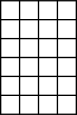
In the grid shown, of the squares are to be shaded so that there are two shaded squares in each row and three shaded squares in each column. Let be the number of shadings with this property. Find the remainder when is divided by
Respuesta: 860
Pista pequeña:
Sombrea primero la columna , luego clasifica según el número de filas sombreadas en ambas de las dos primeras columnas
Shade column first, then classify by the number of rows shaded in both of the first two columns
Pista grande:
Las filas que aún están vacías deben sombrearse en las dos columnas restantes; elegir la columna entonces obliga a la columna
The rows still empty must be shaded in both remaining columns; choosing column then forces column
Solución:
Sombrea tres de las seis filas en la columna formas. Sea el número de filas sombreadas en ambas columnas y la columna puede entonces elegirse de formas. Tras estas dos columnas, filas están completas con dos cuadrados sombreados, filas tienen uno, y filas no tienen ninguno.
Las filas vacías deben sombrearse en ambas columnas y La columna toma esas filas más de las filas con un solo sombreado, de formas, y la columna queda entonces determinada: debe cubrir las filas vacías y exactamente las filas con un solo sombreado omitidas por la columna
Sumando, así que el residuo es
Shade three of the six rows in column ways. Let be the number of rows shaded in both columns and column can then be chosen in ways. After these two columns, rows are complete with two shaded squares, rows have one, and rows have none.
The empty rows must be shaded in both columns and Column takes those rows plus of the singly-shaded rows, in ways, and column is then forced: it must cover the empty rows and exactly the singly-shaded rows skipped by column
Summing, so the remainder is
11.
Para cada entero positivo sea el único entero positivo tal que Por ejemplo, y Si halla el residuo cuando se divide entre
For each positive integer let denote the unique positive integer such that For example, and If find the remainder when is divided by
Respuesta: 955
Pista pequeña:
exactamente cuando un bloque de valores de
exactly when a block of values of
Pista grande:
Los bloques completos para cubren todo restante hasta tiene
Complete blocks for cover every remaining up to has
Solución:
Para un entero positivo la condición significa lo que para enteros equivale exactamente a Así que para exactamente valores de
Como los bloques cubren exactamente y aportan Los valores restantes tienen cada uno sumando
Por tanto y el residuo es
For a positive integer the condition means which for integers is exactly So for precisely values of
Since the blocks exactly cover and contribute The remaining values each have adding
Thus and the remainder is
12.
En el triángulo isósceles está ubicado en el origen y está ubicado en El punto está en el primer cuadrante con y Si se rota en sentido antihorario alrededor del punto hasta que la imagen de quede sobre el semieje positivo, el área de la región común al triángulo original y al triángulo rotado tiene la forma donde son enteros. Halla
In isosceles triangle is located at the origin and is located at Point is in the first quadrant with and If is rotated counterclockwise about point until the image of lies on the positive -axis, the area of the region common to the original triangle and the rotated triangle is in the form where are integers. Find
Respuesta: 875
Pista pequeña:
La rotación es de y como la imagen de es perpendicular a
The rotation is by and since the image of is perpendicular to
Pista grande:
El solapamiento es donde es el pie de sobre y están sobre usa la ley de senos y
The overlap is where is the foot of on and lie on use the law of sines and
Solución:
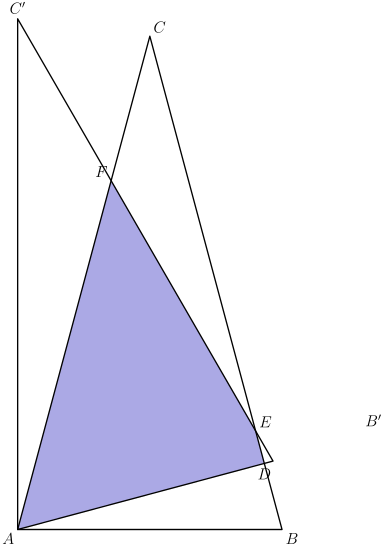
Como forma un ángulo de con el semieje positivo, la rotación es de Sean y las imágenes de y Como y el segmento es perpendicular a sea su intersección, y sean y La región común es el cuadrilátero cuya área es
En el triángulo y así que y la ley de senos da Con
En el triángulo rectángulo y así que y Los triángulos y son semejantes (ángulos rectos en y ), así que, usando Por lo tanto así que y
Since makes a angle with the positive -axis, the rotation is by Let and be the images of and Because and segment is perpendicular to let be their intersection, and let and The common region is the quadrilateral whose area is
In triangle and so and the law of sines gives With
In right triangle and so and Triangles and are similar (right angles at and ), so, using Therefore so and
13.
Una pirámide de base cuadrada con base y vértice tiene ocho aristas de longitud Un plano pasa por los puntos medios de y La intersección del plano con la pirámide tiene un área que puede expresarse como Halla
A square pyramid with base and vertex has eight edges of length A plane passes through the midpoints of and The plane’s intersection with the pyramid has an area that can be expressed as Find
Respuesta: 80
Pista pequeña:
Usa coordenadas: base y ápice el plano que pasa por los tres puntos medios es
Use coordinates: base and apex the plane through the three midpoints is
Pista grande:
La sección transversal es un pentágono; divídelo en un triángulo isósceles y un trapecio isósceles para hallar su área
The cross-section is a pentagon; split it into an isosceles triangle and an isosceles trapezoid to find its area
Solución:
Coloca la base en el ápice es entonces ya que Los puntos medios dados son y y los tres satisfacen la ecuación del plano de corte.
Parametrizando las aristas y se ve que el plano las corta en y La sección transversal es el pentágono con y diagonal
Divide el pentágono a lo largo de El triángulo isósceles tiene altura y área El trapecio isósceles tiene altura y área El total es así que
Place the base at the apex is then since The given midpoints are and and all three satisfy the equation of the cutting plane.
Parametrizing edges and shows the plane meets them at and The cross-section is the pentagon with and diagonal
Split the pentagon along Isosceles triangle has height and area Isosceles trapezoid has height and area The total is so
14.
Sea una sucesión definida como sigue: y para Halla el mayor entero menor o igual que
Let a sequence be defined as follows: and for Find the largest integer less than or equal to
Respuesta: 224
Pista pequeña:
Resta la relación para índices consecutivos para mostrar que es la misma para todo
Subtract the relation for consecutive indices to show is the same for all
Pista grande:
Multiplica la relación de razón constante por y usa la recurrencia original: la fracción buscada es esa constante menos una cantidad positiva muy pequeña
Multiply the constant-ratio relation by and use the original recurrence: the target fraction is that constant minus a tiny positive amount
Solución:
Para se cumplen tanto como . Restando y reagrupando se obtiene así que tiene el mismo valor para todo Como ese valor es y la sucesión satisface
Multiplicando por y sustituyendo resulta así que
La sucesión es creciente: y siempre que Por tanto así que la fracción está estrictamente entre y y la respuesta es
For both and hold. Subtracting and regrouping gives so has the same value for every Since that value is and the sequence satisfies
Multiplying by and substituting yields so
The sequence increases: and whenever Hence so the fraction lies strictly between and and the answer is
15.
Sea un triángulo equilátero, y sean y puntos sobre los lados y respectivamente, con y El punto está sobre el lado de modo que El área del triángulo es Los dos valores posibles de la longitud del lado son donde y son racionales, y es un entero no divisible por el cuadrado de ningún primo. Halla
Let be an equilateral triangle, and let and be points on sides and respectively, with and Point lies on side such that The area of triangle is The two possible values of the length of side are where and are rational, and is an integer not divisible by the square of a prime. Find
Respuesta: 989
Pista pequeña:
Sea y y resta los tres triángulos de las esquinas de para obtener
Let and and subtract the three corner triangles from to get
Pista grande:
obliga a así que
forces so
Solución:
Sea y Usando los ángulos de en y la fórmula del área y Restando las tres de y simplificando, así que
En los ángulos y suman mientras que en el triángulo los ángulos y también suman Por tanto y como los triángulos y son semejantes. Entonces da así que
Sustituyendo en da o sea así que De obtenemos así que Ambos valores dan configuraciones válidas, así que
Let and Using the angles at and the area formula and Subtracting all three from and simplifying, so
At the angles and sum to while in triangle the angles and also sum to Hence and since triangles and are similar. Then gives so
Substituting into gives or so From we get so Both values yield valid configurations, so