2020 AMC 8 Problema 22

A continuación está la solución en video y solución preparada profesionalmente para el Problema 22 del 2020 AMC 8, de LIVE by Po-Shen Loh. También puedes intentar el examen cronometrado completo, ver todas las soluciones del 2020 AMC 8, o revisar la clave de respuestas.

Todos los problemas se usan con el permiso legal oficial de la Mathematical Association of America (MAA).

Conceptos:trabajar hacia atrásdiagrama de árbol

Nivel de dificultad: 1670

22.

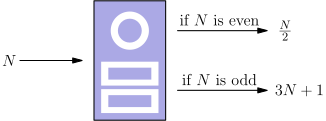
Cuando un entero positivo NN se introduce en una máquina, la salida es un número calculado según la regla que se muestra abajo.

Por ejemplo, comenzando con una entrada de N=7,N=7, la máquina dará como salida 37+1=22.3 \cdot 7 + 1 = 22. Luego, si la salida se introduce repetidamente en la máquina cinco veces más, la salida final es 26.26. 7221134175226 \begin{align*} &7 \to 22 \to 11 \to 34 \\ &\to 17 \to 52 \to 26 \end{align*} Cuando el mismo proceso de 66 pasos se aplica a un valor inicial diferente de N,N, la salida final es 1.1. ¿Cuál es la suma de todos esos enteros NN? N00000000001 \begin{align*} &N \to \underline{\phantom{00}} \to \underline{\phantom{00}} \to \underline{\phantom{00}}\\ &\to \underline{\phantom{00}} \to \underline{\phantom{00}} \to 1 \end{align*}

When a positive integer NN is fed into a machine, the output is a number calculated according to the rule shown below.

For example, starting with an input of N=7,N=7, the machine will output 37+1=22.3 \cdot 7 + 1 = 22. Then if the output is repeatedly inserted into the machine five more times, the final output is 26.26. 7221134175226 \begin{align*} &7 \to 22 \to 11 \to 34 \\ &\to 17 \to 52 \to 26 \end{align*} When the same 66-step process is applied to a different starting value of N,N, the final output is 1.1. What is the sum of all such integers N?N? N00000000001 \begin{align*} &N \to \underline{\phantom{00}} \to \underline{\phantom{00}} \to \underline{\phantom{00}}\\ &\to \underline{\phantom{00}} \to \underline{\phantom{00}} \to 1 \end{align*}

7373

7474

7575

8282

8383

Solución en video:
Miniatura del video de la solución
Play video

Click to load, then click again to play

Solución escrita:

Para ver qué números podemos formar invirtiéndolo, construyamos una máquina inversora.

Esta tomaría NN y daría 2N2N si 2N2N es par (lo cual siempre lo es) o N13\frac{N-1}{3} si N13\frac{N-1}{3} es un entero impar. Nota que N13\frac{N-1}{3} es un entero solo si N1mod3.N \equiv 1 \mod 3. Además, si NN es par, entonces N1N-1 es impar. Eso significaría que N13\frac{N-1}{3} sería impar. Por lo tanto, nuestra máquina inversora da 2N2N y también N13\frac{N-1}{3} si N1mod3N \equiv 1 \mod 3 y NN es par.

Ahora, debemos ver qué puede dar la máquina inversora después de 66 movimientos:

1)1) Solo podemos obtener 2.2.

2)2) A partir de 2,2, solo podemos obtener 4.4.

3)3) A partir de 4,4, podemos obtener 11 y 8.8.

4)4) A partir de 1,1, solo podemos obtener 22; a partir de 8,8, solo podemos obtener 16.16.

5)5) A partir de 2,2, solo podemos obtener 44; a partir de 16,16, podemos obtener 55 y 32.32.

6)6) A partir de 4,4, podemos obtener 11 y 8,8,; a partir de 5,5, podemos obtener 1010; a partir de 3232 podemos obtener 64.64.

El movimiento 66 puede dar 1,8,10,1, 8, 10, y 64,64, y su suma es 83.83.

Por lo tanto, la respuesta correcta es E.

To see which numbers we can make by inverting it, let's make an inverting machine.

This would take NN and yield either 2N2N if 2N2N is even (which it always is) or N13\frac{N-1}{3} if N13\frac{N-1}{3} is an odd integer. Note that N13\frac{N-1}{3} is an integer only if N1mod3.N \equiv 1 \mod 3. Also, if NN is even, then N1N-1 is odd. That would mean N13\frac{N-1}{3} would be odd. Therefore, our inverter machine yields 2N2N and also N13\frac{N-1}{3} if N1mod3N \equiv 1 \mod 3 and NN is even.

Now, we must see what the inverting machine can yield after 66 moves:

1)1) We can only get 2.2.

2)2) From 2,2, we can only get 4.4.

3)3) From 4,4, we can get 11 and 8.8.

4)4) From 1,1, we can get only 22; from 8,8, we can only get 16.16.

5)5) From 2,2, we can get only 44; from 16,16, we can get 55 and 32.32.

6)6) From 4,4, we can get 11 and 8,8,; 5,5, we can get 1010; from 3232 we can get 64.64.

Move 66 can yield 1,8,10,1, 8, 10, and 64,64, and their sum is 83.83.

Thus, the correct answer is E.

← Problema 21#21Examen completoProblema 23#23 →

El Problema 22 en otros años

1985 AMC 8 · 1986 AMC 8 · 1987 AMC 8 · 1988 AMC 8 · 1989 AMC 8 · 1990 AMC 8 · 1991 AMC 8 · 1992 AMC 8 · 1993 AMC 8 · 1994 AMC 8 · 1995 AMC 8 · 1996 AMC 8 · 1997 AMC 8 · 1998 AMC 8 · 1999 AMC 8 · 2000 AMC 8 · 2001 AMC 8 · 2002 AMC 8 · 2003 AMC 8 · 2004 AMC 8 · 2005 AMC 8 · 2006 AMC 8 · 2007 AMC 8 · 2008 AMC 8 · 2009 AMC 8 · 2010 AMC 8 · 2011 AMC 8 · 2012 AMC 8 · 2013 AMC 8 · 2014 AMC 8 · 2015 AMC 8 · 2016 AMC 8 · 2017 AMC 8 · 2018 AMC 8 · 2019 AMC 8 · 2022 AMC 8 · 2023 AMC 8 · 2024 AMC 8 · 2025 AMC 8 · 2026 AMC 8