
Problemas del 1955 AMC 12
¡Desplázate hacia abajo y presiona Iniciar para intentar el examen! O ve al PDF imprimible, la clave de respuestas, o las soluciones profesionales preparadas por LIVE by Po-Shen Loh.
Todos los problemas se usan con el permiso legal oficial de la Mathematical Association of America (MAA).
O salta directamente a un solo problema con su solución: 1 · 2 · 3 · 4 · 5 · 6 · 7 · 8 · 9 · 10 · 11 · 12 · 13 · 14 · 15 · 16 · 17 · 18 · 19 · 20 · 21 · 22 · 23 · 24 · 25 · 26 · 27 · 28 · 29 · 30 · 31 · 32 · 33 · 34 · 35 · 36 · 37 · 38 · 39 · 40 · 41 · 42 · 43 · 44 · 45 · 46 · 47 · 48 · 49 · 50
¿Quieres aprender de forma profesional con clases interactivas en video?
Con tiempo
1:15:00
1.
¿Cuál de las siguientes expresiones no equivale a ?
Which one of the following is not equivalent to
Respuesta: D
Pista pequeña:
Reescribe todas las opciones usando la misma potencia de
Rewrite every choice with the same power of
Pista grande:
El decimal es
The decimal is
Solución:
El decimal dado es Las opciones A y B expresan esto directamente, mientras que y Pero que es diez veces menor.
Por lo tanto, la respuesta correcta es D.
The given decimal is Choices A and B state this directly, while and But which is ten times smaller.
Thus, the correct answer is D.
2.
El ángulo menor entre las manecillas de un reloj a las p. m. es:
The smaller angle between the hands of a clock at p.m. is:
Respuesta: B
Pista pequeña:
En minutos, el minutero gira
In minutes, the minute hand moves
Pista grande:
La manecilla de la hora gira por minuto
The hour hand moves per minute
Solución:
A las el minutero está a después de las mientras que la manecilla de la hora está a Su separación menor es
Por lo tanto, la respuesta correcta es B.
At the minute hand is past while the hour hand is Their smaller separation is
Thus, the correct answer is B.
3.
Si cada número de un conjunto de diez números aumenta en la media aritmética (promedio) de los diez números originales:
If each number in a set of ten numbers is increased by the arithmetic mean (average) of the original ten numbers:
permanece igual
remains the same
aumenta en
is increased by
aumenta en
is increased by
aumenta en
is increased by
aumenta en
is increased by
Respuesta: B
Pista pequeña:
Aumentar las diez cantidades suma a su total
Increasing all ten entries adds to their sum
Pista grande:
El nuevo total todavía se divide entre
The new total is still divided by
Solución:
Si la suma original es la nueva suma es Por consiguiente, la nueva media es La media aumenta en
Por lo tanto, la respuesta correcta es B.
If the original sum is the new sum is Hence the new mean is The mean is increased by
Thus, the correct answer is B.
4.
La igualdad se satisface para:
The equality is satisfied by:
ningún valor real de
no real values of
o
either or
solamente
only
solamente
only
solamente
only
Respuesta: E
Pista pequeña:
Multiplica en cruz, recordando que
Cross-multiply, while remembering that
Pista grande:
Resuelve
Solve
Solución:
Para la multiplicación en cruz da de modo que Este valor hace que ambos denominadores originales sean distintos de cero y satisface la igualdad.
Por lo tanto, la respuesta correcta es E.
For cross-multiplication gives so This value makes both original denominators nonzero and satisfies the equality.
Thus, the correct answer is E.
5.
varía inversamente con el cuadrado de Cuando Cuando es igual a:
varies inversely as the square of When When equals:
Respuesta: D
Pista pequeña:
Escribe la variación como
Write the variation as
Pista grande:
Usa el primer par de valores para determinar
Use the first pair of values to determine
Solución:
La variación inversa con el cuadrado da Como tenemos Para
Por lo tanto, la respuesta correcta es D.
Inverse-square variation gives Since we have At
Thus, the correct answer is D.
6.
Un comerciante compra cierta cantidad de naranjas a razón de por ¢ y la misma cantidad a razón de por ¢. Para “no ganar ni perder”, debe venderlas todas a razón de:
A merchant buys a number of oranges at for ¢ and an equal number at for ¢. To “break even” he must sell all at:
por ¢
for ¢
por ¢
for ¢
por ¢
for ¢
por ¢
for ¢
por ¢
for ¢
Respuesta: B
Pista pequeña:
Usa naranjas en cada compra de igual tamaño para que ambas tarifas se dividan exactamente
Use oranges in each equal-sized purchase so that both quoted rates divide evenly
Pista grande:
Compara el costo total de naranjas con cada precio de venta propuesto
Compare the total cost of oranges with each proposed selling rate
Solución:
Supongamos que compra naranjas a cada precio. Las primeras cuestan ¢ y las otras cuestan ¢, para un total de ¢. Por tanto, debe vender las naranjas por ¢, lo cual equivale a por ¢.
Por lo tanto, la respuesta correcta es B.
Suppose he buys oranges at each rate. The first cost ¢ and the second cost ¢, for ¢ total. Thus oranges must sell for ¢, which is equivalent to for ¢.
Therefore, the correct answer is B.
7.
Si un trabajador sufre una reducción salarial del por ciento, puede recuperar exactamente su salario original obteniendo un aumento del:
If a worker receives a percent cut in wages, he may regain his original pay exactly by obtaining a raise of:
por ciento
percent
por ciento
percent
por ciento
percent
Respuesta: B
Pista pequeña:
Después de la reducción, el salario es el del original
After the cut, the wage is of the original
Pista grande:
Halla qué porcentaje del salario reducido representa el faltante del original
Find the percent of the reduced wage represented by the missing of the original
Solución:
Si el salario original es el salario reducido es El aumento necesario es que como fracción del salario reducido es
Por lo tanto, la respuesta correcta es B.
If the original wage is the reduced wage is The needed increase is which as a fraction of the reduced wage is
Thus, the correct answer is B.
8.
La gráfica de :
The graph of
es una hipérbola que corta solamente al eje
is a hyperbola intersecting only the -axis
es una hipérbola que corta solamente al eje
is a hyperbola intersecting only the -axis
es una hipérbola que no corta a ninguno de los ejes
is a hyperbola intersecting neither axis
es un par de rectas
is a pair of straight lines
no existe
does not exist
Respuesta: D
Pista pequeña:
Factoriza la diferencia de cuadrados
Factor the difference of squares
Pista grande:
Un producto es cero cuando al menos uno de sus dos factores lineales es cero
A product is zero when at least one of its two linear factors is zero
Solución:
Al factorizar, Por tanto, la gráfica es la unión de las dos rectas y
La respuesta correcta es D.
Factoring, Thus the graph is the union of the two straight lines and
The correct answer is D.
9.
Un círculo está inscrito en un triángulo cuyos lados miden y El radio del círculo es:
A circle is inscribed in a triangle with sides and The radius of the circle is:
Respuesta: D
Pista pequeña:
Las longitudes de los lados forman una terna pitagórica
The side lengths form a Pythagorean triple
Pista grande:
Para un triángulo rectángulo,
For a right triangle,
Solución:
Como el triángulo es rectángulo. Su inradio es
Por lo tanto, la respuesta correcta es D.
Because the triangle is right. Its inradius is
Thus, the correct answer is D.
10.
¿Cuántas horas tarda un tren que viaja a una velocidad media de millas por hora entre paradas en recorrer millas si hace paradas de minutos cada una?
How many hours does it take a train traveling at an average rate of mph between stops to travel miles if it makes stops of minutes each?
Respuesta: A
Pista pequeña:
El tiempo en movimiento es horas
The moving time is hours
Pista grande:
Convierte el tiempo total de parada de minutos a horas antes de sumar
Convert the total stopping time from minutes to hours before adding
Solución:
El tren está en movimiento durante horas y detenido durante horas. Por tanto, el tiempo total es
Por lo tanto, la respuesta correcta es A.
The train moves for hours and is stopped for hours. Hence the total time is
Thus, the correct answer is A.
11.
La negación del enunciado «Ningún alumno de aprendizaje lento asiste a esta escuela» es:
The negation of the statement “No slow learners attend this school,” is:
Todos los alumnos de aprendizaje lento asisten a esta escuela.
All slow learners attend this school.
Todos los alumnos de aprendizaje lento no asisten a esta escuela.
All slow learners do not attend this school.
Algunos alumnos de aprendizaje lento asisten a esta escuela.
Some slow learners attend this school.
Algunos alumnos de aprendizaje lento no asisten a esta escuela.
Some slow learners do not attend this school.
Ningún alumno de aprendizaje lento no asiste a esta escuela.
No slow learners do not attend this school.
Respuesta: C
Pista pequeña:
«Ningún» significa que no existe ni un solo ejemplo
“No” means that there does not exist even one example
Pista grande:
Negar una exclusión universal afirma que existe un contraejemplo
Negating a universal exclusion asserts the existence of a counterexample
Solución:
El enunciado original dice que todos los alumnos de aprendizaje lento están ausentes de la escuela. Su negación es que al menos uno de ellos asiste a la escuela.
Por lo tanto, «Algunos alumnos de aprendizaje lento asisten a esta escuela» es correcto, así que la respuesta es C.
The original statement says that every slow learner is absent from the school. Its negation is that at least one slow learner attends the school.
Thus, “Some slow learners attend this school” is correct, so the answer is C.
12.
La solución de es:
The solution of is:
Respuesta: D
Pista pequeña:
La restricción del dominio real de da
The real-domain restriction gives
Pista grande:
Prueba el extremo más sencillo antes de elevar al cuadrado la ecuación
Test the simplest endpoint before squaring the equation
Solución:
El dominio exige Para el lado izquierdo es así que funciona. Para ver que no hay otra solución, observa que ambos radicales son no decrecientes cuando y es estrictamente creciente. Por lo tanto, la suma es mayor que para todo
Por lo tanto, la respuesta correcta es D.
The domain requires At the left side is so works. To see that there is no other solution, note that both radicals are nondecreasing for and is strictly increasing. Therefore the sum exceeds for every
Thus, the correct answer is D.
13.
La fracción es igual a:
The fraction is equal to:
Respuesta: C
Pista pequeña:
Considera como una diferencia de cuadrados
Regard as a difference of squares
Pista grande:
Factorízala usando y
Factor it using and
Solución:
Al factorizar el numerador, Donde la fracción original está definida, al cancelar el factor común queda
Por lo tanto, la respuesta correcta es C.
Factoring the numerator, Where the original fraction is defined, canceling the common factor leaves
Thus, the correct answer is C.
14.
El largo del rectángulo es un por ciento mayor que el lado del cuadrado El ancho del rectángulo es un por ciento menor que el lado del cuadrado. La razón de las áreas, es:
The length of rectangle is percent more than the side of square The width of the rectangle is percent less than the side of the square. The ratio of the areas, is:
Respuesta: A
Pista pequeña:
Sea la longitud del lado del cuadrado
Let the square’s side length be
Pista grande:
El área del rectángulo es
The rectangle’s area is
Solución:
Si el lado del cuadrado es entonces las dimensiones del rectángulo son y Por tanto,
Por lo tanto, la respuesta correcta es A.
If the square side is then the rectangle has dimensions and Therefore
Thus, the correct answer is A.
15.
La razón de las áreas de dos círculos concéntricos es Si el radio del menor es entonces la diferencia entre los radios se aproxima mejor por:
The ratio of the areas of two concentric circles is If the radius of the smaller is then the difference between the radii is best approximated by:
Respuesta: D
Pista pequeña:
Las razones de áreas son los cuadrados de las razones de radios
Area ratios are the squares of radius ratios
Pista grande:
El radio mayor es , así que estima
The larger radius is , so estimate
Solución:
Si el radio mayor es entonces de modo que La diferencia es
Por lo tanto, la mejor aproximación es y la respuesta correcta es D.
If the larger radius is then so The difference is
Thus, the best approximation is and the correct answer is D.
16.
El valor de cuando y es:
The value of when and is:
cualquier número finito
any finite number
sin sentido
meaningless
Respuesta: E
Pista pequeña:
Sustituye primero los dos valores dados en el denominador
Substitute the two given values into the denominator first
Pista grande:
Una fracción con denominador no está definida
A fraction with denominator is undefined
Solución:
La sustitución da Por tanto, la expresión se convierte en que no está definida.
Por lo tanto, la expresión no tiene sentido y la respuesta correcta es E.
Substitution gives Hence the expression becomes which is undefined.
Thus, the expression is meaningless and the correct answer is E.
17.
Si entonces es igual a:
If then equals:
o
either or
Respuesta: C
Pista pequeña:
Pasa al otro lado
Move to the other side
Pista grande:
Usa y combina los logaritmos
Use and combine logarithms
Solución:
Usando logaritmos comunes, Por lo tanto,
La respuesta correcta es C.
Using common logarithms, Therefore
The correct answer is C.
18.
El discriminante de la ecuación es cero. Por consiguiente, sus raíces son:
The discriminant of the equation is zero. Hence, its roots are:
reales e iguales
real and equal
racionales e iguales
rational and equal
racionales y desiguales
rational and unequal
irracionales y desiguales
irrational and unequal
imaginarias
imaginary
Respuesta: A
Pista pequeña:
Usa la fórmula cuadrática con el término del discriminante igual a cero
Use the quadratic formula with the discriminant term equal to zero
Pista grande:
Después clasifica el valor resultante según las opciones dadas
Then inspect the resulting value for the requested classifications
Solución:
La fórmula cuadrática da dos veces porque el discriminante es cero. La raíz es irracional, pero la descripción aplicable entre las ofrecidas es «reales e iguales».
Por lo tanto, la respuesta correcta es A.
The quadratic formula gives twice because the discriminant is zero. The root is irrational, but the requested description that applies is “real and equal.”
Thus, the correct answer is A.
19.
Dos números cuya suma es y el valor absoluto de cuya diferencia es son raíces de la ecuación:
Two numbers whose sum is and the absolute value of whose difference is are roots of the equation:
Respuesta: B
Pista pequeña:
Después de elegir un orden, resuelve y
Solve and after choosing an order
Pista grande:
Un polinomio cuadrático mónico con raíces es
A monic quadratic with roots is
Solución:
Tomando primero el número mayor, da y Su producto es así que la ecuación mónica con estas raíces es
Por lo tanto, la respuesta correcta es B.
Taking the larger number first, gives and Their product is so the monic equation with these roots is
Thus, the correct answer is B.
20.
La expresión es igual a cero para:
The expression equals zero for:
ningún valor real ni imaginario de
no real or imaginary values of
ningún valor real de solamente
no real values of only
ningún valor imaginario de solamente
no imaginary values of only
Respuesta: A
Pista pequeña:
Aísla el radical antes de hacer cualquier operación algebraica
Isolate the radical before doing any algebra
Pista grande:
Si elevas al cuadrado, comprueba cada candidato en la ecuación original porque el radical tiene un signo establecido
If you square, check every candidate in the original equation because the radical has a prescribed sign
Solución:
Para que la expresión se anule, se necesitaría El signo radical denota la raíz cuadrada principal. Esta es no negativa para un radicando real no negativo y, sobre los números complejos, se elige con parte real no negativa; por ello no puede ser igual a Elevar al cuadrado introduciría el candidato extraño para el cual la expresión original vale
Por lo tanto, ningún valor real ni imaginario funciona, y la respuesta correcta es A.
For the expression to vanish, one would need The radical sign denotes the principal square root. It is nonnegative for a nonnegative real radicand and, over the complex numbers, is chosen with nonnegative real part; it therefore cannot equal Squaring would introduce the extraneous candidate for which the original expression is
Thus, no real or imaginary value works, and the correct answer is A.
21.
Representa la hipotenusa de un triángulo rectángulo por y el área por La altura trazada sobre la hipotenusa es:
Represent the hypotenuse of a right triangle by and the area by The altitude on the hypotenuse is:
Respuesta: B
Pista pequeña:
Usa la hipotenusa como base del triángulo
Use the hypotenuse as the base of the triangle
Pista grande:
Si la altura correspondiente es entonces
If the corresponding altitude is then
Solución:
Tomando la hipotenusa como base y denotando su altura por Al despejar se obtiene
Por lo tanto, la respuesta correcta es B.
Taking the hypotenuse as the base and writing its altitude as Solving gives
Thus, the correct answer is B.
22.
En un pedido de , un comerciante puede elegir entre tres descuentos sucesivos de y , y tres descuentos sucesivos de y Al elegir la mejor oferta, puede ahorrar:
On a order a merchant has a choice between three successive discounts of and and three successive discounts of and By choosing the better offer, he can save:
absolutamente nada
nothing at all
Respuesta: D
Pista pequeña:
Los descuentos sucesivos multiplican los factores del precio restante
Successive discounts multiply the remaining-price factors
Pista grande:
Compara con
Compare with
Solución:
La primera oferta deja una fracción del precio. La segunda deja La segunda cuesta menos por del pedido, es decir, dólares.
Por lo tanto, la respuesta correcta es D.
The first offer leaves a fraction of the price. The second leaves The second is cheaper by of the order, or dollars.
Thus, the correct answer is D.
23.
Al revisar la caja chica, un empleado cuenta monedas de veinticinco centavos, de diez centavos, de cinco centavos y de un centavo. Más tarde descubre que de las monedas de cinco centavos se contaron como monedas de veinticinco, y de las monedas de diez centavos se contaron como monedas de un centavo. Para corregir el total obtenido, el empleado debe:
In checking the petty cash a clerk counts quarters, dimes, nickels, and cents. Later he discovers that of the nickels were counted as quarters and of the dimes were counted as cents. To correct the total obtained the clerk must:
no hacer ninguna corrección
make no correction
restar ¢
subtract ¢
restar ¢
subtract ¢
sumar ¢
add ¢
sumar ¢
add ¢
Respuesta: C
Pista pequeña:
Cada moneda de cinco centavos contada como una de veinticinco hace que el total sea ¢ demasiado grande
Each nickel counted as a quarter makes the total too large by ¢
Pista grande:
Cada moneda de diez centavos contada como una de un centavo hace que el total sea ¢ demasiado pequeño
Each dime counted as a cent makes the total too small by ¢
Solución:
Las monedas de cinco centavos contadas como monedas de veinticinco exageran el total en ¢. Las monedas de diez centavos contadas como monedas de un centavo lo reducen en ¢. El exceso neto es de centavos, por lo que se debe restar esa cantidad.
Por lo tanto, la respuesta correcta es C.
The nickels counted as quarters overstate the total by ¢. The dimes counted as cents understate it by ¢. The net overstatement is cents, so that amount must be subtracted.
Thus, the correct answer is C.
24.
La función :
The function
siempre aumenta cuando aumenta
always increases as increases
siempre disminuye cuando disminuye hasta
always decreases as decreases to
no puede ser igual a
cannot equal
tiene un valor máximo cuando es negativo
has a maximum value when is negative
tiene un valor mínimo de
has a minimum value of
Respuesta: E
Pista pequeña:
Completa el cuadrado en
Complete the square in
Pista grande:
Extrae de los términos cuadrático y lineal antes de formar
Factor from the quadratic terms before forming
Solución:
Al completar el cuadrado, El término al cuadrado es no negativo, así que el valor mínimo es alcanzado cuando
Por lo tanto, la respuesta correcta es E.
Completing the square, The squared term is nonnegative, so the minimum value is attained at
Thus, the correct answer is E.
25.
Uno de los factores de es:
One of the factors of is:
ninguno de estos
none of these
Respuesta: E
Pista pequeña:
Reescribe el polinomio como
Rewrite the polynomial as
Pista grande:
Factoriza la diferencia de cuadrados resultante y compara ambos factores con las opciones
Factor the resulting difference of squares and compare both factors with the choices
Solución:
Tenemos Ninguno de los dos factores aparece entre las opciones A a D.
Por lo tanto, la respuesta correcta es E.
We have Neither factor appears among choices A through D.
Thus, the correct answer is E.
26.
El Sr. posee una casa que vale Se la vende al Sr. con una ganancia del El Sr. vuelve a venderle la casa al Sr. con una pérdida del Entonces:
Mr. owns a house worth He sells it to Mr. at profit. Mr. sells the house back to Mr. at a loss. Then:
el Sr. queda a mano
Mr. comes out even
el Sr. gana
Mr. makes
el Sr. gana
Mr. makes
el Sr. pierde
Mr. loses
ninguna de las anteriores es correcta
none of the above is correct
Respuesta: E
Pista pequeña:
El precio de la primera venta es
The first sale price is
Pista grande:
La pérdida del Sr. es el de lo que pagó, no el del valor original de la casa
Mr. ’s loss is of what he paid, not of the original house value
Solución:
El Sr. recibe primero dólares. El Sr. vende después con una pérdida del de su costo de dólares, así que el Sr. recompra la casa por dólares. El Sr. vuelve a poseer la casa y ha ganado dólares; el Sr. ha perdido dólares. Ninguna de las cantidades indicadas es correcta.
Por lo tanto, la respuesta correcta es E.
Mr. first receives dollars. Mr. then sells at a loss of of his -dollar cost, so Mr. buys the house back for dollars. Mr. again owns the house and has gained dollars; Mr. has lost dollars. None of the stated amounts is correct.
Thus, the correct answer is E.
27.
Si y son las raíces de entonces es igual a:
If and are the roots of then equals:
Respuesta: B
Pista pequeña:
Usa y
Use and
Pista grande:
Desarrolla y despeja
Expand and isolate
Solución:
Por las fórmulas de Vieta, y Por lo tanto,
Por lo tanto, la respuesta correcta es B.
By Vieta’s formulas, and Therefore
Thus, the correct answer is B.
28.
En el mismo sistema de ejes se dibujan la gráfica de y la de la ecuación obtenida al sustituir por en la ecuación dada. Si y , estas dos gráficas se cortan:
On the same set of axes are drawn the graph of and the graph of the equation obtained by replacing by in the given equation. If and these two graphs intersect:
en dos puntos, uno sobre el eje y otro sobre el eje
in two points, one on the -axis and one on the -axis
en un punto que no está sobre ninguno de los ejes
in one point located on neither axis
solamente en el origen
only at the origin
en un punto sobre el eje
in one point on the -axis
en un punto sobre el eje
in one point on the -axis
Respuesta: E
Pista pequeña:
La gráfica reflejada es
The reflected graph is
Pista grande:
Iguala las dos expresiones de y usa
Set the two expressions for equal and use
Solución:
Al sustituir por se obtiene En un punto de intersección, de modo que Como debe cumplirse y entonces Hay exactamente una intersección, sobre el eje .
Por lo tanto, la respuesta correcta es E.
Replacing by gives At an intersection, so Since we must have and then There is exactly one intersection, on the -axis.
Thus, the correct answer is E.
29.
En la figura, es tangente al semicírculo es tangente al semicírculo es una línea recta y los arcos se indican en la figura. La medida del ángulo es:
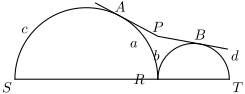
In the figure is tangent to semicircle is tangent to semicircle is a straight line; the arcs are indicated in the figure. Angle is measured by:
Respuesta: E
Pista pequeña:
Traza , que es tangente a ambos semicírculos en
Draw , which is tangent to both semicircles at
Pista grande:
Usa el teorema del ángulo entre dos tangentes en cada círculo, y después
Use the tangent-tangent angle theorem on each circle, then use
Solución:
La recta es tangente a ambos semicírculos en su extremo común Para el círculo mayor, el teorema del ángulo entre dos tangentes da Para el círculo menor, el mismo teorema da Por tanto, el ángulo reflejo de a que pasa por mide Así, el otro ángulo entre las tangentes es porque cada semicírculo superior mide
Por lo tanto, la respuesta correcta es E.
The line is tangent to both semicircles at their common endpoint For the larger circle, the tangent-tangent angle theorem gives For the smaller circle, the same theorem gives Thus the reflex angle from to through has measure Hence the other angle between the tangents is because each upper semicircle has measure
Thus, the correct answer is E.
30.
Cada una de las ecuaciones tiene:
Each of the equations has:
dos raíces enteras
two integral roots
ninguna raíz mayor que
no root greater than
ninguna raíz igual a cero
no root zero
solamente una raíz
only one root
una raíz negativa y una positiva
one negative root and one positive root
Respuesta: B
Pista pequeña:
Resuelve cada ecuación por separado y compara las propiedades de sus raíces
Solve each equation separately and compare the properties of their roots
Pista grande:
Para la ecuación con radicales, descarta los candidatos que hagan negativo cualquiera de los radicandos
For the radical equation, reject candidates that make either radicand negative
Solución:
La primera ecuación da Al factorizar la diferencia de cuadrados en la segunda se obtiene de modo que o Al elevar al cuadrado la tercera se obtiene con candidatos y solamente satisface las restricciones del dominio real. Todas las raíces obtenidas son a lo sumo
Por lo tanto, ninguna ecuación tiene una raíz mayor que y la respuesta correcta es B.
The first equation gives Factoring the difference of squares in the second gives so or Squaring the third gives with candidates and only satisfies the real-domain restrictions. Every root obtained is at most
Thus, each equation has no root greater than and the correct answer is B.
31.
Un triángulo equilátero de lado se divide en un triángulo y un trapecio mediante una recta paralela a uno de sus lados. Si el área del trapecio es igual a la mitad del área del triángulo original, la longitud de la mediana del trapecio es:
An equilateral triangle whose side is is divided into a triangle and a trapezoid by a line drawn parallel to one of its sides. If the area of the trapezoid equals one-half of the area of the original triangle, the length of the median of the trapezoid is:
Respuesta: D
Pista pequeña:
El triángulo pequeño tiene la mitad del área original; determina su lado usando semejanza
The small triangle has half the original area, so determine its side using similarity
Pista grande:
La mediana del trapecio es el promedio de las longitudes de sus dos lados paralelos
The trapezoid median is the average of its two parallel side lengths
Solución:
El triángulo pequeño también tiene la mitad del área original. Si su lado paralelo a la base original tiene longitud la semejanza da de modo que Los lados paralelos del trapecio miden y así que su mediana mide
Por lo tanto, la respuesta correcta es D.
The small triangle also has half the original area. If its side parallel to the original base has length similarity gives so The parallel sides of the trapezoid have lengths and so its median has length
Thus, the correct answer is D.
32.
Si el discriminante de es cero, entonces otra afirmación verdadera sobre y es que:
If the discriminant of is zero, then another true statement about and is that:
forman una progresión aritmética
they form an arithmetic progression
forman una progresión geométrica
they form a geometric progression
son desiguales
they are unequal
son todos números negativos
they are all negative numbers
solamente es negativo y y son positivos
only is negative and and are positive
Respuesta: B
Pista pequeña:
Iguala a cero
Set equal to zero
Pista grande:
Compara la relación resultante con los criterios que definen las progresiones aritméticas y geométricas
Compare the resulting relation with the defining tests for arithmetic and geometric progressions
Solución:
Un discriminante cero da y por tanto Equivalentemente, donde las razones están definidas, que es la relación que caracteriza a como una progresión geométrica.
Por lo tanto, la respuesta correcta es B.
A zero discriminant gives hence Equivalently, where the ratios are defined, which is the defining relation for to form a geometric progression.
Thus, the correct answer is B.
33.
Henry inicia un viaje cuando las manecillas del reloj coinciden entre las a. m. y las a. m. Llega a su destino entre las p. m. y las p. m., cuando las manecillas están separadas exactamente El viaje dura:
Henry starts a trip when the hands of the clock are together between a.m. and a.m. He arrives at his destination between p.m. and p.m. when the hands of the clock are exactly apart. The trip takes:
h
hr.
h min
hr. min.
h min
hr. min.
h min
hr. min.
ninguna de estas
none of these
Respuesta: A
Pista pequeña:
Al inicio, el minutero debe cerrar una brecha de a razón de por minuto
At the start, the minute hand must close a gap at per minute
Pista grande:
Calcula el instante correspondiente después de las cuando las manecillas están opuestas y compara los dos desfases
Compute the corresponding time after when the hands are opposite and compare the two offsets
Solución:
A las la manecilla de la hora lleva de ventaja. El minutero gana por minuto, de modo que las manecillas coinciden minutos después de las A las la manecilla de la hora lleva de ventaja. Para que las manecillas estén separadas en el sentido pertinente, el minutero debe ganar lo que vuelve a tomar minutos. Por tanto, el inicio y el final tienen el mismo desfase de minutos dentro de sus respectivas horas y están separados exactamente seis horas.
Por lo tanto, la respuesta correcta es A.
At the hour hand is ahead. The minute hand gains at per minute, so the hands coincide minutes after At the hour hand is ahead. For the hands to be apart in the relevant direction, the minute hand must gain again taking minutes. The start and finish therefore have the same minute offset within their hours, exactly six hours apart.
Thus, the correct answer is A.
34.
Un poste de pulgadas de diámetro y otro de pulgadas de diámetro se colocan juntos y se atan con alambre. La longitud del alambre más corto que puede rodearlos es:
A -inch-diameter pole and an -inch-diameter pole are placed together and bound together with wire. The length of the shortest wire that will go around them is:
Respuesta: C
Pista pequeña:
El alambre consta de dos segmentos tangentes exteriores comunes y un arco expuesto de cada círculo
The wire consists of two common external tangent segments and one exposed arc on each circle
Pista grande:
Usa radios y ; cada segmento tangente mide
Use radii and ; each tangent segment has length
Solución:
Los centros están separados pulgadas y sus radios difieren en Por tanto, cada segmento tangente exterior común mide para un total de . La geometría de las rectas tangentes deja un arco expuesto de en el círculo de radio y uno de en el círculo de radio . Sus longitudes suman Por lo tanto, la longitud del alambre es
Por lo tanto, la respuesta correcta es C.
The centers are inches apart and their radii differ by Thus each common external tangent segment has length contributing in all. The geometry of the tangent lines leaves a exposed arc on the radius- circle and a exposed arc on the radius- circle. Their lengths total Hence the wire length is
Thus, the correct answer is C.
35.
Tres muchachos acuerdan repartirse una bolsa de canicas de la siguiente manera. El primero toma una canica más que la mitad. El segundo toma un tercio de las que quedan. El tercero descubre que le quedan el doble de canicas que al segundo. El número original de canicas:
Three boys agree to divide a bag of marbles in the following manner. The first boy takes one more than half the marbles. The second takes a third of the number remaining. The third boy finds that he is left with twice as many marbles as the second boy. The original number of marbles:
no es ninguno de los siguientes
is none of the following
no puede determinarse con los datos dados
cannot be determined from the given data
es o
is or
es o
is or
es o
is or
Respuesta: B
Pista pequeña:
Sea el número original y expresa lo que queda después del primer muchacho
Let the original number be and express the remainder after the first boy
Pista grande:
Traduce la condición sobre las porciones de los dos últimos muchachos a una ecuación y comprueba si determina de manera única
Translate the last two boys’ share condition into an equation and see whether it determines uniquely
Solución:
El primero toma y deja El segundo toma un tercio de ese resto y el tercero recibe los otros dos tercios, automáticamente el doble de la porción del segundo. Por tanto, la condición del reparto no impone un valor único de Solamente exige que sea un múltiplo no negativo de por lo que sirven muchos valores, como .
Por lo tanto, el número original no puede determinarse y la respuesta correcta es B.
The first boy takes leaving The second takes one third of that remainder, and the third receives the other two thirds, automatically twice the second boy’s share. Thus the share condition imposes no unique value of It only requires to be a nonnegative multiple of so many values such as work.
Therefore the original number cannot be determined, and the correct answer is B.
36.
Un tanque cilíndrico de petróleo, colocado horizontalmente, tiene una longitud interior de pies y un diámetro interior de pies. Si la superficie rectangular del petróleo tiene un área de pies cuadrados, la profundidad del petróleo es:
A cylindrical oil tank, lying horizontally, has an interior length of feet and an interior diameter of feet. If the rectangular surface of the oil has an area of square feet, the depth of the oil is:
o
either or
Respuesta: E
Pista pequeña:
La superficie del petróleo es un rectángulo de longitud , así que su ancho es
The oil surface is a rectangle of length , so its width is
Pista grande:
En el extremo circular, una cuerda de longitud está a del centro
In the circular end, a chord of length lies from the center
Solución:
La superficie rectangular tiene longitud así que su ancho, que es una cuerda de la sección circular, es La semicuerda mide y el radio es de modo que la distancia del centro a la cuerda es Una cuerda de esta longitud puede estar por debajo o por encima del centro. Medidas desde el fondo del tanque, las profundidades correspondientes son y
Por lo tanto, la respuesta correcta es E.
The rectangular surface has length so its chord width in the circular cross-section is Half the chord is and the radius is so the distance from the center to the chord is A chord of this length can lie either below or above the center. Measured from the bottom of the tank, the corresponding depths are and
Thus, the correct answer is E.
37.
Un número de tres cifras tiene, de izquierda a derecha, las cifras y , con Cuando el número con las cifras invertidas se resta del número original, la cifra de las unidades de la diferencia es Las dos cifras siguientes, de derecha a izquierda, son:
A three-digit number has, from left to right, the digits and with When the number with the digits reversed is subtracted from the original number, the units’ digit in the difference is The next two digits, from right to left, are:
y
and
y
and
imposible de determinar
impossible to tell
y
and
y
and
Respuesta: B
Pista pequeña:
Resta algebraicamente:
Subtract algebraically:
Pista grande:
Halla la diferencia de cifras para la cual termina en
Find the digit for which ends in
Solución:
La diferencia es Como es un entero del al y la cifra de las unidades es necesitamos Esto da de modo que la diferencia es Avanzando de derecha a izquierda después de la cifra de las unidades las cifras siguientes son y
Por lo tanto, la respuesta correcta es B.
The difference is Since is an integer from through and the units digit is we need This gives so the difference is Moving from right to left after the units digit the next digits are and
Thus, the correct answer is B.
38.
Se dan cuatro enteros positivos. Elige tres cualesquiera, calcula su promedio aritmético y suma este resultado al cuarto entero. Así se obtienen los números y . Uno de los enteros originales es:
Four positive integers are given. Select any three of these integers, find their arithmetic average, and add this result to the fourth integer. Thus the numbers and are obtained. One of the original integers is:
Respuesta: B
Pista pequeña:
Si la suma original es y el entero separado es el resultado es
If the original sum is and the singled-out integer is the result is
Pista grande:
Suma los cuatro resultados dados para determinar
Sum all four reported results to determine
Solución:
Si los enteros originales suman el resultado asociado al entero separado es Al sumar los cuatro resultados dados se cuenta el total como así que Por tanto, el resultado proviene de
Por lo tanto, uno de los enteros originales es y la respuesta correcta es B.
If the original integers sum to the result associated with singled-out integer is Summing all four reported results counts the total as so The result therefore comes from
Thus, one original integer is and the correct answer is B.
39.
Si y el menor valor posible de es cero, entonces es igual a:
If then if the least possible value of is zero, is equal to:
Respuesta: B
Pista pequeña:
Completa el cuadrado en
Complete the square in
Pista grande:
El mínimo ocurre cuando
The minimum occurs when
Solución:
Al completar el cuadrado, Su menor valor es Al igualarlo a cero se obtiene
Por lo tanto, la respuesta correcta es B.
Completing the square, Its least value is Setting this equal to zero gives
Thus, the correct answer is B.
40.
Si las fracciones y son desiguales si:
If the fractions and are unequal if:
y
and
Respuesta: A
Pista pequeña:
Multiplica en cruz la igualdad
Cross-multiply the equality
Pista grande:
Después de simplificar, la igualdad queda determinada por
After cancellation, equality is governed by
Solución:
Donde las fracciones están definidas, la igualdad exigiría que se simplifica a En la opción A, da y por lo que la igualdad es imposible. Cada una de las opciones B a E, en cambio, fuerza directamente la igualdad.
Por lo tanto, las fracciones son desiguales bajo la condición de la opción A.
Where the fractions are defined, equality would require which simplifies to Under choice A, gives and so equality is impossible. Each of B through E instead forces equality directly.
Thus, the fractions are unequal under choice A.
41.
Un tren que viaja de Aytown a Beetown sufre un accidente después de h. Permanece detenido durante h, tras lo cual continúa a cuatro quintos de su velocidad habitual y llega a Beetown con h de retraso. Si el tren hubiera recorrido millas más antes del accidente, habría llegado solamente h tarde. La velocidad habitual del tren es:
A train traveling from Aytown to Beetown meets with an accident after hr. It is stopped for hr., after which it proceeds at four-fifths of its usual rate, arriving at Beetown hr. late. If the train had covered miles more before the accident, it would have been just hr. late. The usual rate of the train is:
millas por hora
mph
millas por hora
mph
millas por hora
mph
millas por hora
mph
millas por hora
mph
Respuesta: A
Pista pequeña:
Viajar a de la velocidad añade una cuarta parte del tiempo normal para la distancia afectada
Traveling at speed adds one-fourth of the normal time for the affected distance
Pista grande:
Compara los dos retrasos; desplazar el punto del accidente millas cambia el retraso en hora
Compare the two delays; moving the accident point miles changes the delay by hour
Solución:
Sea la velocidad habitual en millas por hora y la distancia total. Después de la primera hora, el tiempo normal para la distancia restante es Recorrerla a añade una cuarta parte de ese tiempo, así que Si el accidente ocurre millas más tarde, Al restar la segunda ecuación de la primera se obtiene y por tanto millas por hora.
Por lo tanto, la respuesta correcta es A.
Let the usual rate be mph and the total distance be After the first hour, the normal time for the remaining distance is Traveling it at adds one-fourth of that time, so If the accident occurs miles later, Subtracting the second equation from the first gives hence mph.
Thus, the correct answer is A.
42.
Si y son enteros positivos, los radicales y son iguales si y solo si:
If and are positive integers, the radicals and are equal when and only when:
y
and
y tiene cualquier valor
and is any value
y
and
Respuesta: C
Pista pequeña:
Ambos lados son positivos, así que eleva al cuadrado la igualdad
Both sides are positive, so square the equality
Pista grande:
Multiplica la ecuación resultante por y despeja
Multiply the resulting equation by and isolate
Solución:
Como todas las cantidades son positivas, elevar al cuadrado es reversible: Al multiplicar por se obtiene de modo que
Por lo tanto, la respuesta correcta es C.
Because all quantities are positive, squaring is reversible: Multiplying by gives so
Thus, the correct answer is C.
43.
Los pares de valores de y que son soluciones comunes de las ecuaciones y son:
The pairs of values of and that are the common solutions of the equations and are:
pares reales
real pairs
pares reales
real pairs
pares imaginarios
imaginary pairs
pares reales y pares imaginarios
real and imaginary pairs
par real y pares imaginarios
real and imaginary pairs
Respuesta: E
Pista pequeña:
Reescribe la segunda ecuación como
Rewrite the second equation as
Pista grande:
Sustituye para obtener una cúbica en
Substitute to obtain a cubic in
Solución:
La sustitución en da Las tres raíces cúbicas de constan de una raíz real y dos no reales. Cada una determina exactamente un valor correspondiente Por lo tanto, hay un par real y dos pares imaginarios.
Por lo tanto, la respuesta correcta es E.
Substitution into gives The three cube roots of consist of one real root and two nonreal roots. Each determines exactly one corresponding value Therefore there is one real pair and two imaginary pairs.
Thus, the correct answer is E.
44.
En el círculo , la cuerda se prolonga de modo que sea igual a un radio del círculo. Se traza y se prolonga hasta Se traza . ¿Cuál de las siguientes opciones expresa la relación entre los ángulos y ?
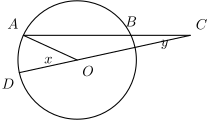
In circle chord is produced so that equals a radius of the circle. is drawn and extended to is drawn. Which of the following expresses the relationship between angles and
no hay ninguna relación especial entre y
there is no special relationship between and
o según la longitud de
or depending upon the length of
Respuesta: A
Pista pequeña:
Como el triángulo es isósceles
Since triangle is isosceles
Pista grande:
Usa el ángulo exterior en y después
Use the exterior angle at , then use
Solución:
Como el triángulo es isósceles, de modo que Por tanto, su ángulo exterior en es Como el triángulo también es isósceles y En el triángulo los ángulos en y son y así que El ángulo es suplementario de y por ello
Por lo tanto, la respuesta correcta es A.
Because triangle is isosceles, so Its exterior angle at is therefore Since triangle is also isosceles and In triangle the angles at and are and so Angle is supplementary to hence
Thus, the correct answer is A.
45.
Se dan una sucesión geométrica cuyo primer término es y con , y una sucesión aritmética cuyo primer término es Se forma una tercera sucesión sumando los términos correspondientes de las dos sucesiones dadas. La suma de los primeros diez términos de la tercera sucesión es:
Given a geometric sequence with the first term and and an arithmetic sequence with the first term A third sequence is formed by adding corresponding terms of the two given sequences. The sum of the first ten terms of the third sequence is:
no puede determinarse con la información dada
not possible to determine from the information given
Respuesta: A
Pista pequeña:
Escribe las dos sucesiones como y
Write the two sequences as and
Pista grande:
Usa las tres primeras sumas y la condición para determinar
Use the first three sums and the condition to determine
Solución:
Las tres primeras sumas término a término dan Al sustituir se obtiene Como tenemos y Los primeros diez términos geométricos suman mientras que los primeros diez términos aritméticos suman Su suma combinada es
Por lo tanto, la respuesta correcta es A.
The first three termwise sums give Substituting yields Since we have and The first ten geometric terms sum to while the first ten arithmetic terms sum to Their combined sum is
Thus, the correct answer is A.
46.
Las gráficas de y se cortan en:
The graphs of and intersect in:
puntos
points
punto
point
puntos
points
ningún punto
no points
un número ilimitado de puntos
an unlimited number of points
Respuesta: B
Pista pequeña:
Resuelve simultáneamente las dos primeras ecuaciones lineales
Solve the first two linear equations simultaneously
Pista grande:
Comprueba si esa solución también satisface cada una de las dos últimas ecuaciones
Check whether that solution also satisfies each of the last two displayed equations
Solución:
Al sumar las dos primeras ecuaciones se obtiene de modo que La sustitución da y por tanto Este punto también está sobre las dos últimas rectas dadas. Por lo tanto, las cuatro gráficas tienen el único punto común
Por lo tanto, la respuesta correcta es B.
Adding the first two equations gives so Substitution gives hence This point also lies on the last two given lines. Therefore all four graphs have the single common point
Thus, the correct answer is B.
47.
Las expresiones y son:
The expressions and are:
siempre iguales
always equal
nunca iguales
never equal
iguales cuando
equal when
iguales cuando
equal when
iguales solamente cuando
equal only when
Respuesta: C
Pista pequeña:
Desarrolla
Expand
Pista grande:
Resta y factoriza la diferencia
Subtract and factor the difference
Solución:
La diferencia es En particular, siempre que esta diferencia es cero y las expresiones son iguales.
Por lo tanto, la respuesta correcta es C.
The difference is In particular, whenever this difference is zero and the expressions are equal.
Thus, the correct answer is C.
48.
Se da el triángulo con medianas es paralelo a y tiene la misma longitud; se trazan y ; la prolongación de corta a en ¿Cuál de las siguientes afirmaciones no es necesariamente correcta?
Given triangle with medians parallel and equal in length to and are drawn; extended meets in Which one of the following statements is not necessarily correct?
es un paralelogramo
is a parallelogram
es una mediana del triángulo
is a median of triangle
Respuesta: B
Pista pequeña:
Sitúa y calcula los puntos medios
Place and compute the midpoints
Pista grande:
Usa y después localiza donde alcanza la altura
Use , then locate where reaches height
Solución:
Sea Entonces Como obtenemos La recta horizontal corta a a mitad de camino de a en Estas coordenadas verifican que es un paralelogramo, y es el punto medio de por lo que es una mediana. Pero que no son iguales en general.
Por lo tanto, la afirmación B no es necesariamente correcta.
Set Then Since we get The horizontal line meets halfway from to at These coordinates verify that is a parallelogram, and is the midpoint of making a median. But which are not generally equal.
Thus, statement B is not necessarily correct.
49.
Las gráficas de y se cortan en:
The graphs of and intersect in:
un punto cuya abscisa es
one point whose abscissa is
un punto cuya abscisa es
one point whose abscissa is
ningún punto
no points
dos puntos distintos
two distinct points
dos puntos idénticos
two identical points
Respuesta: C
Pista pequeña:
Factoriza , pero conserva la restricción original
Factor , but keep the original restriction
Pista grande:
Compara la intersección algebraica de las rectas simplificadas con esa restricción del dominio
Compare the algebraic intersection of the simplified lines with that domain restriction
Solución:
Para Las rectas y se cortarían en Pero está excluido de la función racional original, de modo que ese punto es un hueco y no hay intersección.
Por lo tanto, la respuesta correcta es C.
For The lines and would meet at But is excluded from the original rational function, so that point is a hole and there is no intersection.
Thus, the correct answer is C.
50.
Para adelantar a , que va a millas por hora en una carretera de dos carriles, que va a millas por hora, debe ganar pies. Mientras tanto, a pies de se dirige hacia él a millas por hora. Si y mantienen sus velocidades, para adelantar con seguridad debe aumentar su velocidad en:
In order to pass going mph on a two-lane highway going mph, must gain feet. Meantime, feet from is headed toward him at mph. If and maintain their speeds, then, in order to pass safely, must increase his speed by:
millas por hora
mph
millas por hora
mph
millas por hora
mph
millas por hora
mph
millas por hora
mph
Respuesta: C
Pista pequeña:
Sea la nueva velocidad de e iguala el tiempo de adelantamiento al tiempo antes de que y se encuentren
Let be ’s new speed and equate the passing time to the time before and meet
Pista grande:
Usa distancias y velocidades relativas:
Use relative distances and speeds:
Solución:
Sea la nueva velocidad de . Con respecto a gana a millas por hora, por lo que el tiempo de adelantamiento es proporcional a y cierran su separación de pies a millas por hora, de modo que su tiempo hasta encontrarse es proporcional a En el instante límite para adelantar con seguridad, Así, lo que da millas por hora. debe aumentar su velocidad original en millas por hora.
Por lo tanto, la respuesta correcta es C.
Let be ’s new speed. Relative to gains at mph, so the passing time is proportional to and close their -foot separation at mph, so their meeting time is proportional to At the limiting safe time, Thus giving mph. must increase his original speed by mph.
Therefore, the correct answer is C.