
Problemas del 1952 AMC 12
¡Desplázate hacia abajo y presiona Iniciar para intentar el examen! O ve al PDF imprimible, la clave de respuestas, o las soluciones profesionales preparadas por LIVE by Po-Shen Loh.
Todos los problemas se usan con el permiso legal oficial de la Mathematical Association of America (MAA).
O salta directamente a un solo problema con su solución: 1 · 2 · 3 · 4 · 5 · 6 · 7 · 8 · 9 · 10 · 11 · 12 · 13 · 14 · 15 · 16 · 17 · 18 · 19 · 20 · 21 · 22 · 23 · 24 · 25 · 26 · 27 · 28 · 29 · 30 · 31 · 32 · 33 · 34 · 35 · 36 · 37 · 38 · 39 · 40 · 41 · 42 · 43 · 44 · 45 · 46 · 47 · 48 · 49 · 50
¿Quieres aprender de forma profesional con clases interactivas en video?
Con tiempo
1:15:00
1.
Si el radio de un círculo es un número racional, su área está dada por un número que es:
If the radius of a circle is a rational number, its area is given by a number which is:
Racional
Rational
Irracional
Irrational
Entero
Integral
Un cuadrado perfecto
A perfect square
Ninguna de las anteriores
None of these
Respuesta: B
Pista pequeña:
Escribe el área en función del radio y de
Write the area in terms of the radius and
Pista grande:
El radio de un círculo es positivo, por lo que su cuadrado racional no es cero
A circle’s radius is positive, so its rational square is nonzero
Solución:
Si el radio racional positivo es entonces el área es El factor es un número racional no nulo, y un múltiplo racional no nulo del número irracional es irracional.
Por lo tanto, la respuesta correcta es B.
If the positive rational radius is then its area is The factor is a nonzero rational number, and a nonzero rational multiple of the irrational number is irrational.
Thus, the correct answer is B.
2.
Dos clases de secundaria presentaron el mismo examen. Una clase de estudiantes obtuvo una calificación media de ; la otra clase de estudiantes obtuvo una calificación media de La calificación media de todos los estudiantes de ambas clases es:
Two high school classes took the same test. One class of students made an average grade of ; the other class of students made an average grade of The average grade for all students in both classes is:
Ninguna de las anteriores
None of these
Respuesta: B
Pista pequeña:
Pondera el promedio de cada clase según el número de estudiantes de esa clase
Weight each class average by the number of students in that class
Pista grande:
El promedio combinado es
The combined average is
Solución:
Las dos clases obtuvieron un total combinado de puntos porcentuales entre estudiantes. Su promedio combinado es
Por lo tanto, la respuesta correcta es B.
The two classes earned a combined total of percentage points among students. Their combined average is
Thus, the correct answer is B.
3.
La expresión es igual a:
The expression equals:
Ninguna de las anteriores
None of these
Respuesta: A
Pista pequeña:
Considera la expresión como una diferencia de dos cubos
View the expression as a difference of two cubes
Pista grande:
Usa con
Use with
Solución:
Aplicamos la identidad de la diferencia de cubos con y Como
Por lo tanto, la respuesta correcta es A.
Apply the difference-of-cubes identity with and Since
Thus, the correct answer is A.
4.
El costo de enviar por correo un paquete que pesa libras, donde es un entero, es de centavos por la primera libra y centavos por cada libra adicional. La fórmula del costo es:
The cost of sending a parcel post package weighing pounds, an integer, is cents for the first pound and cents for each additional pound. The formula for the cost is:
Respuesta: C
Pista pequeña:
Solo las libras posteriores a la primera se cobran a la tarifa por libra adicional
Only the pounds after the first are charged at the additional-pound rate
Pista grande:
Un paquete de libras tiene libras adicionales
A -pound package has additional pounds
Solución:
La primera libra cuesta centavos. Las libras restantes cuestan centavos, por lo que
Por lo tanto, la respuesta correcta es C.
The first pound costs cents. The remaining pounds cost cents, so
Thus, the correct answer is C.
5.
Los puntos y están unidos por una recta. Otro punto de esta recta es:
The points and are connected by a straight line. Another point on this line is:
Respuesta: A
Pista pequeña:
Halla la pendiente de la recta que pasa por los dos puntos dados
Find the slope through the two given points
Pista grande:
La recta tiene ecuación
The line has equation
Solución:
La pendiente es por lo que la recta es Al sustituir , se obtiene
Por lo tanto, la respuesta correcta es A.
The slope is so the line is Substituting gives
Thus, the correct answer is A.
6.
La diferencia entre las raíces de es:
The difference of the roots of is:
Respuesta: E
Pista pequeña:
Escribe las dos raíces usando la fórmula cuadrática
Write the two roots using the quadratic formula
Pista grande:
Su separación es la raíz cuadrada del discriminante porque el coeficiente principal es
Their separation is the square root of the discriminant because the leading coefficient is
Solución:
Las raíces son y Por ello, su diferencia positiva es
Por lo tanto, la respuesta correcta es E.
The roots are and Their positive difference is therefore
Thus, the correct answer is E.
7.
Al simplificar, es igual a:
When simplified, is equal to:
Respuesta: B
Pista pequeña:
Primero combina en una sola fracción
First combine into one fraction
Pista grande:
El exponente indica entonces que se toma el recíproco
The exponent then takes the reciprocal
Solución:
Al combinar los términos y luego tomar el recíproco se obtiene
Por lo tanto, la respuesta correcta es B.
Combining the terms and then taking the reciprocal gives
Thus, the correct answer is B.
8.
Dos círculos iguales en el mismo plano no pueden tener el siguiente número de tangentes comunes:
Two equal circles in the same plane cannot have the following number of common tangents:
Ninguna de las anteriores
None of these
Respuesta: A
Pista pequeña:
Considera círculos iguales que se cortan, son tangentes exteriormente o son disjuntos
Consider intersecting, externally tangent, and disjoint equal circles
Pista grande:
Una tangencia interior exigiría radios distintos, a menos que los círculos coincidan
An internal tangency would require unequal radii unless the circles coincide
Solución:
Dos círculos iguales distintos tienen tangentes comunes cuando se cortan, cuando son tangentes exteriormente y cuando son disjuntos. No pueden ser tangentes interiormente, porque la tangencia interior exige que la distancia entre los centros sea igual a la diferencia de los radios, que es Cuando la distancia entre los centros es , los círculos iguales coinciden y tienen infinitas tangentes comunes.
Por lo tanto, es imposible tener exactamente tangente común, así que la respuesta correcta es A.
Two distinct equal circles have common tangents when they intersect, when externally tangent, and when disjoint. They cannot be internally tangent, because internal tangency requires the center distance to equal the difference of the radii, which is At center distance the equal circles coincide and have infinitely many common tangents.
Thus exactly common tangent is impossible, so the correct answer is A.
9.
Si entonces es igual a:
If then equals:
Respuesta: D
Pista pequeña:
Elimina el denominador antes de agrupar los términos que contienen
Clear the denominator before collecting the terms containing
Pista grande:
La ecuación se convierte en
The equation becomes
Solución:
Al eliminar el denominador se obtiene De aquí, , por lo que
Por lo tanto, la respuesta correcta es D.
Clearing the denominator gives Hence , so
Thus, the correct answer is D.
10.
Un automóvil subió una colina a millas por hora y bajó la misma distancia a millas por hora. La velocidad media del viaje de ida y vuelta fue:
An automobile went up a hill at a speed of miles an hour and down the same distance at a speed of miles an hour. The average speed for the round trip was:
millas por hora
mph
millas por hora
mph
millas por hora
mph
millas por hora
mph
Ninguna de las anteriores
None of these
Respuesta: B
Pista pequeña:
Usa las distancias iguales en vez de promediar directamente las dos velocidades
Use equal distances rather than averaging the two speeds directly
Pista grande:
Para un trayecto de una milla en cada dirección, divide la distancia total entre el tiempo total
For a one-mile trip each way, divide the total distance by the total time
Solución:
Para una milla en cada dirección, el tiempo total es de hora. Por lo tanto, la velocidad media es
Por lo tanto, la respuesta correcta es B.
For one mile in each direction, the total time is hour. Thus the average speed is
Thus, the correct answer is B.
11.
Si entonces es incorrecto afirmar:
If then it is incorrect to say:
Respuesta: C
Pista pequeña:
Comprueba el dominio de la función racional antes de evaluarla
Check the domain of the rational function before evaluating it
Pista grande:
El denominador se anula en una de las entradas indicadas
The denominator vanishes at one of the listed inputs
Solución:
La función no está definida en porque allí su denominador es cero, así que es falso. Las demás afirmaciones son válidas: al resolver se obtiene y esta misma fórmula muestra que es su propia inversa.
Por lo tanto, la respuesta correcta es C.
The function is undefined at because its denominator is zero there, so is false. The other statements hold: solving gives and this same formula shows that is its own inverse.
Thus, the correct answer is C.
12.
La suma infinita de una progresión geométrica es La suma de sus dos primeros términos es El primer término de la progresión es:
The sum to infinity of the terms of an infinite geometric progression is The sum of the first two terms is The first term of the progression is:
o
or
o
or
Respuesta: E
Pista pequeña:
Sea el primer término y la razón común
Let the first term be and the common ratio be
Pista grande:
Usa en la ecuación
Use in the equation
Solución:
Sea el primer término y la razón común. La suma infinita da Por lo tanto, los dos primeros términos satisfacen Así, de modo que da mientras que da
Por lo tanto, la respuesta correcta es E.
Let the first term be and the common ratio be The infinite sum gives The first two terms therefore satisfy Thus so gives while gives
Thus, the correct answer is E.
13.
La función , con y mayores que cero, alcanza su valor mínimo cuando:
The function with and greater than zero has its minimum value when:
Respuesta: E
Pista pequeña:
Completa el cuadrado en los términos
Complete the square in the terms
Pista grande:
El término al cuadrado es mínimo cuando
The squared term is minimized when
Solución:
Al completar el cuadrado se obtiene El cuadrado es mínimo cuando
Por lo tanto, la respuesta correcta es E.
Completing the square gives The square is least when
Thus, the correct answer is E.
14.
Una casa y una tienda se vendieron por cada una. La casa se vendió con una pérdida del del costo y la tienda con una ganancia del del costo. La operación completa produjo:
A house and store were sold for each. The house was sold at a loss of of the cost, and the store at a gain of of the cost. The entire transaction resulted in:
Ni pérdida ni ganancia
No loss or gain
Una pérdida de
Loss of
Una ganancia de
Gain of
Una ganancia de
Gain of
Ninguna de las anteriores
None of these
Respuesta: B
Pista pequeña:
Recupera por separado cada costo original a partir de su precio de venta
Recover each original cost from its selling price separately
Pista grande:
La casa se vendió por el de su costo, mientras que la tienda se vendió por el de su costo
The house sold for of cost, while the store sold for of cost
Solución:
La casa costó dólares y la tienda costó dólares. El costo combinado fue de dólares, mientras que el precio de venta combinado fue de dólares, lo que produjo una pérdida de dólares.
Por lo tanto, la respuesta correcta es B.
The house cost dollars, and the store cost dollars. The combined cost was dollars, while the combined selling price was dollars, producing a loss of dollars.
Thus, the correct answer is B.
15.
Los lados de un triángulo están en la razón Entonces:
The sides of a triangle are in the ratio Then:
El triángulo es obtusángulo
The triangle is obtuse
Los ángulos están en la razón
The angles are in the ratio
El triángulo es acutángulo
The triangle is acute
El ángulo opuesto al lado mayor es el doble del ángulo opuesto al lado menor
The angle opposite the largest side is double the angle opposite the smallest side
Ninguna de las anteriores
None of these
Respuesta: C
Pista pequeña:
Compara el cuadrado del lado mayor con la suma de los cuadrados de los otros dos
Compare the square of the largest side with the sum of the squares of the other two
Pista grande:
Aquí es menor que
Here is less than
Solución:
Para un triángulo cuyo lado mayor es Por el recíproco de la desigualdad pitagórica, el ángulo opuesto al lado es agudo. Como es el ángulo mayor, todos los ángulos son agudos.
Por lo tanto, la respuesta correcta es C.
For a triangle with largest side By the converse of the Pythagorean inequality, the angle opposite side is acute. Since it is the largest angle, every angle is acute.
Thus, the correct answer is C.
16.
Si la base de un rectángulo aumenta un y el área no cambia, entonces la altura disminuye en:
If the base of a rectangle is increased by and the area is unchanged, then the altitude is decreased by:
Respuesta: E
Pista pequeña:
La nueva altura debe dividirse entre el mismo factor por el que se multiplicó la base
The new altitude must be divided by the same factor by which the base was multiplied
Pista grande:
Un aumento del en la base multiplica la base por
A base increase multiplies the base by
Solución:
Para mantener el área fija, la altura se multiplica por Su disminución fraccionaria es que equivale a
Por lo tanto, la respuesta correcta es E.
To keep the area fixed, the altitude is multiplied by Its fractional decrease is which is
Thus, the correct answer is E.
17.
Un comerciante compró mercancía con un descuento del sobre el precio de lista. Desea marcarla a un precio que le permita ofrecer un descuento del sobre el precio marcado y aun así obtener una ganancia del del precio de venta. El porcentaje del precio de lista al que debe marcarla es:
A merchant bought some goods at a discount of of the list price. He wants to mark them at such a price that he can give a discount of of the marked price and still make a profit of of the selling price. The percent of the list price at which he should mark them is:
Respuesta: C
Pista pequeña:
Normaliza el precio de lista a y distingue entre costo, precio marcado y precio de venta
Normalize the list price to and distinguish cost, marked price, and selling price
Pista grande:
Una ganancia igual al del precio de venta significa que el costo es el del precio de venta
A profit equal to of selling price means the cost is of selling price
Solución:
Sea el precio de lista. El costo del comerciante es Si el precio de venta es entonces así que Si el precio marcado es el descuento del da de donde
Por lo tanto, el precio marcado debe ser el del precio de lista, así que la respuesta correcta es C.
Let the list price be The merchant’s cost is If the selling price is then so If the marked price is the discount gives hence
The marked price must therefore be of the list price, so the correct answer is C.
18.
solo si:
only if:
Respuesta: D
Pista pequeña:
Combina los logaritmos del lado izquierdo antes de igualar sus argumentos positivos
Combine the logarithms on the left before equating their positive arguments
Pista grande:
Resuelve para hallar
Solve for
Solución:
La regla del producto de logaritmos transforma la ecuación en por lo que los argumentos positivos deben satisfacer Así, lo que da Sus valores admisibles cumplen lo que también mantiene positivos todos los argumentos de los logaritmos.
Por lo tanto, la respuesta correcta es D.
The logarithm product rule changes the equation to so the positive arguments must satisfy Therefore giving Its admissible values have which also keeps all logarithm arguments positive.
Thus, the correct answer is D.
19.
El ángulo del triángulo es trisecado por y que cortan a en y respectivamente. Entonces:
Angle of triangle is trisected by and which meet at and respectively. Then:
Respuesta: D
Pista pequeña:
Compara las áreas de los triángulos y de dos maneras distintas
Compare the areas of triangles and in two different ways
Pista grande:
Sus bases están sobre , y sus ángulos comprendidos en son ángulos iguales de la trisección
They have bases on , and their included angles at are equal trisection angles
Solución:
Los triángulos y tienen bases y sobre la misma recta por lo que su altura común desde da Además, porque ambos son un tercio del ángulo Al usar dos lados y el ángulo comprendido para la misma razón de áreas se obtiene
Por lo tanto, la respuesta correcta es D.
Triangles and have bases and on the same line so their common altitude from gives Also, because both are one-third of angle Using two sides and the included angle for the same area ratio gives
Thus, the correct answer is D.
20.
Si entonces la expresión incorrecta de las siguientes es:
If then the incorrect expression in the following is:
Respuesta: E
Pista pequeña:
Sean y
Let and
Pista grande:
Presta atención al signo de
Pay attention to the sign of
Solución:
Sean y Las primeras cuatro expresiones se convierten, respectivamente, en y Sin embargo, no
Por lo tanto, la respuesta correcta es E.
Set and The first four expressions become and respectively. But not
Thus, the correct answer is E.
21.
Los lados de un polígono regular de lados, con se prolongan para formar una estrella. El número de grados en cada punta de la estrella es:
The sides of a regular polygon of sides, are extended to form a star. The number of degrees at each point of the star is:
Respuesta: B
Pista pequeña:
Relaciona una punta de la estrella con el ángulo exterior en cada uno de sus dos vértices de la base
Relate a star point to the exterior angle at each of its two base vertices
Pista grande:
El ángulo de una punta de la estrella y dos ángulos exteriores del polígono regular forman un triángulo cuya suma angular es un ángulo llano
The angle at a star point and two exterior angles of the regular polygon form a straight-angle triangle
Solución:
Cada ángulo exterior de un polígono regular de lados mide grados. Los dos lados que forman una punta de la estrella, junto con el lado intermedio del polígono, forman un triángulo cuyos dos ángulos de la base son esos ángulos exteriores. Por lo tanto, el ángulo de la punta es
Por lo tanto, la respuesta correcta es B.
Each exterior angle of a regular -gon is degrees. The two sides forming a point of the star, together with the intervening polygon side, make a triangle whose two base angles are those exterior angles. Hence its point angle is
Thus, the correct answer is B.
22.
Sobre la hipotenusa de un triángulo rectángulo se construye un segundo triángulo rectángulo cuya hipotenusa es Si y entonces es igual a:
On hypotenuse of a right triangle a second right triangle is constructed with hypotenuse If and then equals:
Respuesta: B
Pista pequeña:
Usa primero el triángulo para expresar la hipotenusa común
Use triangle first to express the common hypotenuse
Pista grande:
Luego aplica el teorema de Pitágoras al triángulo , cuya hipotenusa es
Then apply the Pythagorean theorem to triangle , whose hypotenuse is
Solución:
En el primer triángulo rectángulo, En el segundo triángulo rectángulo, es la hipotenusa y por lo que Por lo tanto,
Por lo tanto, la respuesta correcta es B.
In the first right triangle, In the second right triangle, is the hypotenuse and so Therefore
Thus, the correct answer is B.
23.
Si tiene raíces numéricamente iguales pero de signos opuestos, el valor de debe ser:
If has roots which are numerically equal but of opposite signs, the value of must be:
Respuesta: A
Pista pequeña:
Elimina el denominador y ordena la ecuación como una cuadrática en
Clear the denominator and collect the equation as a quadratic in
Pista grande:
Las raíces opuestas suman cero, por lo que el coeficiente de debe anularse
Opposite roots have sum zero, so the coefficient of must vanish
Solución:
La multiplicación cruzada da Las raíces de igual magnitud y signos opuestos tienen suma por lo que el coeficiente de es Así, y
Por lo tanto, la respuesta correcta es A.
Cross-multiplication gives Roots that are equal in magnitude and opposite in sign have sum so the coefficient of is Thus and
Thus, the correct answer is A.
24.
En la figura se sabe que el ángulo y El área del cuadrilátero es:
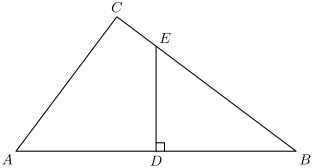
In the figure, it is given that angle and The area of quadrilateral is:
Ninguna de las anteriores
None of these
Respuesta: B
Pista pequeña:
Coloca sobre el eje y halla las coordenadas de a partir de las longitudes de los dos lados
Place on the -axis and find the coordinates of from the two side lengths
Pista grande:
La perpendicular por el punto medio corta a en ; luego usa la fórmula del cordón con
The perpendicular through midpoint meets at ; then use the shoelace formula on
Solución:
Como y el ángulo es recto, Colocamos y Al resolver se obtiene Además,
La recta corta a en La fórmula del cordón para da ahora
Por lo tanto, la respuesta correcta es B.
Since and angle is right, Put and Solving gives Also
The line meets at The shoelace formula for now gives
Thus, the correct answer is B.
25.
Un operario de explosivos preparó una mecha para que la explosión ocurriera en segundos. Se alejó corriendo a yardas por segundo. El sonido viaja a pies por segundo. Cuando el operario oyó la explosión, había recorrido aproximadamente:
A powderman set a fuse for a blast to take place in seconds. He ran away at a rate of yards per second. Sound travels at the rate of feet per second. When the powderman heard the blast, he had run approximately:
yardas
yd.
yardas
yd.
yardas
yd.
yardas
yd.
yardas
yd.
Respuesta: D
Pista pequeña:
Sea el número total de segundos desde que se enciende la mecha hasta que se oye el sonido
Let be the total number of seconds from lighting the fuse until the sound is heard
Pista grande:
En el instante , el sonido ha viajado durante segundos y debe cubrir la distancia del corredor
At time , the sound has traveled for seconds and must cover the runner’s distance
Solución:
Sea el tiempo total en segundos. El operario está a yardas, o pies, del lugar de la explosión. Como el sonido comienza después de segundos, Así, segundos, y la distancia que recorrió es
El valor indicado que se aproxima es yardas, por lo que la respuesta correcta es D.
Let be the total time in seconds. The powderman is yards, or feet, from the blast. Because the sound starts after seconds, Thus seconds, and the distance he ran is
Approximately yards is the listed value, so the correct answer is D.
26.
Si entonces es igual a:
If then equals
Respuesta: C
Pista pequeña:
Sea y expresa la suma solicitada en función de
Let and express the requested sum in terms of
Pista grande:
Usa
Use
Solución:
Sea Al desarrollar se obtiene Como esto se convierte en
Por lo tanto, el valor es así que la respuesta correcta es C.
Let Expanding gives Since this becomes
Thus the value is so the correct answer is C.
27.
La razón entre el perímetro de un triángulo equilátero cuya altura es igual al radio de un círculo y el perímetro de un triángulo equilátero inscrito en el círculo es:
The ratio of the perimeter of an equilateral triangle having an altitude equal to the radius of a circle, to the perimeter of an equilateral triangle inscribed in the circle is:
Respuesta: E
Pista pequeña:
Expresa el lado de cada triángulo equilátero en función del mismo radio del círculo
Express each equilateral triangle’s side length in terms of the same circle radius
Pista grande:
Un triángulo equilátero de altura tiene lado , mientras que uno inscrito tiene lado
An equilateral triangle of altitude has side , while an inscribed one has side
Solución:
Un triángulo equilátero de lado tiene altura Por lo tanto, el primer triángulo tiene lado y perímetro Un triángulo equilátero inscrito en un círculo de radio tiene lado y perímetro
La razón de los perímetros es, por lo tanto, así que la respuesta correcta es E.
An equilateral triangle with side has altitude Thus the first triangle has side and perimeter An equilateral triangle inscribed in a circle of radius has side and perimeter
The perimeter ratio is therefore so the correct answer is E.
28.
En la tabla mostrada, la fórmula que relaciona con es:
In the table shown, the formula relating and is:
Ninguna de las anteriores
None of these
Respuesta: C
Pista pequeña:
Observa las primeras y segundas diferencias de los valores de
Look at the first and second differences of the -values
Pista grande:
La segunda diferencia constante sugiere una cuadrática mónica; prueba la cuadrática indicada
The constant second difference suggests a monic quadratic; test the listed quadratic
Solución:
Las diferencias sucesivas de los valores de son cuyas diferencias sucesivas son todas Por lo tanto, los datos corresponden a una cuadrática mónica. La sustitución muestra que da cuando respectivamente.
Por lo tanto, la respuesta correcta es C.
The successive differences of the -values are whose successive differences are all Thus the data fit a monic quadratic. Substitution shows gives at respectively.
Thus, the correct answer is C.
29.
En un círculo de radio unidades, y son diámetros perpendiculares. Una cuerda que corta a en mide unidades. El diámetro queda dividido en dos segmentos cuyas longitudes son:
In a circle of radius units, and are perpendicular diameters. A chord cutting at is units long. The diameter is divided into two segments whose dimensions are:
Ninguna de las anteriores
None of these
Respuesta: A
Pista pequeña:
Coloca el centro en el origen, toma y representa con coordenadas el otro extremo de la cuerda
Put the center at the origin, take , and represent the other endpoint of the chord by coordinates
Pista grande:
Usa y , y luego halla dónde la recta cruza el diámetro horizontal
Use and , then find where line crosses the horizontal diameter
Solución:
Colocamos el círculo en el origen con y sea Las ecuaciones dan y Tomar no cambia las longitudes de los segmentos.
La recta de a cruza en Por lo tanto, sus distancias a los extremos y del diámetro son
Por lo tanto, la respuesta correcta es A.
Put the circle at the origin with and let The equations give and Taking does not change the segment lengths.
The line from to crosses at Its distances to the endpoints and of diameter are therefore
Thus, the correct answer is A.
30.
Cuando la suma de los primeros diez términos de una progresión aritmética es cuatro veces la suma de los primeros cinco términos, la razón entre el primer término y la diferencia común es:
When the sum of the first ten terms of an arithmetic progression is four times the sum of the first five terms, the ratio of the first term to the common difference is:
Respuesta: A
Pista pequeña:
Escribe ambas sumas parciales en función del primer término y de la diferencia común
Write both partial sums in terms of the first term and common difference
Pista grande:
Usa y simplifica
Use and simplify
Solución:
La fórmula de la suma da La ecuación se convierte en por lo que Por consiguiente,
Por lo tanto, la respuesta correcta es A.
The sum formula gives The equation becomes so Hence
Thus, the correct answer is A.
31.
Dados puntos en un plano, sin que haya tres colineales, el número de rectas que determinan es:
Given points in a plane no three of which are collinear, the number of lines they determine is:
Ninguna de las anteriores
None of these
Respuesta: D
Pista pequeña:
Cada recta se determina eligiendo dos de los puntos
Each line is determined by choosing two of the points
Pista grande:
La condición de que no haya tres puntos colineales garantiza que pares distintos determinen rectas distintas
The condition that no three are collinear ensures that different pairs determine different lines
Solución:
Cada par de puntos determina una recta, y ninguna recta se cuenta mediante más de un par porque no hay tres puntos colineales. Por lo tanto, el número de rectas es
Por lo tanto, la respuesta correcta es D.
Every pair of points determines one line, and no line is counted by more than one pair because no three points are collinear. Therefore the number of lines is
Thus, the correct answer is D.
32.
tarda minutos menos que en recorrer una distancia de millas. viaja de milla por hora más rápido que Si es la velocidad de en millas por hora, entonces el tiempo de para recorrer la distancia es:
takes minutes less time than to travel a distance of miles. travels mile per hour faster than If is ’s rate of speed in miles per hour, then ’s time for the distance is:
Respuesta: D
Pista pequeña:
Usa la relación básica
Use the basic relation
Pista grande:
La pregunta solo pide el tiempo de , y ya se conocen tanto la distancia como la velocidad de
The question asks only for ’s time, and both ’s distance and rate are already given
Solución:
Para la distancia es de millas y la velocidad es de millas por hora. Por lo tanto, No se necesita la comparación con para esta expresión.
Por lo tanto, la respuesta correcta es D.
For the distance is miles and the rate is miles per hour. Thus The comparison with is not needed for this expression.
Thus, the correct answer is D.
33.
Un círculo y un cuadrado tienen el mismo perímetro. Entonces:
A circle and a square have the same perimeter. Then:
Sus áreas son iguales
Their areas are equal
El área del círculo es mayor
The area of the circle is the greater
El área del cuadrado es mayor
The area of the square is the greater
El área del círculo es veces el área del cuadrado
The area of the circle is times the area of the square
Ninguna de las anteriores
None of these
Respuesta: B
Pista pequeña:
Denota el perímetro común por y expresa cada área en función de
Call the common perimeter and express each area in terms of
Pista grande:
El círculo tiene área , mientras que el cuadrado tiene área
The circle has area , while the square has area
Solución:
Con perímetro común el radio del círculo es , por lo que su área es El lado del cuadrado es por lo que su área es Como
El círculo tiene mayor área, por lo que la respuesta correcta es B.
With common perimeter the circle’s radius is , so its area is The square’s side is so its area is Since
The circle has the greater area, so the correct answer is B.
34.
El precio de un artículo aumentó un Después, el nuevo precio disminuyó un Si el precio final era de un dólar, el precio original era:
The price of an article was increased Later the new price was decreased If the last price was one dollar, the original price was:
Un dólar
One dollar
Respuesta: E
Pista pequeña:
Representa el aumento y la disminución mediante factores multiplicativos
Represent the increase and decrease by multiplicative factors
Pista grande:
Si el precio original es entonces
If the original price is then
Solución:
Si el precio original es de dólares, después de ambos cambios el precio es Al igualar esto a se obtiene
Por lo tanto, la respuesta correcta es E.
If the original price is dollars, then after both changes its price is Setting this equal to gives
Thus, the correct answer is E.
35.
Con el denominador racionalizado, la expresión es equivalente a:
With a rational denominator, the expression is equivalent to:
Ninguna de las anteriores
None of these
Respuesta: A
Pista pequeña:
Primero considera el denominador como y multiplica por su conjugado
First treat the denominator as and multiply by its conjugate
Pista grande:
Después de la primera racionalización queda un denominador que contiene ; usa otro conjugado
After the first rationalization, a denominator containing remains; use another conjugate
Solución:
Primero multiplicamos por el conjugado Esto da Al multiplicar numerador y denominador por se obtiene
Por lo tanto, la respuesta correcta es A.
Multiply first by the conjugate This gives Multiplying numerator and denominator by yields
Thus, the correct answer is A.
36.
Para que sea continua en se toma el valor de como:
To be continuous at the value of is taken to be:
Respuesta: E
Pista pequeña:
Factoriza tanto el numerador como el denominador antes de sustituir
Factor both numerator and denominator before substituting
Pista grande:
Cancela el factor común y evalúa la expresión restante
Cancel the common factor and evaluate the remaining expression
Solución:
Para Su límite en es Asignar este valor elimina la discontinuidad.
Por lo tanto, la respuesta correcta es E.
For Its limit at is Assigning this value removes the discontinuity.
Thus, the correct answer is E.
37.
En un círculo de radio pulgadas se trazan dos cuerdas paralelas iguales separadas por pulgadas. El área de la parte del círculo situada entre las cuerdas es:
Two equal parallel chords are drawn inches apart in a circle of radius inches. The area of that part of the circle that lies between the chords is:
Respuesta: B
Pista pequeña:
Las cuerdas paralelas iguales están a la misma distancia del centro, por lo que cada una está a pulgadas de él
Equal parallel chords lie the same distance from the center, so each is inches from it
Pista grande:
Resta del círculo completo los dos segmentos circulares exteriores congruentes
Subtract the two congruent outer circular segments from the whole circle
Solución:
Las cuerdas iguales están simétricamente a pulgadas del centro. Para cualquiera de ellas, el semiángulo en el centro satisface por lo que Cada segmento exterior es un sector de menos el triángulo isósceles: Por lo tanto, el área entre las cuerdas es
Por lo tanto, la respuesta correcta es B.
The equal chords are symmetrically inches from the center. For either chord, the half-angle at the center satisfies so Each outer segment is a sector minus the isosceles triangle: The area between the chords is therefore
Thus, the correct answer is B.
38.
El área de un terreno trapezoidal es de yardas cuadradas. Su altura es de yardas. Se buscan las dos bases, sabiendo que la longitud en yardas de cada una es un entero divisible por El número de soluciones de este problema es:
The area of a trapezoidal field is square yards. Its altitude is yards. Find the two bases, if the number of yards in each base is an integer divisible by The number of solutions to this problem is:
Ninguna
None
Una
One
Dos
Two
Tres
Three
Más de tres
More than three
Respuesta: D
Pista pequeña:
Usa la fórmula del área del trapecio para hallar la suma de las dos bases
Use the trapezoid area formula to find the sum of the two bases
Pista grande:
Enumera los pares no ordenados de múltiplos positivos de que tienen esa suma
List the unordered pairs of positive multiples of with that sum
Solución:
Si las bases son entonces de modo que Los pares positivos no ordenados de múltiplos de son Hay tres soluciones.
Por lo tanto, la respuesta correcta es D.
If the bases are then so The unordered positive pairs of multiples of are There are three solutions.
Thus, the correct answer is D.
39.
Si el perímetro de un rectángulo es y su diagonal es la diferencia entre el largo y el ancho del rectángulo es:
If the perimeter of a rectangle is and its diagonal is the difference between the length and width of the rectangle is:
Respuesta: A
Pista pequeña:
Sean y las longitudes de los lados, y escribe ecuaciones para y
Let the side lengths be and , and write equations for and
Pista grande:
Escribe y luego resta para obtener
Write , then subtract to obtain
Solución:
El perímetro y la diagonal dan Por consiguiente, Al tomar la raíz cuadrada no negativa se obtiene
Por lo tanto, la respuesta correcta es A.
The perimeter and diagonal give Hence Taking the nonnegative square root gives
Thus, the correct answer is A.
40.
Para dibujar la gráfica de se construyó una tabla de valores. Los valores de la función para un conjunto de valores crecientes y equidistantes de fueron y El que es incorrecto es:
In order to draw a graph of a table of values was constructed. These values of the function for a set of equally spaced increasing values of were and The one which is incorrect is:
Ninguno de estos
None of these
Respuesta: E
Pista pequeña:
Una cuadrática evaluada en entradas equidistantes tiene segundas diferencias constantes
A quadratic sampled at equally spaced inputs has constant second differences
Pista grande:
Los valores vecinos también sugieren cuadrados perfectos consecutivos; comprueba cada valor mostrado antes de revisar cuáles aparecen entre las opciones
The surrounding values also suggest consecutive perfect squares; check every displayed table value before checking which values appear among the choices
Solución:
Los valores deben ser los cuadrados consecutivos Estos son Por lo tanto, el valor incorrecto de la tabla es pero no aparece entre las opciones A-D.
En consecuencia, ninguno de los cuatro números indicados es incorrecto, por lo que la respuesta correcta es E.
The values are intended to be the consecutive squares These are Thus the incorrect table entry is but it is not one of choices A-D.
Consequently none of the four listed numbers is incorrect, so the correct answer is E.
41.
Aumentar el radio de un cilindro en unidades aumenta el volumen en unidades cúbicas. Aumentar la altura del cilindro en unidades también aumenta el volumen en unidades cúbicas. Si la altura original es entonces el radio original es:
Increasing the radius of a cylinder by units increases the volume by cubic units. Increasing the altitude of the cylinder by units also increases the volume by cubic units. If the original altitude is then the original radius is:
Respuesta: C
Pista pequeña:
Sea el radio original y escribe cada uno de los dos aumentos de volumen
Let the original radius be and write each of the two volume increases
Pista grande:
Iguala y
Equate and
Solución:
Con altura original y radio aumentar el radio añade unidades cúbicas. Aumentar la altura en añade unidades cúbicas. Al igualarlos se obtiene o Su raíz positiva es
Por lo tanto, la respuesta correcta es C.
With original height and radius increasing the radius adds cubic units. Increasing the height by adds cubic units. Equating these gives or Its positive root is
Thus, the correct answer is C.
42.
Sea un decimal periódico. Si denota las cifras de que no se repiten y denota las cifras que sí se repiten, entonces la expresión incorrecta es:
Let represent a repeating decimal. If denotes the figures of which do not repeat themselves, and denotes the figures which do repeat themselves, then the incorrect expression is:
Respuesta: D
Pista pequeña:
Desplaza el punto decimal primero más allá de las cifras no periódicas y luego más allá de un bloque de cifras periódicas
Shift the decimal point first past the nonrepeating digits and then past one block of repeating digits
Pista grande:
Resta de y compara el resultado con la opción D
Subtract from and compare the result with choice D
Solución:
Después de desplazar el punto más allá del bloque no periódico, y después de desplazarlo un bloque periódico más, Al restar se obtiene la relación estándar Esto no es como afirma la opción D.
Por lo tanto, la expresión incorrecta, y con ello la respuesta correcta, es D.
After shifting past the nonrepeating block, and after shifting one repeating block farther, Subtracting yields the standard relation This is not as stated in choice D.
Thus, the incorrect expression, and hence the correct answer, is D.
43.
El diámetro de un círculo se divide en partes iguales. Sobre cada parte se construye un semicírculo. Cuando se hace muy grande, la suma de las longitudes de los arcos de los semicírculos se aproxima a una longitud:
The diameter of a circle is divided into equal parts. On each part a semicircle is constructed. As becomes very large, the sum of the lengths of the arcs of the semicircles approaches a length:
Igual a la semicircunferencia del círculo original
Equal to the semi-circumference of the original circle
Igual al diámetro del círculo original
Equal to the diameter of the original circle
Mayor que el diámetro pero menor que la semicircunferencia del círculo original
Greater than the diameter but less than the semi-circumference of the original circle
Infinita
That is infinite
Mayor que la semicircunferencia pero finita
Greater than the semi-circumference but finite
Respuesta: A
Pista pequeña:
Sea el diámetro original, de modo que cada semicírculo pequeño tenga diámetro
Let the original diameter be , so each small semicircle has diameter
Pista grande:
Multiplica la longitud del arco de un semicírculo pequeño por el número de partes
Multiply the arc length of one small semicircle by the number of parts
Solución:
Cada semicírculo pequeño tiene diámetro por lo que la longitud de su arco es La suma de las longitudes de arco es exactamente la semicircunferencia del círculo original. Esta igualdad se cumple para todo positivo, no solo en el límite.
Por lo tanto, la respuesta correcta es A.
Each small semicircle has diameter so its arc length is The sum of all arc lengths is exactly the semi-circumference of the original circle. This equality holds for every positive not merely in the limit.
Thus, the correct answer is A.
44.
Si un entero de dos cifras es veces la suma de sus cifras, el número formado al intercambiar las cifras es la suma de las cifras multiplicada por:
If an integer of two digits is times the sum of its digits, the number formed by interchanging the digits is the sum of the digits multiplied by:
Respuesta: C
Pista pequeña:
Sean y las dos cifras, y expresa tanto el número original como el invertido
Let the two digits be and , and express both the original and reversed numbers
Pista grande:
Los dos números suman
The two numbers add to
Solución:
Sea el número original El número invertido es Como el número invertido es igual a
Por lo tanto, la respuesta correcta es C.
Let the original number be The reversed number is Since the reversed number equals
Thus, the correct answer is C.
45.
Si y son dos números positivos distintos, entonces:
If and are two unequal positive numbers, then:
Respuesta: E
Pista pequeña:
Reconoce las medias aritmética, geométrica y armónica de y
Recognize the arithmetic, geometric, and harmonic means of and
Pista grande:
Para números positivos distintos, las desigualdades entre las medias son estrictas
For unequal positive numbers, the mean inequalities are strict
Solución:
La desigualdad entre las medias aritmética y geométrica da para valores positivos distintos Al aplicar la misma desigualdad a y se obtiene Así, el orden decreciente es media aritmética, media geométrica y media armónica.
Por lo tanto, la respuesta correcta es E.
The arithmetic-geometric mean inequality gives for unequal positive Applying the same inequality to and gives Therefore the decreasing order is arithmetic mean, geometric mean, harmonic mean.
Thus, the correct answer is E.
46.
La base de un nuevo rectángulo es igual a la suma de la diagonal y el lado mayor de un rectángulo dado, mientras que la altura del nuevo rectángulo es igual a la diferencia entre la diagonal y el lado mayor del rectángulo dado. El área del nuevo rectángulo es:
The base of a new rectangle equals the sum of the diagonal and the greater side of a given rectangle, while the altitude of the new rectangle equals the difference of the diagonal and the greater side of the given rectangle. The area of the new rectangle is:
Mayor que el área del rectángulo dado
Greater than the area of the given rectangle
Igual al área del rectángulo dado
Equal to the area of the given rectangle
Igual al área de un cuadrado cuyo lado es igual al lado menor del rectángulo dado
Equal to the area of a square with its side equal to the smaller side of the given rectangle
Igual al área de un cuadrado cuyo lado es igual al lado mayor del rectángulo dado
Equal to the area of a square with its side equal to the greater side of the given rectangle
Igual al área de un rectángulo cuyas dimensiones son la diagonal y el lado menor del rectángulo dado
Equal to the area of a rectangle whose dimensions are the diagonal and shorter side of the given rectangle
Respuesta: C
Pista pequeña:
Sea la diagonal y sean los lados mayor y menor
Let be the diagonal and the greater and smaller sides
Pista grande:
El área nueva es
The new area is
Solución:
Sean y las longitudes de los lados mayor y menor, y sea la diagonal. El área del nuevo rectángulo es El teorema de Pitágoras da por lo que el área nueva es Esta es el área de un cuadrado cuyo lado es igual al lado menor del rectángulo original.
Por lo tanto, la respuesta correcta es C.
Let the greater and smaller side lengths be and and let the diagonal be The new rectangle’s area is The Pythagorean theorem gives so the new area is This is the area of a square whose side equals the smaller side of the original rectangle.
Thus, the correct answer is C.
47.
En el sistema de ecuaciones las raíces enteras en el orden son:
In the set of equations the integral roots in the order are:
Respuesta: D
Pista pequeña:
Compara los exponentes en para expresar en función de
Compare exponents in to express in terms of
Pista grande:
Para la solución positiva prevista, da ; sustituye ambas relaciones en la suma
For the intended positive solution, gives ; substitute both relations into the sum
Solución:
Para la solución entera positiva prevista, la primera ecuación da La segunda ecuación es por lo que y Al sustituir en se obtiene La solución entera positiva es que da y La sustitución directa verifica las tres ecuaciones mostradas.
Por lo tanto, la respuesta prevista entre las opciones es D.
For the intended positive integral solution, the first equation gives The second equation is so and Substituting into gives The positive integral solution is which gives and Direct substitution verifies all three displayed equations.
Thus, the intended listed answer is D.
48.
Dos ciclistas separados por millas parten al mismo tiempo. Si viajaran en la misma dirección, se encontrarían en horas; si viajaran en direcciones opuestas, se cruzarían en horas. La razón entre la velocidad del ciclista más rápido y la del más lento es:
Two cyclists, miles apart, and starting at the same time, would be together in hours if they traveled in the same direction, but would pass each other in hours if they traveled in opposite directions. The ratio of the speed of the faster cyclist to that of the slower is:
Respuesta: A
Pista pequeña:
Sean y las velocidades del ciclista más rápido y del más lento, y escribe las ecuaciones de velocidad relativa para la misma dirección y para direcciones opuestas
Let the faster and slower speeds be and , and write the same-direction and opposite-direction relative-speed equations
Pista grande:
Usa y , y luego despeja
Use and , then solve for
Solución:
Sean las velocidades Las dos condiciones de encuentro dan Al sumar y restar estas ecuaciones se obtiene Por consiguiente,
Por lo tanto, la respuesta correcta es A.
Let the speeds be The two meeting conditions give Adding and subtracting these equations yields Therefore
Thus, the correct answer is A.
49.
En la figura, y son un tercio de sus respectivos lados. Se deduce que y de manera análoga para las rectas y Entonces el área del triángulo es:
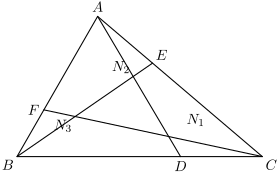
In the figure, and are one-third of their respective sides. It follows that and similarly for lines and Then the area of triangle is:
Ninguna de las anteriores
None of these
Respuesta: C
Pista pequeña:
Las razones de áreas son invariantes bajo transformaciones afines, así que elige coordenadas convenientes para el triángulo
Area ratios are affine-invariant, so choose convenient coordinates for triangle
Pista grande:
Ubica mediante las condiciones de un tercio, intersecta las tres cevianas y compara las dos áreas con determinantes
Locate by the one-third conditions, intersect the three cevians, and compare the two areas with determinants
Solución:
Usamos Entonces Al intersectar por pares se obtiene La fórmula del área mediante determinantes da Por consiguiente,
Por lo tanto, la respuesta correcta es C.
Use Then Intersecting in pairs gives The determinant area formula gives Hence
Thus, the correct answer is C.
50.
Un segmento que inicialmente mide pulgada crece según la siguiente ley, donde el primer término es la longitud inicial. Si el proceso de crecimiento continúa indefinidamente, el límite de la longitud del segmento es:
A line initially inch long grows according to the following law, where the first term is the initial length. If the growth process continues forever, the limit of the length of the line is:
Respuesta: D
Pista pequeña:
Agrupa cada par que tenga la misma potencia de
Group each pair having the same power of
Pista grande:
Los términos posteriores al inicial suman
The terms after the initial equal
Solución:
Después del término inicial, cada potencia aparece una vez por sí sola y una vez multiplicada por Como el límite es
Por lo tanto, la respuesta correcta es D.
After the initial term, each power appears once by itself and once multiplied by Since the limit is
Thus, the correct answer is D.