2022 AIME I Problema 11

A continuación está la solución preparada profesionalmente para el Problema 11 del 2022 AIME I, de LIVE by Po-Shen Loh. También puedes intentar el examen cronometrado completo, ver todas las soluciones del 2022 AIME I, o revisar la clave de respuestas.

Todos los problemas se usan con el permiso legal oficial de la Mathematical Association of America (MAA).

Conceptos:potencia de un puntorecta tangenteley de los cosenosparalelogramo

Nivel de dificultad: 3060

11.

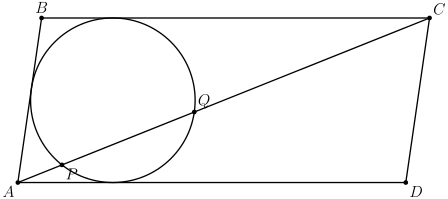
Sea ABCDABCD un paralelogramo con BAD<90.\angle BAD \lt 90^\circ. Una circunferencia tangente a los lados DA,\overline{DA}, AB,\overline{AB}, y BC\overline{BC} corta a la diagonal AC\overline{AC} en los puntos PP y QQ con AP<AQ,AP \lt AQ, como se muestra. Supón que AP=3,AP = 3, PQ=9,PQ = 9, y QC=16.QC = 16. Entonces el área de ABCDABCD puede expresarse en la forma mn,m\sqrt{n}, donde mm y nn son enteros positivos, y nn no es divisible por el cuadrado de ningún primo. Halla m+n.m + n.

Let ABCDABCD be a parallelogram with BAD<90.\angle BAD \lt 90^\circ. A circle tangent to sides DA,\overline{DA}, AB,\overline{AB}, and BC\overline{BC} intersects diagonal AC\overline{AC} at points PP and QQ with AP<AQ,AP \lt AQ, as shown. Suppose that AP=3,AP = 3, PQ=9,PQ = 9, and QC=16.QC = 16. Then the area of ABCDABCD can be expressed in the form mn,m\sqrt{n}, where mm and nn are positive integers, and nn is not divisible by the square of any prime. Find m+n.m + n.

Solución:

Por la potencia de un punto, APAQ=312=36AP \cdot AQ = 3 \cdot 12 = 36 y CQCP=1625=400,CQ \cdot CP = 16 \cdot 25 = 400, así que las longitudes de tangente desde AA y CC son 66 y 20.20. El punto de tangencia sobre AB\overline{AB} está a 66 de A,A, y por tanto a AB6AB - 6 de B;B; tangentes iguales desde BB colocan el punto de tangencia sobre BC\overline{BC} a esa misma distancia de B,B, así que su distancia a CC es BC(AB6)=20,BC - (AB - 6) = 20, lo que da BC=AB+14.BC = AB + 14.

Sea BAD=2θ.\angle BAD = 2\theta. El centro está sobre la bisectriz de A\angle A con longitud de tangente desde AA igual a 6,6, así que el radio es ρ=6tanθ.\rho = 6\tan\theta. La circunferencia es tangente a ambas rectas paralelas ADAD y BC,BC, cuya distancia entre sí es ABsin2θ,AB \sin 2\theta, así que ABsin2θ=2ρ=12tanθ,AB \sin 2\theta = 2\rho = 12 \tan\theta, que se simplifica a ABcos2θ=6.AB \cos^2\theta = 6. En el triángulo ABC,ABC, ABC=1802θ\angle ABC = 180^\circ - 2\theta y AC=3+9+16=28,AC = 3 + 9 + 16 = 28, así que la ley de cosenos da 784=AB2+BC2+2ABBCcos2θ. \begin{aligned} 784 &= AB^2 + BC^2 \\ &\quad {}+ 2 \cdot AB \cdot BC \cos 2\theta. \end{aligned} Sustituyendo BC=AB+14BC = AB + 14 y cos2θ=2cos2θ1,\cos 2\theta = 2\cos^2\theta - 1, los términos en AB2AB^2 se cancelan y, usando ABcos2θ=6,AB\cos^2\theta = 6, la ecuación se reduce a 24AB+336+196=784,24\,AB + 336 + 196 = 784, así que AB=212AB = \frac{21}{2} y cos2θ=47.\cos^2\theta = \frac{4}{7}.

Entonces sin2θ=23747=437,\sin 2\theta = 2\sqrt{\frac{3}{7}}\sqrt{\frac{4}{7}} = \frac{4\sqrt{3}}{7}, y el área es ABBCsin2θ=212492437=1473, \begin{aligned} &AB \cdot BC \sin 2\theta \\ &= \frac{21}{2} \cdot \frac{49}{2} \cdot \frac{4\sqrt{3}}{7} \\ &= 147\sqrt{3}, \end{aligned} así que m+n=147+3=150.m + n = 147 + 3 = 150.

By power of a point, APAQ=312=36AP \cdot AQ = 3 \cdot 12 = 36 and CQCP=1625=400,CQ \cdot CP = 16 \cdot 25 = 400, so the tangent lengths from AA and CC are 66 and 20.20. The tangent point on AB\overline{AB} is 66 from A,A, hence AB6AB - 6 from B;B; equal tangents from BB put the tangent point on BC\overline{BC} at that same distance from B,B, so its distance from CC is BC(AB6)=20,BC - (AB - 6) = 20, giving BC=AB+14.BC = AB + 14.

Let BAD=2θ.\angle BAD = 2\theta. The center lies on the bisector of A\angle A with the tangent length from AA equal to 6,6, so the radius is ρ=6tanθ.\rho = 6\tan\theta. The circle is tangent to both parallel lines ADAD and BC,BC, whose distance apart is ABsin2θ,AB \sin 2\theta, so ABsin2θ=2ρ=12tanθ,AB \sin 2\theta = 2\rho = 12 \tan\theta, which simplifies to ABcos2θ=6.AB \cos^2\theta = 6. In triangle ABC,ABC, ABC=1802θ\angle ABC = 180^\circ - 2\theta and AC=3+9+16=28,AC = 3 + 9 + 16 = 28, so the law of cosines gives 784=AB2+BC2+2ABBCcos2θ. \begin{aligned} 784 &= AB^2 + BC^2 \\ &\quad {}+ 2 \cdot AB \cdot BC \cos 2\theta. \end{aligned} Substituting BC=AB+14BC = AB + 14 and cos2θ=2cos2θ1,\cos 2\theta = 2\cos^2\theta - 1, the AB2AB^2 terms cancel and, using ABcos2θ=6,AB\cos^2\theta = 6, the equation collapses to 24AB+336+196=784,24\,AB + 336 + 196 = 784, so AB=212AB = \frac{21}{2} and cos2θ=47.\cos^2\theta = \frac{4}{7}.

Then sin2θ=23747=437,\sin 2\theta = 2\sqrt{\frac{3}{7}}\sqrt{\frac{4}{7}} = \frac{4\sqrt{3}}{7}, and the area is ABBCsin2θ=212492437=1473, \begin{aligned} &AB \cdot BC \sin 2\theta \\ &= \frac{21}{2} \cdot \frac{49}{2} \cdot \frac{4\sqrt{3}}{7} \\ &= 147\sqrt{3}, \end{aligned} so m+n=147+3=150.m + n = 147 + 3 = 150.

← Problema 10#10Examen completoProblema 12#12 →

El Problema 11 en otros años