
Problemas del 2022 AIME I
¡Desplázate hacia abajo y presiona Iniciar para intentar el examen! O ve al PDF imprimible, la clave de respuestas, o las soluciones profesionales preparadas por LIVE by Po-Shen Loh.
Todos los problemas se usan con el permiso legal oficial de la Mathematical Association of America (MAA).
O salta directamente a un solo problema con su solución: 1 · 2 · 3 · 4 · 5 · 6 · 7 · 8 · 9 · 10 · 11 · 12 · 13 · 14 · 15
¿Quieres aprender de forma profesional con clases interactivas en video?
Con tiempo
3:00:00
1.
Los polinomios cuadráticos y tienen coeficientes principales y respectivamente. Las gráficas de ambos polinomios pasan por los dos puntos y Halla
Quadratic polynomials and have leading coefficients of and respectively. The graphs of both polynomials pass through the two points and Find
Respuesta: 116
Pista pequeña:
Considera los términos cuadráticos se cancelan, así que es lineal
Consider the quadratic terms cancel, so is linear
Pista grande:
pasa por y extiende esa recta de vuelta hasta
passes through and extend that line back to
Solución:
Sea Los coeficientes principales y se cancelan, así que es una función lineal. Como ambas gráficas pasan por y obtenemos y
La pendiente de es así que
Let The leading coefficients and cancel, so is a linear function. Since both graphs pass through and we get and
The slope of is so
2.
Halla el entero positivo de tres dígitos cuya representación en base nueve es donde y son dígitos (no necesariamente distintos).
Find the three-digit positive integer whose representation in base nine is where and are (not necessarily distinct) digits.
Respuesta: 227
Pista pequeña:
Escribe la condición como y simplifica
Write the condition as and simplify
Pista grande:
A partir de reduce módulo para determinar en términos de y luego prueba valores pequeños de
From reduce modulo to pin down in terms of then test small values of
Solución:
La condición dice que se simplifica a Como los dígitos también aparecen en un numeral en base nueve, cada uno es a lo sumo Reduciendo módulo se obtiene así que
Para hace que supere para da así que Para cada el requerido obliga a que quede fuera del rango así que no hay otra solución.
El número es y en efecto
The condition says which simplifies to Since the digits also appear in a base-nine numeral, each is at most Reducing modulo gives so
For makes exceed for gives so For each the required forces outside the range so there is no other solution.
The number is and indeed
3.
En el trapecio isósceles las bases paralelas y tienen longitudes y respectivamente, y Las bisectrices de y se cortan en y las bisectrices de y se cortan en Halla
In isosceles trapezoid parallel bases and have lengths and respectively, and The angle bisectors of and meet at and the angle bisectors of and meet at Find
Respuesta: 242
Pista pequeña:
Sea el punto donde la bisectriz de corta a ; los ángulos alternos internos hacen que el triángulo sea isósceles con
Let the bisector of meet at alternate interior angles make triangle isosceles with
Pista grande:
En el triángulo isósceles la bisectriz desde también es la mediana, así que es el punto medio de Haz lo mismo para y usa coordenadas.
In isosceles triangle the bisector from is also the median, so is the midpoint of Do the same for and use coordinates.
Solución:
Sea el punto donde la bisectriz de corta a Como tenemos así que el triángulo es isósceles con La bisectriz de es entonces la mediana desde en este triángulo, así que que está sobre ambas bisectrices, es el punto medio de Simétricamente, es el punto medio de donde está sobre con
Coloca y de modo que y para la altura apropiada Entonces y así que
Por lo tanto
Let the bisector of meet at Since we have so triangle is isosceles with The bisector of is then the median from in this triangle, so which lies on both bisectors, is the midpoint of Symmetrically, is the midpoint of where is on with
Place and so and for the appropriate height Then and so
Therefore
4.
Sean y donde Halla la cantidad de pares ordenados de enteros positivos que no superan y satisfacen la ecuación
Let and where Find the number of ordered pairs of positive integers not exceeding that satisfy the equation
Respuesta: 834
Pista pequeña:
Ambos números están en la circunferencia unitaria: tiene argumento y tiene argumento mientras que tiene argumento
Both numbers lie on the unit circle: has argument and has argument while has argument
Pista grande:
Igualar los argumentos da es decir cuenta cuántos caen en cada residuo
Matching arguments gives i.e. count how many hit each residue
Solución:
Tanto como tienen módulo en forma polar y mientras que Por lo tanto, la ecuación equivale a la condición de argumentos es decir,
Para cada esto determina el residuo es o módulo según o Entre hay valores con y valores en cada caso con o Entre hay valores con y valores en cada una de las otras dos clases.
El total es
Both and have modulus in polar form and while The equation is therefore a statement about arguments: i.e.
For each this determines the residue is or modulo according as or Among there are values with and values each with or Among there are values with and values in each of the other two classes.
The count is
5.
Un río recto de metros de ancho fluye de oeste a este a razón de metros por minuto. Melanie y Sherry están sentadas en la orilla sur del río, con Melanie a una distancia de metros río abajo de Sherry. Respecto al agua, Melanie nada a metros por minuto, y Sherry nada a metros por minuto. Al mismo tiempo, Melanie y Sherry comienzan a nadar en línea recta hacia un punto de la orilla norte del río que equidista de sus posiciones iniciales. Las dos mujeres llegan a este punto simultáneamente. Halla
A straight river that is meters wide flows from west to east at a rate of meters per minute. Melanie and Sherry sit on the south bank of the river with Melanie a distance of meters downstream from Sherry. Relative to the water, Melanie swims at meters per minute, and Sherry swims at meters per minute. At the same time, Melanie and Sherry begin swimming in straight lines to a point on the north bank of the river that is equidistant from their starting positions. The two women arrive at this point simultaneously. Find
Respuesta: 550
Pista pequeña:
El punto de encuentro está justo al norte del punto medio entre ellas. La velocidad de cada nadadora respecto al agua es su velocidad respecto al suelo menos la corriente
The meeting point is due north of the midpoint between them. Each swimmer’s velocity relative to the water is her ground velocity minus the current
Pista grande:
Con restar las dos ecuaciones de rapidez da
With subtracting the two speed equations gives
Solución:
Coloca a Sherry en el origen y a Melanie en sobre la orilla sur. Un punto de la orilla norte equidistante de ambas es Si ambas llegan en el tiempo entonces la velocidad de cada nadadora respecto al agua es su velocidad respecto al suelo menos la corriente así que
Restando, con así que Sustituyendo de nuevo, da así que
Por lo tanto
Put Sherry at the origin and Melanie at on the south bank. A point on the north bank equidistant from both is If both arrive at time then each swimmer’s velocity relative to the water is her ground velocity minus the current so
Subtracting, with so Substituting back, gives so
Therefore
6.
Halla la cantidad de pares ordenados de enteros tales que la sucesión sea estrictamente creciente y ningún conjunto de cuatro términos (no necesariamente consecutivos) forme una progresión aritmética.
Find the number of ordered pairs of integers such that the sequence is strictly increasing and no set of four (not necessarily consecutive) terms forms an arithmetic progression.
Respuesta: 228
Pista pequeña:
Cuenta los pares malos entre las elecciones con toda progresión de cuatro términos debe usar o
Count the bad pairs among the choices with every four-term progression must use or
Pista grande:
Aparte de y exactamente tres pares completan una progresión con dos de los términos fijos. Cuidado con el doble conteo.
Beyond and exactly three pairs complete a progression with two of the fixed terms. Watch for double counting.
Solución:
La sucesión es estrictamente creciente exactamente cuando lo que da pares. Los seis términos fijos no contienen ninguna progresión aritmética de cuatro términos, así que toda progresión debe involucrar a o Si solo uno de ellos está involucrado, tres términos fijos ya deben estar en progresión: solo se extiende con y solo se extiende con Así que las violaciones de una sola variable son ( pares) y ( pares), que se solapan en el par
Si tanto como están involucrados, dos términos fijos completan la progresión. Revisando las posiciones posibles: da da da da da fuera de rango; y da De estos, y ya se contaron, así que y son los únicos pares malos nuevos.
La cantidad de pares válidos es
The sequence is increasing exactly when giving pairs. The six fixed terms contain no four-term arithmetic progression, so every progression must involve or If only one of them is involved, three fixed terms must already be in progression: extends only by and extends only by So the single-variable violations are ( pairs) and ( pairs), which overlap in the pair
If both and are involved, two fixed terms complete the progression. Checking the possible positions: gives gives gives gives gives out of range; and gives Of these, and are already counted, so and are the only new bad pairs.
The number of valid pairs is
7.
Sean enteros distintos de a El mínimo valor positivo posible de puede escribirse como donde y son enteros positivos primos entre sí. Halla
Let be distinct integers from to The minimum possible positive value of can be written as where and are relatively prime positive integers. Find
Respuesta: 289
Pista pequeña:
Apunta a un numerador de busca dos ternas de dígitos distintos cuyos productos difieran exactamente en
Aim for a numerator of look for two triples of distinct digits whose products differ by exactly
Pista grande:
Reserva los tres dígitos sobrantes más grandes para el denominador, y luego descarta denominadores mayores mostrando que obligan a una diferencia de numerador de al menos
Save the three largest leftover digits for the denominator, then rule out bigger denominators by showing they force a numerator difference of at least
Solución:
Intenta hacer que el numerador sea igual a manteniendo dígitos grandes en el denominador. Los productos y difieren en y dejan para el denominador, dando el valor
Para superar esto, una fracción necesitaría numerador con denominador mayor que Los denominadores que superan son y provenientes respectivamente de y Al dividir los seis dígitos restantes en dos ternas, las menores diferencias positivas entre los productos son respectivamente y Los límites inferiores resultantes superan todos a
Así que el mínimo valor positivo es y
Try to make the numerator equal to while keeping large digits in the denominator. The products and differ by and leave for the denominator, giving the value
To beat this, a fraction would need numerator with denominator greater than The denominators exceeding are and coming respectively from and Splitting the remaining six digits into two triples, the smallest positive numerator differences are respectively and The resulting lower bounds all exceed
So the minimum positive value is and
8.
El triángulo equilátero está inscrito en la circunferencia de radio La circunferencia es tangente a los lados y y es tangente internamente a Las circunferencias y se definen de manera análoga. Las circunferencias y se cortan en seis puntos, dos puntos por cada par de circunferencias. Los tres puntos de intersección más cercanos a los vértices de son los vértices de un triángulo equilátero grande en el interior de y los otros tres puntos de intersección son los vértices de un triángulo equilátero más pequeño en el interior de La longitud del lado del triángulo equilátero más pequeño puede escribirse como donde y son enteros positivos. Halla
Equilateral triangle is inscribed in circle with radius Circle is tangent to sides and and is internally tangent to Circles and are defined analogously. Circles and meet in six points — two points for each pair of circles. The three intersection points closest to the vertices of are the vertices of a large equilateral triangle in the interior of and the other three intersection points are the vertices of a smaller equilateral triangle in the interior of The side length of the smaller equilateral triangle can be written as where and are positive integers. Find
Respuesta: 378
Pista pequeña:
Halla primero: su centro está sobre la recta su radio es la mitad de su distancia a y la tangencia interna a fija todo
Find first: its center lies on line its radius is half its distance from and internal tangency to fixes everything
Pista grande:
Los dos puntos de intersección de y están sobre la recta y el circunradio de cada triángulo es la distancia de ese punto al centro
The two intersection points of and lie on line and each triangle’s circumradius is the distance from that point to the center
Solución:
Sea el centro de El centro de está sobre la recta (la bisectriz de ) a cierta distancia de como forma un ángulo de con el radio es La tangencia interna a exige que el centro esté a de lo que obliga al centro a pasar más allá de así que y el centro está más allá de
Coloca en el origen con Entonces los tres centros son y todos con radio Las intersecciones de y están sobre el eje : da El punto está más cerca de y pertenece al triángulo más grande, así que el triángulo más pequeño tiene el vértice a distancia de
Por simetría, el triángulo más pequeño es equilátero con circunradio así que su lado es Por lo tanto
Let be the center of The center of lies on line (the bisector of ) at some distance from since makes a angle with the radius is Internal tangency to requires the center to be from which forces the center past so and the center is beyond
Place at the origin with Then the three centers are and all with radius The intersections of and lie on the -axis: gives The point is closer to and belongs to the larger triangle, so the smaller triangle has vertex at distance from
By symmetry the smaller triangle is equilateral with circumradius so its side is Thus
9.
Ellina tiene doce bloques, dos de cada uno: rojo (), azul (), amarillo (), verde (), naranja () y morado (). Llama a una disposición de bloques par si hay un número par de bloques entre cada par de bloques del mismo color. Por ejemplo, la disposición es par. Ellina dispone sus bloques en una fila en orden aleatorio. La probabilidad de que su disposición sea par es donde y son enteros positivos primos entre sí. Halla
Ellina has twelve blocks, two each of red (), blue (), yellow (), green (), orange (), and purple (). Call an arrangement of blocks even if there is an even number of blocks between each pair of blocks of the same color. For example, the arrangement is even. Ellina arranges her blocks in a row in random order. The probability that her arrangement is even is where and are relatively prime positive integers. Find
Respuesta: 247
Pista pequeña:
Hay un número par de bloques entre las posiciones y exactamente cuando y tienen paridad opuesta
There is an even number of blocks between positions and exactly when and have opposite parity
Pista grande:
Así que cada color debe ocupar una posición impar y una par: los seis lugares impares contienen los seis colores una vez, igual que los seis lugares pares
So each color must occupy one odd and one even position: the six odd slots hold all six colors once, as do the six even slots
Solución:
Si un color ocupa las posiciones el número de bloques entre ellas es que es par exactamente cuando y tienen paridad opuesta. Así que una disposición es par precisamente cuando cada color ocupa una posición impar y una posición par, es decir, los seis lugares impares contienen cada color exactamente una vez, y lo mismo hacen los seis lugares pares.
Contando las disposiciones de los doce bloques (los bloques del mismo color son idénticos), hay en total, y pares (una permutación de los seis colores en los lugares impares y otra en los lugares pares). La probabilidad es
Como la respuesta es
If a color occupies positions the number of blocks between them is which is even exactly when and have opposite parity. So an arrangement is even precisely when every color occupies one odd position and one even position — that is, the six odd slots contain each color exactly once, and so do the six even slots.
Counting arrangements of the twelve blocks (blocks of the same color identical), there are in total, and even ones (a permutation of the six colors in the odd slots and another in the even slots). The probability is
Since the answer is
10.
Tres esferas de radios y son mutuamente tangentes externamente. Un plano corta a las esferas en tres circunferencias congruentes con centros en y respectivamente, y los centros de las esferas están todos del mismo lado de este plano. Supón que Halla
Three spheres with radii and are mutually externally tangent. A plane intersects the spheres in three congruent circles centered at and respectively, and the centers of the spheres all lie on the same side of this plane. Suppose that Find
Respuesta: 756
Pista pequeña:
Si el centro de una esfera está a altura sobre el plano, su circunferencia tiene radio al cuadrado la congruencia relaciona las tres alturas
If a sphere’s center sits at height above the plane, its circle has radius squared congruence ties the three heights together
Pista grande:
y son los pies de los centros, así que combínalo con
and are the feet of the centers, so combine with
Solución:
Sean las alturas de los centros de las esferas sobre el plano. El centro de cada circunferencia es el pie de la perpendicular desde el centro de la esfera, y el radio común de las circunferencias satisface
Las dos primeras esferas son tangentes, así que sus centros distan y proyectando sobre el plano, Por lo tanto La congruencia da así que y (el otro signo da una suma negativa), lo que produce y Entonces así que
El primer y el tercer centro distan así que
Let the sphere centers be at heights above the plane. Each circle’s center is the foot of the perpendicular from the sphere’s center, and the common circle radius satisfies
The first two spheres are tangent, so their centers are apart, and projecting onto the plane, Thus Congruence gives so and (the other sign gives a negative sum), yielding and Then so
The first and third centers are apart, so
11.
Sea un paralelogramo con Una circunferencia tangente a los lados y corta a la diagonal en los puntos y con como se muestra. Supón que y Entonces el área de puede expresarse en la forma donde y son enteros positivos, y no es divisible por el cuadrado de ningún primo. Halla
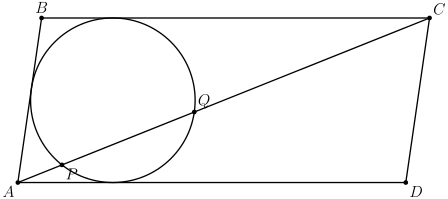
Let be a parallelogram with A circle tangent to sides and intersects diagonal at points and with as shown. Suppose that and Then the area of can be expressed in the form where and are positive integers, and is not divisible by the square of any prime. Find
Respuesta: 150
Pista pequeña:
Potencia de un punto: y dan longitudes de tangente desde y desde
Power of a point: and give tangent lengths from and from
Pista grande:
Tangentes iguales obligan a y la tangencia a ambas rectas paralelas y da termina con la ley de cosenos sobre
Equal tangents force and tangency to both parallel lines and gives finish with the law of cosines on
Solución:
Por la potencia de un punto, y así que las longitudes de tangente desde y son y El punto de tangencia sobre está a de y por tanto a de tangentes iguales desde colocan el punto de tangencia sobre a esa misma distancia de así que su distancia a es lo que da
Sea El centro está sobre la bisectriz de con longitud de tangente desde igual a así que el radio es La circunferencia es tangente a ambas rectas paralelas y cuya distancia entre sí es así que que se simplifica a En el triángulo y así que la ley de cosenos da Sustituyendo y los términos en se cancelan y, usando la ecuación se reduce a así que y
Entonces y el área es Por lo tanto,
By power of a point, and so the tangent lengths from and are and The tangent point on is from hence from equal tangents from put the tangent point on at that same distance from so its distance from is giving
Let The center lies on the bisector of with the tangent length from equal to so the radius is The circle is tangent to both parallel lines and whose distance apart is so which simplifies to In triangle and so the law of cosines gives Substituting and the terms cancel and, using the equation collapses to so and
Then and the area is so
12.
Para cualquier conjunto finito sea el número de elementos de Define donde la suma se toma sobre todos los pares ordenados tales que y son subconjuntos de con Por ejemplo, porque la suma se toma sobre los siguientes pares de subconjuntos: lo que da Sea donde y son enteros positivos primos entre sí. Halla el residuo cuando se divide entre
For any finite set let denote the number of elements in Define where the sum is taken over all ordered pairs such that and are subsets of with For example, because the sum is taken over the pairs of subsets giving Let where and are relatively prime positive integers. Find the remainder when is divided by
Respuesta: 245
Pista pequeña:
Intercambia el orden de la suma: para cada elemento, cuenta los pares con que lo contienen en ambos conjuntos
Swap the order of summation: for each element, count the pairs with that contain it in both sets
Pista grande:
así que luego simplifica el cociente de términos consecutivos
so then simplify the ratio of consecutive terms
Solución:
Cuenta elemento por elemento: es igual al número de ternas con y Para un fijo y un tamaño hay elecciones para cada uno de y que contienen a así que por la identidad de Vandermonde
Por lo tanto, Como no divide ni a ni a ni a esta fracción está en su mínima expresión: y
Entonces cuyo residuo módulo es
Count element by element: equals the number of triples with and For a fixed and size there are choices for each of and containing so by the Vandermonde identity
Therefore Since divides neither nor this fraction is in lowest terms: and
Then whose remainder modulo is
13.
Sea el conjunto de todos los números racionales que pueden expresarse como un decimal periódico de la forma donde al menos uno de los dígitos o es distinto de cero. Sea el número de numeradores distintos que se obtienen cuando los números de se escriben como fracciones en su mínima expresión. Por ejemplo, tanto como se cuentan entre los numeradores distintos de los números de porque y Halla el residuo cuando se divide entre
Let be the set of all rational numbers that can be expressed as a repeating decimal in the form where at least one of the digits or is nonzero. Let be the number of distinct numerators obtained when numbers in are written as fractions in lowest terms. For example, both and are counted among the distinct numerators for numbers in because and Find the remainder when is divided by
Respuesta: 392
Pista pequeña:
Cada elemento de es con y
Every element of is with and
Pista grande:
es un numerador exactamente cuando y para algún divisor de Clasifica según cuáles de o lo dividen.
is a numerator exactly when and for some divisor of Classify by which of or divide it.
Solución:
Cada elemento de es igual a para algún donde En su mínima expresión esto es donde divide a y recíprocamente, cualquier de este tipo surge de Así que cuenta los enteros que son a lo sumo, y coprimos con, algún divisor de
Clasifica según cuáles de los primos o lo dividen, usando siempre el mayor divisor coprimo con Si toma hay tales Si solo divide a toma los múltiplos de hasta que evitan y suman Si solo divide a toma eso da Si solo divide a entonces no admite ninguno. Si es divisible por pero no por toma los valores y dan más, y cualquier divisible por o necesitaría lo cual es imposible.
Por lo tanto y el residuo módulo es
Every element of equals for some where In lowest terms this is where divides and conversely any such arises from So counts the integers that are at most, and coprime to, some divisor of
Classify by which of the primes or divide it, always using the largest divisor coprime to If take there are such If only divides take multiples of up to avoiding and number If only divides take that gives If only divides then admits none. If is divisible by but not by take the values and give more, and any divisible by or would need which is impossible.
Therefore and the remainder modulo is
14.
Dado y un punto sobre uno de sus lados, llama a la recta la recta divisoria de a través de si pasa por y divide en dos polígonos de igual perímetro. Sea un triángulo donde y y son enteros positivos. Sean y los puntos medios de y respectivamente, y supón que las rectas divisorias de a través de y se cortan a Halla el perímetro de
Given and a point on one of its sides, call line the splitting line of through if passes through and divides into two polygons of equal perimeter. Let be a triangle where and and are positive integers. Let and be the midpoints of and respectively, and suppose that the splitting lines of through and intersect at Find the perimeter of
Respuesta: 459
Pista pequeña:
Muestra que la recta divisoria a través de es paralela a la bisectriz desde corta a en con y
Show the splitting line through is parallel to the angle bisector from it meets at with and
Pista grande:
Las bisectrices desde y se cruzan a así que la condición de obliga a luego haz que sea un cuadrado perfecto
The bisectors from and cross at so the condition forces then make a perfect square
Solución:
Escribe y para el semiperímetro. La recta divisoria a través de corta a en el punto Al igualar los perímetros de las dos partes y cancelar el segmento común se obtiene por lo que En el triángulo la ley de senos muestra esto requiere que se reduce mediante y a cierto porque esos ángulos son complementarios. Por lo tanto, la recta divisoria a través de es paralela a la bisectriz desde y de igual modo la que pasa por es paralela a la bisectriz desde
Las bisectrices internas desde y forman un ángulo de así que el ángulo agudo entre las dos rectas divisorias es lo que obliga a La ley de cosenos da Pon de modo que y y son raíces de lo que exige que sea un cuadrado perfecto Entonces divide a y divide a escribir y convierte la condición en La desigualdad triangular y restringen y al revisarlos, solo funciona, con
Así que y lo que da un triángulo válido. El perímetro es
Write and for the semiperimeter. The splitting line through meets at the point Equating the two piece perimeters and cancelling their common segment gives so In triangle the law of sines shows this needs which reduces via and to true because those angles are complementary. Hence the splitting line through is parallel to the angle bisector from and likewise the one through is parallel to the bisector from
The internal bisectors from and meet at so the acute angle between the two splitting lines is forcing The law of cosines gives Set so and and are roots of requiring to be a perfect square Then divides and divides writing and turns the condition into The triangle inequality and restrict and checking these, only works, with
So and giving — a valid triangle. The perimeter is
15.
Sean y números reales positivos que satisfacen el sistema de ecuaciones Entonces puede escribirse como donde y son enteros positivos primos entre sí. Halla
Let and be positive real numbers satisfying the system of equations Then can be written as where and are relatively prime positive integers. Find
Respuesta: 33
Pista pequeña:
Factoriza cada radical como y sustituye
Factor each radical as and substitute
Pista grande:
Cada ecuación se reduce por la fórmula de adición a etc.; resuelve el pequeño sistema lineal para los ángulos y usa
Each equation collapses by the addition formula to etc.; solve the little linear system for the angles and use
Solución:
Cada radicando se factoriza: y análogamente los demás, así que Sustituyamos con Entonces y cada ecuación se reduce mediante la fórmula de suma del seno:
Una elección admisible es que da La única otra rama compatible con usa sumas por pares y da su producto de abajo es el opuesto del de la primera rama, así que el cuadrado pedido es igual. Para la primera rama, la identidad de ángulo doble da y
Por tanto, cuyo cuadrado es Así,
Each radicand factors: and so on, so Substitute with Then and each equation collapses by the sine addition formula:
One admissible choice is which gives The only other branch consistent with uses pairwise sums giving its product below is the negative of the first branch’s product, so the requested square is identical. For the first branch, the double-angle identity gives and
Therefore whose square is Thus