
Problemas del 1954 AMC 12
¡Desplázate hacia abajo y presiona Iniciar para intentar el examen! O ve al PDF imprimible, la clave de respuestas, o las soluciones profesionales preparadas por LIVE by Po-Shen Loh.
Todos los problemas se usan con el permiso legal oficial de la Mathematical Association of America (MAA).
O salta directamente a un solo problema con su solución: 1 · 2 · 3 · 4 · 5 · 6 · 7 · 8 · 9 · 10 · 11 · 12 · 13 · 14 · 15 · 16 · 17 · 18 · 19 · 20 · 21 · 22 · 23 · 24 · 25 · 26 · 27 · 28 · 29 · 30 · 31 · 32 · 33 · 34 · 35 · 36 · 37 · 38 · 39 · 40 · 41 · 42 · 43 · 44 · 45 · 46 · 47 · 48 · 49 · 50
¿Quieres aprender de forma profesional con clases interactivas en video?
Con tiempo
1:15:00
1.
El cuadrado de es:
The square of is:
Respuesta: E
Pista pequeña:
Usa
Use
Pista grande:
La constante se cancela con el que queda al elevar el radical al cuadrado
The constant cancels with the inside the squared radical
Solución:
Al desarrollar se obtiene
Por lo tanto, la respuesta correcta es E.
Expanding gives
Thus, the correct answer is E.
2.
Al eliminar las fracciones, la ecuación se puede transformar en Las raíces de esta última ecuación son y Entonces las raíces de la primera ecuación son:
The equation can be transformed by eliminating fractions to the equation The roots of the latter equation are and Then the roots of the first equation are:
y
and
solamente
only
solamente
only
ni ni
neither nor
y alguna otra raíz
and some other root
Respuesta: C
Pista pequeña:
Comprueba ambas raíces en el denominador de la ecuación original
Check both roots against the denominator in the original equation
Pista grande:
Eliminar un denominador puede introducir un valor para el cual la expresión original no está definida
Clearing a denominator can introduce a value at which the original expression is undefined
Solución:
La cuadrática transformada se factoriza como Sin embargo, la ecuación original tiene denominador así que no está definida en La sustitución de es válida y satisface la ecuación original.
Por lo tanto, la única raíz es y la respuesta correcta es C.
The transformed quadratic factors as However, the original equation has denominator so it is undefined at Substitution of is valid and satisfies the original equation.
Thus, the only root is and the correct answer is C.
3.
Si varía como el cubo de y varía como la quinta raíz de entonces varía como la potencia -ésima de donde es:
If varies as the cube of and varies as the fifth root of then varies as the th power of where is:
Respuesta: C
Pista pequeña:
Escribe y
Write and
Pista grande:
Sustituye la segunda ley de variación en la primera y multiplica los exponentes
Substitute the second variation law into the first and multiply the exponents
Solución:
Como es proporcional a su cubo es proporcional a Puesto que es proporcional a Por consiguiente,
Por lo tanto, la respuesta correcta es C.
Since is proportional to its cube is proportional to Because is proportional to Hence
Thus, the correct answer is C.
4.
Si el máximo común divisor de y se reduce en será igual a:
If the Highest Common Divisor of and is diminished by it will equal:
Respuesta: E
Pista pequeña:
Usa el algoritmo de Euclides o factoriza los dos números
Use the Euclidean algorithm or factor the two numbers
Pista grande:
Su máximo común divisor es
Their greatest common divisor is
Solución:
El algoritmo de Euclides da Al reducir este valor en , se obtiene
Por lo tanto, la respuesta correcta es E.
The Euclidean algorithm gives Diminishing this by gives
Thus, the correct answer is E.
5.
Un hexágono regular está inscrito en un círculo de radio pulgadas. Su área es:
A regular hexagon is inscribed in a circle of radius inches. Its area is:
pulgadas cuadradas
sq. in.
pulgadas cuadradas
sq. in.
pulgadas cuadradas
sq. in.
pulgadas cuadradas
sq. in.
pulgadas cuadradas
sq. in.
Respuesta: A
Pista pequeña:
El lado de un hexágono regular inscrito mide lo mismo que el radio del círculo
An inscribed regular hexagon has side length equal to the circle’s radius
Pista grande:
Divide el hexágono en seis triángulos equiláteros de lado
Divide the hexagon into six equilateral triangles of side
Solución:
El hexágono consta de seis triángulos equiláteros de lado Su área es pulgadas cuadradas.
Por lo tanto, la respuesta correcta es A.
The hexagon consists of six equilateral triangles of side Its area is square inches.
Thus, the correct answer is A.
6.
El valor de es:
The value of is:
Respuesta: D
Pista pequeña:
Evalúa por separado cada uno de los cuatro términos usando
Evaluate each of the four terms separately, using
Pista grande:
La quinta raíz real de es , por lo que
The real fifth root of is , so
Solución:
Para los valores admisibles de los cuatro términos son Por lo tanto, la expresión es
Por lo tanto, la respuesta correcta es D.
For permissible the four terms are Therefore the expression is
Thus, the correct answer is D.
7.
Un ama de casa ahorró al comprar un vestido en oferta. Si pagó por el vestido, ahorró aproximadamente:
A housewife saved in buying a dress on sale. If she spent for the dress, she saved about:
Respuesta: B
Pista pequeña:
Suma el ahorro al precio de oferta para recuperar el precio original
Add the savings to the sale price to recover the original price
Pista grande:
Calcula como porcentaje
Compute as a percentage
Solución:
El precio original era de La fracción ahorrada fue es decir, aproximadamente
Por lo tanto, la respuesta correcta es B.
The original price was The fraction saved was or about
Thus, the correct answer is B.
8.
La base de un triángulo mide el doble que el lado de un cuadrado, y sus áreas son iguales. Entonces la razón entre la altura del triángulo y el lado del cuadrado es:
The base of a triangle is twice as long as a side of a square and their areas are the same. Then the ratio of the altitude of the triangle to the side of the square is:
Respuesta: C
Pista pequeña:
Sea el lado del cuadrado y la altura del triángulo
Let the square’s side be and the triangle’s altitude be
Pista grande:
Iguala con
Equate with
Solución:
Si el lado del cuadrado es la base del triángulo es La igualdad de áreas da Por lo tanto, así que la razón pedida es
La respuesta correcta es C.
If the square side is the triangle base is Equal areas give Thus so the requested ratio is
The correct answer is C.
9.
Un punto está fuera de un círculo y a pulgadas de su centro. Una secante trazada desde corta el círculo en y , de modo que el segmento exterior mide pulgadas y mide pulgadas. El radio del círculo es:
A point is outside a circle and is inches from the center. A secant from cuts the circle at and so that the external segment of the secant is inches and is inches. The radius of the circle is:
pulgadas
in.
pulgadas
in.
pulgadas
in.
pulgadas
in.
pulgadas
in.
Respuesta: C
Pista pequeña:
La potencia de la secante es el producto de la longitud exterior por la longitud de la secante completa
The secant power is the external length times the whole secant length
Pista grande:
Iguala con
Equate with
Solución:
La potencia de es También es así que Por consiguiente, y pulgadas.
Por lo tanto, la respuesta correcta es C.
The power of is It is also so Hence and inches.
Thus, the correct answer is C.
10.
La suma de los coeficientes numéricos en el desarrollo del binomio es:
The sum of the numerical coefficients in the expansion of the binomial is:
Respuesta: C
Pista pequeña:
La suma de los coeficientes se obtiene eligiendo valores convenientes de y
The coefficient sum is obtained by choosing convenient values of and
Pista grande:
Haz
Set
Solución:
Al hacer , cada monomio vale por lo que el valor del desarrollo es igual a la suma de sus coeficientes. Por lo tanto, la suma es
La respuesta correcta es C.
Setting makes every monomial equal to so the value of the expansion equals the sum of its coefficients. Thus the sum is
The correct answer is C.
11.
Un comerciante exhibió varios vestidos, cada uno con un precio marcado. Luego colocó un letrero que decía: « de descuento en estos vestidos». El costo de los vestidos era del precio al que realmente los vendió. Entonces la razón entre el costo y el precio marcado era:
A merchant placed on display some dresses, each with a marked price. He then posted a sign “ off on these dresses.” The cost of the dresses was of the price at which he actually sold them. Then the ratio of the cost to the marked price was:
Respuesta: A
Pista pequeña:
El precio de venta es del precio marcado
The selling price is of the marked price
Pista grande:
El costo es de ese precio de venta
The cost is of that selling price
Solución:
Si el precio marcado es entonces el precio de venta es Por lo tanto, el costo es La razón entre el costo y el precio marcado es
Por lo tanto, la respuesta correcta es A.
If the marked price is then the selling price is The cost is therefore The cost-to-marked-price ratio is
Thus, the correct answer is A.
12.
La solución del sistema es:
The solution of the equations is:
y
and
y
and
no hay solución
There is no solution
hay una cantidad ilimitada de soluciones
There are an unlimited number of solutions
y
and
Respuesta: C
Pista pequeña:
Compara el segundo miembro izquierdo con el doble del primero
Compare the second left-hand side with twice the first
Pista grande:
Al duplicar la primera ecuación, el miembro derecho tendría que ser , no
Doubling the first equation would require the right-hand side to be , not
Solución:
El miembro izquierdo de la segunda ecuación es exactamente el doble del miembro izquierdo de la primera, pero su miembro derecho no es el doble de Las ecuaciones exigirían que una misma expresión fuera igual tanto a como a lo cual es imposible.
Por lo tanto, no hay solución y la respuesta correcta es C.
The left side of the second equation is exactly twice the left side of the first, but its right side is not twice The equations would require the same expression to equal both and which is impossible.
Thus, there is no solution, and the correct answer is C.
13.
Un cuadrilátero está inscrito en un círculo. Si en los cuatro arcos determinados por los lados del cuadrilátero se inscriben ángulos sin que corten los lados entre vértices, su suma será:
A quadrilateral is inscribed in a circle. If angles are inscribed in the four arcs cut off by the sides of the quadrilateral, without intersecting the sides between vertices, their sum will be:
Respuesta: B
Pista pequeña:
Sean las medidas de los cuatro arcos consecutivos
Let the four consecutive arc measures be
Pista grande:
Un ángulo cuyo vértice está en el arco de medida intercepta los otros tres arcos, cuya medida total es
An angle whose vertex lies in the arc of measure intercepts the other three arcs, of total measure
Solución:
Sean las medidas de los cuatro arcos, cuya suma es El ángulo situado en el arco de medida intercepta los otros tres arcos, por lo que mide y lo mismo ocurre con los demás. Su suma es
Por lo tanto, la respuesta correcta es B.
Let the four arcs have measures whose sum is The angle placed in the arc of measure intercepts the other three arcs, so it measures and similarly for the others. Their sum is
Thus, the correct answer is B.
14.
Al simplificar, es igual a:
When simplified equals:
Respuesta: E
Pista pequeña:
Escribe con denominador
Put over the denominator
Pista grande:
El numerador se convierte en
The numerator becomes
Solución:
Para Como su raíz cuadrada es
Por lo tanto, la respuesta correcta es E.
For Because its square root is
Thus, the correct answer is E.
15.
es igual a:
equals:
Respuesta: D
Pista pequeña:
Escribe
Write
Pista grande:
Usa y
Use and
Solución:
Usando las leyes de los logaritmos,
Por lo tanto, la respuesta correcta es D.
Using logarithm laws,
Thus, the correct answer is D.
16.
Si entonces es igual a:
If then equals:
Respuesta: D
Pista pequeña:
Sustituye en el polinomio antes de restar
Substitute into the polynomial before subtracting
Pista grande:
Después de cancelar, extrae el factor
After cancellation, factor out
Solución:
Al desarrollar y cancelar se obtiene
Por lo tanto, la respuesta correcta es D.
Expanding and canceling gives
Thus, the correct answer is D.
17.
La gráfica de la función :
The graph of the function goes:
sube hacia la derecha y baja hacia la izquierda
up to the right and down to the left
baja hacia la derecha y sube hacia la izquierda
down to the right and up to the left
sube hacia la derecha y sube hacia la izquierda
up to the right and up to the left
baja hacia la derecha y baja hacia la izquierda
down to the right and down to the left
no se comporta de ninguna de estas maneras
none of these ways
Pista pequeña:
La constante desplaza la gráfica verticalmente, pero no cambia su comportamiento en los extremos
The constant shifts the graph vertically but does not change its end behavior
Pista grande:
Un término principal positivo de grado impar tiende a a la derecha y a a la izquierda
A positive odd-degree leading term tends to on the right and on the left
Solución:
El término principal determina el comportamiento en los extremos. Cuando tiende a tiende a cuando tiende a tiende a Por lo tanto, la gráfica sube hacia la derecha y baja hacia la izquierda.
La respuesta correcta es A.
The leading term controls the end behavior. As tends to tends to as tends to tends to Thus the graph goes up to the right and down to the left.
The correct answer is A.
18.
De los siguientes conjuntos, el que incluye todos los valores de que satisfacen es:
Of the following sets, the one that includes all values of which will satisfy is:
Respuesta: D
Pista pequeña:
Reúne los términos con en un lado y las constantes en el otro
Collect the -terms on one side and constants on the other
Pista grande:
Al sumar a ambos lados se obtiene
Adding to both sides gives
Solución:
Al sumar a ambos lados se obtiene por lo que
Por lo tanto, la respuesta correcta es D.
Adding to both sides gives so
Thus, the correct answer is D.
19.
Si se unen los tres puntos de tangencia del círculo inscrito en un triángulo, los ángulos del triángulo resultante:
If the three points of contact of a circle inscribed in a triangle are joined, the angles of the resulting triangle:
siempre son iguales a
are always equal to
siempre son un ángulo obtuso y dos ángulos agudos desiguales
are always one obtuse angle and two unequal acute angles
siempre son un ángulo obtuso y dos ángulos agudos iguales
are always one obtuse angle and two equal acute angles
siempre son ángulos agudos
are always acute angles
siempre son desiguales entre sí
are always unequal to each other
Respuesta: D
Pista pequeña:
Une el incentro con dos puntos de tangencia adyacentes
Join the incenter to two adjacent points of tangency
Pista grande:
El ángulo del triángulo de contacto opuesto al ángulo del triángulo original es
The angle of the contact triangle opposite vertex angle is
Solución:
Los radios trazados a dos puntos de tangencia adyacentes son perpendiculares a los lados correspondientes. El ángulo central entre esos radios es El ángulo correspondiente del triángulo de contacto es la mitad del arco que intercepta, y resulta Los otros dos ángulos son y Como todo ángulo de un triángulo está estrictamente entre y los tres son agudos.
Por lo tanto, la respuesta correcta es D.
The radii to two adjacent tangency points are perpendicular to the corresponding sides. The central angle between those radii is The relevant angle of the contact triangle is half the intercepted arc, giving The other two angles are and Since every triangle angle lies strictly between and all three are acute.
Thus, the correct answer is D.
20.
La ecuación tiene:
The equation has:
ninguna raíz real negativa
no negative real roots
ninguna raíz real positiva
no positive real roots
ninguna raíz real
no real roots
raíz positiva y negativas
positive and negative roots
raíces positivas y negativa
positive and negative root
Respuesta: B
Pista pequeña:
Prueba los enteros negativos pequeños sugeridos por el término constante
Test the small negative integers suggested by the constant term
Pista grande:
El polinomio se factoriza como
The polynomial factors as
Solución:
El polinomio se factoriza como Sus raíces son así que no tiene raíces reales positivas.
Por lo tanto, la respuesta correcta es B.
The polynomial factors as Its roots are so it has no positive real roots.
Thus, the correct answer is B.
21.
Las raíces de la ecuación se pueden hallar resolviendo:
The roots of the equation can be found by solving:
Respuesta: C
Pista pequeña:
Multiplica por para eliminar el exponente negativo
Multiply by to remove the negative exponent
Pista grande:
Aísla el radical en antes de elevar al cuadrado
Isolate the radical in before squaring
Solución:
Al multiplicar por se obtiene Al elevar al cuadrado y simplificar, así que
Por lo tanto, la respuesta correcta es C.
Multiplying by gives Squaring and simplifying, so
Thus, the correct answer is C.
22.
La expresión no se puede evaluar para ni para porque no se permite dividir entre cero. Para otros valores de
The expression cannot be evaluated for or since division by zero is not allowed. For other values of
La expresión toma muchos valores distintos.
The expression takes on many different values.
La expresión tiene únicamente el valor
The expression has only the value
La expresión tiene únicamente el valor
The expression has only the value
La expresión siempre tiene un valor entre y
The expression always has a value between and
La expresión tiene un valor mayor que o menor que
The expression has a value greater than or less than
Respuesta: B
Pista pequeña:
Combina las dos fracciones sobre su denominador común
Combine the two fractions over their common denominator
Pista grande:
El numerador se factoriza como
The numerator factors as
Solución:
Al combinar los numeradores se obtiene Para los valores permitidos los factores se cancelan y la expresión es igual a
Por lo tanto, la respuesta correcta es B.
Combining the numerators gives For the allowed values the factors cancel and the expression equals
Thus, the correct answer is B.
23.
Si la ganancia sobre un artículo que cuesta dólares y se vende por dólares es entonces la ganancia está dada por:
If the margin made on an article costing dollars and selling for dollars is then the margin is given by:
Respuesta: D
Pista pequeña:
Usa junto con
Use together with
Pista grande:
Expresa en términos de y luego divide entre
Express in terms of , then divide by
Solución:
Como Por lo tanto,
Por lo tanto, la respuesta correcta es D.
Since Therefore
Thus, the correct answer is D.
24.
Los valores de para los cuales la ecuación tiene raíces reales e iguales son:
The values of for which the equation will have real and equal roots are:
y
and
solamente
only
y
and
y
and
solamente
only
Respuesta: A
Pista pequeña:
Combina los términos lineales para escribir el coeficiente de como
Combine the linear terms to write the coefficient of as
Pista grande:
Iguala a cero el discriminante
Set the discriminant equal to zero
Solución:
Una raíz real repetida exige que Por lo tanto, de modo que Los dos valores son y
Por lo tanto, la respuesta correcta es A.
A repeated real root requires Thus so The two values are and
Thus, the correct answer is A.
25.
Las dos raíces de la ecuación son y:
The two roots of the equation are and:
Respuesta: D
Pista pequeña:
Usa el producto de las raíces en lugar de resolver la cuadrática
Use the product of the roots rather than solving the quadratic
Pista grande:
El producto es el término constante dividido entre el coeficiente principal
The product is the constant coefficient divided by the leading coefficient
Solución:
Por las fórmulas de Vieta, el producto de las dos raíces es Como una raíz es la otra es igual a este producto.
Por lo tanto, la respuesta correcta es D.
By Vieta’s formulas, the product of the two roots is Since one root is the other root equals this product.
Thus, the correct answer is D.
26.
El segmento rectilíneo queda dividido en de modo que Se trazan círculos cuyos diámetros son y , y una tangente común corta en la prolongación de . Entonces es igual a:
The straight line is divided at so that Circles are described on and as diameters and a common tangent meets produced at Then equals:
el diámetro del círculo menor
the diameter of the smaller circle
el radio del círculo menor
the radius of the smaller circle
el radio del círculo mayor
the radius of the larger circle
la diferencia de los dos radios
the difference of the two radii
Respuesta: B
Pista pequeña:
El punto es el centro exterior de homotecia de los dos círculos
The point is the external center of similitude of the two circles
Pista grande:
Sea y compara en la razón las distancias desde a los dos centros
Let and compare the distances from to the two centers in the ratio
Solución:
Sea de modo que y Medidos desde los centros de los círculos están en y y sus radios están en razón Si la tangente exterior común hace que sea el centro exterior de homotecia, por lo que Así, y que es el radio del círculo menor.
Por lo tanto, la respuesta correcta es B.
Let so and Measured from the circle centers are at and and their radii are in the ratio If the common external tangent makes the external center of similitude, so Hence and which is the radius of the smaller circle.
Thus, the correct answer is B.
27.
Un cono circular recto tiene como base un círculo del mismo radio que una esfera dada. El volumen del cono es la mitad del volumen de la esfera. La razón entre la altura del cono y el radio de su base es:
A right circular cone has for its base a circle having the same radius as a given sphere. The volume of the cone is one-half that of the sphere. The ratio of the altitude of the cone to the radius of its base is:
Pista pequeña:
Escribe ambos volúmenes usando su radio común
Write both volumes using their common radius
Pista grande:
Iguala con la mitad de
Set equal to half of
Solución:
La condición sobre los volúmenes es Al cancelar los factores comunes se obtiene así que la razón pedida es
Por lo tanto, la respuesta correcta es D.
The volume condition is Cancelling the common factors gives so the requested ratio is
Thus, the correct answer is D.
28.
Si y el valor de es:
If and the value of is:
Respuesta: B
Pista pequeña:
Las razones dadas implican
The given ratios imply
Pista grande:
Escribe y
Write and
Solución:
Al multiplicar las dos razones dadas, Escribe y Entonces
Por lo tanto, la respuesta correcta es B.
Multiplying the two given ratios, Put and Then
Thus, the correct answer is B.
29.
Si la razón de los catetos de un triángulo rectángulo es entonces la razón de los segmentos correspondientes en que la perpendicular trazada desde el vértice divide la hipotenusa es:
If the ratio of the legs of a right triangle is then the ratio of the corresponding segments of the hypotenuse made by a perpendicular upon it from the vertex is:
Respuesta: A
Pista pequeña:
Los dos segmentos de la hipotenusa son las proyecciones de los catetos
The two hypotenuse segments are the projections of the legs
Pista grande:
Por semejanza, su razón es la razón de los cuadrados de los catetos correspondientes
By similarity, their ratio is the ratio of the squares of the corresponding legs
Solución:
Si los catetos tienen longitudes y sus proyecciones sobre la hipotenusa miden y Por lo tanto, su razón es Como esta razón es
Por lo tanto, la respuesta correcta es A.
If the legs have lengths and their projections on the hypotenuse have lengths and Their ratio is therefore With this is
Thus, the correct answer is A.
30.
y juntos pueden hacer un trabajo en días; y , en cuatro días; y y , en días. El número de días que necesita para hacer el trabajo solo es:
and together can do a job in days; and can do it in four days; and and in days. The number of days required for to do the job alone is:
Respuesta: B
Pista pequeña:
Sean las fracciones del trabajo que cada persona completa por día
Let be the fractions of the job completed per day
Pista grande:
Suma y , y luego resta
Add and , then subtract
Solución:
Sean las tasas diarias individuales. Entonces Por lo tanto, así que Por consiguiente, necesita días.
Por lo tanto, la respuesta correcta es B.
Let be the individual daily rates. Then Thus so Therefore needs days.
Thus, the correct answer is B.
31.
En el triángulo y El punto está dentro del triángulo y cumple El número de grados del ángulo es:
In triangle Point is within the triangle with The number of degrees in angle is:
Respuesta: A
Pista pequeña:
Los dos ángulos de la base del triángulo miden
The base angles of triangle are both
Pista grande:
Si los ángulos iguales miden entonces la otra parte del ángulo mide
If the equal angles are then the other part of angle is
Solución:
Los ángulos de la base del triángulo isósceles son Sea Entonces En el triángulo
Por lo tanto, la respuesta correcta es A.
The base angles of the isosceles triangle are Put Then In triangle
Thus, the correct answer is A.
32.
Los factores de son:
The factors of are:
Respuesta: E
Pista pequeña:
Suma y resta para formar una diferencia de cuadrados
Add and subtract to form a difference of squares
Pista grande:
Escribe
Write
Solución:
Usando una diferencia de cuadrados,
Por lo tanto, la respuesta correcta es E.
Using a difference of squares,
Thus, the correct answer is E.
33.
Un banco cobra por un préstamo de El prestatario recibe y paga el préstamo en cuotas mensuales de . La tasa de interés es aproximadamente:
A bank charges for a loan of The borrower receives and repays the loan in installments of a month. The interest rate is approximately:
Respuesta: D
Pista pequeña:
El cargo de es el interés sobre un saldo que disminuye cada mes
The charge is interest on a balance that decreases by each month
Pista grande:
Aproxima el capital pendiente promedio mediante el promedio de y
Approximate the average outstanding principal by the average of and
Solución:
El saldo disminuye en pasos iguales de , desde hasta por lo que su valor pendiente promedio es aproximadamente Por lo tanto, el cargo anual es de aproximadamente La opción más cercana es
Por lo tanto, la respuesta correcta es D.
The balance decreases in equal steps from to so its average outstanding value is approximately The annual charge is therefore about The nearest choice is
Thus, the correct answer is D.
34.
La fracción
The fraction
es igual a
equals
es menor que por
is less than by
es menor que por
is less than by
es mayor que por
is greater than by
es mayor que por
is greater than by
Respuesta: D
Pista pequeña:
Escribe como
Write as
Pista grande:
Resta este decimal finito de usando el denominador
Subtract this terminating decimal from using the denominator
Solución:
Exactamente, Por lo tanto, es mayor por la cantidad indicada.
Por lo tanto, la respuesta correcta es D.
Exactly, Thus is greater by the stated amount.
Thus, the correct answer is D.
35.
En el triángulo rectángulo mostrado, la suma de las distancias y es igual a la suma de las distancias y Si y entonces es igual a:
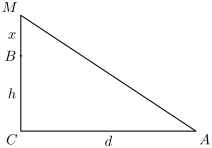
In the right triangle shown the sum of the distances and is equal to the sum of the distances and If and then equals:
Respuesta: A
Pista pequeña:
Usa el teorema de Pitágoras para expresar en términos de
Use the Pythagorean theorem to express in terms of
Pista grande:
A partir de aísla el radical y eleva al cuadrado
From isolate the radical and square
Solución:
La condición y el teorema de Pitágoras dan Después de aislar el radical y elevar al cuadrado, Al cancelar los términos comunes queda por lo que
Por lo tanto, la respuesta correcta es A.
The condition and the Pythagorean theorem give After isolating the radical and squaring, Cancelling common terms leaves so
Thus, the correct answer is A.
36.
Un bote tiene una velocidad de millas por hora en aguas tranquilas. En una corriente de millas por hora, recorre cierta distancia río abajo y regresa. La razón entre la velocidad promedio del viaje de ida y vuelta y la velocidad en aguas tranquilas es:
A boat has a speed of mph in still water. In a stream that has a current of mph it travels a certain distance downstream and returns. The ratio of the average speed for the round trip to the speed in still water is:
Respuesta: C
Pista pequeña:
Las velocidades río abajo y río arriba son y millas por hora
The downstream and upstream speeds are mph and mph
Pista grande:
Para distancias iguales, divide el doble de la distancia entre
For equal distances, divide twice the distance by
Solución:
Para una distancia de ida el tiempo total es Por lo tanto, la velocidad promedio de ida y vuelta es Su razón con es
Por lo tanto, la respuesta correcta es C.
For a one-way distance the total time is Thus the round-trip average speed is Its ratio to is
Thus, the correct answer is C.
37.
Dado el triángulo , donde biseca se prolonga hasta y es recto, entonces:
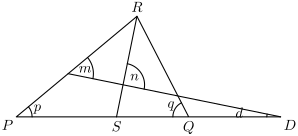
Given triangle with bisecting extended to and a right angle, then:
ninguna de las anteriores es correcta
none of these is correct
Respuesta: B
Pista pequeña:
Antes de bisecarse, el ángulo en mide
The bisected angle at measures before it is halved
Pista grande:
Como la transversal es perpendicular a la bisectriz, complementa la mitad de
Since the transversal is perpendicular to the angle bisector, complements half of
Solución:
El ángulo en es Como biseca este ángulo, el ángulo entre y es La recta que forma es perpendicular a por lo que
Por lo tanto, la respuesta correcta es B.
The angle at is Because bisects this angle, the angle between and is The line forming is perpendicular to so
Thus, the correct answer is B.
38.
Si y el valor aproximado de cuando es:
If and the value of when is approximately:
Respuesta: B
Pista pequeña:
Divide entre para obtener
Divide by to obtain
Pista grande:
Usa y divide entre
Use and divide by
Solución:
La ecuación se reduce a así que
Por lo tanto, la respuesta correcta es B.
The equation reduces to so
Thus, the correct answer is B.
39.
El lugar geométrico del punto medio de un segmento trazado desde un punto exterior fijo hasta un círculo dado de centro y radio es:
The locus of the midpoint of a line segment that is drawn from a given external point to a given circle with center and radius is:
una recta perpendicular a
a straight line perpendicular to
una recta paralela a
a straight line parallel to
un círculo de centro y radio
a circle with center and radius
un círculo con centro en el punto medio de y radio
a circle with center at the midpoint of and radius
un círculo con centro en el punto medio de y radio
a circle with center at the midpoint of and radius
Respuesta: E
Pista pequeña:
Sea el extremo variable sobre el círculo dado y sea su punto medio con
Let the variable endpoint on the given circle be and its midpoint with be
Pista grande:
La transformación es una homotecia de centro y razón
The map is a dilation centered at with scale factor
Solución:
Cuando el extremo se mueve sobre el círculo de centro su punto medio con el punto fijo es la imagen de bajo una homotecia de razón y centro Por lo tanto, el lugar geométrico es un círculo cuyo centro es el punto medio de y cuyo radio es
Por lo tanto, la respuesta correcta es E.
As the endpoint moves on the circle centered at its midpoint with the fixed point is the image of under a dilation of scale centered at Therefore the locus is a circle whose center is the midpoint of and whose radius is
Thus, the correct answer is E.
40.
Si entonces es igual a:
If then equals:
Respuesta: C
Pista pequeña:
Sea ; entonces la condición dada es
Set , so the given condition is
Pista grande:
Usa
Use
Solución:
Sea La identidad cúbica estándar da Como esta expresión es
Por lo tanto, la respuesta correcta es C.
Let The standard cubic identity gives Since this expression is
Thus, the correct answer is C.
41.
La suma de todas las raíces de es:
The sum of all the roots of is:
Respuesta: B
Pista pequeña:
Usa la fórmula de Vieta para la suma de las raíces de una cúbica
Use Vieta’s formula for the sum of the roots of a cubic
Pista grande:
Cambia el signo del coeficiente de y divide entre el coeficiente de
Negate the coefficient of and divide by the coefficient of
Solución:
Para la suma de las raíces es En este caso es
Por lo tanto, la respuesta correcta es B.
For the sum of the roots is Here it is
Thus, the correct answer is B.
42.
Considera en el mismo sistema de ejes las gráficas de y . Estas parábolas tienen exactamente la misma forma. Entonces:
Consider the graphs of and on the same set of axes. These parabolas have exactly the same shape. Then:
las gráficas coinciden.
the graphs coincide.
la gráfica de está más abajo que la de
the graph of is lower than the graph of
la gráfica de está a la izquierda de la de
the graph of is to the left of the graph of
la gráfica de está a la derecha de la de
the graph of is to the right of the graph of
la gráfica de está más arriba que la de
the graph of is higher than the graph of
Respuesta: D
Pista pequeña:
Calcula la coordenada de cada vértice usando
Find the -coordinate of each vertex using
Pista grande:
La gráfica tiene su vértice en , mientras que la gráfica lo tiene en
Graph has vertex , whereas graph has vertex
Solución:
El vértice de tiene coordenada igual a Por lo tanto, la gráfica tiene su vértice en mientras que la gráfica lo tiene en Las alturas de sus vértices son iguales, así que la gráfica es la misma parábola desplazada hacia la derecha.
Por lo tanto, la respuesta correcta es D.
The vertex of has -coordinate Thus graph has its vertex at while graph has its vertex at Their vertex heights are equal, so graph is the same parabola shifted to the right.
Thus, the correct answer is D.
43.
La hipotenusa de un triángulo rectángulo mide pulgadas y el radio del círculo inscrito mide pulgada. El perímetro del triángulo, en pulgadas, es:
The hypotenuse of a right triangle is inches and the radius of the inscribed circle is inch. The perimeter of the triangle in inches is:
Respuesta: B
Pista pequeña:
Para un triángulo rectángulo con catetos e hipotenusa el inradio es
For a right triangle with legs and hypotenuse the inradius is
Pista grande:
Sustituye y para hallar
Substitute and to find
Solución:
Para un triángulo rectángulo, Con y se obtiene Por consiguiente, el perímetro es
Por lo tanto, la respuesta correcta es B.
For a right triangle, With and this gives Hence the perimeter is
Thus, the correct answer is B.
44.
Un hombre nacido en la primera mitad del siglo XIX tenía años en el año Nació en:
A man born in the first half of the nineteenth century was years old in the year He was born in:
Respuesta: E
Pista pequeña:
Su año de nacimiento es
His birth year is
Pista grande:
Usa el requisito de que sea un año del siglo XIX y prueba el entero cercano
Use the requirement that is a nineteenth-century year and test the nearby integer
Solución:
El año debe estar en el siglo XIX, así que , porque , mientras que los cuadrados vecinos quedan fuera del intervalo pertinente. Por lo tanto, su año de nacimiento es que está en la primera mitad del siglo.
Por lo tanto, la respuesta correcta es E.
The year must lie in the nineteenth century, so because while the neighboring squares fall outside the relevant range. His birth year is therefore which is in the first half of the century.
Thus, the correct answer is E.
45.
En un rombo se trazan dentro del rombo segmentos paralelos a la diagonal con extremos en los lados del rombo. Se dibuja una gráfica que muestra la longitud de un segmento como función de su distancia al vértice La gráfica es:
In a rhombus line segments are drawn within the rhombus, parallel to diagonal and terminated in the sides of the rhombus. A graph is drawn showing the length of a segment as a function of its distance from vertex The graph is:
una recta que pasa por el origen.
a straight line passing through the origin.
una recta que atraviesa el cuadrante superior derecho.
a straight line cutting across the upper right quadrant.
dos segmentos que forman una derecha
two line segments forming an upright
dos segmentos que forman una invertida
two line segments forming an inverted
ninguna de las anteriores.
none of these.
Respuesta: D
Pista pequeña:
Imagina que un segmento paralelo a se mueve desde hacia el vértice opuesto
Imagine moving a segment parallel to from toward the opposite vertex
Pista grande:
Su longitud aumenta linealmente hasta alcanzar la diagonal completa y luego disminuye linealmente hasta cero
Its length grows linearly to the full diagonal and then decreases linearly to zero
Solución:
Al comenzar en la sección paralela tiene longitud y crece linealmente hasta alcanzar la diagonal Al continuar hacia el vértice opuesto, su longitud disminuye linealmente hasta volver a Por lo tanto, la gráfica consta de dos segmentos que forman una invertida.
Por lo tanto, la respuesta correcta es D.
Starting at the parallel cross section has length and grows linearly until it reaches the diagonal Continuing toward the opposite vertex, its length decreases linearly back to The graph is therefore made of two line segments forming an inverted
Thus, the correct answer is D.
46.
En el diagrama, si los puntos y son puntos de tangencia, entonces es igual a:
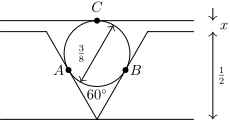
In the diagram, if points and are points of tangency, then equals:
Respuesta: E
Pista pequeña:
La medida marcada de de pulgada es el diámetro del círculo
The marked -inch measure is the circle’s diameter
Pista grande:
Con radio el centro está de pulgada por encima del vértice de , porque
With radius the center is inch above the vertex because
Solución:
El radio mide de pulgada. El centro está sobre la bisectriz. El radio perpendicular a cualquiera de los lados inclinados y el segmento del vértice al centro forman un triángulo rectángulo con un ángulo de , por lo que el centro está de pulgada por encima del vértice. Así, la tangente superior está de pulgada por encima del vértice. Como la recta horizontal inferior está pulgada por encima del vértice,
Por lo tanto, la respuesta correcta es E.
The radius is inch. The center lies on the angle bisector. The perpendicular radius to either sloping side and the segment from the vertex to the center form a right triangle with a angle, so the center is inch above the vertex. Hence the top tangent is inch above the vertex. Since the ledge is inch above the vertex,
Thus, the correct answer is E.
47.
En el punto medio del segmento , que mide unidades, se levanta una perpendicular de longitud unidades. Con centro en se traza un arco de radio igual a que corta en Entonces y son las raíces de:
At the midpoint of line segment which is units long, a perpendicular is erected with length units. An arc is described from with a radius equal to meeting at Then and are the roots of:
Respuesta: B
Pista pequeña:
La suma es
The sum is
Pista grande:
Usa en el triángulo rectángulo para demostrar que
Use in right triangle to show
Solución:
Sea Como el teorema de Pitágoras da Además, Su suma es y su producto es Por lo tanto, son las raíces de
Por lo tanto, la respuesta correcta es B.
Let Since the Pythagorean theorem gives Also, Their sum is and their product is Therefore they are the roots of
Thus, the correct answer is B.
48.
Una hora después de salir, un tren sufre un accidente que lo demora media hora; después continúa a de su velocidad anterior y llega con horas de retraso. Si el accidente hubiera ocurrido millas más adelante, habría llegado con solo horas de retraso. La longitud del viaje, en millas, era:
A train, an hour after starting, meets with an accident which detains it a half hour, after which it proceeds at of its former rate and arrives hours late. Had the accident happened miles farther along the line, it would have arrived only hours late. The length of the trip in miles was:
Respuesta: C
Pista pequeña:
Sean la velocidad normal y la longitud del viaje; reducir la velocidad a añade un tercio del tiempo normal en la distancia afectada
Let the normal speed be and the trip length be ; slowing to adds one-third of the normal time on the affected distance
Pista grande:
Usa las dos ecuaciones del retraso para hallar primero y luego
Use the two late-arrival equations to find first , then
Solución:
Sean la velocidad normal y la longitud del viaje. Recorrer una distancia a en vez de a añade un tercio de su tiempo normal de recorrido. En el primer caso, por lo que Si el accidente ocurre millas más adelante, Al sustituir , se obtiene de donde y
Por lo tanto, la respuesta correcta es C.
Let the normal speed be and the trip length be Traveling a distance at rather than adds one-third of its normal travel time. In the first case, so If the accident happens miles farther along, Substituting gives hence and
Thus, the correct answer is C.
49.
La diferencia de los cuadrados de dos números impares siempre es divisible entre Si y los números impares son y , para demostrar la afirmación dada escribimos la diferencia de los cuadrados en la forma:
The difference of the squares of two odd numbers is always divisible by If and and are the odd numbers, to prove the given statement we put the difference of the squares in the form:
Respuesta: C
Pista pequeña:
Desarrolla los dos cuadrados y agrupa cada variable con su sucesor
Expand the two squares and group each variable with its successor
Pista grande:
Cada uno de los productos y es par
Each product and is even
Solución:
Al desarrollar y reagrupar, Tanto como son pares, así que su diferencia es par. Por consiguiente, la expresión mostrada es divisible entre
Por lo tanto, la respuesta correcta es C.
Expanding and regrouping, Each of and is even, so their difference is even. The displayed expression is consequently divisible by
Thus, the correct answer is C.
50.
Las horas entre las y las en que las manecillas de un reloj forman un ángulo de grados, redondeadas al minuto más cercano, son:
The times between and o’clock, correct to the nearest minute, when the hands of a clock will form an angle of degrees are:
y
and
y
and
y
and
y
and
y
and
Respuesta: A
Pista pequeña:
A los minutos después de las la separación con signo entre las manecillas es
At minutes after the signed separation of the hands is
Pista grande:
Resuelve para obtener ambos valores de
Solve for both values of
Solución:
A los minutos después de las la manecilla de la hora está en y la de los minutos en Por lo tanto, Las dos soluciones son Al minuto más cercano, las horas son y
Por lo tanto, la respuesta correcta es A.
At minutes after the hour hand is at and the minute hand is at Thus The two solutions are To the nearest minute, the times are and
Thus, the correct answer is A.