
Problemas del 2023 AMC 10B
¡Desplázate hacia abajo y presiona Iniciar para intentar el examen! O ve al PDF imprimible, la clave de respuestas, o las soluciones profesionales preparadas por LIVE by Po-Shen Loh.
Todos los problemas se usan con el permiso legal oficial de la Mathematical Association of America (MAA).
O salta directamente a un solo problema con su solución: 1 · 2 · 3 · 4 · 5 · 6 · 7 · 8 · 9 · 10 · 11 · 12 · 13 · 14 · 15 · 16 · 17 · 18 · 19 · 20 · 21 · 22 · 23 · 24 · 25
¿Quieres aprender de forma profesional con clases interactivas en video?
Con tiempo
1:15:00
1.
La señora Jones está sirviendo jugo de naranja en cuatro vasos idénticos para sus cuatro hijos. Llena los primeros tres vasos por completo, pero se queda sin jugo cuando el cuarto vaso está solo lleno. ¿Qué fracción de un vaso debe verter la señora Jones desde cada uno de los primeros tres vasos hacia el cuarto para que los cuatro vasos tengan la misma cantidad de jugo?
Mrs. Jones is pouring orange juice into four identical glasses for her four sons. She fills the first three glasses completely but runs out of juice when the fourth glass is only full. What fraction of a glass must Mrs. Jones pour from each of the first three glasses into the fourth glass so that all four glasses will have the same amount of juice?
Respuesta: C
Pista pequeña:
Halla la cantidad total de jugo y luego divídela en partes iguales entre los cuatro vasos.
Find the total amount of juice, then divide it equally among the four glasses
Pista grande:
Cada vaso lleno termina en el nivel común, así que debe verter menos ese nivel.
Each full glass ends at the common level, so it must pour out minus that level
Solución:
En total hay vasos de jugo. Al repartirlos entre cuatro, cada vaso queda con Así que un vaso lleno debe verter Por lo tanto, C es la respuesta correcta.
There’s glasses of juice in all. Split four ways, each glass ends up with So a full glass has to pour out Thus, C is the correct answer.
2.
Carlos fue a una tienda de deportes a comprar zapatillas para correr. Las zapatillas estaban en oferta, con una reducción de en cada par. Carlos también sabía que debía pagar un impuesto de ventas de sobre el precio rebajado. Tenía dólares. ¿Cuál es el precio original, antes del descuento, de las zapatillas más caras que podía comprar?
Carlos went to a sports store to buy running shoes. Running shoes were on sale, with prices reduced by on every pair of shoes. Carlos also knew that he had to pay a sales tax on the discounted price. He had dollars. What is the original (before discount) price of the most expensive shoes he could afford to buy?
Respuesta: B
Pista pequeña:
Un descuento del multiplica el precio por un impuesto del lo multiplica por .
A discount multiplies the price by a tax multiplies by
Pista grande:
Iguala el costo final a y despeja .
Set the final cost equal to and solve for
Solución:
Sea el precio original. Después del descuento y el impuesto, Carlos paga Puede pagarlo cuando lo que significa Así que las zapatillas más caras que puede permitirse cuestan Por lo tanto, la respuesta es B.
Let be the original price. After the discount and tax, Carlos pays He can afford it when which means So the priciest shoes he can swing start at Therefore, the answer is B.
3.
Un triángulo rectángulo -- está inscrito en el círculo y un triángulo rectángulo -- está inscrito en el círculo ¿Cuál es la razón entre el área del círculo y el área del círculo ?
A -- right triangle is inscribed in circle and a -- right triangle is inscribed in circle What is the ratio of the area of circle to the area of circle
Respuesta: D
Pista pequeña:
La hipotenusa de un triángulo rectángulo es un diámetro de su circunferencia circunscrita.
The hypotenuse of a right triangle is a diameter of its circumscribed circle
Pista grande:
Los radios son y el área escala como el cuadrado del radio.
The radii are and area scales as the square of the radius
Solución:
La hipotenusa de un triángulo rectángulo es un diámetro de la circunferencia que lo rodea. Así, el círculo tiene diámetro y el círculo tiene diámetro Las áreas escalan como el cuadrado de eso, dando Por lo tanto, D es la respuesta correcta.
The hypotenuse of a right triangle is a diameter of the circle around it. So circle has diameter and circle has diameter Areas scale as the square of that, giving Thus, D is the correct answer.
4.
El pincel de Jackson hace una franja angosta con un ancho de milímetros. Jackson tiene suficiente pintura para hacer una franja de metros de largo. ¿Cuántos centímetros cuadrados de papel podría cubrir Jackson con pintura?
Jackson’s paintbrush makes a narrow strip with a width of millimeters. Jackson has enough paint to make a strip meters long. How many square centimeters of paper could Jackson cover with paint?
Respuesta: C
Pista pequeña:
Convierte todo a centímetros: mm cm y m cm.
Convert everything to centimeters: mm cm and m cm
Pista grande:
El área es ancho largo una vez que ambos están en las mismas unidades.
Area is width length once both are in the same units
Solución:
Primero pon todo en centímetros. La franja mide mm cm de ancho y m cm de largo. Su área es centímetros cuadrados. Por lo tanto, la respuesta es C.
Put everything in centimeters first. The strip is mm cm wide and m cm long. Its area is square centimeters. Therefore, the answer is C.
5.
Maddy y Lara ven una lista de números escrita en un pizarrón. Maddy suma a cada número de la lista y encuentra que la suma de sus nuevos números es Lara multiplica cada número de la lista por y encuentra que la suma de sus nuevos números también es ¿Cuántos números están escritos en el pizarrón?
Maddy and Lara see a list of numbers written on a blackboard. Maddy adds to each number in the list and finds that the sum of her new numbers is Lara multiplies each number in the list by and finds that the sum of her new numbers is also How many numbers are written on the blackboard?
Respuesta: A
Pista pequeña:
Sea la cantidad y la suma original sumar a cada número añade .
Let the count be and the original sum be adding to each number adds
Pista grande:
La condición de Lara da así que .
Lara’s condition gives so
Solución:
Sea la suma original y la cantidad de números. Maddy suma a cada uno, así que su total es Lara triplica cada uno, así que el suyo es dando Entonces así que Por lo tanto, A es la respuesta correcta.
Let be the original sum and the number of entries. Maddy adds to each, so her total is Lara triples each, so hers is giving Then so Thus, A is the correct answer.
6.
Sea y para ¿Cuántos términos de la sucesión son pares?
Let and for How many terms in the sequence are even?
Respuesta: E
Pista pequeña:
Sigue solo la paridad de los términos: impar, impar, par, y luego se repite.
Track only the parity of the terms: odd, odd, even, and then it repeats
Pista grande:
Los términos pares aparecen exactamente en las posiciones que son múltiplos de .
Even terms occur exactly at positions that are multiples of
Solución:
Sigue las paridades: van impar, impar, par, y luego se repiten con periodo Así que es par exactamente cuando es divisible entre Entre eso son múltiplos de Por lo tanto, la respuesta es E.
Track the parities: run odd, odd, even, then repeat with period So is even exactly when is divisible by Among that’s multiples of Therefore, the answer is E.
7.
El cuadrado se rota en sentido horario alrededor de su centro para obtener el cuadrado como se muestra abajo. ¿Cuál es la medida en grados de ?
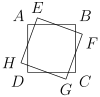
Square is rotated clockwise about its center to obtain square as shown below. What is the degree measure of
Respuesta: B
Pista pequeña:
Sea el centro; entonces y .
Let be the center; then and
Pista grande:
El triángulo es isósceles, y la diagonal forma un ángulo de con .
Triangle is isosceles, and the diagonal makes a angle with
Solución:
Sea el centro común. La rotación lleva a así que y Eso hace que el triángulo sea isósceles, con ángulos base La diagonal divide el ángulo recto en así que Restando, Por lo tanto, B es la respuesta correcta.
Let be the shared center. The rotation carries to so and That makes triangle isosceles, with base angles The diagonal splits the right angle at so Subtracting, Thus, B is the correct answer.
8.
¿Cuál es la cifra de las unidades de la siguiente expresión?
What is the units digit of
Respuesta: A
Pista pequeña:
Las cifras de las unidades de las potencias de ciclan las potencias de ciclan .
Units digits of powers of cycle powers of cycle
Pista grande:
Reduce cada exponente módulo luego suma las dos cifras de las unidades.
Reduce each exponent modulo then add the two units digits
Solución:
Solo importan las cifras de las unidades. Las potencias de ciclan con periodo y así que termina en Las potencias de ciclan y así que termina en Súmalas: así que la cifra de las unidades es Por lo tanto, la respuesta es A.
Only the units digits matter. Powers of cycle with period and so ends in Powers of cycle and so ends in Add them: so the units digit is Therefore, the answer is A.
9.
Los números y son un par de cuadrados perfectos positivos consecutivos cuya diferencia es ¿Cuántos pares de cuadrados perfectos positivos consecutivos tienen una diferencia menor o igual que ?
The numbers and are a pair of consecutive positive perfect squares whose difference is How many pairs of consecutive positive perfect squares have a difference of less than or equal to
Respuesta: B
Pista pequeña:
Los cuadrados consecutivos y difieren en .
Consecutive squares and differ by
Pista grande:
Resuelve para los enteros positivos .
Solve for positive integers
Solución:
Los cuadrados consecutivos y difieren en Necesitamos lo que da Así que recorre para pares. Por lo tanto, B es la respuesta correcta.
Consecutive squares and differ by We need which gives So runs for pairs. Thus, B is the correct answer.
10.
Estás jugando un juego. Un rectángulo cubre dos casillas adyacentes (orientado ya sea horizontal o verticalmente) de una cuadrícula de casillas , pero no te dicen cuáles dos casillas están cubiertas. Tu objetivo es encontrar al menos una casilla que esté cubierta por el rectángulo. Un “turno” consiste en que adivinas una casilla, tras lo cual te dicen si esa casilla está cubierta por el rectángulo oculto. ¿Cuál es el número mínimo de turnos que necesitas para garantizar que al menos una de tus casillas adivinadas esté cubierta por el rectángulo?
You are playing a game. A rectangle covers two adjacent squares (oriented either horizontally or vertically) of a grid of squares, but you are not told which two squares are covered. Your goal is to find at least one square that is covered by the rectangle. A “turn” consists of you guessing a square, after which you are told whether that square is covered by the hidden rectangle. What is the minimum number of turns you need to ensure that at least one of your guessed squares is covered by the rectangle?
Respuesta: C
Pista pequeña:
Si ninguna de tus casillas adivinadas está cubierta, las dos casillas cubiertas están entre las casillas que no adivinaste.
If none of your guesses is covered, the two covered squares lie among the squares you did not guess
Pista grande:
Las casillas no adivinadas no deben tener dos adyacentes; la mayor cantidad de casillas no adyacentes en una cuadrícula es .
The unguessed squares must have no two adjacent; the most non-adjacent squares in a grid is
Solución:
Supón que toda adivinanza falla. Entonces el dominó queda por completo sobre casillas no adivinadas, así que esas casillas incluyen dos celdas adyacentes. Para forzar un acierto, necesitamos que las casillas no adivinadas no tengan dos adyacentes. Colorea la cuadrícula como un tablero de ajedrez. El mayor conjunto de casillas mutuamente no adyacentes tiene celdas, las de un solo color: las cuatro esquinas y el centro. Así que debemos adivinar al menos casillas. Y bastan: adivina los cuatro puntos medios de los lados, ya que todo dominó cubre una casilla de cada color, y por tanto un punto medio de lado. Por lo tanto, la respuesta es C.
Suppose every guess misses. Then the domino lies entirely on unguessed squares, so those squares include two adjacent cells. To force a hit, we need the unguessed squares to have no two adjacent. Color the grid like a checkerboard. The biggest set of pairwise non-adjacent squares has cells, one color’s worth: the four corners and the center. So we must guess at least squares. And is enough: guess the four edge midpoints, since every domino covers one square of each color, hence one edge midpoint. Therefore, the answer is C.
11.
Suzanne fue al banco y retiró El cajero le dio esta cantidad usando billetes de billetes de y billetes de con al menos uno de cada denominación. ¿Cuántas colecciones diferentes de billetes pudo haber recibido Suzanne?
Suzanne went to the bank and withdrew The teller gave her this amount using bills, bills, and bills, with at least one of each denomination. How many different collections of bills could Suzanne have received?
Respuesta: B
Pista pequeña:
Divide entre la paridad entonces obliga a que el número de billetes de sea par.
Divide by parity then forces the number of bills to be even
Pista grande:
Escribiendo cuenta los pares de enteros positivos con .
Writing count positive integer pairs with
Solución:
Sean el número de billetes de . Entonces que se reduce a Tanto como son pares, así que también lo es, forzando Ahora significa Con el número de pares es Por lo tanto, B es la respuesta correcta.
Let count the bills. Then which divides down to Both and are even, so is too, forcing Now means With the pairs number Thus, B is the correct answer.
12.
Cuando las raíces del polinomio se eliminan de la recta de los números reales, lo que queda es la unión de intervalos abiertos disjuntos. ¿En cuántos de esos intervalos es positivo?
When the roots of the polynomial are removed from the real number line, what remains is the union of disjoint open intervals. On how many of those intervals is positive?
Respuesta: C
Pista pequeña:
Para todo factor es positivo; el signo de solo puede cambiar en una raíz.
For every factor is positive; the sign of can only change at a root
Pista grande:
Cruzar la raíz invierte el signo exactamente cuando el exponente es impar.
Crossing the root flips the sign exactly when the exponent is odd
Solución:
Para todo factor es positivo, así que Ahora muévete a la izquierda. Cruzar invierte el signo solo cuando es impar, es decir en Así que los once intervalos, de derecha a izquierda, tienen signos Seis son positivos. Por lo tanto, la respuesta es C.
For every factor is positive, so Now move left. Crossing flips the sign only when is odd, that is at So the eleven intervals, right to left, carry signs Six are positive. Therefore, the answer is C.
13.
¿Cuál es el área de la región en el plano de coordenadas definida por la siguiente desigualdad?
What is the area of the region in the coordinate plane defined by the inequality
Respuesta: B
Pista pequeña:
Sustituye y entonces es un rombo.
Substitute and then is a diamond
Pista grande:
Reflejar la parte del primer cuadrante sobre ambos ejes la copia veces.
Reflecting the first-quadrant piece across both axes copies it times
Solución:
Sustituye Entonces es un rombo centrado en con diagonales de longitud así que tiene área y queda por completo en La aplicación es cuatro a uno sobre así que la región completa tiene área Por lo tanto, B es la respuesta correcta.
Substitute Then is a diamond centered at with diagonals of length so it has area and it sits entirely in The map is four-to-one over so the full region has area Thus, B is the correct answer.
14.
¿Cuántos pares ordenados de enteros satisfacen la siguiente ecuación?
How many ordered pairs of integers satisfy the equation
Respuesta: C
Pista pequeña:
Si entonces de lo contrario supón .
If then otherwise assume
Pista grande:
Entonces obliga a .
Then forces
Solución:
Si la ecuación fuerza dando De lo contrario ambos son distintos de cero; supón Entonces así que y Toma da Toma Eso deja tres en total. Por lo tanto, la respuesta es C.
If the equation forces giving Otherwise both are nonzero; assume Then so and Take gives Take That leaves three in all. Therefore, the answer is C.
15.
¿Cuál es el menor entero positivo tal que sea un cuadrado perfecto?
What is the least positive integer such that is a perfect square?
Respuesta: C
Pista pequeña:
Empareja los factoriales: un cuadrado por un número impar.
Pair the factorials: a square times an odd number
Pista grande:
Los factores impares sobrantes y determinan qué primos aparecen a una potencia impar.
The leftover odd factors and determine which primes appear to an odd power
Solución:
Agrupa el producto como Como cada par es un cuadrado perfecto por un número impar. Esos números impares se multiplican dando con parte libre de cuadrados Y tiene parte libre de cuadrados Multiplica ambas: la parte libre de cuadrados de todo el producto es Ese es el menor a saber Por lo tanto, C es la respuesta correcta.
Group the product as Since each pair is a perfect square times an odd number. Those odd numbers multiply to with squarefree part And has squarefree part Multiply the two: the squarefree part of the whole thing is That’s the smallest namely Thus, C is the correct answer.
16.
Define un subno como un entero positivo de o más cifras donde las cifras son estrictamente crecientes de izquierda a derecha. De manera similar, define un bajno como un entero positivo de o más cifras donde las cifras son estrictamente decrecientes de izquierda a derecha. Por ejemplo, el número es un subno y es un bajno. Sea el número total de subnos y sea el número total de bajnos. ¿Cuánto vale ?
Define an upno to be a positive integer of or more digits where the digits are strictly increasing moving left to right. Similarly, define a downno to be a positive integer of or more digits where the digits are strictly decreasing moving left to right. For instance, the number is an upno and is a downno. Let equal the total number of upnos and let equal the total number of downnos. What is
Respuesta: E
Pista pequeña:
Cada número de este tipo es simplemente una elección de su conjunto de cifras, escrito en el orden requerido.
Each such number is just a choice of its set of digits, written in the required order
Pista grande:
Los números crecientes usan cifras de los números decrecientes también pueden incluir un al final.
Increasing numbers use digits from decreasing numbers may also include a trailing
Solución:
Un subno es simplemente una elección de al menos cifras, escritas en orden creciente. Un nunca puede aparecer: no puede ir al frente ni seguir a una cifra menor. Así que las cifras provienen de dando Un bajno puede terminar en así que sus cifras son cualquier subconjunto de de tamaño dando Así que Por lo tanto, la respuesta es E.
An upno is just a choice of at least digits, written in increasing order. A can never appear: it can’t lead and can’t follow a smaller digit. So the digits come from giving A downno can end in so its digits are any subset of of size giving So Therefore, the answer is E.
17.
Una caja rectangular tiene longitudes de arista distintas y La suma de las longitudes de las aristas de es la suma de las áreas de las caras de es y el volumen de es ¿Cuál es la longitud de la diagonal interior más larga que une dos vértices de ?
A rectangular box has distinct edge lengths and The sum of the lengths of all edges of is the sum of the areas of all faces of is and the volume of is What is the length of the longest interior diagonal connecting two vertices of
Respuesta: D
Pista pequeña:
La suma de aristas da y la suma de áreas de caras da .
The edge sum gives and the face-area sum gives
Pista grande:
La diagonal es desarrolla para recuperar su radicando a partir de las dos sumas simétricas conocidas.
The diagonal is expand to recover its radicand from the two known symmetric sums
Solución:
Las aristas dan así que Las caras dan así que La diagonal espacial es Por lo tanto, D es la respuesta correcta.
The edges give so The faces give so The space diagonal is Thus, D is the correct answer.
18.
Supón que y son enteros positivos tales que ¿Cuáles de los siguientes enunciados son necesariamente verdaderos?
I. Si o o ambos, entonces
II. Si entonces o o ambos.
III. si y solo si
Suppose and are positive integers such that Which of the following statements are necessarily true?
I. If or or both, then
II. If then or or both.
III. if and only if
y
and
Solo
only
Solo y
and only
Solo
only
Solo y
and only
Respuesta: E
Pista pequeña:
Elimina los denominadores para obtener luego reduce módulo .
Clear denominators to get then reduce modulo
Pista grande:
impone condiciones sobre módulo y sobre módulo .
forces conditions on modulo and on modulo
Solución:
Elimina los denominadores para obtener Reduce módulo los primos de y Así que si y solo si no es divisible ni por ni por y no es divisible ni por ni por lo que es exactamente y Eso resuelve III, y hace verdadero II ya que el “y” implica el “o”. El enunciado I falla, sin embargo: toma Entonces pero es divisible entre Así que solo II y III se cumplen. Por lo tanto, la respuesta es E.
Clear denominators to get Reduce modulo the primes of and So iff is divisible by neither nor and is divisible by neither nor which is exactly and That settles III, and it makes II true since the “and” implies the “or.” Statement I fails, though: take Then yet is divisible by So only II and III hold. Therefore, the answer is E.
19.
La rana Sonya elige un punto de forma uniforme al azar dentro del cuadrado en el plano de coordenadas y salta a ese punto. Luego elige una distancia de forma uniforme al azar de y una dirección de forma uniforme al azar de Todas sus elecciones son independientes. Ahora salta la distancia en la dirección elegida. ¿Cuál es la probabilidad de que caiga fuera del cuadrado?
Sonya the frog chooses a point uniformly at random lying within the square in the coordinate plane and hops to that point. She then chooses a distance uniformly at random from and a direction uniformly at random from All her choices are independent. She now hops the distance in the chosen direction. What is the probability that she lands outside the square?
Respuesta: B
Pista pequeña:
Por simetría, condiciona a una dirección, digamos este; solo importa la coordenada hacia ese borde.
By symmetry, condition on one direction, say east; only the coordinate toward that edge matters
Pista grande:
Para una distancia de salto fija la caída queda fuera con probabilidad promedia sobre .
For a fixed hop distance the landing is outside with probability average over
Solución:
Las cuatro direcciones se comportan igual por simetría, así que digamos que salta al este. Cae fuera exactamente cuando su coordenada más la distancia de salto supera Fija Su coordenada es uniforme en así que supera con probabilidad Ahora promedia sobre uniforme en Por lo tanto, B es la respuesta correcta.
The four directions behave the same by symmetry, so say she hops east. She lands outside exactly when her -coordinate plus the hop distance tops Fix Her -coordinate is uniform on so it beats with probability Now average over uniform on Thus, B is the correct answer.
20.
Se dibujan cuatro semicírculos congruentes sobre la superficie de una esfera de radio como se muestra, creando una curva cerrada que divide la superficie en dos regiones congruentes. La longitud de la curva es ¿Cuánto vale ?
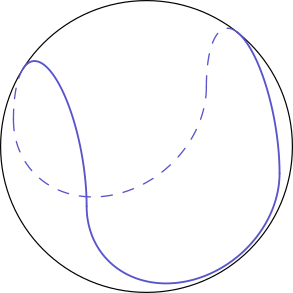
Four congruent semicircles are drawn on the surface of a sphere with radius as shown, creating a closed curve that divides the surface into two congruent regions. The length of the curve is What is
Respuesta: A
Pista pequeña:
La curva cerrada consta de cuatro arcos semicirculares congruentes, así que su longitud es veces la longitud de un semicírculo donde es el radio del arco.
The closed curve is four congruent semicircular arcs, so its length is times one semicircle’s length where is the arc radius
Pista grande:
Los cuatro extremos de los arcos forman un cuadrado inscrito en un círculo máximo, así que el diámetro de cada arco es una cuerda de longitud haciendo que el radio del arco sea .
The four arc endpoints form a square inscribed in a great circle, so each arc’s diameter is a chord of length making the arc radius
Solución:
La curva consta de cuatro arcos semicirculares congruentes, así que su longitud es veces un semicírculo, donde es el radio del arco. Los arcos se encuentran en cuatro puntos que forman un cuadrado inscrito en un círculo máximo de la esfera de radio , y el diámetro de cada arco es un lado de ese cuadrado, una cuerda de longitud Así que (Compruébalo de otra manera: el círculo pequeño está en un plano a distancia del centro, dando radio ) La longitud total es así que Por lo tanto, la respuesta es A.
The curve is four congruent semicircular arcs, so its length is times one semicircle, where is the arc radius. The arcs meet at four points that form a square inscribed in a great circle of the radius- sphere, and each arc’s diameter is a side of that square, a chord of length So (Check it another way: the small circle sits in a plane at distance from the center, giving radius ) The total length is so Therefore, the answer is A.
21.
Cada una de bolas se coloca al azar en una de cajas. ¿Cuál de las siguientes opciones está más cerca de la probabilidad de que cada una de las cajas contenga un número impar de bolas?
Each of balls is randomly placed into one of bins. Which of the following is closest to the probability that each of the bins will contain an odd number of balls?
Respuesta: E
Pista pequeña:
Codifica “conteo impar” en cada caja con un filtro de signos , reemplazando la imparidad por .
Encode “odd count” in each bin with a sign filter, replacing oddness by
Pista grande:
Esto da solo y dan términos grandes.
This gives only and give large terms
Solución:
Las asignaciones son igualmente probables. Un filtro de signos cuenta las que tienen cada caja impar: Para y ambos términos valen Para cada otra elección de signos, la suma entre paréntesis es o y el término completo vale así que estos seis términos suman Por lo tanto el conteo es Al dividir, la probabilidad es apenas por debajo de Por lo tanto, E es la respuesta correcta.
All assignments are equally likely. A sign filter counts the ones with every bin odd: For and both terms equal For each other sign choice, the sum in parentheses is or and the full term equals so these six terms total Thus the count is Dividing, the probability is a hair under Thus, E is the correct answer.
22.
¿Cuántos valores distintos de satisfacen donde denota el mayor entero menor o igual que ?
How many distinct values of satisfy where denotes the largest integer less than or equal to
un número infinito
an infinite number
Respuesta: B
Pista pequeña:
Haz entonces .
Set then
Pista grande:
Exige y encuentra los enteros que funcionan.
Require and find the integers that work
Solución:
Haz Entonces da Para que esto sea consistente necesitamos El lado izquierdo, se cumple para todo entero El lado derecho, se cumple solo para Esos dan así que hay valores distintos. Por lo tanto, la respuesta es B.
Set Then gives For this to be consistent we need The left side, holds for every integer The right side, holds only for Those give so there are distinct values. Therefore, the answer is B.
23.
Una progresión aritmética de enteros positivos tiene términos, término inicial y diferencia común Carl escribió correctamente todos los términos de esta progresión salvo uno, que quedó desviado en La suma de los términos que escribió fue ¿Cuánto valía ?
An arithmetic sequence of positive integers has terms, initial term and common difference Carl wrote down all the terms in this sequence correctly except for one term, which was off by The sum of the terms he wrote down was What is
Respuesta: B
Pista pequeña:
La suma escrita difiere de la suma verdadera en así que o .
The written sum differs from the true sum by so or
Pista grande:
Como factoriza y usa .
Since factor and use
Solución:
La suma verdadera es Como un término está desviado en el total escrito satisface así que o Además así que divide a Como y tenemos de donde Para ningún divisor de está entre y Para el único divisor de en este rango es Así o Como y son enteros positivos con obtenemos Entonces Por lo tanto, B es la respuesta correcta.
The true sum is Since one term is off by the written total satisfies so or Also so divides Since and we have hence For no divisor of lies between and For the only divisor of in this range is Thus or Since and are positive integers with we get Then Thus, B is the correct answer.
24.
¿Cuál es el perímetro de la frontera de la región formada por todos los puntos que pueden expresarse como con y ?
What is the perimeter of the boundary of the region consisting of all points which can be expressed as with and
Respuesta: E
Pista pequeña:
Al fijar el par barre un rectángulo ; variar lo desliza a lo largo de .
Fixing the pair sweeps a rectangle; varying slides it along
Pista grande:
La frontera es un hexágono cuyos lados opuestos miden y .
The boundary is a hexagon with opposite side lengths and
Solución:
Fija Cuando barren el punto llena un rectángulo alineado con los ejes, con esquina inferior izquierda Cuando va de a este rectángulo se desliza a lo largo del vector cuya longitud es La región barrida es un hexágono con simetría central. Sus pares de lados opuestos miden y heredados de los dos lados del rectángulo y del segmento de deslizamiento. Por lo tanto, su perímetro es Por lo tanto, la respuesta es E.
Fix As sweep the point fills a axis-aligned rectangle with lower-left corner As runs from to this rectangle slides along the vector whose length is The swept region is a centrally symmetric hexagon. Its opposite pairs of sides have lengths and inherited from the two sides of the rectangle and the sliding segment. Therefore its perimeter is Therefore, the answer is E.
25.
Un pentágono regular de área se imprime en papel y se recorta. Los cinco vértices del pentágono se doblan hacia el centro del pentágono, creando un pentágono más pequeño. ¿Cuál es el área del nuevo pentágono?
A regular pentagon with area is printed on paper and cut out. All five vertices are folded to the center of the pentagon, creating a smaller pentagon. What is the area of the new pentagon?
Respuesta: B
Pista pequeña:
Doblar un vértice hacia el centro pliega a lo largo de la mediatriz del segmento de ese vértice al centro, una recta a distancia del centro.
Folding a vertex to the center creases along the perpendicular bisector of the segment from that vertex to the center, a line at distance from the center
Pista grande:
La apotema reemplaza a así que el área escala por usa .
Apothem replaces so the area scales by use
Solución:
El pentágono original tiene circunradio Doblar un vértice hacia el centro pliega a lo largo de la mediatriz del segmento centro-vértice, una recta a distancia del centro. Esos cinco pliegues delimitan el nuevo pentágono regular, cuya apotema es (la apotema original era ). Así que el nuevo pentágono es semejante con razón y su área es el área anterior por Sustituye el factor se vuelve Así que la nueva área es Por lo tanto, B es la respuesta correcta.
Let the original pentagon have circumradius Folding a vertex to the center creases along the perpendicular bisector of the center-to-vertex segment, a line at distance from the center. Those five creases bound the new regular pentagon, whose apothem is (the original apothem was ). So the new pentagon is similar with ratio and its area is the old area times Plug in the factor becomes So the new area is Thus, B is the correct answer.