
Problemas del 1967 AMC 12
¡Desplázate hacia abajo y presiona Iniciar para intentar el examen! O ve al PDF imprimible, la clave de respuestas, o las soluciones profesionales preparadas por LIVE by Po-Shen Loh.
Todos los problemas se usan con el permiso legal oficial de la Mathematical Association of America (MAA).
O salta directamente a un solo problema con su solución: 1 · 2 · 3 · 4 · 5 · 6 · 7 · 8 · 9 · 10 · 11 · 12 · 13 · 14 · 15 · 16 · 17 · 18 · 19 · 20 · 21 · 22 · 23 · 24 · 25 · 26 · 27 · 28 · 29 · 30 · 31 · 32 · 33 · 34 · 35 · 36 · 37 · 38 · 39 · 40
¿Quieres aprender de forma profesional con clases interactivas en video?
Con tiempo
1:15:00
1.
El número de tres cifras se suma al número para obtener el número de tres cifras Si es divisible entre entonces es igual a:
The three-digit number is added to the number to give the three-digit number If is divisible by then equals:
Respuesta: C
Pista pequeña:
Usa la suma de cifras de
Use the digit sum of
Pista grande:
Después de hallar compara las cifras de las decenas en la suma
After finding compare the tens digits in the addition
Solución:
La divisibilidad entre exige que sea múltiplo de Como es una cifra, esto da La suma es entonces por lo que Así,
Por lo tanto, la respuesta correcta es C.
Divisibility by requires to be a multiple of Since is a digit, this gives The addition is then so Hence
Therefore, the correct answer is C.
2.
Una expresión equivalente a
es:
An equivalent of the expression
is:
Respuesta: D
Pista pequeña:
Desarrolla cada producto en cuatro términos
Expand each product into four terms
Pista grande:
Busca la cancelación de los términos y
Look for cancellation of the and terms
Solución:
El primer producto es mientras que el segundo es Al sumar se obtiene
Por lo tanto, la respuesta correcta es D.
The first product is while the second is Adding gives
Therefore, the correct answer is D.
3.
El lado de un triángulo equilátero mide Se inscribe un círculo en el triángulo y un cuadrado en el círculo. El área del cuadrado es:
The side of an equilateral triangle is A circle is inscribed in the triangle and a square is inscribed in the circle. The area of the square is:
Respuesta: B
Pista pequeña:
El inradio de un triángulo equilátero de lado es
The inradius of an equilateral triangle of side is
Pista grande:
La diagonal del cuadrado es el diámetro del círculo
The square’s diagonal is the circle’s diameter
Solución:
El inradio es El cuadrado inscrito tiene diagonal por lo que su área es la mitad del cuadrado de esa diagonal:
Por lo tanto, la respuesta correcta es B.
The inradius is The inscribed square has diagonal so its area is half the square of that diagonal:
Therefore, the correct answer is B.
4.
Dado que todos los logaritmos tienen la misma base y Si entonces es:
Given all logarithms to the same base and If then is:
Respuesta: C
Pista pequeña:
Reescribe las igualdades logarítmicas como y
Rewrite the logarithmic equalities as and
Pista grande:
Sustituye esas potencias en
Substitute those powers into
Solución:
Las igualdades dadas implican y Por lo tanto, Como esto es y tenemos
Por lo tanto, la respuesta correcta es C.
The given equalities imply and Therefore Since this is and we have
Therefore, the correct answer is C.
5.
Un triángulo está circunscrito a un círculo de radio pulgadas. Si el perímetro del triángulo es pulgadas y el área es pulgadas cuadradas, entonces es:
A triangle is circumscribed about a circle of radius inches. If the perimeter of the triangle is inches and the area is square inches, then is:
independiente del valor de
independent of the value of
Respuesta: D
Pista pequeña:
Divide el triángulo en tres triángulos menores de altura
Split the triangle into three smaller triangles with altitude
Pista grande:
Expresa usando el semiperímetro
Express using the semiperimeter
Solución:
Los tres radios trazados a los puntos de tangencia dividen el triángulo en triángulos menores cuya área total es Por consiguiente,
Por lo tanto, la respuesta correcta es D.
The three radii to the points of tangency split the triangle into smaller triangles whose total area is Hence
Therefore, the correct answer is D.
6.
Si entonces es igual a:
If then equals:
7.
Si donde son números reales y entonces:
If where are real numbers and then:
debe ser negativo
must be negative
debe ser positivo
must be positive
no puede ser cero
must not be zero
puede ser negativo o cero, pero no positivo
can be negative or zero, but not positive
puede ser positivo, negativo o cero
can be positive, negative, or zero
Respuesta: E
Pista pequeña:
Los signos de no están restringidos, salvo que
The signs of are unrestricted except that
Pista grande:
Prueba y elige para que el lado derecho sea positivo
Try and choose so that the right side is positive
Solución:
Tomamos y La desigualdad se convierte en que satisfacen valores positivos, cero y negativos de Así, ninguno de los tres signos posibles es obligatorio.
Por lo tanto, la respuesta correcta es E.
Take and The inequality becomes which is satisfied by positive, zero, and negative values of Thus none of the three possible signs is forced.
Therefore, the correct answer is E.
8.
A onzas de una solución ácida al se añaden onzas de agua para obtener una solución al . Si entonces es:
To ounces of an solution of acid, ounces of water are added to yield an solution. If then is:
no queda determinado por la información dada
not determined by the given information
Respuesta: A
Pista pequeña:
La cantidad de ácido permanece en onzas
The amount of acid remains ounces
Pista grande:
Iguala eso a multiplicado por el volumen final
Set that equal to times the final volume
Solución:
La conservación del ácido da Por tanto, así que y
Por lo tanto, la respuesta correcta es A.
Conservation of acid gives Hence so and
Therefore, the correct answer is A.
9.
Sea en unidades cuadradas, el área de un trapecio tal que la base menor, la altura y la base mayor, en ese orden, forman una progresión aritmética. Entonces:
Let in square units, be the area of a trapezoid such that the shorter base, the altitude, and the longer base, in that order, are in arithmetic progression. Then:
debe ser un entero
must be an integer
debe ser una fracción racional
must be a rational fraction
debe ser un número irracional
must be an irrational number
debe ser un entero o una fracción racional
must be an integer or a rational fraction
por separado, ni , ni , ni , ni es cierta
taken alone neither nor nor nor is true
Respuesta: E
Pista pequeña:
Escribe las tres longitudes como y
Write the three lengths as and
Pista grande:
El área resultante es pero el problema no restringe qué clase de número es
The resulting area is but the problem does not restrict the kind of number is
Solución:
Sean la base menor, la altura y la base mayor y Entonces Según esto puede ser un entero, un racional no entero o un irracional. Ninguna de las opciones (A) a (D) tiene que cumplirse.
Por lo tanto, la respuesta correcta es E.
Let the shorter base, altitude, and longer base be and Then Depending on this can be an integer, a nonintegral rational number, or an irrational number. No one of choices (A) through (D) must hold.
Therefore, the correct answer is E.
10.
Si
es una identidad para valores racionales positivos de entonces el valor de es:
If
is an identity for positive rational values of then the value of is:
Respuesta: A
Pista pequeña:
Multiplica por
Multiply by
Pista grande:
Compara el coeficiente de y el término constante
Compare the coefficient of and the constant term
Solución:
Al eliminar denominadores se obtiene Por lo tanto, y Al resolver se obtiene de modo que
Por lo tanto, la respuesta correcta es A.
Clearing denominators gives Therefore and Solving gives so
Therefore, the correct answer is A.
11.
Si el perímetro del rectángulo es pulgadas, el menor valor de la diagonal en pulgadas, es:
If the perimeter of rectangle is inches, the least value of diagonal in inches, is:
ninguna de las anteriores
none of these
Respuesta: B
Pista pequeña:
Si los lados adyacentes son y eleva la diagonal al cuadrado
If adjacent sides are and square the diagonal
Pista grande:
Completa el cuadrado en
Complete the square in
Solución:
Sean los lados adyacentes y Entonces Esto se minimiza cuando y da
Por lo tanto, la respuesta correcta es B.
Let adjacent sides be and Then This is minimized at giving
Therefore, the correct answer is B.
12.
Si el área (convexa) limitada por el eje y las rectas y es entonces es igual a:
If the (convex) area bounded by the -axis and the lines and is then equals:
ninguna de las anteriores
none of these
Respuesta: B
Pista pequeña:
Los lados verticales paralelos miden y
The parallel vertical sides have lengths and
Pista grande:
Su separación es , así que usa la fórmula del área de un trapecio
Their separation is , so use the trapezoid-area formula
Solución:
La región limitada es un trapecio con lados paralelos y separados por Así, Por lo tanto, de modo que Las alturas de los extremos son positivas, como exige la región convexa indicada.
Por lo tanto, la respuesta correcta es B.
The bounded region is a trapezoid with parallel sides and separated by Thus Hence so The endpoint heights are positive, as required for the stated convex region.
Therefore, the correct answer is B.
13.
Se quiere construir un triángulo dados el lado (opuesto al ángulo ), el ángulo y la altura desde Si es el número de soluciones no congruentes, entonces
A triangle is to be constructed given side (opposite angle ), angle and the altitude from If is the number of noncongruent solutions, then
es
is
es
is
debe ser cero
must be zero
debe ser infinito
must be infinite
debe ser cero o infinito
must be zero or infinite
Respuesta: E
Pista pequeña:
Fija y traza desde el rayo que forma el ángulo dado
Fix and draw the ray from making the given angle
Pista grande:
La distancia de a ese rayo es fija, sin importar dónde esté sobre él
The distance from to that ray is fixed, regardless of where lies on it
Solución:
Fijamos y trazamos desde el rayo que forma el ángulo prescrito Su distancia a es fija. Si esa distancia no es no hay solución. Si es entonces puede elegirse en infinitas posiciones del rayo, lo que produce infinitos triángulos no congruentes. Así, debe ser cero o infinito.
Por lo tanto, la respuesta correcta es E.
Fix and draw the ray from that makes the prescribed angle Its distance from is fixed. If that distance is not there is no solution. If it is then may be chosen at infinitely many positions on the ray, producing infinitely many noncongruent triangles. Thus must be zero or infinite.
Therefore, the correct answer is E.
14.
Sea Si entonces puede expresarse como:
Let If then can be expressed as:
Respuesta: C
Pista pequeña:
Despeja de
Solve for
Pista grande:
Compara con
Compare with
Solución:
De obtenemos así que Como esto es
Por lo tanto, la respuesta correcta es C.
From we obtain so Since this is
Therefore, the correct answer is C.
15.
La diferencia entre las áreas de dos triángulos semejantes es pies cuadrados, y la razón del área mayor a la menor es el cuadrado de un entero. El área del triángulo menor, en pies cuadrados, es un entero, y uno de sus lados mide pies. El lado correspondiente del triángulo mayor, en pies, mide:
The difference in the areas of two similar triangles is square feet, and the ratio of the larger area to the smaller is the square of an integer. The area of the smaller triangle, in square feet, is an integer, and one of its sides is feet. The corresponding side of the larger triangle, in feet, is:
Respuesta: D
Pista pequeña:
Sea el factor entero de escala de los lados
Let the integer side-scale factor be
Pista grande:
Si el área menor es entonces
If the smaller area is then
Solución:
Sea el factor de escala de los lados el entero y el área menor el entero Entonces Así, es un divisor positivo de El único cuadrado resultante es por lo que El lado correspondiente mide
Por lo tanto, la respuesta correcta es D.
Let the side-scale factor be the integer and the smaller area be the integer Then Thus is a positive divisor of The only resulting square is so The corresponding side is
Therefore, the correct answer is D.
16.
Sea el producto con cada factor escrito en base igual a en base Sea con cada sumando expresado en base Entonces en base es:
Let the product each factor written in base equal in base Let each term expressed in base Then in base is:
Respuesta: B
Pista pequeña:
Convierte los tres factores y en polinomios en
Translate the three factors and into polynomials in
Pista grande:
La cúbica resultante tiene la base válida
The resulting cubic has the valid base
Solución:
La ecuación del producto es Se simplifica a Así, la base válida es La suma requerida es que es
Por lo tanto, la respuesta correcta es B.
The product equation is It simplifies to Thus the valid base is The required sum is which is
Therefore, the correct answer is B.
17.
Si y son las raíces reales distintas de entonces necesariamente:
If and are the distinct real roots of then it must follow that:
o
or
y
and
y
and
Respuesta: A
Pista pequeña:
Dos raíces reales distintas exigen que el discriminante sea positivo
Distinct real roots require the discriminant to be positive
Pista grande:
Usa
Use
Solución:
La condición del discriminante es por lo que Por las fórmulas de Vieta, y por tanto
Por lo tanto, la respuesta correcta es A.
The discriminant condition is so By Vieta’s formulas, and therefore
Therefore, the correct answer is A.
18.
Si y entonces
If and then
puede tomar cualquier valor real
can take any real value
Respuesta: B
Pista pequeña:
Factoriza para ubicar
Factor to locate
Pista grande:
Revisa cómo varía en ese intervalo
Check how varies on that interval
Solución:
La desigualdad da En este intervalo, es creciente, con valores extremos y Los extremos están excluidos, por lo que
Por lo tanto, la respuesta correcta es B.
The inequality gives On this interval is increasing, with endpoint values and The endpoints are excluded, so
Therefore, the correct answer is B.
19.
El área de un rectángulo no cambia cuando se alarga pulgadas y se estrecha de pulgada, ni cuando se acorta pulgadas y se ensancha de pulgada. Su área, en pulgadas cuadradas, es:
The area of a rectangle remains unchanged when it is made inches longer and inch narrower, or when it is made inches shorter and inch wider. Its area, in square inches, is:
Respuesta: E
Pista pequeña:
Sean y el largo y el ancho originales
Let the original length and width be and
Pista grande:
Desarrolla ambas ecuaciones de áreas iguales; los términos se cancelan
Expand both equal-area equations; the terms cancel
Solución:
Las dos condiciones son Al desarrollar, dan y Por tanto, y
Por lo tanto, la respuesta correcta es E.
The two conditions are After expanding, these give and Hence and
Therefore, the correct answer is E.
20.
Se inscribe un círculo en un cuadrado de lado luego un cuadrado en ese círculo, después un círculo en este último cuadrado, y así sucesivamente. Si es la suma de las áreas de los primeros círculos así inscritos, entonces, cuando crece sin límite, se aproxima a:
A circle is inscribed in a square of side then a square is inscribed in that circle, then a circle is inscribed in the latter square, and so on. If is the sum of the areas of the first circles so inscribed, then, as grows beyond all bounds, approaches:
Respuesta: A
Pista pequeña:
El primer círculo tiene área
The first circle has area
Pista grande:
Cada círculo sucesivo tiene la mitad del área del círculo anterior
Each successive circle has half the preceding circle’s area
Solución:
El primer círculo tiene área Cada cuadrado inscrito reduce el cuadrado del radio del círculo siguiente, y por tanto su área, por un factor de Así, la suma límite es
Por lo tanto, la respuesta correcta es A.
The first circle has area Each inscribed square reduces the next circle’s squared radius, and hence its area, by a factor of Thus the limiting sum is
Therefore, the correct answer is A.
21.
En el triángulo rectángulo , la hipotenusa y el cateto La bisectriz del ángulo corta al lado opuesto en Se construye entonces un segundo triángulo rectángulo , con hipotenusa y cateto Si la bisectriz del ángulo corta al lado opuesto en la longitud de es:
In right triangle the hypotenuse and leg The bisector of angle meets the opposite side in A second right triangle is then constructed with hypotenuse and leg If the bisector of angle meets the opposite side in the length of is:
Respuesta: B
Pista pequeña:
Usa el teorema de la bisectriz en el triángulo --
Use the angle-bisector theorem in the -- triangle
Pista grande:
El segundo triángulo es una copia del primero a media escala
The second triangle is a half-scale copy of the first
Solución:
Como el teorema de la bisectriz da Así, y por lo que el triángulo es una copia a media escala de
Para la bisectriz desde en el triángulo original, por lo que Así, es la mitad, es decir,
Por lo tanto, la respuesta correcta es B.
Since the angle-bisector theorem gives Hence and so triangle is a half-scale copy of
For the angle bisector from in the original triangle, so Therefore is half of this, or
Thus, the correct answer is B.
22.
Para números naturales, cuando se divide entre el cociente es y el residuo es Cuando se divide entre el cociente es y el residuo es Entonces, cuando se divide entre el residuo es:
For natural numbers, when is divided by the quotient is and the remainder is When is divided by the quotient is and the remainder is Then, when is divided by the remainder is:
Respuesta: A
Pista pequeña:
Escribe y
Write and
Pista grande:
Sustituye la segunda ecuación en la primera y aísla el múltiplo de
Substitute the second equation into the first and isolate the multiple of
Solución:
La sustitución da Las cotas de los residuos implican por lo que este es efectivamente el residuo.
Por lo tanto, la respuesta correcta es A.
Substitution gives The remainder bounds imply so this is indeed the remainder.
Therefore, the correct answer is A.
23.
Si es real y positivo y crece sin límite, entonces se aproxima a:
If is real and positive and grows beyond all bounds, then approaches:
ningún número finito
no finite number
Respuesta: B
Pista pequeña:
Combina los logaritmos en uno solo
Combine the logarithms into one logarithm
Pista grande:
Halla el límite de
Find the limit of
Solución:
La diferencia es La fracción se aproxima a por lo que la expresión se aproxima a
Por lo tanto, la respuesta correcta es B.
The difference is The fraction approaches so the expression approaches
Therefore, the correct answer is B.
24.
El número de pares solución en enteros positivos de la ecuación es:
The number of solution-pairs in positive integers of the equation is:
ninguna de las anteriores
none of these
Respuesta: A
Pista pequeña:
Reduce la ecuación módulo para hallar la forma de
Reduce the equation modulo to find the form of
Pista grande:
Cuenta los valores positivos que dejan
Count the positive values that leave
Solución:
Módulo la ecuación da por lo que Escribimos Entonces La positividad exige lo que da pares.
Por lo tanto, la respuesta correcta es A.
Modulo the equation gives so Write Then Positivity requires giving pairs.
Therefore, the correct answer is A.
25.
Para todo número impar se cumple:
For every odd number we have:
es divisible entre
is divisible by
es divisible entre
is divisible by
es divisible entre
is divisible by
es divisible entre
is divisible by
es divisible entre
is divisible by
Respuesta: A
Pista pequeña:
Trabaja módulo para la opción (A)
Work modulo for choice (A)
Pista grande:
Como toda potencia positiva tiene el mismo residuo
Since every positive power has the same residue
Solución:
Como es impar, es un entero positivo. Módulo tenemos Por lo tanto, Así, la opción (A) siempre se cumple.
Por lo tanto, la respuesta correcta es A.
Because is odd, is a positive integer. Modulo we have Therefore Thus choice (A) always holds.
Therefore, the correct answer is A.
26.
Si se usa solo la información tabulada entonces la afirmación más precisa que puede hacerse sobre es que está entre:
If one uses only the tabular information then the strongest statement one can make for is that it lies between:
y
and
y
and
y
and
y
and
y
and
Respuesta: C
Pista pequeña:
Compara con para obtener una cota inferior
Compare with for a lower bound
Pista grande:
Compara con para obtener una cota superior
Compare with for an upper bound
Solución:
De obtenemos por lo que De obtenemos por lo que Este es el intervalo más estrecho de la lista que justifica la tabla.
Por lo tanto, la respuesta correcta es C.
From we get so From we get so This is the narrowest listed interval justified by the table.
Therefore, the correct answer is C.
27.
Dos velas de la misma longitud están hechas de materiales distintos, de modo que una se consume por completo a ritmo uniforme en horas y la otra en horas. ¿A qué hora de la tarde deben encenderse para que, a las P.M., el resto de una tenga el doble de longitud que el de la otra?
Two candles of the same length are made of different materials so that one burns out completely at a uniform rate in hours and the other in hours. At what time P.M. should the candles be lighted so that, at P.M., one stub is twice the length of the other?
Respuesta: C
Pista pequeña:
Sea el número de horas que arden las velas antes de las P.M.
Let be the number of hours the candles burn before P.M.
Pista grande:
Las fracciones restantes son y
Their remaining fractions are and
Solución:
Después de horas, las velas más rápida y más lenta conservan las fracciones y . El resto de la más lenta debe ser el doble del de la más rápida: Así, horas minutos. Al contar hacia atrás desde las P.M. se obtiene P.M.
Por lo tanto, la respuesta correcta es C.
After hours, the faster and slower candles have fractions and remaining. The slower stub must be twice the faster: Thus hours minutes. Counting back from P.M. gives P.M.
Therefore, the correct answer is C.
28.
Dadas las dos hipótesis: I Algunos Mems no son Ens y II Ningún En es Vee. Si «algunos» significa «al menos uno», podemos concluir que:
Given the two hypotheses: I Some Mems are not Ens and II No Ens are Vees. If “some” means “at least one,” we can conclude that:
Algunos Mems no son Vees
Some Mems are not Vees
Algunos Vees no son Mems
Some Vees are not Mems
Ningún Mem es Vee
No Mem is a Vee
Algunos Mems son Vees
Some Mems are Vees
Ninguna de , , ni se deduce de las afirmaciones dadas
Neither nor nor nor is deducible from the given statements
Respuesta: E
Pista pequeña:
Traduce las tres clases de objetos a conjuntos
Translate the three kinds of objects into sets
Pista grande:
Prueba tanto como manteniendo verdaderas las dos hipótesis
Test both and while keeping the two hypotheses true
Solución:
Las hipótesis solo dicen que algún elemento de está fuera de y que Un modelo con hace falsas (A), (B) y (C) mientras satisface las hipótesis. Un modelo con hace falsa (D). Por tanto, ninguna de las opciones (A) a (D) es forzosa.
Por lo tanto, la respuesta correcta es E.
The hypotheses say only that some element of lies outside and that A model with makes (A), (B), and (C) false while satisfying the hypotheses. A model with makes (D) false. Hence none of choices (A) through (D) is forced.
Therefore, the correct answer is E.
29.
es un diámetro de un círculo. Se trazan las tangentes y de modo que y se corten en un punto del círculo. Si y el diámetro del círculo es:
is a diameter of a circle. Tangents and are drawn so that and intersect in a point on the circle. If and the diameter of the circle is:
Respuesta: C
Pista pequeña:
Sea el punto de intersección sobre el círculo; entonces
Let the intersection point on the circle be ; then
Pista grande:
Usa las tangentes paralelas para comparar los triángulos rectángulos y
Use the parallel tangents to compare right triangles and
Solución:
Sea el diámetro. Como la intersección de y está sobre el círculo, esas dos rectas son perpendiculares por el teorema de Tales. Además, las tangentes y son paralelas. Los triángulos rectángulos resultantes y son semejantes, por lo que De aquí, y
Por lo tanto, la respuesta correcta es C.
Let be the diameter. Since the intersection of and lies on the circle, those two lines are perpendicular by Thales’ theorem. Also the tangents and are parallel. The resulting right triangles and are similar, so Hence and
Therefore, the correct answer is C.
30.
Un comerciante compró radios por dólares, siendo un entero positivo. Cedió dos radios a un bazar comunitario por la mitad de su costo. Vendió los demás con una ganancia de por cada radio. Si la ganancia total fue de entonces el menor valor posible de según la información dada es:
A dealer bought radios for dollars, a positive integer. He contributed two radios to a community bazaar at half their cost. The rest he sold at a profit of on each radio sold. If the overall profit was then the least possible value of for the given information is:
Respuesta: D
Pista pequeña:
Cada radio cuesta dólares
Each radio costs dollars
Pista grande:
Escribe el ingreso total de ventas con ganancia y dos ventas a mitad de costo
Write the total intake from profitable sales and two half-cost sales
Solución:
Las ventas regulares producen mientras que los dos radios del bazar producen juntos . Como el ingreso total es Esto se reduce a La positividad exige y da el entero positivo
Por lo tanto, la respuesta correcta es D.
The regular sales bring while the two bazaar radios bring together. Since the total intake is This reduces to Positivity requires and gives the positive integer
Therefore, the correct answer is D.
31.
Sea donde son enteros consecutivos y Entonces es:
Let where are consecutive integers and Then is:
siempre un entero par
always an even integer
a veces un entero impar y a veces no
sometimes an odd integer, sometimes not
siempre un entero impar
always an odd integer
a veces racional y a veces no
sometimes rational, sometimes not
siempre irracional
always irrational
Respuesta: C
Pista pequeña:
Toma y desarrolla
Set and expand
Pista grande:
Intenta reconocer como el cuadrado de
Try to recognize as the square of
Solución:
Con y Así, Como es par, este entero siempre es impar.
Por lo tanto, la respuesta correcta es C.
With and Thus Since is even, this integer is always odd.
Therefore, the correct answer is C.
32.
En el cuadrilátero , cuyas diagonales y se cortan en se tiene y La longitud de es:
In quadrilateral with diagonals and intersecting at and The length of is:
Respuesta: E
Pista pequeña:
Usa el triángulo para hallar
Use triangle to find
Pista grande:
Los ángulos y son suplementarios
Angles and are supplementary
Solución:
En el triángulo Por lo tanto, Al aplicar la ley de los cosenos en el triángulo , se obtiene Así que
Por lo tanto, la respuesta correcta es E.
In triangle Therefore Applying the law of cosines in triangle gives Hence
Therefore, the correct answer is E.
33.
En este diagrama se construyen semicírculos sobre los diámetros y de modo que sean mutuamente tangentes. Si entonces la razón entre el área sombreada y el área de un círculo de radio es:
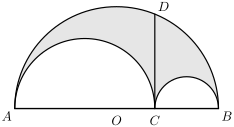
In this diagram semi-circles are constructed on diameters and so that they are mutually tangent. If then the ratio of the shaded area to the area of a circle with as radius is:
Respuesta: D
Pista pequeña:
Resta del área del semicírculo grande las áreas de los dos pequeños
Subtract the two small semicircle areas from the large one
Pista grande:
En el triángulo rectángulo el teorema de la altura da
In right triangle the altitude theorem gives
Solución:
Sean y El área sombreada es la del semicírculo grande menos las de los dos pequeños: Como está en el semicírculo de diámetro el triángulo es rectángulo y su altura satisface Por lo tanto, un círculo de radio tiene área La razón pedida es
Por lo tanto, la respuesta correcta es D.
Let and The shaded area is the large semicircle minus the two smaller ones: Since lies on the semicircle with diameter triangle is right, and its altitude satisfies A circle of radius therefore has area The required ratio is
Therefore, the correct answer is D.
34.
En los lados y del triángulo se toman respectivamente los puntos y , de modo que y La razón entre el área del triángulo y la del triángulo es:
Points are taken respectively on sides and of triangle so that and The ratio of the area of triangle to that of triangle is:
Respuesta: A
Pista pequeña:
Resta del triángulo los tres triángulos de las esquinas
Subtract the three corner triangles from triangle
Pista grande:
Cada triángulo de una esquina tiene razón de áreas
Each corner triangle has area ratio
Solución:
En cada vértice, las fracciones de los dos lados adyacentes que usa el triángulo de la esquina son y Así, el área de cada uno de esos triángulos es veces Por lo tanto,
Por lo tanto, la respuesta correcta es A.
At each vertex, the two adjacent side fractions used by the corner triangle are and Thus each corner triangle has area times Therefore
Therefore, the correct answer is A.
35.
Las raíces de están en progresión aritmética. La diferencia entre la mayor y la menor es:
The roots of are in arithmetic progression. The difference between the largest and smallest roots is:
Respuesta: B
Pista pequeña:
Escribe las raíces como y
Write the roots as and
Pista grande:
Usa su suma para hallar y luego su producto para hallar
Use their sum to find then use their product to find
Solución:
Sean las raíces y Su suma es por lo que Su producto es Al sustituir , se obtiene así que la diferencia entre las raíces extremas es
Por lo tanto, la respuesta correcta es B.
Let the roots be and Their sum is so Their product is Substituting gives so the difference between the extreme roots is
Therefore, the correct answer is B.
36.
Se da una progresión geométrica de cinco términos, cada uno un entero positivo menor que La suma de los cinco es Si es la suma de los términos de la progresión que son cuadrados de enteros, entonces es:
Given a geometric progression of five terms, each a positive integer less than The sum of the five terms is If is the sum of those terms in the progression which are squares of integers, then is:
Respuesta: C
Pista pequeña:
Escribe la razón común racional en su forma irreducible
Write the rational common ratio in lowest terms as
Pista grande:
La integridad obliga a que el término medio sea múltiplo de ; usa que es primo
Integrality forces the middle term to be a multiple of ; use that is prime
Solución:
Sea la razón común en su forma irreducible y sea el término medio. Como los cinco términos son enteros, es divisible por así que escribimos Entonces la suma es divisible por Por ello, es o Pero el término medio es menor que así que
Por lo tanto, La cota da Si alguno es las sumas posibles son o no La coprimalidad deja entonces que y sean y , en cualquier orden. La progresión es Sus términos cuadrados suman
Por lo tanto, la respuesta correcta es C.
Let the common ratio be in lowest terms and the middle term be Since all five terms are integers, is divisible by so write The sum is then divisible by Thus is or But the middle term is less than so
Thus The bound gives If either is the possible sums are or not Coprimality therefore leaves and equal to and in either order. The progression is Its square terms sum to
Therefore, the correct answer is C.
37.
Desde los vértices del triángulo se trazan los segmentos , cada uno perpendicular a una recta que no corta al triángulo. Los puntos son las intersecciones de con esas perpendiculares. Si es la longitud del segmento perpendicular , trazado hasta desde el punto de intersección de las medianas del triángulo, entonces es:
Segments are drawn from the vertices of triangle each perpendicular to a straight line not intersecting the triangle. Points are the intersection points of with the perpendiculars. If is the length of the perpendicular segment drawn to from the intersection point of the medians of the triangle, then is:
indeterminado
undetermined
Respuesta: A
Pista pequeña:
La distancia con signo de un punto a una recta fija es una función afín
Signed distance from a point to a fixed line is an affine function
Pista grande:
El centroide es el promedio de los tres vértices
The centroid is the average of the three vertices
Solución:
Como no corta al triángulo, las tres distancias perpendiculares tienen el mismo signo. La distancia con signo a una recta fija es afín, y el centroide es el promedio de los vértices. Por lo tanto, su distancia es el promedio
Por lo tanto, la respuesta correcta es A.
Because does not intersect the triangle, the three perpendicular distances have the same sign. Signed distance to a fixed line is affine, and the centroid is the average of the vertices. Therefore its distance is the average
Therefore, the correct answer is A.
38.
Se da un conjunto formado por dos tipos de elementos no definidos, “pib” y “maa”, y los cuatro postulados:
Todo pib es una colección de maas.
Dos pibs distintos cualesquiera tienen uno y solo un maa en común.
Todo maa pertenece a dos y solo dos pibs.
Hay exactamente cuatro pibs.
Considera los tres teoremas:
Hay exactamente seis maas.
Hay exactamente tres maas en cada pib.
Para cada maa hay exactamente otro maa que no comparte ningún pib con él.
Los teoremas que se deducen de los postulados son:
Given a set consisting of two undefined elements “pib” and “maa,” and the four postulates:
Every pib is a collection of maas.
Any two distinct pibs have one and only one maa in common.
Every maa belongs to two and only two pibs.
There are exactly four pibs.
Consider the three theorems:
There are exactly six maas.
There are exactly three maas in each pib.
For each maa there is exactly one other maa not in the same pib with it.
The theorems which are deducible from the postulates are:
solo
only
solo y
and only
solo y
and only
solo y
and only
todos
all
Respuesta: E
Pista pequeña:
Etiqueta los cuatro pibs como y
Label the four pibs and
Pista grande:
Cada maa corresponde a un par no ordenado de pibs
Each maa corresponds to an unordered pair of pibs
Solución:
Etiqueta los cuatro pibs como y Por y cada maa es precisamente el maa común a un par no ordenado de pibs. Por ello hay maas, lo que demuestra
Un pib fijo contiene los tres maas con lo que demuestra Para el maa el único maa que no comparte ninguno de esos pibs es el que pertenece al par complementario de pibs, lo que demuestra Se deducen los tres.
Por lo tanto, la respuesta correcta es E.
Label the four pibs and By and every maa is exactly the common maa of one unordered pair of pibs. Thus there are maas, proving
A fixed pib contains the three maas with proving For maa the unique maa sharing neither pib is the one belonging to the complementary pair of pibs, proving All three follow.
Therefore, the correct answer is E.
39.
Se dan los conjuntos de enteros consecutivos donde cada conjunto contiene un elemento más que el anterior y el primer elemento de cada conjunto es uno mayor que el último del conjunto precedente. Sea la suma de los elementos del -ésimo conjunto. Entonces es igual a:
Given the sets of consecutive integers where each set contains one more element than the preceding one, and where the first element of each succeeding set is one more than the last element of the preceding set. Let be the sum of the elements in the th set. Then equals:
ninguna de las anteriores
none of these
Respuesta: B
Pista pequeña:
El último número del -ésimo conjunto es
The last number in the th set is
Pista grande:
Suma los enteros consecutivos que terminan en ese número
Sum the consecutive integers ending at that number
Solución:
El -ésimo conjunto termina en y contiene enteros consecutivos. Su suma es Por lo tanto,
Por lo tanto, la respuesta correcta es B.
The th set ends at and contains consecutive integers. Its sum is Thus
Therefore, the correct answer is B.
40.
Dentro del triángulo equilátero hay un punto tal que y Al entero más cercano, el área del triángulo es:
Located inside equilateral triangle is a point such that and To the nearest integer the area of triangle is:
Respuesta: D
Pista pequeña:
Gira alrededor de , en el sentido que lleva a
Rotate by about so that maps to
Pista grande:
El triángulo -- resultante determina
The resulting -- triangle determines
Solución:
Gira alrededor de hasta Como esta rotación lleva a se tiene y Así, el triángulo es rectángulo. Además, el triángulo es equilátero, por lo que
Si el triángulo equilátero tiene lado la ley de los cosenos en el triángulo da Su área es cuyo entero más cercano es
Por lo tanto, la respuesta correcta es D.
Rotate by about to Since this rotation sends to we have and Thus triangle is right. Also triangle is equilateral, so
If the equilateral triangle has side the law of cosines in triangle gives Its area is whose nearest integer is
Therefore, the correct answer is D.