
2018 AMC 8 Problema 24
Intenta el Problema 24 del 2018 AMC 8 a continuación y luego compara tu respuesta con la solución en video y solución preparada profesionalmente de LIVE by Po-Shen Loh. También puedes intentar el examen cronometrado completo, ver todas las soluciones del 2018 AMC 8, o revisar la clave de respuestas.
Todos los problemas se usan con el permiso legal oficial de la Mathematical Association of America (MAA).
24.
En el cubo con vértices opuestos y e son los puntos medios de las aristas y respectivamente. Sea la razón del área de la sección transversal al área de una de las caras del cubo. ¿Cuánto vale ?
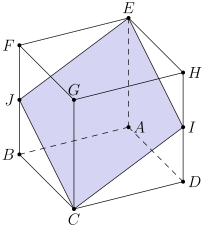
In the cube with opposite vertices and and are the midpoints of edges and respectively. Let be the ratio of the area of the cross-section to the area of one of the faces of the cube. What is
Respuesta: C
Pista pequeña:
El cuadrilátero es un rombo, así que usa sus diagonales.
The quadrilateral is a rhombus, so use its diagonals.
Pista grande:
Expresa las diagonales y en términos de la longitud del lado del cubo.
Express the diagonals and in terms of the cube side length.
Solución en video:

Click to load, then click again to play
Solución escrita:
Sea la longitud de una arista del cubo. Como cada lado de la sección transversal tiene la misma longitud, concluimos que es un rombo. Su área es la mitad del producto de sus diagonales. Por el teorema de Pitágoras, Aplicando de nuevo el teorema de Pitágoras, Por lo tanto, Así, y la respuesta correcta es C.
Allow to represent the length of an edge of the cube. Noting that each side of the cross section is equal in length, we conclude that is a rhombus. The area of this rhombus can be calculated as as the area of a rhombus is equal to half the product of its diagonals. Using the Pythagorean Theorem: Similarly, using the Pythagorean Theorem again lets us see that: Therefore, Thus, and the correct answer is C.
El Problema 24 en otros años
- 1985 AMC 8
- 1986 AMC 8
- 1987 AMC 8
- 1988 AMC 8
- 1989 AMC 8
- 1990 AMC 8
- 1991 AMC 8
- 1992 AMC 8
- 1993 AMC 8
- 1994 AMC 8
- 1995 AMC 8
- 1996 AMC 8
- 1997 AMC 8
- 1998 AMC 8
- 1999 AMC 8
- 2000 AMC 8
- 2001 AMC 8
- 2002 AMC 8
- 2003 AMC 8
- 2004 AMC 8
- 2005 AMC 8
- 2006 AMC 8
- 2007 AMC 8
- 2008 AMC 8
- 2009 AMC 8
- 2010 AMC 8
- 2011 AMC 8
- 2012 AMC 8
- 2013 AMC 8
- 2014 AMC 8
- 2015 AMC 8
- 2016 AMC 8
- 2017 AMC 8
- 2019 AMC 8
- 2020 AMC 8
- 2022 AMC 8
- 2023 AMC 8
- 2024 AMC 8
- 2025 AMC 8
- 2026 AMC 8