
Problemas del 2011 AMC 12A
¡Desplázate hacia abajo y presiona Iniciar para intentar el examen! O ve al PDF imprimible, la clave de respuestas, o las soluciones profesionales preparadas por LIVE by Po-Shen Loh.
Todos los problemas se usan con el permiso legal oficial de la Mathematical Association of America (MAA).
O salta directamente a un solo problema con su solución: 1 · 2 · 3 · 4 · 5 · 6 · 7 · 8 · 9 · 10 · 11 · 12 · 13 · 14 · 15 · 16 · 17 · 18 · 19 · 20 · 21 · 22 · 23 · 24 · 25
¿Quieres aprender de forma profesional con clases interactivas en video?
Con tiempo
1:15:00
1.
Un plan de telefonía móvil cuesta cada mes, más ¢ por cada mensaje de texto enviado, más ¢ por cada minuto usado por encima de horas. En enero Michelle envió mensajes de texto y habló durante horas. ¿Cuánto tuvo que pagar?
A cell phone plan costs each month, plus ¢ per text message sent, plus ¢ for each minute used over hours. In January Michelle sent text messages and talked for hours. How much did she have to pay?
Respuesta: D
Pista pequeña:
horas son minutos por encima del límite de horas
hours is minutes over the -hour allowance
Pista grande:
Suma la tarifa base, ¢ por la cantidad de mensajes, y ¢ por los minutos de exceso
Add the base fee, ¢ times the texts, and ¢ times the overage minutes
Solución:
El cargo por mensajes es centavos Ella habló minutos más allá del límite de horas, así que el exceso es centavos
El total es
Por lo tanto, la respuesta correcta es D.
The text charge is cents She talked minutes past the -hour allowance, so the overage is cents
The total is
Thus, the correct answer is D.
2.
Hay monedas colocadas planas sobre una mesa según la figura. ¿Cuál es el orden de las monedas de arriba hacia abajo?
There are coins placed flat on a table according to the figure. What is the order of the coins from top to bottom?
Respuesta: E
Pista pequeña:
Una moneda cuyo contorno es un círculo completo y sin interrupciones está encima
A coin whose outline is a complete, unbroken circle lies on top
Pista grande:
En cada superposición, la moneda cuyo arco se dibuja sin interrupción es la que está más arriba
At each overlap, the coin whose arc is drawn without interruption is the higher one
Solución:
La moneda está dibujada como un círculo completo y sin interrupciones, así que nada la cubre y está encima.
Al leer las superposiciones restantes, el arco descubierto de cada moneda muestra que está por encima de la siguiente: cubre a cubre a cubre a y cubre a mientras queda por debajo de las demás. Esto da el orden de arriba hacia abajo
Por lo tanto, la respuesta correcta es E.
Coin is drawn as a complete, unbroken circle, so nothing covers it and it lies on top.
Reading the remaining overlaps, each coin’s uncovered arc shows it sits above the next: covers covers covers and covers while lying under the others. This gives the top-to-bottom order
Thus, the correct answer is E.
3.
Una botella pequeña de champú puede contener mililitros de champú, mientras que una botella grande puede contener mililitros de champú. Jasmine quiere comprar la cantidad mínima de botellas pequeñas necesaria para llenar por completo una botella grande. ¿Cuántas botellas debe comprar?
A small bottle of shampoo can hold milliliters of shampoo, whereas a large bottle can hold milliliters of shampoo. Jasmine wants to buy the minimum number of small bottles necessary to completely fill a large bottle. How many bottles must she buy?
Respuesta: E
Pista pequeña:
Divide entre
Divide by
Pista grande:
Como botellas no alcanzan los redondea el cociente hacia arriba
Since bottles fall short of round the quotient up
Solución:
Catorce botellas contienen mililitros, lo cual no es suficiente. Quince botellas contienen mililitros, lo cual basta.
Así que Jasmine necesita botellas.
Por lo tanto, la respuesta correcta es E.
Fourteen bottles hold milliliters, which is not enough. Fifteen bottles hold milliliters, which suffices.
So Jasmine needs bottles.
Thus, the correct answer is E.
4.
En una escuela primaria, los estudiantes de tercer grado, cuarto grado y quinto grado corren un promedio de y minutos por día, respectivamente. Hay el doble de estudiantes de tercer grado que de cuarto grado, y el doble de estudiantes de cuarto grado que de quinto grado. ¿Cuál es el promedio de minutos corridos por día por estos estudiantes?
At an elementary school, the students in third grade, fourth grade, and fifth grade run an average of and minutes per day, respectively. There are twice as many third graders as fourth graders, and twice as many fourth graders as fifth graders. What is the average number of minutes run per day by these students?
Respuesta: C
Pista pequeña:
Sea la cantidad de estudiantes de quinto grado entonces la de cuarto grado es y la de tercer grado es
Let the number of fifth graders be so fourth graders is and third graders is
Pista grande:
El promedio es
The average is
Solución:
Toma los tamaños de los grados en la razón para tercer, cuarto y quinto grado. El promedio ponderado es
Por lo tanto, la respuesta correcta es C.
Take the grade sizes in the ratio for third, fourth, and fifth grades. The weighted average is
Thus, the correct answer is C.
5.
El verano pasado de las aves que vivían en Town Lake eran gansos, eran cisnes, eran garzas, y eran patos. ¿Qué porcentaje de las aves que no eran cisnes eran gansos?
Last summer of the birds living on Town Lake were geese, were swans, were herons, and were ducks. What percent of the birds that were not swans were geese?
Respuesta: C
Pista pequeña:
Las aves que no son cisnes constituyen del total
The non-swan birds make up of the total
Pista grande:
Calcula como porcentaje
Compute as a percent
Solución:
Las aves que no son cisnes constituyen del total, y los gansos son del total. La fracción pedida es
Por lo tanto, la respuesta correcta es C.
The birds that are not swans make up of the total, and geese are of the total. The requested fraction is
Thus, the correct answer is C.
6.
Los jugadores de un equipo de baloncesto anotaron algunos tiros de tres puntos, algunos tiros de dos puntos, y algunos tiros libres de un punto. Anotaron tantos puntos con los tiros de dos puntos como con los de tres puntos. Su cantidad de tiros libres acertados fue uno más que su cantidad de tiros de dos puntos acertados. La puntuación total del equipo fue de puntos. ¿Cuántos tiros libres acertaron?
The players on a basketball team made some three-point shots, some two-point shots, and some one-point free throws. They scored as many points with two-point shots as with three-point shots. Their number of successful free throws was one more than their number of successful two-point shots. The team’s total score was points. How many free throws did they make?
Respuesta: A
Pista pequeña:
Sea la cantidad de tiros de dos puntos; los puntos de los tiros de dos puntos y de tres puntos son cada uno
Let be the number of two-point shots; the points from two-point and three-point shots are each
Pista grande:
Los tiros libres son así que el total es
The free throws number so the total is
Solución:
Sea la cantidad de tiros de dos puntos. Los tiros de dos puntos anotan puntos, y los tiros de tres puntos anotan los mismos puntos. Los tiros libres son y anotan puntos.
El total es así que y los tiros libres son
Por lo tanto, la respuesta correcta es A.
Let be the number of two-point shots. The two-point shots score points, and the three-point shots score the same points. The free throws number and score points.
The total is so and the free throws number
Thus, the correct answer is A.
7.
La mayoría de los estudiantes de la clase de la Sra. Demeanor compraron lápices en la librería de la escuela. Cada uno de estos estudiantes compró la misma cantidad de lápices, y esta cantidad era mayor que El costo de un lápiz en centavos era mayor que la cantidad de lápices que compró cada estudiante, y el costo total de todos los lápices fue ¿Cuál era el costo de un lápiz en centavos?
A majority of the students in Ms. Demeanor’s class bought pencils at the school bookstore. Each of these students bought the same number of pencils, and this number was greater than The cost of a pencil in cents was greater than the number of pencils each student bought, and the total cost of all the pencils was What was the cost of a pencil in cents?
Respuesta: B
Pista pequeña:
Factoriza y sea (estudiantes)(lápices)(costo)
Factor and let (students)(pencils)(cost)
Pista grande:
Una mayoría significa más de estudiantes, así que la cantidad de estudiantes es
A majority means more than students, so the number of students is
Solución:
El total en centavos es Escribiendo (estudiantes)(lápices por persona)(costo por lápiz) la cantidad de estudiantes es un divisor de que es una mayoría de por lo tanto más de El único divisor así es
Entonces (lápices)(costo) con costo lápices lo que obliga a lápices a centavos cada uno.
Por lo tanto, la respuesta correcta es B.
Total cents is Writing (students)(pencils each)(cost per pencil) the number of students is a divisor of that is a majority of hence more than The only such divisor is
Then (pencils)(cost) with cost pencils forcing pencils at cents each.
Thus, the correct answer is B.
8.
En la sucesión de ocho términos el valor de es y la suma de tres términos consecutivos cualesquiera es ¿Cuánto vale ?
In the eight-term sequence the value of is and the sum of any three consecutive terms is What is
Respuesta: C
Pista pequeña:
Que las ternas consecutivas tengan sumas iguales obliga a que la sucesión se repita cada tres términos
Consecutive triples having equal sums forces the sequence to repeat every three terms
Pista grande:
Así que es igual a lo que significa que es lo mismo que
So equals which means is the same as
Solución:
Como obtenemos y de igual manera la sucesión se repite con período Así el octavo término, es igual a
De y tenemos
Por lo tanto, la respuesta correcta es C.
Since we get and likewise the sequence repeats with period Thus the eighth term, equals
From and we have
Thus, the correct answer is C.
9.
En una convención de gemelos y trillizos, había conjuntos de gemelos y conjuntos de trillizos, todos de familias diferentes. Cada gemelo estrechó la mano de todos los gemelos excepto su hermano/hermana y de la mitad de los trillizos. Cada trillizo estrechó la mano de todos los trillizos excepto sus hermanos y de la mitad de los gemelos. ¿Cuántos apretones de manos hubo?
At a twins and triplets convention, there were sets of twins and sets of triplets, all from different families. Each twin shook hands with all the twins except his/her sibling and with half the triplets. Each triplet shook hands with all the triplets except his/her siblings and with half the twins. How many handshakes took place?
Respuesta: B
Pista pequeña:
Hay gemelos y trillizos; cuenta por separado los apretones gemelo-gemelo, trillizo-trillizo, y gemelo-trillizo
There are twins and triplets; count twin-twin, triplet-triplet, and twin-triplet handshakes separately
Pista grande:
Cada gemelo saluda a gemelos y cada trillizo saluda a trillizos; divide esos dos totales entre
Each twin greets twins and each triplet greets triplets; divide those two totals by
Solución:
Hay gemelos y trillizos.
Apretones gemelo-gemelo: cada gemelo estrecha la mano de otros gemelos, lo que da
Apretones trillizo-trillizo: cada trillizo estrecha la mano de otros trillizos, lo que da
Apretones gemelo-trillizo: cada gemelo estrecha la mano de la mitad de los trillizos, lo que da (cada apretón de este tipo se cuenta una vez).
El total es
Por lo tanto, la respuesta correcta es B.
There are twins and triplets.
Twin-twin handshakes: each twin shakes other twins, giving
Triplet-triplet handshakes: each triplet shakes other triplets, giving
Twin-triplet handshakes: each twin shakes half the triplets, giving (each such handshake counted once).
The total is
Thus, the correct answer is B.
10.
Se lanza una vez un par de dados justos estándar de caras. La suma de los números obtenidos determina el diámetro de un círculo. ¿Cuál es la probabilidad de que el valor numérico del área del círculo sea menor que el valor numérico de la circunferencia del círculo?
A pair of standard -sided fair dice is rolled once. The sum of the numbers rolled determines the diameter of a circle. What is the probability that the numerical value of the area of the circle is less than the numerical value of the circle’s circumference?
Respuesta: B
Pista pequeña:
Con diámetro el área es y la circunferencia es
With diameter the area is and the circumference is
Pista grande:
La desigualdad se reduce a
The inequality reduces to
Solución:
Para diámetro que el área circunferencia significa es decir Como esto requiere una suma de o
Una suma de tiene probabilidad y una suma de tiene probabilidad lo que suma
Por lo tanto, la respuesta correcta es B.
For diameter area circumference means i.e. Since this needs a sum of or
A sum of has probability and a sum of has probability totaling
Thus, the correct answer is B.
11.
Los círculos y tienen cada uno radio Los círculos y comparten un punto de tangencia. El círculo tiene un punto de tangencia con el punto medio de ¿Cuál es el área dentro del círculo pero fuera del círculo y del círculo ?
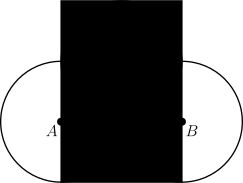
Circles and each have radius Circles and share one point of tangency. Circle has a point of tangency with the midpoint of What is the area inside circle but outside circle and circle
Respuesta: C
Pista pequeña:
Coloca los centros en y la distancia de a cada uno de es
Place the centers at and the distance from to each of is
Pista grande:
El área buscada es el área de menos las dos superposiciones en forma de lente de con y con
The wanted area is the area of minus the two lens-shaped overlaps of with and with
Solución:
Coloca de modo que su punto de tangencia es el origen, el punto medio de Entonces ya que pasa por el origen.
La distancia de a (y a ) es Dos círculos unitarios cuyos centros están a de distancia se superponen en una lente de área
Los círculos y se encuentran solo en el origen, así que las dos lentes no se superponen. El área buscada es
Por lo tanto, la respuesta correcta es C.
Place so their tangency point is the origin, the midpoint of Then since passes through the origin.
The distance from to (and to ) is Two unit circles whose centers are apart overlap in a lens of area
Circles and meet only at the origin, so the two lenses do not overlap. The wanted area is
Thus, the correct answer is C.
12.
Una lancha motora y una balsa salieron ambas del muelle en un río y se dirigieron río abajo. La balsa se dejó llevar a la velocidad de la corriente del río. La lancha motora mantuvo una velocidad constante con respecto al río. La lancha motora llegó al muelle río abajo, luego inmediatamente giró y viajó de vuelta río arriba. Finalmente se encontró con la balsa en el río horas después de salir del muelle ¿Cuántas horas tardó la lancha motora en ir de a ?
A power boat and a raft both left dock on a river and headed downstream. The raft drifted at the speed of the river current. The power boat maintained a constant speed with respect to the river. The power boat reached dock downriver, then immediately turned and traveled back upriver. It eventually met the raft on the river hours after leaving dock How many hours did it take the power boat to go from to
Respuesta: D
Pista pequeña:
Trabaja en el marco de referencia del agua, en el cual la balsa permanece quieta
Work in the frame of the water, in which the raft stays put
Pista grande:
Con respecto al agua la lancha viaja a la misma velocidad al ir y al volver, así que tarda tiempos iguales en cada trayecto
Relative to the water the boat travels at the same speed going out and coming back, so it takes equal times each way
Solución:
Mide todo con respecto al agua. En ese marco la balsa está inmóvil en el punto donde empezó la lancha, y la lancha se mueve a su velocidad constante con respecto al agua, tanto río abajo como río arriba.
La lancha deja la balsa, se aleja durante cierto tiempo, luego regresa a ella a la misma velocidad relativa, así que emplea tiempos iguales en ir y en volver. Por lo tanto el trayecto de ida hasta tarda la mitad de que es horas.
Por lo tanto, la respuesta correcta es D.
Measure everything relative to the water. In that frame the raft is stationary at the point where the boat started, and the boat moves at its constant speed relative to the water, both downstream and upstream.
The boat leaves the raft, travels away for some time, then returns to it at the same relative speed, so it spends equal times going and returning. Hence the outbound leg to takes half of which is hours.
Thus, the correct answer is D.
13.
El triángulo tiene longitudes de lados y La recta que pasa por el incentro de paralela a corta a en y a en ¿Cuál es el perímetro de ?
Triangle has side-lengths and The line through the incenter of parallel to intersects at and at What is the perimeter of
Respuesta: B
Pista pequeña:
Sea el incentro. Como el ángulo es igual a
Let be the incenter. Since the angle equals
Pista grande:
Eso hace que sea isósceles con y de manera similar
That makes isosceles with and similarly
Solución:
Sea el incentro. Como biseca y los ángulos alternos dan así que es isósceles con De manera similar
Por lo tanto el perímetro de es
Por lo tanto, la respuesta correcta es B.
Let be the incenter. Because bisects and alternate angles give so is isosceles with Similarly
Therefore the perimeter of is
Thus, the correct answer is B.
14.
Supongamos que y son enteros positivos de un solo dígito elegidos de forma independiente y al azar. ¿Cuál es la probabilidad de que el punto esté por encima de la parábola ?
Suppose and are single-digit positive integers chosen independently and at random. What is the probability that the point lies above the parabola
Respuesta: E
Pista pequeña:
El punto está por encima de la parábola cuando es decir
The point is above the parabola when i.e.
Pista grande:
Cuenta los válidos en para cada solo permiten alguno
Count valid in for each only allow any
Solución:
Sustituyendo el punto está por encima de la parábola cuando es decir
Para los valores sirven. Para así que lo que da Para así que lo que da Para ningún sirve.
El conteo es de así que la probabilidad es
Por lo tanto, la respuesta correcta es E.
Substituting the point is above the parabola when i.e.
For all values work. For so giving For so giving For no works.
The count is out of so the probability is
Thus, the correct answer is E.
15.
La base circular de una semiesfera de radio descansa sobre la base de una pirámide cuadrada de altura La semiesfera es tangente a las otras cuatro caras de la pirámide. ¿Cuál es la longitud de la arista de la base de la pirámide?
The circular base of a hemisphere of radius rests on the base of a square pyramid of height The hemisphere is tangent to the other four faces of the pyramid. What is the edge-length of the base of the pyramid?
Respuesta: A
Pista pequeña:
Toma la sección transversal que pasa por el ápice y los puntos medios de dos aristas opuestas de la base
Take the cross-section through the apex and the midpoints of two opposite base edges
Pista grande:
En esa sección transversal, la recta inclinada va de a y su distancia al centro es
In that cross-section, the slant line runs from to and its distance from the center is
Solución:
Sea la base con lado centrada en el origen, con el ápice a altura Corta con el plano vertical que pasa por el ápice y los puntos medios de dos aristas opuestas de la base. La cara inclinada aparece como la recta de a
Esta recta es La semiesfera es tangente a la cara, así que la distancia del origen a esta recta es el radio
Entonces así que y lo que da
Por lo tanto, la respuesta correcta es A.
Let the base have side centered at the origin, with apex at height Cut with the vertical plane through the apex and the midpoints of two opposite base edges. The slant face appears as the line from to
This line is The hemisphere is tangent to the face, so the distance from the origin to this line is the radius
Then so and giving
Thus, the correct answer is A.
16.
A cada vértice del pentágono convexo se le debe asignar un color. Hay colores para elegir, y los extremos de cada diagonal deben tener colores diferentes. ¿Cuántas coloraciones diferentes son posibles?
Each vertex of convex pentagon is to be assigned a color. There are colors to choose from, and the ends of each diagonal must have different colors. How many different colorings are possible?
Respuesta: C
Pista pequeña:
Las cinco diagonales forman un único -ciclo entre los vértices
The five diagonals form a single -cycle among the vertices
Pista grande:
El número de coloraciones propias de un ciclo de longitud con colores es
The number of proper colorings of a cycle of length with colors is
Solución:
Las diagonales conectan los vértices en el orden que es un -ciclo. La condición es exactamente que este ciclo esté coloreado de forma propia.
El número de -coloraciones propias de un ciclo de longitud es Con y
Por lo tanto, la respuesta correcta es C.
The diagonals connect the vertices in the order which is a -cycle. The condition is exactly that this cycle is properly colored.
The number of proper -colorings of a cycle of length is With and
Thus, the correct answer is C.
17.
Círculos con radios y son mutuamente tangentes exteriores. ¿Cuál es el área del triángulo determinado por los puntos de tangencia?
Circles with radii and are mutually externally tangent. What is the area of the triangle determined by the points of tangency?
Respuesta: D
Pista pequeña:
Los centros forman un triángulo con lados es decir un triángulo rectángulo --
The centers form a triangle with sides i.e. a -- right triangle
Pista grande:
Coloca el ángulo recto en el centro del círculo de radio y ubica cada punto de tangencia en el segmento que conecta
Put the right angle at the center of the radius- circle and locate each tangency point on the connecting segment
Solución:
Los centros están separados por las sumas de radios: y un triángulo rectángulo con el ángulo recto en el centro de radio . Coloca ese centro en el centro de radio en y el centro de radio en
Los puntos de tangencia están sobre los segmentos a distancias iguales a los radios: y sobre la hipotenusa en
Por la fórmula del cordón, el área es
Por lo tanto, la respuesta correcta es D.
The centers are separated by the sums of radii: and a right triangle with the right angle at the radius- center. Place that center at the radius- center at and the radius- center at
The tangency points lie on the segments at distances equal to the radii: and on the hypotenuse at
By the shoelace formula the area is
Thus, the correct answer is D.
18.
Supongamos que ¿Cuál es el máximo valor posible de ?
Suppose that What is the maximum possible value of
Respuesta: D
Pista pequeña:
La ecuación significa la frontera del cuadrado
The equation means the boundary of the square
Pista grande:
En ese cuadrado, es mayor cuando y
On that square, is largest when and
Solución:
La identidad convierte la condición en la frontera del cuadrado con y
En esta región aumenta a medida que disminuye y a medida que aumenta, así que el máximo está en
Por lo tanto, la respuesta correcta es D.
The identity turns the condition into the boundary of the square with and
On this region increases as decreases and as increases, so the maximum is at
Thus, the correct answer is D.
19.
En una competición con jugadores, la cantidad de jugadores a los que se les otorga estatus de élite es igual a Supongamos que a jugadores se les otorga estatus de élite. ¿Cuál es la suma de los dos menores valores posibles de ?
Nota: es el mayor entero menor o igual que
At a competition with players, the number of players given elite status is equal to Suppose that players are given elite status. What is the sum of the two smallest possible values of
Note: is the greatest integer less than or equal to
Respuesta: C
Pista pequeña:
Sea entonces
Let so
Pista grande:
Para que ese sea consistente, lo que obliga a
For that to be consistent, which forces
Solución:
Sea así que la cantidad de élite es lo que da
La consistencia requiere es decir así que
Las dos menores opciones son que da y que da Su suma es
Por lo tanto, la respuesta correcta es C.
Let so the elite count is giving
Consistency requires i.e. so
The two smallest choices are giving and giving Their sum is
Thus, the correct answer is C.
20.
Sea donde y son enteros. Supongamos que y para algún entero ¿Cuánto vale ?
Let where and are integers. Suppose that and for some integer What is
Respuesta: C
Pista pequeña:
De así que y
From so and
Pista grande:
Las cotas obligan a y
The bounds force and
Solución:
Como tenemos Entonces
De obtenemos y de obtenemos Restando, luego y
Así que que está en lo que da
Por lo tanto, la respuesta correcta es C.
Since we have Then
From we get and from we get Subtracting, then and
So which lies in giving
Thus, the correct answer is C.
21.
Sea y para enteros sea Si es el mayor valor de para el cual el dominio de es no vacío, el dominio de es ¿Cuánto vale ?
Let and for integers let If is the largest value of for which the domain of is nonempty, the domain of is What is
Pista pequeña:
Construye los dominios de adentro hacia afuera: requiere que esté en el dominio de
Build the domains outward: needs to lie in the domain of
Pista grande:
Los tres primeros dominios son y continúa recordando que una raíz cuadrada es no negativa
The first three domains are and continue while remembering that a square root is nonnegative
Solución:
Cada paso requiere que esté en el dominio de Siguiendo los dominios:
(solo el valor es posible).
Para necesitaríamos imposible, así que el dominio es vacío. Por lo tanto y
Por lo tanto, la respuesta correcta es A.
Each step requires to lie in the domain of Tracking the domains:
(only the value is possible).
For we would need impossible, so the domain is empty. Hence and
Thus, the correct answer is A.
22.
Sea una región cuadrada y un entero. Un punto en el interior de se llama -radial particional si hay rayos que emanan de y dividen en triángulos de igual área. ¿Cuántos puntos son -radiales particionales pero no -radiales particionales?
Let be a square region and an integer. A point in the interior of is called -ray partitional if there are rays emanating from that divide into triangles of equal area. How many points are -ray partitional but not -ray partitional?
Respuesta: C
Pista pequeña:
Los puntos -radiales particionales forman una cuadrícula: para son los puntos interiores una matriz
The -ray partitional points form a grid: for they are the interior points an array
Pista grande:
Un punto es a la vez - y -radial particional exactamente cuando es -radial particional
A point is both - and -ray partitional exactly when it is -ray partitional
Solución:
Escalemos el cuadrado a y escribamos Los rayos deben incluir los que pasan por los cuatro vértices. Cada triángulo pequeño tiene área Los triángulos cuyas bases dividen el lado inferior tienen área total así que su cantidad es Del mismo modo, las cantidades junto a los lados superior, izquierdo y derecho son y
Estos cuatro números deben ser enteros positivos. Por tanto, es par y Recíprocamente, al dividir cada lado en la cantidad indicada de segmentos iguales y unir los puntos de división con , se producen triángulos de igual área. Estos son exactamente los puntos particionales.
Para los puntos son con lo que da Un punto así también es particional de rayos exactamente cuando y para enteros Por tanto, y deben ser múltiplos de Hay opciones para cada uno, de modo que la intersección tiene puntos.
Así, el conteo es
Por lo tanto, la respuesta correcta es C.
Scale the square to and write The rays must include those through the four vertices. Every small triangle has area The triangles whose bases partition the bottom side together have area so their number is Similarly, the numbers along the top, left, and right sides are and
These four numbers must be positive integers. Hence is even and Conversely, partitioning each side into the indicated number of equal segments and joining the division points to produces equal-area triangles. Thus these are exactly the partitional points.
For the points are with giving Such a point is also -ray partitional exactly when and for integers Thus and must both be multiples of There are choices for each, so the overlap has points.
So the count is
Thus, the correct answer is C.
23.
Sea y donde y son números complejos. Supongamos que y para todo para el cual está definido. ¿Cuál es la diferencia entre el mayor y el menor valor posible de ?
Let and where and are complex numbers. Suppose that and for all for which is defined. What is the difference between the largest and smallest possible values of
Respuesta: C
Pista pequeña:
Representa con la matriz entonces significa que es la identidad
Represent by the matrix then means is the identity
Pista grande:
El caso de orden obliga a lo que da
The order- case forces which gives
Solución:
La composición directa da donde y
La matriz representa a Para que sea la identidad, su cuadrado debe ser escalar. Al comparar las entradas fuera de la diagonal y las dos entradas diagonales, hay dos posibilidades: o bien y o bien La primera da (con ); la segunda da
En el segundo caso, Cuando recorre el círculo unitario, varía de a así que Ambos extremos se alcanzan: tomemos y El caso separado también tiene Por tanto, la diferencia pedida es
Por lo tanto, la respuesta correcta es C.
Direct composition gives where and
The matrix represents For to be the identity, its square must be scalar. Comparing the off-diagonal entries and the two diagonal entries gives two possibilities: either and or The first gives (with ); the second gives
In the second case, As runs around the unit circle, ranges from to so Both endpoints occur: take and The separate case also has Therefore the requested difference is
Thus, the correct answer is C.
24.
Considera todos los cuadriláteros tales que y ¿Cuál es el radio del mayor círculo posible que cabe dentro o sobre la frontera de tal cuadrilátero?
Consider all quadrilaterals such that and What is the radius of the largest possible circle that fits inside or on the boundary of such a quadrilateral?
Respuesta: C
Pista pequeña:
Si cabe un círculo de radio , al dividir desde su centro se ve que el área del cuadrilátero es al menos
If a circle of radius fits, splitting from its center shows the quadrilateral’s area is at least
Pista grande:
La desigualdad de Bretschneider acota el área mediante el caso cíclico; el caso de igualdad también es tangencial porque las sumas de lados opuestos son iguales
Bretschneider’s inequality bounds the area by the cyclic case; the equality case is also tangential because opposite side sums are equal
Solución:
Supongamos que un círculo de radio y centro cabe en uno de los cuadriláteros. Si son las distancias de a las rectas que contienen los cuatro lados, entonces cada Al dividir el cuadrilátero en cuatro triángulos,
La desigualdad de Bretschneider acota el área de todo cuadrilátero con estos lados mediante el caso cíclico:
Por tanto, La igualdad se alcanza: el cuadrilátero cíclico con estos lados también es tangencial porque y su incírculo tiene radio
Por lo tanto, la respuesta correcta es C.
Suppose a circle of radius centered at fits in one of the quadrilaterals. If are the distances from to the four side lines, then each Splitting the quadrilateral into four triangles gives
Bretschneider’s inequality bounds the area of any quadrilateral with these sides by the cyclic case:
Therefore Equality is attainable: the cyclic quadrilateral with these sides is also tangential because and its incircle has radius
Thus, the correct answer is C.
25.
El triángulo tiene y Sean y el ortocentro, el incentro y el circuncentro de respectivamente. Supongamos que el área del pentágono es la máxima posible. ¿Cuánto vale ?
Triangle has and Let and be the orthocenter, incenter, and circumcenter of respectively. Assume that the area of the pentagon is the maximum possible. What is
Respuesta: D
Pista pequeña:
Como los puntos están todos en un mismo círculo
Because the points all lie on one circle
Pista grande:
En ese círculo, maximiza el cuadrilátero haciendo iguales los tres subarcos consecutivos de a
On that circle, maximize the quadrilateral by making the three consecutive subarcs from to equal
Solución:
Escribamos y Como tenemos así que Las fórmulas angulares usuales dan Por tanto, están en un mismo círculo.
Además, y fijan el circunradio por lo que y el círculo que pasa por son fijos. Al perseguir ángulos en , obtenemos Por tanto, las cuerdas correspondientes satisfacen
El área del pentágono es el área fija más Para dos puntos que dividen un arco fijo un cuadrilátero inscrito tiene área máxima cuando sus tres subarcos consecutivos son iguales (equivalentemente, cuando se maximiza la suma de sus senos). Así, en el máximo,
En tenemos Las cuerdas iguales dan y y cada uno de estos ángulos mide Por tanto, de donde y
Por lo tanto, la respuesta correcta es D.
Write and Since we have so The standard angle formulas give Hence lie on one circle.
Also and fix the circumradius so and the circle through are fixed. Angle chasing at gives Thus the corresponding chords satisfy
The pentagon’s area is the fixed area plus For two points dividing a fixed arc an inscribed quadrilateral has greatest area when its three consecutive subarcs are equal (equivalently, maximize the sum of their sines). Hence at the maximum
In Equal chords make and each of these angles is Therefore so and
Thus, the correct answer is D.