
Problemas del 2000 AMC 12
¡Desplázate hacia abajo y presiona Iniciar para intentar el examen! O ve al PDF imprimible, la clave de respuestas, o las soluciones profesionales preparadas por LIVE by Po-Shen Loh.
Todos los problemas se usan con el permiso legal oficial de la Mathematical Association of America (MAA).
O salta directamente a un solo problema con su solución: 1 · 2 · 3 · 4 · 5 · 6 · 7 · 8 · 9 · 10 · 11 · 12 · 13 · 14 · 15 · 16 · 17 · 18 · 19 · 20 · 21 · 22 · 23 · 24 · 25
¿Quieres aprender de forma profesional con clases interactivas en video?
Con tiempo
1:15:00
1.
En el año Estados Unidos será sede de la Olimpiada Internacional de Matemáticas. Sean y enteros positivos distintos tales que el producto ¿Cuál es el mayor valor posible de la suma ?
In the year the United States will host the International Mathematical Olympiad. Let and be distinct positive integers such that the product What is the largest possible value of the sum
Respuesta: E
Pista pequeña:
Factoriza en primos.
Factor into primes
Pista grande:
Para maximizar la suma, haz que uno de los factores sea lo más grande posible y los otros pequeños.
To maximize the sum, make one factor as large as possible and the others small
Solución:
La factorización da
Para maximizar la suma de tres enteros positivos distintos con este producto, tomamos y
La mayor suma es
Por lo tanto, la respuesta correcta es E.
Factoring gives
To maximize the sum of three distinct positive integers with this product, take and
The largest sum is
Thus, the correct answer is E.
2.
¿Cuánto vale ?
What is
Respuesta: A
Pista pequeña:
Escribe el factor inicial como .
Write the leading factor as
Pista grande:
Al multiplicar potencias de la misma base se suman los exponentes.
Multiplying powers of the same base adds the exponents
Solución:
Al escribir obtenemos
Todas las demás opciones son mayores que este valor.
Por lo tanto, la respuesta correcta es A.
Writing we get
All of the other options are larger than this.
Thus, the correct answer is A.
3.
Cada día, Jenny comía el de las gomitas que había en su frasco al comienzo de ese día. Al final del segundo día quedaban . ¿Cuántas gomitas había originalmente en el frasco?
Each day, Jenny ate of the jellybeans that were in her jar at the beginning of that day. At the end of the second day, remained. How many jellybeans were in the jar originally?
Respuesta: B
Pista pequeña:
Comer el deja el al final de cada día.
Eating leaves at the end of each day
Pista grande:
Después de dos días queda de la cantidad original.
After two days, of the original amount remains
Solución:
Como cada día se come el , al final de cada día queda el . Si es la cantidad original, entonces
Al resolver obtenemos de modo que
Por lo tanto, la respuesta correcta es B.
Since is eaten each day, remains at the end of each day. If is the original number, then
Solving gives so
Thus, the correct answer is B.
4.
La sucesión de Fibonacci comienza con dos , y cada término posterior es la suma de sus dos predecesores. ¿Cuál de los diez dígitos es el último en aparecer en la posición de las unidades de un número de la sucesión de Fibonacci?
The Fibonacci sequence starts with two s, and each term afterwards is the sum of its two predecessors. Which one of the ten digits is the last to appear in the units position of a number in the Fibonacci sequence?
Respuesta: C
Pista pequeña:
Sigue solo el dígito de las unidades de cada término.
Track only the units digit of each term
Pista grande:
Enumera los dígitos de las unidades hasta que hayan aparecido los diez dígitos, y observa cuál aparece el último.
List the units digits until all ten digits have appeared, and note which shows up last
Solución:
La sucesión de los dígitos de las unidades comienza
Al recorrer esta lista, el dígito es el último de los diez dígitos en aparecer.
Por lo tanto, la respuesta correcta es C.
The sequence of units digits begins
Scanning this list, the digit is the last of the ten digits to appear.
Thus, the correct answer is C.
5.
Si donde ¿cuánto vale ?
If where then what is
Respuesta: C
Pista pequeña:
Como la cantidad es negativa, así que .
Since the quantity is negative, so
Pista grande:
Despeja de , luego calcula .
Solve for then compute
Solución:
Como tenemos de modo que
Entonces
Por lo tanto, la respuesta correcta es C.
Since we have so
Then
Thus, the correct answer is C.
6.
Se eligen dos números primos distintos entre y . Cuando su suma se resta de su producto, ¿cuál de los siguientes números se podría obtener?
Two different prime numbers between and are chosen. When their sum is subtracted from their product, which of the following numbers could be obtained?
Respuesta: C
Pista pequeña:
Los primos son y ; nota que
The primes are and ; note that
Pista grande:
Ambos primos son impares, así que luego prueba los candidatos restantes.
Both primes are odd, so then test the remaining candidates
Solución:
Los primos entre y son y
Para dos de estos primos, es el producto de dos números pares menos así que es congruente con Esto deja y El segundo exigiría pero no hay dos números distintos de cuyo producto sea
En efecto,
Así, la respuesta correcta es C.
The primes between and are and
For two such primes, is a product of two even numbers minus hence it is This leaves and The latter would require but no two distinct numbers in have product
Indeed,
Thus, the correct answer is C.
7.
¿Cuántos enteros positivos tienen la propiedad de que es un entero positivo?
How many positive integers have the property that is a positive integer?
Respuesta: E
Pista pequeña:
Si entonces .
If then
Pista grande:
Para que sea un entero, debe ser un divisor positivo de .
For to be an integer, must be a positive divisor of
Solución:
Si entonces de modo que debe ser un divisor positivo de
Las posibilidades dan es decir, y
Hay valores de de este tipo.
Por lo tanto, la respuesta correcta es E.
If then so must be a positive divisor of
The possibilities give that is, and
There are such values of
Thus, the correct answer is E.
8.
Las figuras y constan de y cuadrados unitarios sin solapamiento, respectivamente. Si se continuara el patrón, ¿cuántos cuadrados unitarios sin solapamiento habría en la figura ?
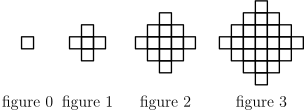
Figures and consist of and nonoverlapping unit squares, respectively. If the pattern were continued, how many nonoverlapping unit squares would there be in figure
Respuesta: C
Pista pequeña:
Cada figura es un rombo cuyas filas son los números impares que suben y luego bajan.
Each figure is a diamond whose rows are the odd numbers up and back down
Pista grande:
La figura tiene cuadrados unitarios.
Figure has unit squares
Solución:
La figura es un rombo cuyas longitudes de fila aumentan a lo largo de los números impares y luego disminuyen, dando un total de cuadrados unitarios. Esto coincide con para .
Por lo tanto, la figura tiene cuadrados unitarios.
Por lo tanto, la respuesta correcta es C.
Figure is a diamond whose row lengths increase through the odd numbers and back down, giving a total of unit squares. This matches for
Therefore figure has unit squares.
Thus, the correct answer is C.
9.
La señora Walter tomó un examen en una clase de matemáticas de cinco estudiantes. Introdujo las calificaciones en orden aleatorio en una hoja de cálculo, que recalculaba el promedio de la clase después de introducir cada calificación. La señora Walter notó que, después de introducir cada calificación, el promedio siempre era un entero. Las calificaciones (en orden ascendente) eran y ¿Cuál fue la última calificación que introdujo la señora Walter?
Mrs. Walter gave an exam in a mathematics class of five students. She entered the scores in random order into a spreadsheet, which recalculated the class average after each score was entered. Mrs. Walter noticed that after each score was entered, the average was always an integer. The scores (listed in ascending order) were and What was the last score Mrs. Walter entered?
Respuesta: C
Pista pequeña:
La suma de las primeras calificaciones introducidas debe ser divisible por .
The sum of the first scores entered must be divisible by
Pista grande:
Usa la divisibilidad por y luego por ; los residuos de las calificaciones módulo son .
Use divisibility by then by ; the residues of the scores modulo are
Solución:
El total es que es divisible por La suma de las tres primeras calificaciones debe ser divisible por
Módulo las calificaciones son La única terna cuya suma es múltiplo de es así que estas son las tres primeras (con en tercer lugar, ya que las dos primeras, y deben tener la misma paridad).
Como la cuarta calificación debe ser que es Eso deja como la última calificación introducida.
Por lo tanto, la respuesta correcta es C.
The total is which is divisible by The sum of the first three scores must be divisible by
Modulo the scores are The only triple summing to a multiple of is so these are the first three (with third, since the first two, and must have equal parity).
Since the fourth score must be which is That leaves as the last score entered.
Thus, the correct answer is C.
10.
El punto se refleja en el plano , luego su imagen se rota alrededor del eje para producir y finalmente, se traslada unidades en la dirección positiva de para producir ¿Cuáles son las coordenadas de ?
The point is reflected in the -plane, then its image is rotated by about the -axis to produce and finally, is translated by units in the positive direction to produce What are the coordinates of
Respuesta: E
Pista pequeña:
Reflejar en el plano cambia el signo de la coordenada .
Reflecting in the -plane negates the -coordinate
Pista grande:
Un giro de alrededor del eje cambia el signo tanto de la coordenada como de la .
A turn about the -axis negates both the - and -coordinates
Solución:
Reflejar en el plano da
Rotar alrededor del eje cambia el signo de y dando
Trasladar unidades en la dirección positiva de da
Por lo tanto, la respuesta correcta es E.
Reflecting in the -plane gives
Rotating about the -axis negates and giving
Translating units in the positive direction gives
Thus, the correct answer is E.
11.
Dos números reales no nulos, y satisfacen Halla un valor posible de
Two non-zero real numbers, and satisfy Find a possible value of
Respuesta: E
Pista pequeña:
Combina sobre un denominador común: .
Combine over a common denominator:
Pista grande:
Sustituye por en el numerador y desarrolla.
Replace with in the numerator and expand
Solución:
Al combinar sobre un denominador común,
Al sustituir por en el numerador,
Por lo tanto, la expresión es igual a
Por lo tanto, la respuesta correcta es E.
Combining over a common denominator,
Replacing with in the numerator,
Therefore the expression equals
Thus, the correct answer is E.
12.
Sean y enteros no negativos tales que ¿Cuál es el valor máximo de
Let and be nonnegative integers such that What is the maximum value of
Respuesta: E
Pista pequeña:
Observa que .
Pista grande:
Los tres factores suman así que su producto es mayor cuando son iguales.
The three factors sum to so their product is largest when they are equal
Solución:
Observa que
Como esto es igual a Los tres factores suman así que su producto se maximiza cuando cada uno es igual a dando
El valor máximo es
Por lo tanto, la respuesta correcta es E.
Observe that
Since this equals The three factors sum to so their product is maximized when each equals giving
The maximum value is
Thus, the correct answer is E.
13.
Una mañana, cada miembro de la familia de Angela bebió una mezcla de onzas de café con leche. Las cantidades de café y de leche variaban de taza en taza, pero nunca eran cero. Angela bebió un cuarto de la cantidad total de leche y un sexto de la cantidad total de café. ¿Cuántas personas hay en la familia?
One morning each member of Angela’s family drank an -ounce mixture of coffee with milk. The amounts of coffee and milk varied from cup to cup, but were never zero. Angela drank a quarter of the total amount of milk and a sixth of the total amount of coffee. How many people are in the family?
Respuesta: C
Pista pequeña:
Supón que la propia taza de Angela contiene unidades de café y unidades de leche con .
Suppose Angela’s own cup contains units of coffee and units of milk with
Pista grande:
Entonces el total de la familia es de café y de leche, así que el número de personas es .
Then the family total is coffee and milk, so the number of people is
Solución:
Medimos las cantidades en tazas de onzas, así que la taza de Angela contiene de café y de leche con
Como Angela bebió un sexto del café, el café total es ; como bebió un cuarto de la leche, la leche total es El número de personas es igual al número total de tazas,
Esto es un entero solo cuando es un entero, y como esto obliga a dando personas.
Por lo tanto, la respuesta correcta es C.
Measure amounts in -ounce cups, so Angela’s cup holds coffee and milk with
Since Angela drank a sixth of the coffee, the total coffee is ; since she drank a quarter of the milk, the total milk is The number of people equals the total number of cups,
This is an integer only when is an integer, and since this forces giving people.
Thus, the correct answer is C.
14.
Cuando la media, la mediana y la moda de la lista
se ordenan de manera creciente, forman una progresión aritmética no constante. ¿Cuál es la suma de todos los valores reales posibles de ?
When the mean, median, and mode of the list
are arranged in increasing order, they form a non-constant arithmetic progression. What is the sum of all possible real values of
Respuesta: E
Pista pequeña:
La moda es y la media es .
The mode is and the mean is
Pista grande:
Divide en casos según dónde caiga respecto a los otros números, y exige que la progresión sea no constante.
Split into cases by where falls relative to the other numbers, and require a non-constant progression
Solución:
Los seis números fijos suman así que la media es y la moda es Si entonces es a la vez mediana y moda, lo que obliga a una progresión constante, así que
Caso : la mediana es Exigir que formen una progresión aritmética da como el único valor en este rango.
Caso : la mediana es y la progresión obliga a que la media sea así que dando
La suma de todos los valores posibles es
Por lo tanto, la respuesta correcta es E.
The six fixed numbers sum to so the mean is and the mode is If then is both median and mode, forcing a constant progression, so
Case : the median is Requiring to form an arithmetic progression yields as the only value in this range.
Case : the median is and the progression forces the mean to be so giving
The sum of all possible values is
Thus, the correct answer is E.
15.
Sea una función para la cual Halla la suma de todos los valores de para los cuales
Let be a function for which Find the sum of all values of for which
Respuesta: B
Pista pequeña:
Para evaluar haz de modo que .
To evaluate set so
Pista grande:
Esto da una cuadrática en ; usa la fórmula de la suma de raíces .
This gives a quadratic in ; use the sum-of-roots formula
Solución:
Al hacer obtenemos así que
Esto se reordena a
Por la fórmula de la suma de raíces, la suma de los valores de es
Por lo tanto, la respuesta correcta es B.
Setting gives so
This rearranges to
By the sum-of-roots formula, the sum of the values of is
Thus, the correct answer is B.
16.
Un tablero de ajedrez de filas y columnas tiene un número escrito en cada casilla, empezando en la esquina superior izquierda, de modo que la primera fila se numera la segunda fila y así sucesivamente hacia abajo del tablero. Si el tablero se renumera de modo que la columna izquierda, de arriba abajo, sea la segunda columna y así sucesivamente a lo ancho del tablero, algunas casillas tienen los mismos números en ambos sistemas de numeración. Halla la suma de los números de estas casillas (bajo cualquiera de los sistemas).
A checkerboard of rows and columns has a number written in each square, beginning in the upper left corner, so that the first row is numbered the second row and so on down the board. If the board is renumbered so that the left column, top to bottom, is the second column and so on across the board, some squares have the same numbers in both numbering systems. Find the sum of the numbers in these squares (under either system).
Respuesta: D
Pista pequeña:
La casilla en la fila columna se numera originalmente y después.
The square in row column is numbered originally and after
Pista grande:
Igualar las dos expresiones da ; halla todos los válidos.
Setting the two expressions equal gives ; find all valid
Solución:
La casilla se numera originalmente y tras la renumeración. Igualarlos da
Las soluciones con y son y
Estas casillas contienen los números y cuya suma es
Por lo tanto, la respuesta correcta es D.
The square is numbered originally and after renumbering. Setting these equal gives
The solutions with and are and
These squares hold the numbers and whose sum is
Thus, the correct answer is D.
17.
Una circunferencia con centro en tiene radio y contiene al punto El segmento es tangente a la circunferencia en y Si el punto está en y biseca ¿cuánto vale ?
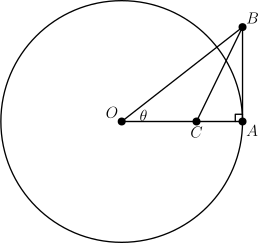
A circle centered at has radius and contains the point Segment is tangent to the circle at and If point lies on and bisects then what is
Respuesta: D
Pista pequeña:
Como y tenemos y .
Since and we have and
Pista grande:
La bisectriz da y .
The bisector gives and
Solución:
Como y es tangente en el ángulo es recto, así que
Como biseca el teorema de la bisectriz da Usando
Al multiplicar numerador y denominador por obtenemos
Por lo tanto, la respuesta correcta es D.
Because and is tangent at angle is right, so
Since bisects the angle bisector theorem gives Using
Multiplying numerator and denominator by gives
Thus, the correct answer is D.
18.
En el año el día del año es un martes. En el año el día también es un martes. ¿En qué día de la semana cayó el día del año ?
In year the th day of the year is a Tuesday. In year the th day is also a Tuesday. On what day of the week did the th day of year occur?
jueves
Thursday
viernes
Friday
sábado
Saturday
domingo
Sunday
lunes
Monday
Respuesta: A
Pista pequeña:
Dos fechas caen en el mismo día de la semana exactamente cuando el número de días entre ellas es un múltiplo de .
Two dates fall on the same weekday exactly when the number of days between them is a multiple of
Pista grande:
Usa los dos martes dados para decidir cuál de es un año bisiesto.
Use the two given Tuesdays to decide which of is a leap year
Solución:
Desde el día del año hasta el día del año el número de días es si no es un año bisiesto. Pero lo que caería en un lunes, no en un martes.
Así que el año es bisiesto, y la diferencia es de días, dando un martes como se indica. Se sigue que el año no es bisiesto.
El día del año precede al martes del día del año en días. Como ese día es días de la semana antes del martes, es decir, jueves.
Por lo tanto, la respuesta correcta es A.
From day of year to day of year the number of days is if is not a leap year. But which would land on a Monday, not a Tuesday.
So year is a leap year, and the gap is days, giving a Tuesday as stated. It follows that year is not a leap year.
The th day of year precedes the Tuesday on day of year by days. Since that day is weekdays before Tuesday, namely Thursday.
Thus, the correct answer is A.
19.
En el triángulo y Sea el punto medio de y sea la intersección de con la bisectriz del ángulo ¿Cuál de los siguientes está más cerca del área del triángulo ?
In triangle and Let denote the midpoint of and let denote the intersection of with the bisector of angle Which of the following is closest to the area of triangle
Respuesta: C
Pista pequeña:
Por la fórmula de Herón, el área de es así que la altura desde hasta es .
By Heron’s formula the area of is so the altitude from to is
Pista grande:
está a distancia de ; el pie de la bisectriz satisface .
is at distance from ; the bisector foot satisfies
Solución:
Por la fórmula de Herón, el área de es así que la altura desde hasta es
El punto medio está a de La bisectriz desde corta a en con así que
Tanto como están sobre así que tiene base y altura dando un área de
Por lo tanto, la respuesta correcta es C.
By Heron’s formula, the area of is so the altitude from to is
The midpoint is from The bisector from meets at with so
Both and lie on so has base and altitude giving area
Thus, the correct answer is C.
20.
Si y son números positivos que satisfacen y ¿cuánto vale ?
If and are positive numbers satisfying and then what is
Respuesta: B
Pista pequeña:
Suma las tres ecuaciones y, por separado, multiplica las tres.
Add the three equations, and separately multiply all three together
Pista grande:
Al desarrollar el producto se obtiene más la suma que ya calculaste.
Expanding the product produces plus the sum you already computed
Solución:
Al sumar las tres ecuaciones se obtiene
Al multiplicarlas se obtiene
Al desarrollar el producto, El grupo central es la suma así que
Por lo tanto así que .
Por lo tanto, la respuesta correcta es B.
Adding the three equations gives
Multiplying them gives
Expanding the product, The middle group is the sum so
Hence so
Thus, the correct answer is B.
21.
Por un punto en la hipotenusa de un triángulo rectángulo se trazan rectas paralelas a los catetos del triángulo, de modo que el triángulo queda dividido en un cuadrado y dos triángulos rectángulos más pequeños. El área de uno de los dos triángulos rectángulos pequeños es veces el área del cuadrado. ¿Cuál es la razón entre el área del otro triángulo rectángulo pequeño y el área del cuadrado?
Through a point on the hypotenuse of a right triangle, lines are drawn parallel to the legs of the triangle so that the triangle is divided into a square and two smaller right triangles. The area of one of the two small right triangles is times the area of the square. What is the ratio of the area of the other small right triangle to the area of the square?
Respuesta: D
Pista pequeña:
Sea el cuadrado de lado ; un triángulo pequeño tiene un cateto a lo largo del cuadrado, así que su área es .
Let the square have side ; one small triangle has a leg along the square, so its area is
Pista grande:
Los dos triángulos pequeños son semejantes, así que el cateto correspondiente del otro triángulo es .
The two small triangles are similar, so the other triangle’s matching leg is
Solución:
Sea el cuadrado de lado El triángulo pequeño que comparte un lado del cuadrado tiene un cateto perpendicular así que su área es dando
Los dos triángulos pequeños son semejantes, así que el cateto del otro triángulo a lo largo del cuadrado es y su área es
Por lo tanto, la respuesta correcta es D.
Let the square have side The small triangle sharing one side of the square has a perpendicular leg so its area is giving
The two small triangles are similar, so the other triangle’s leg along the square is and its area is
Thus, the correct answer is D.
22.
La gráfica de abajo muestra una parte de la curva definida por el polinomio de cuarto grado ¿Cuál de los siguientes es el menor?
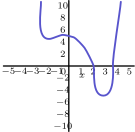
The graph below shows a portion of the curve defined by the quartic polynomial Which of the following is the smallest?
El producto de los ceros de
The product of the zeros of
El producto de los ceros no reales de
The product of the non-real zeros of
La suma de los coeficientes de
The sum of the coefficients of
La suma de los ceros reales de
The sum of the real zeros of
Respuesta: C
Pista pequeña:
La gráfica muestra exactamente dos ceros reales, ambos positivos, así que tiene dos ceros no reales (conjugados).
The graph shows exactly two real zeros, both positive, so has two non-real (conjugate) zeros
Pista grande:
El producto de todos los ceros es igual a la intersección con el eje ; divídelo entre el producto de los ceros reales.
The product of all zeros equals the -intercept; divide it by the product of the real zeros
Solución:
La gráfica cruza el eje exactamente dos veces, ambas en valores positivos, así que tiene dos ceros reales y dos ceros no reales (complejos conjugados).
Leyendo de la gráfica: la suma de los coeficientes es la suma de los ceros reales es mayor que y el producto de todos los ceros es la intersección con el eje , que es menor que
Sea el producto de los ceros reales, así que El producto de los ceros no reales es que es menor que
Esto es menor que todas las demás cantidades listadas.
Por lo tanto, la respuesta correcta es C.
The graph crosses the -axis exactly twice, both times at positive values, so has two real zeros and two non-real (complex conjugate) zeros.
Reading off the graph: the sum of the coefficients is the sum of the real zeros is greater than and the product of all zeros is the -intercept, which is less than
Let be the product of the real zeros, so The product of the non-real zeros is which is less than
This is smaller than every other listed quantity.
Thus, the correct answer is C.
23.
El profesor Gamble compra un billete de lotería, que requiere que elija seis enteros distintos del al inclusive. Elige sus números de modo que la suma de los logaritmos en base diez de sus seis números sea un entero. Resulta que los enteros del billete ganador tienen la misma propiedad: la suma de sus logaritmos en base diez es un entero. ¿Cuál es la probabilidad de que el profesor Gamble tenga el billete ganador?
Professor Gamble buys a lottery ticket, which requires that he pick six different integers from through inclusive. He chooses his numbers so that the sum of the base-ten logarithms of his six numbers is an integer. It so happens that the integers on the winning ticket have the same property -- the sum of the base-ten logarithms is an integer. What is the probability that Professor Gamble holds the winning ticket?
Respuesta: B
Pista pequeña:
La suma de los logaritmos es un entero exactamente cuando el producto de los seis números es una potencia de .
The sum of logarithms is an integer exactly when the product of the six numbers is a power of
Pista grande:
Solo pueden aparecer números de la forma ; equilibra el total de factores de y de .
Only numbers of the form can appear; balance the total factors of and
Solución:
La suma de los logaritmos es un entero exactamente cuando el producto de los seis números es Como cada número elegido debe tener la forma así que debe pertenecer a
Para cada uno, registremos el exceso de factores de sobre factores de : El producto es una potencia de solo si los seis valores elegidos tienen el mismo total de factores y , es decir, si los excesos suman
Los únicos excesos negativos son para y para Un billete de seis números con exceso total debe contener ambos; si faltara uno, no habría suficientes ceros y excesos positivos pequeños para completar seis números. Los otros cuatro números deben sumar un exceso de Hay dos números con exceso (), dos con exceso () y dos con exceso (); cualquier exceso de al menos dejaría muy pocos ceros para completar cuatro números. Debemos tomar ambos números de exceso , uno de exceso y uno de exceso . Esto da exactamente cuatro billetes válidos: y
El profesor Gamble tiene uno de estos cuatro, y solo uno coincide con el billete ganador, por lo que la probabilidad es
Por lo tanto, la respuesta correcta es B.
The sum of the logarithms is an integer exactly when the product of the six numbers is Since each chosen number must be of the form so it comes from
For each, record the excess of factors of over factors of : The product is a power of only if the six chosen values have equal totals of s and s, i.e. their excesses sum to
The only negative excesses are for and for A six-number ticket with total excess must contain both: omitting either leaves too few zero and small positive excesses to reach six numbers. The other four numbers must therefore have total excess There are two numbers of excess (), two of excess (), and two of excess (); any number of excess at least would leave too few zeros to complete a four-number selection. Thus we must take both excess- numbers, one excess- number, and one excess- number. This gives exactly four valid tickets: and
Professor Gamble holds one of these four, and only one matches the winning ticket, so the probability is
Thus, the correct answer is B.
24.
Si los arcos circulares y tienen centros en y respectivamente, entonces existe un círculo tangente tanto al arco como al arco y a Si la longitud del arco es ¿cuál es la circunferencia del círculo?
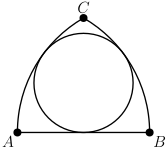
If circular arcs and have centers at and respectively, then there exists a circle tangent to both arc and arc and to If the length of arc is then what is the circumference of the circle?
Respuesta: D
Pista pequeña:
Ambos arcos tienen radio y está a distancia tanto de como de así que es equilátero.
Both arcs have radius and is at distance from both and so is equilateral
Pista grande:
Usa la potencia de un punto en con para hallar el radio del círculo pequeño .
Use Power of a Point at with to find the small circle’s radius
Solución:
Cada arco tiene radio y está a distancia tanto de como de así que es equilátero. Por lo tanto, el arco subtiende de un círculo de radio cuya circunferencia completa es
Sea el círculo pequeño de radio que toca en su punto medio donde Por la potencia de un punto, así que dando y por lo tanto
Las circunferencias están en la razón de los radios, así que la circunferencia del círculo pequeño es .
Por lo tanto, la respuesta correcta es D.
Each arc has radius and is at distance from both and so is equilateral. Thus arc subtends of a circle of radius whose full circumference is
Let the small circle have radius and touch at its midpoint where By Power of a Point, so giving hence
The circumferences are in the ratio of the radii, so the small circle’s circumference is
Thus, the correct answer is D.
25.
Ocho triángulos equiláteros congruentes, cada uno de un color diferente, se usan para construir un octaedro regular. ¿De cuántas maneras distinguibles se puede construir el octaedro? (Dos octaedros coloreados son distinguibles si ninguno se puede rotar para verse exactamente igual que el otro.)
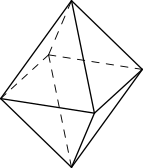
Eight congruent equilateral triangles, each of a different color, are used to construct a regular octahedron. How many distinguishable ways are there to construct the octahedron? (Two colored octahedrons are distinguishable if neither can be rotated to look just like the other.)
Respuesta: E
Pista pequeña:
Hay maneras de colocar los ocho colores distintos antes de tener en cuenta las rotaciones.
There are ways to place the eight distinct colors before accounting for rotations
Pista grande:
El grupo de rotaciones del octaedro tiene elementos, y los colores distintos hacen que cada disposición tenga un estabilizador trivial.
The rotation group of the octahedron has elements, and distinct colors give each arrangement a trivial stabilizer
Solución:
Hay maneras de asignar los ocho colores distintos a las ocho caras. Dos asignaciones dan el mismo octaedro exactamente cuando una es una rotación de la otra.
El grupo de rotaciones de un octaedro regular tiene elementos. Como los ocho colores son diferentes, ninguna rotación no trivial fija una coloración, así que cada octaedro distinguible corresponde a exactamente asignaciones.
Por lo tanto, el número de octaedros distinguibles es
Por lo tanto, la respuesta correcta es E.
There are ways to assign the eight distinct colors to the eight faces. Two assignments give the same octahedron exactly when one is a rotation of the other.
The rotation group of a regular octahedron has elements. Because all eight colors are different, no nontrivial rotation fixes a coloring, so each distinguishable octahedron corresponds to exactly assignments.
Therefore the number of distinguishable octahedrons is
Thus, the correct answer is E.