
Problemas del 1956 AMC 12
¡Desplázate hacia abajo y presiona Iniciar para intentar el examen! O ve al PDF imprimible, la clave de respuestas, o las soluciones profesionales preparadas por LIVE by Po-Shen Loh.
Todos los problemas se usan con el permiso legal oficial de la Mathematical Association of America (MAA).
O salta directamente a un solo problema con su solución: 1 · 2 · 3 · 4 · 5 · 6 · 7 · 8 · 9 · 10 · 11 · 12 · 13 · 14 · 15 · 16 · 17 · 18 · 19 · 20 · 21 · 22 · 23 · 24 · 25 · 26 · 27 · 28 · 29 · 30 · 31 · 32 · 33 · 34 · 35 · 36 · 37 · 38 · 39 · 40 · 41 · 42 · 43 · 44 · 45 · 46 · 47 · 48 · 49 · 50
¿Quieres aprender de forma profesional con clases interactivas en video?
Con tiempo
1:15:00
1.
El valor de cuando es:
The value of when is:
Respuesta: A
Pista pequeña:
Evalúa la potencia antes de hacer la multiplicación
Evaluate the exponent before doing the multiplication
Pista grande:
Para el segundo término es
At the second term is
Solución:
Al sustituir y evaluar primero la potencia, se obtiene
Por lo tanto, la respuesta correcta es A.
Substituting and evaluating the exponent first, gives
Thus, the correct answer is A.
2.
El Sr. Jones vendió dos pipas a cada una. Con respecto al costo, obtuvo una ganancia del en una y, en la otra, una pérdida del En la venta de las pipas:
Mr. Jones sold two pipes at each. Based on the cost his profit on one was and his loss on the other was On the sale of the pipes, he:
quedó a mano
broke even
perdió ¢
lost ¢
ganó ¢
gained ¢
perdió ¢
lost ¢
ganó ¢
gained ¢
Respuesta: D
Pista pequeña:
Recupera cada costo dividiendo el precio de venta entre o
Recover each cost by dividing the sale price by or
Pista grande:
Compara el costo total con el precio de venta total de
Compare the combined cost with the combined selling price of
Solución:
La pipa vendida con una ganancia del costó mientras que la vendida con una pérdida del costó Su costo total fue de pero se vendieron por así que el Sr. Jones perdió centavos.
Por lo tanto, la respuesta correcta es D.
The pipe sold at a profit cost while the pipe sold at a loss cost Their combined cost was but they sold for so Mr. Jones lost cents.
Thus, the correct answer is D.
3.
La distancia que recorre la luz en un año es aproximadamente millas. La distancia que recorre en años es:
The distance light travels in one year is approximately miles. The distance light travels in years is:
millas
miles
millas
miles
millas
miles
millas
miles
millas
miles
Respuesta: D
Pista pequeña:
Multiplicar por desplaza el punto decimal dos lugares a la derecha
Multiplying by moves the decimal point two places to the right
Pista grande:
Reescribe la distancia dada como
Rewrite the given distance as
Solución:
La distancia dada es millas. Al multiplicar por se obtiene millas.
Por lo tanto, la respuesta correcta es D.
The given distance is miles. Multiplying by gives miles.
Thus, the correct answer is D.
4.
Un hombre dispone de para invertir. Invierte al y al Para obtener un ingreso anual de debe invertir el resto al:
A man has to invest. He invests at and at In order to have a yearly income of he must invest the remainder at:
Respuesta: E
Pista pequeña:
Halla primero tanto el capital aún no invertido como el ingreso que todavía necesita
First find both the uninvested principal and the income still needed
Pista grande:
Las dos primeras inversiones producen y al año
The first two investments earn and per year
Solución:
La cantidad que queda por invertir es Las dos primeras inversiones producen dólares, así que la inversión restante debe producir dólares. La tasa necesaria es
Por lo tanto, la respuesta correcta es E.
The amount left to invest is The first two investments earn dollars, so the remaining investment must earn dollars. Its required rate is
Thus, the correct answer is E.
5.
Se coloca una moneda de cinco centavos sobre una mesa. El número de monedas de cinco centavos que pueden colocarse a su alrededor, cada una tangente a ella y a otras dos, es:
A nickel is placed on a table. The number of nickels which can be placed around it, each tangent to it and to two others is:
Respuesta: C
Pista pequeña:
Une el centro de la moneda central con los centros de dos monedas vecinas
Join the center of the middle nickel to the centers of two neighboring nickels
Pista grande:
Esos tres círculos iguales y mutuamente tangentes forman un triángulo equilátero de centros
Those three mutually tangent equal circles make an equilateral triangle of centers
Solución:
Los centros de la moneda central y de dos monedas vecinas cualesquiera están separados entre sí por dos radios, de modo que forman un triángulo equilátero. Por lo tanto, dos centros exteriores consecutivos subtienden en el centro de la moneda central. Caben exactamente monedas a su alrededor.
Por lo tanto, la respuesta correcta es C.
The centers of the middle nickel and any two neighboring nickels are pairwise two radii apart, so they form an equilateral triangle. Therefore consecutive outer centers subtend at the center of the middle nickel. Exactly nickels fit around it.
Thus, the correct answer is C.
6.
En un grupo de vacas y gallinas, el número de patas era mayor que el doble del número de cabezas. El número de vacas era:
In a group of cows and chickens, the number of legs was more than twice the number of heads. The number of cows was:
Respuesta: B
Pista pequeña:
El doble del número de cabezas ya cuenta dos patas por animal
Twice the number of heads already accounts for two legs per animal
Pista grande:
Cada vaca aporta dos patas adicionales por encima de esa base
Each cow contributes two additional legs beyond that baseline
Solución:
Contar dos patas por cada cabeza incluye las dos patas de cada gallina y dos de las cuatro patas de cada vaca. Así, cada vaca aporta exactamente dos de las patas adicionales. Por consiguiente, el número de vacas es
Por lo tanto, la respuesta correcta es B.
Counting two legs for every head accounts for both legs of each chicken and two of each cow’s four legs. Thus every cow contributes exactly two of the extra legs. Hence the number of cows is
Thus, the correct answer is B.
7.
Las raíces de la ecuación serán recíprocas si:
The roots of the equation will be reciprocal if:
Respuesta: C
Pista pequeña:
Si las raíces son y las raíces recíprocas satisfacen
If the roots are and reciprocal roots satisfy
Pista grande:
Usa la fórmula de Vieta
Use Vieta’s formula
Solución:
Por las fórmulas de Vieta, el producto de las dos raíces es Las raíces recíprocas tienen producto así que lo que exige
Por lo tanto, la respuesta correcta es C.
By Vieta’s formulas, the product of the two roots is Reciprocal roots have product so which requires
Thus, the correct answer is C.
8.
Si entonces, cuando
If then, when
Respuesta: B
Pista pequeña:
Sustituye en el exponente de
Substitute into the exponent on
Pista grande:
Escribe como
Write as
Solución:
Cuando el lado derecho es Por lo tanto, de modo que y
Por lo tanto, la respuesta correcta es B.
When the right side is Therefore so and
Thus, the correct answer is B.
9.
Simplifica el resultado es:
Simplify the result is:
Respuesta: D
Pista pequeña:
Sustituye cada raíz -ésima por un exponente de
Replace each th root by an exponent of
Pista grande:
Cada corchete tiene exponente
Each bracket has exponent
Solución:
En cada uno de los dos factores, las raíces anidadas y la cuarta potencia exterior multiplican el exponente de por Por tanto, cada factor es y su producto es
Por lo tanto, la respuesta correcta es D.
For each of the two factors, the nested roots and outer fourth power multiply the exponent of by Thus each factor is and their product is
Therefore, the correct answer is D.
10.
Un círculo de radio pulgadas tiene su centro en el vértice de un triángulo equilátero y pasa por los otros dos vértices. El lado prolongado a través de corta el círculo en El número de grados del ángulo es:
A circle of radius inches has its center at the vertex of an equilateral triangle and passes through the other two vertices. The side extended through intersects the circle at The number of degrees of angle is:
Respuesta: B
Pista pequeña:
Los radios y forman un ángulo central de
The radii and form a central angle
Pista grande:
El ángulo es un ángulo inscrito que subtiende el arco menor
Angle is an inscribed angle intercepting the minor arc
Solución:
Como es equilátero, el ángulo central mide El ángulo inscrito subtiende el mismo arco menor por lo que su medida es la mitad del ángulo central:
Por lo tanto, la respuesta correcta es B.
Since is equilateral, the central angle is The inscribed angle intercepts the same minor arc so its measure is half the central angle:
Thus, the correct answer is B.
11.
La expresión es igual a:
The expression equals:
Respuesta: A
Pista pequeña:
Combina los dos términos fraccionarios sobre
Combine the two fractional terms over
Pista grande:
El producto de los denominadores conjugados es
The product of the conjugate denominators is
Solución:
Al combinar los términos fraccionarios, Al sumar el inicial se obtiene
Por lo tanto, la respuesta correcta es A.
Combining the fractional terms, Adding the initial gives
Thus, the correct answer is A.
12.
Si se divide entre el cociente es:
If is divided by the quotient is:
Respuesta: E
Pista pequeña:
Reescribe como
Rewrite as
Pista grande:
Factoriza usando
Factor
Solución:
Donde el cociente está definido,
Por lo tanto, la respuesta correcta es E.
Where the quotient is defined,
Thus, the correct answer is E.
13.
Dados dos enteros positivos y con El porcentaje en que es menor que es:
Given two positive integers and with The percent that is less than is:
Respuesta: C
Pista pequeña:
La cantidad en que es menor es
The amount by which is smaller is
Pista grande:
Como la comparación se hace con usa como denominador
Because the comparison is to use as the denominator
Solución:
La diferencia es Medida como fracción del valor de referencia es Multiplicar por convierte la fracción en un porcentaje:
Por lo tanto, la respuesta correcta es C.
The difference is Measured as a fraction of the reference value this is Multiplying by converts the fraction to a percent:
Thus, the correct answer is C.
14.
Los puntos y están sobre un círculo La recta tangente en y la secante se cortan en con entre y Si y entonces es igual a:
The points and are on a circle The tangent line at and the secant intersect at lying between and If and then equals:
Respuesta: B
Pista pequeña:
Usa
Use
Pista grande:
Si entonces
If then
Solución:
Sea Como está entre y tenemos El teorema de la tangente y la secante da Por tanto, o bien Una longitud es positiva, así que
Por lo tanto, la respuesta correcta es B.
Let Since lies between and we have The tangent-secant theorem gives Thus or A length is positive, so
Therefore, the correct answer is B.
15.
La raíz o las raíces de son:
The root(s) of is (are):
y
and
solamente
only
y
and
solamente
only
Respuesta: A
Pista pequeña:
La ecuación original exige
The original equation requires
Pista grande:
Multiplica toda la ecuación por y reúne términos
Multiply through by and collect terms
Solución:
Para multiplicar por da Por tanto, así que Tanto como satisfacen la restricción del dominio.
Por lo tanto, la respuesta correcta es A.
For multiplying by gives Hence so Both and satisfy the domain restriction.
Thus, the correct answer is A.
16.
La suma de tres números es La razón del primero al segundo es y la razón del segundo al tercero es El segundo número es:
The sum of three numbers is The ratio of the first to the second is and the ratio of the second to the third is The second number is:
Respuesta: C
Pista pequeña:
Elige una escala común para que los tres números tengan razón
Choose a common scaling so the three numbers have ratio
Pista grande:
Esas partes de la razón suman
Those ratio parts add to
Solución:
La razón del primero al segundo y la del segundo al tercero se combinan para dar la razón entre los tres números Las partes totales equivalen a por lo que cada parte vale El segundo número es
Por lo tanto, la respuesta correcta es C.
The first-to-second ratio and second-to-third ratio combine to give the three-number ratio The total parts equal so each part is The second number is
Thus, the correct answer is C.
17.
La fracción se obtuvo sumando las fracciones y Los valores de y deben ser, respectivamente:
The fraction was obtained by adding the two fractions and The values of and must be, respectively:
Respuesta: D
Pista pequeña:
Factoriza
Factor
Pista grande:
Después de combinar las dos fracciones, iguala coeficientes en
After combining the two fractions, match coefficients in
Solución:
Al combinar las fracciones parciales propuestas se obtiene Al igualar su numerador con resulta Al resolver se obtiene y
Por lo tanto, la respuesta correcta es D.
Combining the proposed partial fractions gives Matching its numerator with yields Solving gives and
Thus, the correct answer is D.
18.
Si entonces es igual a:
If then equals:
Respuesta: E
Pista pequeña:
Escribe como
Write as
Pista grande:
La cantidad es positiva
The quantity is positive
Solución:
Tenemos Como es positivo, Al tomar el recíproco se obtiene
Por lo tanto, la respuesta correcta es E.
We have Since is positive, Taking the reciprocal gives
Thus, the correct answer is E.
19.
Se encienden al mismo tiempo dos velas de la misma altura. La primera se consume en horas y la segunda en horas. Suponiendo que cada vela arde a velocidad constante, ¿cuántas horas después de encenderlas tenía la primera el doble de altura que la segunda?
Two candles of the same height are lighted at the same time. The first is consumed in hours and the second in hours. Assuming that each candle burns at a constant rate, in how many hours after being lighted was the first candle twice the height of the second?
h
hr.
h
hr.
h
hr.
h
hr.
h
hr.
Respuesta: D
Pista pequeña:
Escala la altura inicial común a
Scale the common initial height to
Pista grande:
Después de horas, las fracciones restantes son y
After hours the remaining fractions are and
Solución:
Sea la altura inicial de cada vela. Después de horas, las alturas restantes son y La condición requerida es Al multiplicar por se obtiene de modo que y
Por lo tanto, la respuesta correcta es D.
Let each initial height be After hours the remaining heights are and The required condition is Multiplying by gives so and
Thus, the correct answer is D.
20.
Si y entonces el valor de redondeado a la décima más cercana, es:
If and then the value of to the nearest tenth is:
Respuesta: C
Pista pequeña:
Toma logaritmos comunes en ambos lados
Take common logarithms of both sides
Pista grande:
Usa
Use
Solución:
Al tomar logaritmos comunes se obtiene Como Redondeado a la décima más cercana, es
Por lo tanto, la respuesta correcta es C.
Taking common logarithms gives Since To the nearest tenth, this is
Thus, the correct answer is C.
21.
Si cada una de dos rectas que se cortan intersecta una hipérbola y ninguna es tangente a ella, entonces el número posible de puntos de intersección con la hipérbola es:
If each of two intersecting lines intersects a hyperbola and neither line is tangent to the hyperbola, then the possible number of points of intersection with the hyperbola is:
o
or
o
or
o
or
o
or
Respuesta: E
Pista pequeña:
Una recta no tangente que intersecta una hipérbola puede cortarla en uno o dos puntos
A non-tangent line that intersects a hyperbola can meet it in either one or two points
Pista grande:
Las dos rectas pueden compartir un punto de la hipérbola, pues ellas mismas se cortan
The two lines may share one hyperbola point, since the lines themselves intersect
Solución:
Una recta puede cortar una hipérbola en un solo punto finito, cuando su dirección es paralela a una asíntota, o en dos puntos finitos. Si se eligen las dos rectas de modo que sus conjuntos de intersecciones finitas con la hipérbola sean disjuntos, pueden aportar o intersecciones distintas. Si el punto donde se cortan las dos rectas pertenece a la hipérbola, ese punto se cuenta una sola vez.
Por lo tanto, son posibles o y la respuesta correcta es E.
A line can meet a hyperbola in either one finite point, when its direction is parallel to an asymptote, or two finite points. By choosing the two lines so that their finite intersection sets on the hyperbola are disjoint, they can therefore contribute or distinct intersections. If their own intersection lies on the hyperbola, one point is shared instead.
Thus, or are possible, and the correct answer is E.
22.
Jones recorrió millas en su primer viaje. En otro viaje recorrió millas a una velocidad tres veces mayor. Comparado con el tiempo anterior, el nuevo tiempo fue:
Jones covered a distance of miles on his first trip. On a later trip he traveled miles while going three times as fast. His new time compared with the old time was:
tres veces mayor
three times as much
el doble
twice as much
el mismo
the same
la mitad
half as much
un tercio
a third as much
Respuesta: B
Pista pequeña:
Escribe cada tiempo de viaje como distancia dividida entre velocidad
Write each travel time as distance divided by speed
Pista grande:
Si la velocidad anterior es compara con
If the old speed is compare with
Solución:
Si la primera velocidad fue el tiempo anterior fue El tiempo posterior fue Por tanto, el nuevo tiempo fue el doble del anterior.
La respuesta correcta es B.
If the first speed was the old time was The later time was Thus the new time was twice the old time.
The correct answer is B.
23.
De la ecuación donde y son constantes reales, se nos dice que el discriminante es cero. Las raíces son necesariamente:
About the equation with and real constants, we are told that the discriminant is zero. The roots are necessarily:
iguales y enteras
equal and integral
iguales y racionales
equal and rational
iguales y reales
equal and real
iguales e irracionales
equal and irrational
iguales e imaginarias
equal and imaginary
Respuesta: C
Pista pequeña:
Un discriminante cero hace coincidir los dos valores de la fórmula cuadrática
A zero discriminant makes the two quadratic-formula values coincide
Pista grande:
La raíz doble es
The repeated root is
Solución:
Una cuadrática con coeficientes reales y discriminante cero tiene la raíz doble Como es un número real no nulo, esta raíz es real. No tiene que ser siempre racional ni siempre irracional.
Por lo tanto, las raíces son necesariamente iguales y reales, así que la respuesta correcta es C.
A quadratic with real coefficients and discriminant zero has the repeated root Since is a nonzero real number, this root is real. It need not always be rational or always be irrational.
Thus, the roots are necessarily equal and real, so the correct answer is C.
24.
En la figura, el ángulo y Entonces el ángulo es igual a:
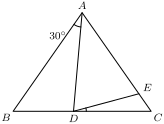
In the figure angle and Then angle equals:
Respuesta: D
Pista pequeña:
Sea y expresa el ángulo de la base en usando el triángulo isósceles
Let and express the base angle at using isosceles triangle
Pista grande:
Usa para expresar y después divide el ángulo llano en
Use to express then split the straight angle at
Solución:
Sea Como y El triángulo da así que Como
Por lo tanto, la respuesta correcta es D.
Let Since and Triangle gives so Since
Thus, the correct answer is D.
25.
La suma de todos los números de la forma donde toma valores enteros de a es:
The sum of all numbers of the form where takes on integral values from to is:
Respuesta: C
Pista pequeña:
Separa en dos sumas
Separate into two sums
Pista grande:
Usa
Use
Solución:
Calculamos
Por lo tanto, la respuesta correcta es C.
We compute
Thus, the correct answer is C.
26.
¿Cuál de las siguientes combinaciones de datos no determina el triángulo indicado?
Which one of the following combinations of given parts does not determine the indicated triangle?
ángulo de la base y ángulo del vértice; triángulo isósceles
base angle and vertex angle; isosceles triangle
ángulo del vértice y base; triángulo isósceles
vertex angle and the base; isosceles triangle
radio del círculo circunscrito; triángulo equilátero
the radius of the circumscribed circle; equilateral triangle
un cateto y el radio del círculo inscrito; triángulo rectángulo
one arm and the radius of the inscribed circle; right triangle
dos ángulos y un lado opuesto a uno de ellos; triángulo escaleno
two angles and a side opposite one of them; scalene triangle
Respuesta: A
Pista pequeña:
Pregunta si cada conjunto de datos fija tanto el tamaño como la forma
Ask whether each set of information fixes scale as well as shape
Pista grande:
Dos ángulos solamente determinan una clase de semejanza si no se proporciona alguna longitud
Two angles determine only a similarity class unless some length is also supplied
Solución:
En un triángulo isósceles, un ángulo de la base y el ángulo del vértice determinan los tres ángulos, pero no se especifica ninguna longitud de lado. Por tanto, triángulos de cualquier tamaño tienen los mismos datos, así que el triángulo no queda determinado. Cada otra opción incluye suficiente información de longitud, directamente o mediante un radio, para fijar tanto el tamaño como la forma.
Por lo tanto, la respuesta correcta es A.
In an isosceles triangle, a base angle and the vertex angle determine all three angles, but no side length is specified. Therefore triangles of every scale have the same given data, so the triangle is not determined. Each other choice includes enough length information, directly or through a radius, to fix the scale as well as the shape.
Thus, the correct answer is A.
27.
Si un ángulo de un triángulo permanece igual, pero cada uno de los dos lados que lo forman se duplica, entonces el área se multiplica por:
If an angle of a triangle remains unchanged but each of its two including sides is doubled, then the area is multiplied by:
más de
more than
Respuesta: C
Pista pequeña:
Usa la fórmula del área para dos lados y el ángulo comprendido
Use the area formula for two sides and their included angle
Pista grande:
Duplicar ambos factores laterales multiplica su producto por
Doubling both side factors multiplies their product by
Solución:
Si los lados comprendidos son y y su ángulo invariable es el área original es Después de duplicar ambos lados, el área es
Por lo tanto, la respuesta correcta es C.
If the included sides are and and their unchanged angle is the original area is After both sides are doubled, the area is
Thus, the correct answer is C.
28.
El Sr. J dejó toda su herencia a su esposa, su hija, su hijo y la cocinera. Su hija y su hijo recibieron la mitad de la herencia, repartida en la razón de a Su esposa recibió el doble que el hijo. Si la cocinera recibió un legado de entonces la herencia completa era:
Mr. J left his entire estate to his wife, his daughter, his son, and the cook. His daughter and son got half the estate, sharing in the ratio of to His wife got twice as much as the son. If the cook received a bequest of then the entire estate was:
Respuesta: D
Pista pequeña:
Sean y las partes de la hija y del hijo
Let the daughter’s and son’s shares be and
Pista grande:
Sus son la mitad de la herencia, mientras que la otra mitad es los de la esposa más
Their is half the estate, while the other half is the wife’s plus
Solución:
Sea lo que recibe la hija y lo que recibe el hijo. Juntos reciben que es la mitad de la herencia. La esposa recibe así que la otra mitad da Por tanto, y la herencia completa es dólares.
Por lo tanto, la respuesta correcta es D.
Let the daughter receive and the son Together they receive which is half the estate. The wife receives so the other half gives Thus and the whole estate is dollars.
Therefore, the correct answer is D.
29.
Los puntos de intersección de y se unen sucesivamente. La figura resultante es:
The points of intersection of and are joined in succession. The resulting figure is:
una recta
a straight line
un triángulo equilátero
an equilateral triangle
un paralelogramo
a parallelogram
un rectángulo
a rectangle
un cuadrado
a square
Respuesta: D
Pista pequeña:
Usa para hallar las posibles sumas
Use to find the possible sums
Pista grande:
Los cuatro puntos de intersección son permutaciones y opuestos de
The four intersection points are permutations and negatives of
Solución:
En un punto de intersección, de modo que Junto con esto da los cuatro puntos En su orden cíclico alrededor del círculo, los vectores de lados adyacentes son perpendiculares, por lo que el cuadrilátero es un rectángulo. Sus lados adyacentes tienen longitudes desiguales, así que no es un cuadrado.
Por lo tanto, la respuesta correcta es D.
At an intersection, so Together with this gives the four points In their cyclic order around the circle, adjacent side vectors are perpendicular, so the quadrilateral is a rectangle. Its adjacent side lengths are unequal, so it is not a square.
Thus, the correct answer is D.
30.
Si la altura de un triángulo equilátero es entonces el área es:
If the altitude of an equilateral triangle is then the area is:
Respuesta: B
Pista pequeña:
Para un lado de longitud un triángulo equilátero tiene altura
For side length an equilateral triangle has altitude
Pista grande:
Una vez conocido usa el área
Once is known, use area
Solución:
Sea la longitud del lado. De obtenemos Por tanto, el área es
Por lo tanto, la respuesta correcta es B.
Let the side length be From we get Hence the area is
Thus, the correct answer is B.
31.
En nuestro sistema de numeración la base es diez. Si se cambiara la base a cuatro, se contaría así: El vigésimo número sería:
In our number system the base is ten. If the base were changed to four you would count as follows: The twentieth number would be:
Respuesta: E
Pista pequeña:
El vigésimo entero positivo representa el valor ordinario
The twentieth positive number represents the ordinary value
Pista grande:
Divide sucesivamente entre o exprésalo usando los valores posicionales y
Divide successively by or express it using the place values and
Solución:
El vigésimo entero positivo tiene valor ordinario Como su representación en base cuatro es
Por lo tanto, la respuesta correcta es E.
The twentieth positive integer has ordinary value Since its base-four representation is
Thus, the correct answer is E.
32.
George y Henry comenzaron una carrera desde extremos opuestos de la piscina. Después de un minuto y medio, se cruzaron en el centro. Si no perdieron tiempo al dar la vuelta y mantuvieron sus respectivas velocidades, ¿cuántos minutos después de comenzar se cruzaron por segunda vez?
George and Henry started a race from opposite ends of the pool. After a minute and a half, they passed each other in the center of the pool. If they lost no time in turning and maintained their respective speeds, how many minutes after starting did they pass each other the second time?
Respuesta: B
Pista pequeña:
Que se encuentren en el centro significa que los dos nadadores tienen la misma velocidad
Meeting at the center means the two swimmers have equal speeds
Pista grande:
Llegan a los extremos opuestos a los minutos, dan la vuelta y cada uno necesita recorrer otra media piscina
They reach the opposite ends at minutes, turn, and need another half-pool each
Solución:
Como partieron simultáneamente de extremos opuestos y se encontraron primero en el centro, sus velocidades son iguales. Cada uno llega al extremo opuesto después de minutos. Dan la vuelta de inmediato y cada uno necesita entonces otros minutos para regresar al centro, donde vuelven a encontrarse. El segundo encuentro ocurre después de minutos.
Por lo tanto, la respuesta correcta es B.
Because they started simultaneously from opposite ends and first met at the center, their speeds are equal. Each reaches the opposite end after minutes. They turn immediately, and each then needs another minutes to return to the center, where they meet again. The second meeting occurs after minutes.
Thus, the correct answer is B.
33.
El número es igual a:
The number is equal to:
una fracción racional
a rational fraction
un decimal finito
a finite decimal
un decimal periódico infinito
an infinite repeating decimal
un decimal infinito no periódico
an infinite non-repeating decimal
Respuesta: E
Pista pequeña:
Recuerda qué clase de desarrollo decimal tiene todo número racional
Recall what kind of decimal expansion every rational number has
Pista grande:
El número es irracional, por lo que su desarrollo decimal no termina ni se repite
The number is irrational, so its decimal neither terminates nor repeats
Solución:
El número es irracional. El desarrollo decimal de un número racional termina o acaba repitiéndose, mientras que el de un número irracional es infinito y no periódico. El decimal finito es solo una aproximación.
Por lo tanto, la respuesta correcta es E.
The number is irrational. A rational number has a decimal expansion that either terminates or eventually repeats, whereas an irrational number has an infinite non-repeating decimal expansion. The finite decimal is only an approximation.
Thus, the correct answer is E.
34.
Si es cualquier entero no negativo, siempre es divisible entre:
If is any whole number, is always divisible by:
cualquier múltiplo de
any multiple of
y
and
Respuesta: A
Pista pequeña:
Factoriza la expresión como
Factor the expression as
Pista grande:
Entre tres enteros consecutivos hay un múltiplo de y los factores aportan al menos dos factores
Among three consecutive integers there is a multiple of and the factors supply at least two powers of
Solución:
Tenemos Entre y uno es divisible entre Si es par, es divisible entre si es impar, tanto como son pares, por lo que su producto es divisible entre Así, la expresión siempre es divisible entre No siempre es divisible entre pues da
Por lo tanto, la respuesta correcta es A.
We have Among and one is divisible by If is even, is divisible by if is odd, both and are even, so their product is divisible by Thus the expression is always divisible by It is not always divisible by since gives
Therefore, the correct answer is A.
35.
Un rombo está formado por dos radios y dos cuerdas de un círculo cuyo radio mide pies. El área del rombo en pies cuadrados es:
A rhombus is formed by two radii and two chords of a circle whose radius is feet. The area of the rhombus in square feet is:
Respuesta: B
Pista pequeña:
Cada lado del rombo mide así que cada cuerda es igual al radio
Every side of the rhombus has length so each chord equals the radius
Pista grande:
Una cuerda igual al radio subtiende un ángulo central de usa
A chord equal to the radius subtends a central angle; use
Solución:
Los cuatro lados del rombo son iguales al radio del círculo, Una cuerda cuya longitud es igual al radio forma un triángulo equilátero con los dos radios que llegan a sus extremos, de modo que el ángulo central comprendido es Por lo tanto, el área del rombo es
Por lo tanto, la respuesta correcta es B.
All four sides of the rhombus equal the circle’s radius, A chord of length equal to the radius forms an equilateral triangle with the two radii to its endpoints, so the included central angle is Therefore the rhombus has area
Thus, the correct answer is B.
36.
Si la suma es un cuadrado perfecto y es menor que entonces los valores posibles de son:
If the sum is a perfect square and if is less than then the possible values for are:
solo
only
y
and
solo
only
y
and
y
and
Respuesta: E
Pista pequeña:
Reescribe como
Rewrite as
Pista grande:
Genera soluciones positivas sucesivas multiplicando por y detente cuando
Generate successive positive solutions by multiplying by stopping when
Solución:
La condición es o bien Las soluciones positivas de esta ecuación de Pell se generan a partir de la solución fundamental Sus primeros pares son Por tanto, los valores con son
Por lo tanto, la respuesta correcta es E.
The condition is or The positive solutions of this Pell equation are generated from the fundamental solution Their first pairs are Thus the values with are
Therefore, the correct answer is E.
37.
En un mapa cuya escala es de millas por pulgada y media, cierta propiedad está representada por un rombo con un ángulo de La diagonal opuesta al ángulo de mide pulgadas. El área de la propiedad en millas cuadradas es:
On a map whose scale is miles to an inch and a half, a certain estate is represented by a rhombus having a angle. The diagonal opposite is in. The area of the estate in square miles is:
Respuesta: E
Pista pequeña:
En un rombo con un ángulo de la diagonal más corta es igual al lado
In a rhombus, the shorter diagonal equals the side length
Pista grande:
La escala es de millas por pulgada; convierte primero el lado de de pulgada antes de hallar el área
The scale is miles per inch, so convert the -inch side before finding area
Solución:
La diagonal opuesta al ángulo de divide el rombo en dos triángulos equiláteros, de modo que su longitud es igual al lado del rombo. La escala del mapa es de millas por pulgada, por lo que la longitud real del lado es millas. Por lo tanto, el área del rombo es
Por lo tanto, la respuesta correcta es E.
The diagonal opposite the angle divides the rhombus into two equilateral triangles, so its length equals the rhombus side. The map scale is miles per inch, hence the actual side length is miles. Therefore the rhombus area is
Thus, the correct answer is E.
38.
En un triángulo rectángulo con catetos y e hipotenusa la altura trazada sobre la hipotenusa es Entonces:
In a right triangle with sides and and hypotenuse the altitude drawn on the hypotenuse is Then:
Respuesta: D
Pista pequeña:
Calcula el área del triángulo usando los catetos o usando la hipotenusa y su altura
Compute the triangle’s area using either the legs or the hypotenuse and its altitude
Pista grande:
A partir de sustituye y divide entre
From substitute and divide by
Solución:
Al igualar las dos fórmulas del área se obtiene así que Al elevar al cuadrado y usar resulta Al dividir entre se obtiene
Por lo tanto, la respuesta correcta es D.
Equating two area formulas gives so Squaring and using yields Dividing by gives
Thus, the correct answer is D.
39.
La hipotenusa y un cateto de un triángulo rectángulo son enteros consecutivos. El cuadrado del otro cateto es:
The hypotenuse and one arm of a right triangle are consecutive integers. The square of the second arm is:
ninguna de las anteriores
none of these
Respuesta: C
Pista pequeña:
Si el otro cateto es entonces
If the second arm is then
Pista grande:
Factoriza la diferencia de cuadrados y usa
Factor the difference of squares and use
Solución:
Por el teorema de Pitágoras, Como y son consecutivos y tenemos Por consiguiente,
Por lo tanto, la respuesta correcta es C.
By the Pythagorean theorem, Since and are consecutive and we have Hence
Thus, the correct answer is C.
40.
Si y entonces es igual a:
If and then equals:
Respuesta: A
Pista pequeña:
Usa la primera ecuación para sustituir en la segunda
Use the first equation to replace in the second
Pista grande:
Saca como factor común después de escribir
Factor after writing
Solución:
De la primera ecuación, Por lo tanto, Al despejar se obtiene
Por lo tanto, la respuesta correcta es A.
From the first equation, Therefore Solving gives
Thus, the correct answer is A.
41.
La ecuación donde es satisfecha por:
The equation where is satisfied by:
ningún valor de
no value of
todos los valores de
all values of
solo
only
todos y solo los valores enteros de
all integral values of only
todos y solo los valores racionales de
all rational values of only
Respuesta: C
Pista pequeña:
Sustituye en ambos lados antes de desarrollar
Substitute on both sides before expanding
Pista grande:
Los términos y los términos constantes se cancelan
The and constant terms cancel
Solución:
Al sustituir se obtiene Al cancelar los términos cuadráticos y constantes comunes queda así que Este valor satisface ambas ecuaciones.
Por lo tanto, la respuesta correcta es C.
Substituting gives Cancelling the common quadratic and constant terms leaves so This value satisfies both equations.
Thus, the correct answer is C.
42.
La ecuación tiene:
The equation has:
ninguna raíz
no root
una raíz real
one real root
una raíz real y una raíz imaginaria
one real root and one imaginary root
dos raíces imaginarias
two imaginary roots
dos raíces reales
two real roots
Respuesta: A
Pista pequeña:
Para que las raíces cuadradas sean reales, el dominio exige
For real square roots the domain requires
Pista grande:
En ese dominio, compara directamente con
On that domain, compare directly with
Solución:
Para que haya una solución real, Entonces por lo que En consecuencia, y no puede ser igual a cero. La ecuación original es una expresión radical real, por lo que las raíces no reales están fuera de su dominio.
La respuesta correcta es A.
For a real solution, Then so Consequently and it cannot equal zero. The original equation is a real radical expression, so nonreal roots are outside its domain.
The correct answer is A.
43.
El número de triángulos escalenos cuyos lados tienen longitudes enteras y cuyo perímetro es menor que es:
The number of scalene triangles having all sides of integral lengths, and perimeter less than is:
Respuesta: C
Pista pequeña:
Ordena los lados enteros distintos como y usa
Order the distinct integer sides as and use
Pista grande:
Enumera las posibilidades según el lado mayor; la cota del perímetro solo permite valores pequeños de
List possibilities by the largest side; the perimeter bound leaves only small values of
Solución:
Escribimos los lados enteros distintos en orden creciente. Al revisar las posibilidades pequeñas que cumplen la desigualdad triangular y la cota del perímetro, se obtiene Para el menor candidato escaleno nuevo que satisface es cuyo perímetro ya es y ninguna opción mayor puede servir. Por tanto, hay triángulos.
La respuesta correcta es C.
Write the distinct integer sides in increasing order. Checking the small possibilities under the triangle inequality and perimeter bound gives For the smallest new scalene candidate satisfying is whose perimeter is already and larger choices cannot qualify. Thus there are triangles.
The correct answer is C.
44.
Si significa que y son números tales que es menor que y es menor que cero, entonces:
If means that and are numbers such that is less than and is less than zero, then:
pero
but
pero
but
Respuesta: B
Pista pequeña:
Ambos números son negativos, pero tiene mayor valor absoluto
Both numbers are negative, but has the larger absolute value
Pista grande:
Multiplica una vez por y otra por invirtiendo cada desigualdad
Multiply once by and once by reversing each inequality
Solución:
Como al multiplicar por el número negativo se invierte la desigualdad y se obtiene Al multiplicar la misma desigualdad por el número negativo se obtiene Por lo tanto,
Por lo tanto, la respuesta correcta es B.
Since multiplying by the negative number reverses the inequality and gives Multiplying the same inequality by the negative number gives Therefore
Thus, the correct answer is B.
45.
Una rueda con neumático de caucho tiene un diámetro exterior de pulgadas. Cuando el radio se reduce un cuarto de pulgada, el número de vueltas en una milla:
A wheel with a rubber tire has an outside diameter of in. When the radius has been decreased a quarter of an inch, the number of revolutions in one mile will:
aumenta aproximadamente un
be increased about
aumenta aproximadamente un
be increased about
aumenta aproximadamente un
be increased about
aumenta un
be increased
permanece igual
remain the same
Respuesta: A
Pista pequeña:
Para una distancia fija, el número de vueltas es inversamente proporcional al radio de la rueda
For a fixed distance, the revolution count is inversely proportional to the wheel’s radius
Pista grande:
Compara el radio original con el nuevo radio
Compare the original radius with the new radius
Solución:
El radio original es de pulgadas y el nuevo radio es de pulgadas. Para una distancia fija, el número de vueltas varía en proporción inversa al radio, por lo que el aumento relativo es Esto es aproximadamente
Por lo tanto, la respuesta correcta es A.
The original radius is inches and the new radius is inches. For a fixed distance, the number of revolutions varies inversely with radius, so the relative increase is This is about
Thus, the correct answer is A.
46.
Para que la ecuación sea cierta cuando es positivo, puede tomar:
For the equation to be true where is positive, can have:
cualquier valor positivo menor que
any positive value less than
cualquier valor menor que
any value less than
solo el valor cero
the value zero only
cualquier valor no negativo
any non-negative value
cualquier valor
any value
Respuesta: A
Pista pequeña:
Multiplica en cruz y despeja en función de
Cross-multiply and solve for in terms of
Pista grande:
La ecuación se reduce a despeja también de esta relación
The equation reduces to also solve this relation for
Solución:
Al multiplicar en cruz se obtiene así que y Todo positivo produce Recíprocamente, para cualquier por lo que existe tal
Por tanto, puede ser cualquier valor positivo menor que y la respuesta correcta es A.
Cross-multiplication gives so and Every positive gives Conversely, for any so such an exists.
Thus, may be any positive value less than and the correct answer is A.
47.
Un ingeniero dijo que podía terminar una sección de carretera en días con la cantidad actual de cierto tipo de máquina. Sin embargo, con máquinas más, el trabajo podría hacerse en días. Si todas las máquinas trabajan al mismo ritmo, ¿cuántos días tardaría una sola máquina en hacer el trabajo?
An engineer said he could finish a highway section in days with his present supply of a certain type of machine. However, with more of these machines the job could be done in days. If the machines all work at the same rate, how many days would it take to do the job with one machine?
Respuesta: D
Pista pequeña:
Sea el número actual de máquinas y mide el trabajo en máquina-días
Let be the present number of machines and measure work in machine-days
Pista grande:
Iguala con
Equate with
Solución:
Si actualmente hay máquinas, el trabajo requiere máquina-días. Con tres máquinas más requiere máquina-días, así que de donde Por lo tanto, el trabajo requiere máquina-días, de modo que una sola máquina tardaría días.
Por lo tanto, la respuesta correcta es D.
If there are presently machines, the job requires machine-days. With three more machines it requires machine-days, so giving The job therefore requires machine-days, so one machine would take days.
Thus, the correct answer is D.
48.
Si es un entero positivo, entonces puede ser un entero positivo si y solo si es:
If is a positive integer, then can be a positive integer, if and only if is:
al menos
at least
igual a o
equal to or
no mayor que
no more than
igual a
equal to
igual a o
equal to or
Respuesta: B
Pista pequeña:
Sea la positividad obliga a que sea un entero impar positivo
Let positivity forces to be a positive odd integer
Pista grande:
Reescribe el cociente como de modo que debe ser un divisor positivo de
Rewrite the quotient as so must be a positive divisor of
Solución:
Sea Para que el cociente sea positivo se requiere y es impar. Como Así, debe ser un divisor positivo de Las posibilidades y dan y respectivamente, y cada una funciona. Ningún otro entero positivo funciona.
Por lo tanto, el conjunto matemáticamente correcto es que aparece en la opción ajustada B.
Set A positive quotient requires and is odd. Since Thus must be a positive divisor of The possibilities and give and respectively, and each works. No other positive integer works.
Therefore the mathematically correct set is shown in the adjusted choice B.
49.
El triángulo está formado por tres tangentes al círculo y entonces el ángulo es igual a:
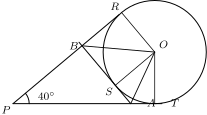
Triangle is formed by three tangents to circle and then angle equals:
Respuesta: E
Pista pequeña:
El círculo es tangente a un lado del triángulo y a las prolongaciones de los otros dos, por lo que es el excentro opuesto a
The circle is tangent to one side of triangle and the extensions of the other two, so is the excenter opposite
Pista grande:
Las bisectrices de los ángulos exteriores en y forman un ángulo de
The external angle bisectors at and form an angle of
Solución:
El círculo se encuentra al otro lado de respecto de por lo que es el excentro opuesto a Así, y bisecan los ángulos exteriores en y Si los ángulos interiores en y son y entonces el triángulo tiene en y ángulos de y respectivamente. Por tanto,
Por lo tanto, la respuesta correcta es E.
The circle lies opposite across side so is the excenter opposite Thus and bisect the exterior angles at and If the interior angles at and are and then triangle has angles and at and Hence
Thus, the correct answer is E.
50.
En el triángulo Sobre se construye el cuadrado hacia el exterior del triángulo. Si es el número de grados del ángulo entonces
In triangle On square is constructed away from the triangle. If is the number of degrees in angle then
depende del triángulo
depends upon triangle
es independiente del triángulo
is independent of the triangle
puede ser igual al ángulo
may equal angle
nunca puede ser igual al ángulo
can never equal angle
es mayor que pero menor que
is greater than but less than
Respuesta: B
Pista pequeña:
Escala a y coloca
Scale to and place
Pista grande:
Como el cuadrado está fuera del triángulo, toma y compara los vectores y
Because the square is outside the triangle, take and compare vectors and
Solución:
Escalamos los lados iguales a y colocamos Como el cuadrado se construye hacia el exterior del triángulo, Sea y Entonces Su producto punto es mientras que el valor absoluto de su producto cruzado bidimensional también es Por lo tanto, de modo que independientemente de y, por tanto, de la forma del triángulo.
Por lo tanto, la respuesta correcta es B.
Scale the equal sides to and place Since square is constructed away from the triangle, Put and Then Their dot product is while the absolute value of their two-dimensional cross product is also Therefore so independent of and hence independent of the triangle’s shape.
Thus, the correct answer is B.