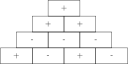
Supongamos que tenemos dos celdas y la celda encima de ellas. Si nos dan la celda inferior izquierda y la celda superior, siempre podemos hallar la celda inferior derecha como sigue:
Si la celda superior es
+, entonces la celda inferior derecha debe ser igual a la celda inferior izquierda, y si la celda superior es
−, la celda inferior derecha debe ser la opuesta a la celda inferior izquierda.
Ahora, supongamos que nos dan una fila. Luego, supongamos que elegimos un valor para la celda que está debajo y a la izquierda de la celda más a la izquierda de nuestra fila dada. Entonces podemos determinar inductivamente toda la fila de abajo hallando primero la celda inferior derecha de la celda más a la izquierda de nuestra fila, y usando esa celda recién hallada como referencia inferior izquierda para la segunda celda desde la izquierda de la fila dada, para hallar su celda inferior derecha correspondiente. El proceso continúa hasta que la fila debajo de la fila dada queda completamente resuelta.
Por lo tanto, como sabemos que la fila superior tiene una celda con
+, tenemos
2 opciones para la fila de abajo, dependiendo de nuestra elección de la celda inferior izquierda. De igual modo, tenemos
2 opciones para la tercera fila, y así
2 opciones para la cuarta fila. Esto da
2⋅2⋅2=8 opciones totales para la fila inferior de la pirámide de signos.
Así, la respuesta correcta es C.
Suppose we have two cells and the cell above them. If we are given the bottom left cell and the top cell, we can always find the bottom right cell as follows:
If the top cell is
+, then the bottom right cell must be the same as the bottom left cell, and if the top cell is
−, the bottom right cell must be the opposite of the bottom left cell.
Now, suppose we are given a row. Then, suppose we choose a value for the cell below and to the left of the leftmost cell in our given row. We then can inductively determine the entire row below our given by first finding the bottom-right cell of the leftmost cell in our row, and using that newly found cell as the bottom-left reference for the second to the left cell in the given row to find its bottom-right counterpart. The process continues on until the row below the given row is fully solved.
Therefore, since we know that the top row has a cell labelled
+, we have
2 choices for the row below, depending on our choice of the bottom-left cell. Similarly, we have
2 choices for the third row, and thus
2 choices for the fourth row. This makes
2⋅2⋅2=8 total choices for the bottom row of the sign pyramid.
Thus, the correct answer is C.