
Problemas del 2025 AMC 12B
¡Desplázate hacia abajo y presiona Iniciar para intentar el examen! O ve al PDF imprimible, la clave de respuestas, o las soluciones profesionales preparadas por LIVE by Po-Shen Loh.
Todos los problemas se usan con el permiso legal oficial de la Mathematical Association of America (MAA).
O salta directamente a un solo problema con su solución: 1 · 2 · 3 · 4 · 5 · 6 · 7 · 8 · 9 · 10 · 11 · 12 · 13 · 14 · 15 · 16 · 17 · 18 · 19 · 20 · 21 · 22 · 23 · 24 · 25
¿Quieres aprender de forma profesional con clases interactivas en video?
Con tiempo
1:15:00
1.
Las instrucciones de una bolsa de gramos de granos de café dicen que preparar correctamente una taza grande de café de filtro requiere gramos de granos de café. ¿Cuál es la mayor cantidad de tazas grandes de café bien preparadas que se pueden hacer con los granos de esa bolsa?
The instructions on a -gram bag of coffee beans say that proper brewing of a large mug of pour-over coffee requires grams of coffee beans. What is the greatest number of properly brewed large mugs of coffee that can be made from the coffee beans in that bag?
Respuesta: B
Pista pequeña:
Divide el total de gramos entre los gramos necesarios por taza.
Divide the total grams by the grams needed per mug
Pista grande:
Solo cuentan las tazas completas, así que redondea hacia abajo.
Only whole mugs count, so round down
Solución:
Cada taza usa gramos, y Solo se pueden preparar tazas completas, así que la mayor cantidad es
Por lo tanto, la respuesta correcta es B.
Each mug uses grams, and Only complete mugs can be brewed, so the greatest number is
Thus, the correct answer is B.
2.
Jerry escribió el dígito de las unidades de cada uno de los primeros cuadrados positivos: ¿Cuál es la suma de todos los números que Jerry escribió?
Jerry wrote down the ones digit of each of the first positive squares: What is the sum of all the numbers Jerry wrote down?
Respuesta: D
Pista pequeña:
El dígito de las unidades de depende solo del dígito de las unidades de por lo que la lista se repite cada términos.
The ones digit of depends only on the ones digit of so the list repeats every terms
Pista grande:
Suma un bloque completo de multiplica por el número de bloques y luego añade los términos sobrantes.
Sum one full block of multiply by the number of blocks, then add the leftover terms
Solución:
Los dígitos de las unidades de son que suman Los términos contienen bloques completos ( términos) más adicionales con dígitos que suman El total es
Por lo tanto, la respuesta correcta es D.
The ones digits of are which sum to The terms contain full blocks ( terms) plus more with digits summing to The total is
Thus, the correct answer is D.
3.
¿Cuál es el valor de donde ?
What is the value of where
Respuesta: D
Pista pequeña:
Multiplica por pares: primero y .
Multiply in pairs: and
Pista grande:
Usa para reducir cada producto antes de multiplicar los dos resultados.
Use to reduce each product before multiplying the two results
Solución:
y Entonces
Por lo tanto, la respuesta correcta es D.
and Then
Thus, the correct answer is D.
4.
El valor del número de dos dígitos en base siete es igual al valor del número de dos dígitos en base nueve. ¿Cuánto vale ?
The value of the two-digit number in base seven equals the value of the two-digit number in base nine. What is
Respuesta: A
Pista pequeña:
Escribe cada número según su base: es y es .
Write each number in terms of its base: is and is
Pista grande:
Iguala y simplifica hasta obtener una razón entre y .
Set and simplify to a ratio between and
Solución:
Al imponer , obtenemos así que Por tanto, y Como ambos son dígitos en base siete y solo funciona . Así, y en efecto Por tanto,
Por lo tanto, la respuesta correcta es A.
Setting gives so Thus and Because both are base-seven digits and only works. Hence and indeed Therefore
Thus, the correct answer is A.
5.
Los enteros positivos y satisfacen la ecuación ¿Cuál es el menor valor posible de ?
Positive integers and satisfy the equation What is the least possible value of
Respuesta: E
Pista pequeña:
Reduce módulo para determinar .
Reduce modulo to pin down
Pista grande:
Como es positivo y solo son posibles unos pocos valores de .
Since is positive and only a few values of are possible
Solución:
Módulo la ecuación da así que Con la única opción es lo que da por lo que Entonces
Por lo tanto, la respuesta correcta es E.
Modulo the equation gives so With the only option is which gives so Then
Thus, the correct answer is E.
6.
Emmy le dice a Max: “Hoy encargué sudaderas del club de matemáticas.” Max pregunta: “¿Cuánto costó cada camiseta?” Emmy responde: “Te doy una pista. El costo total fue donde y son dígitos y ” Tras una pausa, Max dice: “Fue un buen precio.” ¿Cuánto vale ?
Emmy says to Max, “I ordered math club sweatshirts today.” Max asks, “How much did each shirt cost?” Emmy responds, “I’ll give you a hint. The total cost was where and are digits and ” After a pause, Max says, “That was a good price.” What is
Respuesta: C
Pista pequeña:
En centavos, el total es y debe ser divisible entre .
In cents the total is and it must be divisible by
Pista grande:
Reduce módulo para obtener y luego prueba dígitos con .
Reduce modulo to get then test digits with
Solución:
El total en centavos es que debe ser múltiplo de Como y la condición es es decir, Al reducir de nuevo módulo , obtenemos así que el único dígito no nulo posible es Entonces es divisible entre solo para el dígito En efecto, de modo que
Por lo tanto, la respuesta correcta es C.
The total in cents is which must be a multiple of Since and the condition is i.e. Reducing once more modulo gives so the only possible nonzero digit is Then is divisible by only for the digit Indeed so
Thus, the correct answer is C.
7.
¿Cuál es el valor de la siguiente suma?
What is the value of
Respuesta: C
Pista pequeña:
Escribe .
Write
Pista grande:
Con cada término se convierte en .
With each term becomes
Solución:
Sea El numerador es igual a así que cada término es Al telescopiar desde hasta queda
Por lo tanto, la respuesta correcta es C.
Let The numerator equals so each term is Telescoping from to leaves
Thus, the correct answer is C.
8.
Existen enteros y tales que el polinomio tiene a como raíz. ¿Cuánto vale ?
There are integers and such that the polynomial has as a root. What is
Respuesta: C
Pista pequeña:
Los coeficientes enteros obligan a que el conjugado también sea raíz.
Integer coefficients force the conjugate to be a root as well
Pista grande:
Las tres raíces suman así que halla la tercera raíz y luego desarrolla para leer y .
The three roots sum to so find the third root, then expand to read off and
Solución:
El conjugado también es raíz, y estos dos son las raíces de La tercera raíz satisface así que Entonces lo que da y por lo que
Por lo tanto, la respuesta correcta es C.
The conjugate is also a root, and these two are the roots of The third root satisfies so Then giving and so
Thus, the correct answer is C.
9.
¿Cuál es el dígito de las decenas de ?
What is the tens digit of
Respuesta: C
Pista pequeña:
El dígito de las decenas está determinado por .
The tens digit is determined by
Pista grande:
Para tiene ciclo de periodo reduce el exponente módulo .
For cycles with period reduce the exponent modulo
Solución:
Aquí Para los dos últimos dígitos de se repiten con periodo recorriendo Como termina en así que el dígito de las decenas es
Por lo tanto, la respuesta correcta es C.
Here For the last two digits of cycle with period through Since ends in so the tens digit is
Thus, the correct answer is C.
10.
La altura sobre la hipotenusa de un triángulo rectángulo queda dividida en dos segmentos de longitudes por la mediana al lado más corto del triángulo. ¿Cuál es la razón ?
The altitude to the hypotenuse of a right triangle is divided into two segments of lengths by the median to the shortest side of the triangle. What is the ratio
Respuesta: A
Pista pequeña:
Coloca el ángulo recto en el origen con los catetos sobre los ejes y asigna coordenadas a cada punto.
Place the right angle at the origin with the legs along the axes and coordinatize every point
Pista grande:
Halla dónde la mediana al lado más corto corta la altura sobre la hipotenusa y luego divide la altura en ese punto.
Find where the median to the shortest side crosses the altitude to the hypotenuse, then split the altitude at that point
Solución:
Toma de modo que es la hipotenusa y es el lado más corto. La altura desde corta a en La mediana desde hasta el punto medio del lado más corto cruza la altura en Esto divide la altura en , así que ,
Por lo tanto, la respuesta correcta es A.
Take so is the hypotenuse and is the shortest side. The altitude from meets at The median from to crosses the altitude at This splits the altitude into and so and
Thus, the correct answer is A.
11.
Nueve atletas, no habiendo dos de la misma estatura, se presentan a las pruebas del equipo de baloncesto. Uno por uno, sacan al azar una muñequera, sin reemplazo, de una bolsa que contiene muñequeras azules, rojas y verdes. Se dividen en un grupo azul, un grupo rojo y un grupo verde. Al miembro más alto de cada grupo se le nombra capitán del grupo. ¿Cuál es la probabilidad de que los capitanes de grupo sean los tres atletas más altos?
Nine athletes, no two of whom are the same height, try out for the basketball team. One at a time, they draw a wristband at random, without replacement, from a bag containing blue bands, red bands, and green bands. They are divided into a blue group, a red group, and a green group. The tallest member of each group is named the group captain. What is the probability that the group captains are the three tallest athletes?
Respuesta: C
Pista pequeña:
Los capitanes son los tres más altos exactamente cuando los tres más altos caen en tres grupos diferentes.
The captains are the three tallest exactly when the three tallest land in three different groups
Pista grande:
Coloca a los tres más altos uno por uno; cada uno debe evitar los grupos ya usados, cuyas plazas reducen el conjunto disponible.
Place the tallest three one at a time; each must avoid the groups already used, whose slots shrink the pool
Solución:
Cada grupo tiene plazas. Los tres atletas más altos son los capitanes precisamente cuando caen en tres grupos diferentes. Al colocarlos uno por uno en las plazas, el segundo debe evitar el grupo del primero ( de las plazas restantes) y el tercero debe evitar ambos grupos usados ( de las plazas restantes). La probabilidad es
Por lo tanto, la respuesta correcta es C.
Each group has slots. The three tallest athletes are the captains precisely when they fall into three different groups. Placing them one at a time into the slots, the second must avoid the first’s group ( of the remaining slots) and the third must avoid both used groups ( of the remaining slots). The probability is
Thus, the correct answer is C.
12.
Abajo se muestra el limpiaparabrisas del lado del conductor de un autobús grande.
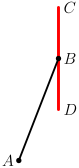
El brazo pivota de un lado a otro alrededor del punto barriendo un arco de simétrico respecto a la recta vertical que pasa por La escobilla está unida a por su punto medio y permanece vertical mientras el brazo se mueve. El brazo mide pies de largo, y la escobilla mide pies de alto. ¿Cuál es el área del parabrisas limpiada por el limpiaparabrisas, en pies cuadrados, redondeada a la centésima más cercana? (Supón que el parabrisas es una superficie plana vertical.)
The windshield wiper on the driver’s side of a large bus is depicted below.
Arm pivots back and forth around point sweeping out an arc of symmetric about the vertical line through The wiper blade is attached to at its midpoint and stays vertical as the arm moves. The arm is feet long, and the wiper blade is feet tall. What is the area of the windshield cleaned by the wiper, in square feet, to the nearest hundredth? (Assume that the windshield is a flat vertical surface.)
Pista pequeña:
Al girar el brazo, traza un arco de radio la escobilla es siempre un segmento vertical de altura centrado en .
As the arm turns, traces an arc of radius the blade is always a vertical segment of height centered at
Pista grande:
Cada recta vertical corta la región limpiada en un segmento de altura constante así que el área es esa altura por el ancho horizontal barrido.
Each vertical line meets the cleaned region in a segment of constant height so the area is that height times the horizontal width swept
Solución:
Pon en el origen. Entonces para así que la coordenada horizontal de recorre un ancho de En cada posición horizontal pasa exactamente una escobilla vertical de altura así que por el principio de Cavalieri el área limpiada es pies cuadrados.
Por lo tanto, la respuesta correcta es C.
Put at the origin. Then for so the horizontal coordinate of ranges over a width of At each horizontal position exactly one vertical blade of height passes through, so by Cavalieri’s principle the cleaned area is square feet.
Thus, the correct answer is C.
13.
Un círculo se ha dividido en sectores de distintos tamaños. Luego de los sectores se pintan de rojo, de verde y de azul, de modo que dos sectores vecinos nunca se pintan del mismo color. Abajo se muestra una de esas coloraciones.
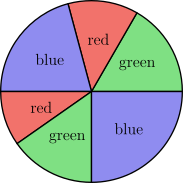
¿Cuántas coloraciones diferentes son posibles?
A circle has been divided into sectors of different sizes. Then of the sectors are painted red, painted green, and painted blue so that no two neighboring sectors are painted the same color. One such coloring is shown below.
How many different colorings are possible?
Respuesta: D
Pista pequeña:
Como los sectores del mismo color no pueden tocarse, los dos sectores de cada color forman un par no adyacente.
Because same-colored sectors cannot touch, the two sectors of each color form a non-adjacent pair
Pista grande:
Cuenta las maneras de dividir los sectores en tres pares no adyacentes y luego asigna los tres colores a los pares.
Count the ways to split the sectors into three non-adjacent pairs, then assign the three colors to the pairs
Solución:
Los dos sectores de cada color deben formar un par no adyacente, así que una coloración es una forma de dividir los sectores dispuestos en ciclo en tres pares no adyacentes junto con una asignación de los tres colores. Los pares no adyacentes son las aristas del complemento del -ciclo, el prisma triangular, que tiene emparejamientos perfectos. Asignar los tres colores de maneras da coloraciones.
Por lo tanto, la respuesta correcta es D.
The two sectors of each color must be a non-adjacent pair, so a coloring is a way to split the cyclic sectors into three non-adjacent pairs together with an assignment of the three colors. The non-adjacent pairs are the edges of the complement of the -cycle, the triangular prism, which has perfect matchings. Assigning the three colors in ways gives colorings.
Thus, the correct answer is D.
14.
Considera una sucesión decreciente de enteros positivos que satisface las dos condiciones siguientes:
• El promedio (media aritmética) de los primeros términos de la sucesión es
• Para todo el promedio de los primeros términos de la sucesión es menos que el promedio de los primeros términos de la sucesión.
¿Cuál es el mayor valor posible de ?
Consider a decreasing sequence of positive integers that satisfies the following two conditions:
• The average (arithmetic mean) of the first terms in the sequence is
• For all the average of the first terms in the sequence is less than the average of the first terms in the sequence.
What is the greatest possible value of
Respuesta: B
Pista pequeña:
Sea el promedio de los primeros términos; la segunda condición da para .
Let be the average of the first terms; the second condition gives for
Pista grande:
A partir de recupera para y luego exige que cada término se mantenga positivo.
From recover for then require every term to stay positive
Solución:
El promedio de los primeros términos es para así que la suma parcial es Para que es positivo exactamente cuando Un inicio válido como mantiene toda la sucesión estrictamente decreciente, así que el mayor posible es
Por lo tanto, la respuesta correcta es B.
The average of the first terms is for so the partial sum is For which is positive exactly when A valid start such as keeps the whole sequence strictly decreasing, so the greatest possible is
Thus, the correct answer is B.
15.
Un recipiente tiene una base cuadrada de , una abertura cuadrada superior de y cuatro caras trapezoidales congruentes, como se muestra. Empezando con el recipiente vacío, una manguera que suministra agua a ritmo constante tarda minutos en llenar el recipiente hasta la línea media de los trapecios.
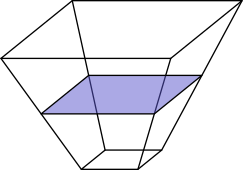
¿Cuántos minutos más tardará en llenar el resto del recipiente?
A container has a square bottom, a open square top, and four congruent trapezoidal sides, as shown. Starting when the container is empty, a hose that runs water at a constant rate takes minutes to fill the container up to the midline of the trapezoids.
How many more minutes will it take to fill the remainder of the container?
Respuesta: D
Pista pequeña:
A la fracción de altura la sección transversal es un cuadrado de lado así que su área es
At height fraction the cross-section is a square of side so its area is
Pista grande:
Compara el volumen hasta la línea media () con el volumen total; el tiempo de llenado es proporcional al volumen.
Compare the volume up to the midline () with the total volume; fill time is proportional to volume
Solución:
A la fracción de altura la sección cuadrada tiene lado así que el volumen llenado hasta la altura es Hasta la línea media esto es y el volumen total es El volumen restante es que es veces la primera parte, así que el resto tarda minutos más.
Por lo tanto, la respuesta correcta es D.
At height fraction the square cross-section has side so the volume filled up to height is Up to the midline this is and the full volume is The remaining volume is which is times the first part. So the remainder takes more minutes.
Thus, the correct answer is D.
16.
Un reloj analógico empieza a medianoche y funciona durante minutos antes de detenerse. Cuando el reloj se detiene, ¿cuál es la tangente del ángulo agudo entre la manecilla de las horas y la manecilla de los minutos?
An analog clock starts at midnight and runs for minutes before stopping. What is the tangent of the acute angle between the hour hand and the minute hand when the clock stops?
Respuesta: B
Pista pequeña:
Reduce minutos módulo horas para hallar hacia dónde apuntan las manecillas.
Reduce minutes modulo hours to find where the hands point
Pista grande:
Halla el ángulo de cada manecilla, toma la diferencia aguda y luego evalúa .
Find each hand’s angle, take the acute difference, then evaluate
Solución:
minutos son horas minutos, que módulo horas equivale a La manecilla de los minutos apunta a y la de las horas a así que el ángulo agudo entre ellas es Usando el valor del ángulo mitad,
Por lo tanto, la respuesta correcta es B.
minutes is hours minutes, which modulo hours reads The minute hand points at and the hour hand at so the acute angle between them is Using the half-angle value,
Thus, the correct answer is B.
17.
Cada uno de los cuadrados de una cuadrícula se va a colorear de rojo, azul o amarillo de manera que cada cuadrado rojo comparta un lado con al menos un cuadrado azul, cada cuadrado azul comparta un lado con al menos un cuadrado amarillo, y cada cuadrado amarillo comparta un lado con al menos un cuadrado rojo. Las coloraciones que se pueden obtener una de otra mediante rotaciones y/o reflexiones se consideran iguales. ¿Cuántas coloraciones diferentes son posibles?
Each of the squares in a grid is to be colored red, blue, or yellow in such a way that each red square shares an edge with at least one blue square, each blue square shares an edge with at least one yellow square, and each yellow square shares an edge with at least one red square. Colorings that can be obtained from one another by rotations and/or reflections are to be considered the same. How many different colorings are possible?
Respuesta: C
Pista pequeña:
Todos los colores deben aparecer, y las condiciones cíclicas rojo azul amarillo rojo restringen fuertemente la disposición.
Every color must appear, and the cyclic conditions red blue yellow red tightly constrain the layout
Pista grande:
Cuenta todas las coloraciones válidas de la cuadrícula fija (etiquetada) y luego reduce por las rotaciones y reflexiones usando el lema de Burnside.
Count all valid colorings of the fixed (labeled) grid, then reduce by the rotations and reflections using Burnside’s lemma
Solución:
Primero contamos las coloraciones de la cuadrícula con posiciones etiquetadas. Al comprobar sucesivamente las filas posibles y rechazar una fila en cuanto una casilla cuyos vecinos ya se conocen carece del color siguiente requerido, se obtiene el siguiente conteo completo según las cantidades de casillas rojas, azules y amarillas: Así, la identidad fija coloraciones.
Para las otras simetrías, los números de coloraciones fijas son para cada rotación no trivial, para cada reflexión respecto a un eje horizontal o vertical y para cada reflexión diagonal. (Para una reflexión axial, una comprobación directa de las tres filas palindrómicas da las posibilidades). Por tanto, el lema de Burnside da
Así, la respuesta correcta es C.
First count colorings of the grid with its positions labeled. Checking the possible rows in succession and rejecting a row as soon as a square whose neighbors are now known lacks its required next color gives the following complete count by the numbers of red, blue, and yellow squares: Thus the identity symmetry fixes colorings.
For the other symmetries, the fixed-coloring counts are for each nontrivial rotation, for each reflection across a horizontal or vertical axis, and for each diagonal reflection. (For an axis reflection, a direct check of the three palindromic rows gives the possibilities.) Therefore Burnside’s lemma gives
Thus, the correct answer is C.
18.
Awnik juega repetidamente un juego que tiene una probabilidad de ganar de Los resultados de los juegos son independientes. ¿Cuál es el valor esperado del número de juegos que jugará hasta que haya ganado y perdido al menos una vez cada uno?
Awnik repeatedly plays a game that has a probability of winning of The outcomes of the games are independent. What is the expected value of the number of games he will play until he has both won and lost at least once?
Respuesta: D
Pista pequeña:
Después del primer juego ya tienes un resultado; luego solo esperas el resultado contrario.
After the first game you already have one outcome; you then wait only for the opposite outcome
Pista grande:
El número esperado de juegos para obtener un resultado de probabilidad es condiciona según si el primer juego es victoria o derrota.
The expected number of games to get an outcome of probability is condition on whether the first game is a win or a loss
Solución:
El primer juego produce un resultado. Si fue una victoria (probabilidad ), la espera esperada de una derrota es si fue una derrota (probabilidad ), la espera esperada de una victoria es Así que el total esperado es
Por lo tanto, la respuesta correcta es D.
The first game produces one outcome. If it was a win (probability ), the expected wait for a loss is if it was a loss (probability ), the expected wait for a win is So the expected total is
Thus, the correct answer is D.
19.
Una cuadrícula rectangular de cuadrados tiene filas y columnas. Cada cuadrado tiene espacio para dos números. Horace y Vera llenan cada uno la cuadrícula colocando los números del al en los cuadrados. Horace la llena horizontalmente: coloca del al en orden de izquierda a derecha en la fila coloca del al en la fila en orden de izquierda a derecha, y continúa de forma similar hasta la fila Vera la llena verticalmente: coloca del al en orden de arriba abajo en la columna luego del al en la columna en orden de arriba abajo, y continúa de forma similar hasta la columna ¿Cuántos cuadrados reciben dos copias del mismo número?
A rectangular grid of squares has rows and columns. Each square has room for two numbers. Horace and Vera each fill in the grid by putting the numbers from through into the squares. Horace fills the grid horizontally: he puts through in order from left to right into row puts through into row in order from left to right, and continues similarly through row Vera fills the grid vertically: she puts through in order from top to bottom into column then through into column in order from top to bottom, and continues similarly through column How many squares get two copies of the same number?
Respuesta: C
Pista pequeña:
Escribe el número de Horace y el número de Vera del cuadrado en la fila columna como fórmulas en y
Write the Horace-number and the Vera-number of the square in row column as formulas in and
Pista grande:
Igualarlos da halla qué valores de hacen que sea un entero en el rango
Setting them equal gives find which make an integer in range
Solución:
En la fila columna Horace escribe y Vera escribe Igualarlos da es decir Esto requiere así que , esto es valores, y cada uno da un válido entre y Así que cuadrados coinciden.
Por lo tanto, la respuesta correcta es C.
In row column Horace writes and Vera writes Setting these equal gives i.e. This requires so — that is values, and each yields a valid between and So squares match.
Thus, the correct answer is C.
20.
Una rana salta a lo largo de la recta numérica según las siguientes reglas.
• Empieza en
• Si está en entonces se mueve a con probabilidad y desaparece con probabilidad
• Para o si está en entonces se mueve a con probabilidad se mueve a con probabilidad y desaparece con probabilidad
¿Cuál es la probabilidad de que la rana llegue a ?
A frog hops along the number line according to the following rules.
• It starts at
• If it is at then it moves to with probability and it disappears with probability
• For or if it is at then it moves to with probability it moves to with probability and it disappears with probability
What is the probability that the frog reaches
Respuesta: E
Pista pequeña:
Sea la probabilidad de llegar finalmente a partiendo de escribe una ecuación de primer paso en cada estado
Let be the probability of eventually reaching starting from write a first-step equation at each state
Pista grande:
Resuelve el sistema lineal con y valor cada vez que la rana desaparece.
Solve the linear system with and value whenever the frog disappears
Solución:
Sea la probabilidad de llegar a desde Entonces y para con Resolviendo hacia arriba se obtiene y luego da así que
Por lo tanto, la respuesta correcta es E.
Let be the probability of reaching from Then and for with Solving upward gives and then yields so
Thus, the correct answer is E.
21.
Dos triángulos no congruentes tienen la misma área. Cada triángulo tiene lados de longitud y y el tercer lado de cada triángulo tiene longitud entera. ¿Cuál es la suma de las longitudes de los terceros lados?
Two non-congruent triangles have the same area. Each triangle has sides of length and and the third side of each triangle has integer length. What is the sum of the lengths of the third sides?
Respuesta: C
Pista pequeña:
Con lados y y ángulo incluido el área es así que áreas iguales provienen de y .
With sides and and included angle the area is so equal areas come from and
Pista grande:
Por la ley de cosenos, los terceros lados satisfacen así que
By the law of cosines the third sides satisfy so
Solución:
El área con ángulo incluido es así que dos triángulos de igual área usan los ángulos y cuyos cosenos son Por la ley de los cosenos, los terceros lados satisfacen y por ello Como ambos lados enteros deben ser impares. Al comprobar los cuadrados impares en el intervalo dado por la desigualdad triangular , solo queda Por lo tanto, la suma es
Así, la respuesta correcta es C.
The area with included angle is so two triangles of equal area use angles and with cosines By the law of cosines the third sides satisfy hence Since both integer sides must be odd. Checking the odd squares in the triangle-inequality range leaves only Therefore the sum is
Thus, the correct answer is C.
22.
¿Cuál es la mayor área posible del triángulo del plano complejo cuyos vértices son y donde el número complejo satisface ?
What is the greatest possible area of the triangle in the complex plane with vertices and where is a complex number satisfying
Respuesta: C
Pista pequeña:
Estos vértices se obtienen multiplicando los puntos fijos todos por , así que el triángulo se escala por el factor .
The vertices are times the fixed points so the triangle is that fixed triangle scaled by
Pista grande:
El área es igual al área del triángulo fijo por ; la condición representa una circunferencia, así que hay que maximizar sobre ella.
Its area is times a fixed area; the condition is a circle, so maximize on it
Solución:
Los vértices son así que el triángulo es el triángulo fijo de vértices , cuya área es , escalado por el factor de modo que su área es La condición equivale a así que es como máximo La mayor área es
Por lo tanto, la respuesta correcta es C.
The vertices are and so the triangle is the fixed triangle with vertices — which has area — scaled by giving area The condition is the circle on which is at most So the greatest area is
Thus, the correct answer is C.
23.
Sea el conjunto de todos los enteros tales que para todo par de enteros no negativos con el residuo de dividir entre es menor que el residuo de dividir entre ¿Cuál es la suma de los elementos de ?
Let be the set of all integers such that for all pairs of nonnegative integers with the remainder when is divided by is less than the remainder when is divided by What is the sum of the elements of
Respuesta: E
Pista pequeña:
La condición dice que la función es estrictamente creciente en .
The condition says the map is strictly increasing on
Pista grande:
Una reordenación creciente de que empieza en debe ser la identidad, lo que obliga a .
An increasing rearrangement of starting at must be the identity, forcing
Solución:
La condición requiere que sea estrictamente creciente en Una lista estrictamente creciente de valores distintos en debe ser así que es decir, es divisible por Como la suma de todos sus divisores es Excluyendo queda
Por lo tanto, la respuesta correcta es E.
The condition requires to be strictly increasing on A strictly increasing list of distinct values in must be so i.e. is divisible by Since the sum of all its divisors is Excluding leaves
Thus, the correct answer is E.
24.
¿Cuántos números reales satisfacen la ecuación ?
How many real numbers satisfy the equation
Respuesta: D
Pista pequeña:
Una solución necesita así que está en .
A solution needs so lies in
Pista grande:
En cada semionda monótona de el logaritmo, que sube lentamente, cruza una vez; cuenta con cuidado las ramas en ambos extremos.
On each monotonic half-wave of the slowly rising log crosses once; count the branches carefully at both ends
Solución:
Como toda solución está en Para el logaritmo es negativo, así que solo pueden contribuir los lóbulos negativos del seno en Cada uno tiene una intersección a cada lado de su mínimo; en el último lóbulo, la segunda intersección es el extremo Esta parte aporta entonces soluciones.
Para solo contribuyen los lóbulos positivos. Hay : uno en cada intervalo de a para Cada uno después del primero tiene una intersección a cada lado de su máximo. El primero tiene solo una intersección nueva porque su extremo izquierdo es la solución ya contada Así, aporta soluciones más.
Para completar, la unicidad afirmada en cada medio lóbulo se obtiene derivando la diferencia de los dos lados. En un medio lóbulo positivo descendente, es estrictamente decreciente. En uno positivo ascendente, su derivada aumenta y luego disminuye una vez, así que la diferencia cruza de negativa a positiva una sola vez. Aplicar el mismo argumento a trata un lóbulo negativo. El total es
Por lo tanto, la respuesta correcta es D.
Since every solution lies in For the logarithm is negative, so only the negative sine lobes in can contribute. Each has one crossing on each side of its minimum; on the last lobe, the second crossing is the endpoint Hence this part contributes solutions.
For only positive lobes contribute. There are of them: one in each interval from to for Every one after the first has one crossing on each side of its maximum. The first has only one new crossing because its left endpoint is the already-counted solution Thus contributes more solutions.
For completeness, the claimed uniqueness on each half-lobe follows by differentiating the difference of the two sides. On a falling positive half-lobe it is strictly decreasing. On a rising positive half-lobe its derivative increases and then decreases once, so the difference crosses from negative to positive only once. Applying the same argument to handles a negative lobe. The total is
Thus, the correct answer is D.
25.
Tres circunferencias concéntricas tienen radios Un triángulo equilátero de lado tiene un vértice sobre cada circunferencia. ¿Cuánto vale ?
Three concentric circles have radii An equilateral triangle with side length has one vertex on each circle. What is
Respuesta: E
Pista pequeña:
Si un punto está a distancias de los vértices de un triángulo equilátero de lado existe una relación simétrica entre
For a point at distances from the vertices of an equilateral triangle of side there is a symmetric relation among
Pista grande:
Usa , y sustituye .
Use with
Solución:
Para el centro común a distancias de los vértices de un triángulo equilátero de lado se cumple la identidad . Esto se simplifica a es decir así que
Por lo tanto, la respuesta correcta es E.
For the common center at distances from the vertices of an equilateral triangle of side the identity holds. This simplifies to i.e. so
Thus, the correct answer is E.