
Problemas del 2017 AMC 12A
¡Desplázate hacia abajo y presiona Iniciar para intentar el examen! O ve al PDF imprimible, la clave de respuestas, o las soluciones profesionales preparadas por LIVE by Po-Shen Loh.
Todos los problemas se usan con el permiso legal oficial de la Mathematical Association of America (MAA).
O salta directamente a un solo problema con su solución: 1 · 2 · 3 · 4 · 5 · 6 · 7 · 8 · 9 · 10 · 11 · 12 · 13 · 14 · 15 · 16 · 17 · 18 · 19 · 20 · 21 · 22 · 23 · 24 · 25
¿Quieres aprender de forma profesional con clases interactivas en video?
Con tiempo
1:15:00
1.
Pablo compra paletas heladas para sus amigos. La tienda vende paletas sueltas a cada una, cajas de paletas a y cajas de paletas a ¿Cuál es el mayor número de paletas que Pablo puede comprar con ?
Pablo buys popsicles for his friends. The store sells single popsicles for each, -popsicle boxes for and -popsicle boxes for What is the greatest number of popsicles that Pablo can buy with
Respuesta: D
Pista pequeña:
La mejor oferta es la caja de paletas, a por
The best value is the -popsicle box, at for
Pista grande:
Gasta en dos cajas de , y luego usa los restantes en una caja de
Spend on two -boxes, then use the remaining on a -box
Solución:
Las paletas más baratas provienen de la caja de paletas, a cada una. Incluso a ese precio, paletas costarían más que
Así que Pablo puede comprar a lo sumo y lo logra con dos cajas de por y una caja de por obteniendo paletas.
Por lo tanto, la respuesta correcta es D.
The cheapest popsicles come from the -popsicle box, at each. Even at that rate, popsicles would cost more than
So Pablo can buy at most and he achieves this with two -boxes for and one -box for giving popsicles.
Thus, the correct answer is D.
2.
La suma de dos números reales no nulos es veces su producto. ¿Cuál es la suma de los recíprocos de los dos números?
The sum of two nonzero real numbers is times their product. What is the sum of the reciprocals of the two numbers?
Respuesta: C
Pista pequeña:
La suma de los recíprocos es
The sum of reciprocals is
Pista grande:
Divide la ecuación entre
Divide the equation by
Solución:
Sean los números y de modo que
Dividiendo ambos lados entre se obtiene y el lado izquierdo es exactamente Así que la suma de los recíprocos es
Por lo tanto, la respuesta correcta es C.
Let the numbers be and so
Dividing both sides by gives and the left side is exactly So the sum of the reciprocals is
Thus, the correct answer is C.
3.
La Sra. Carroll prometió que quien respondiera bien todas las preguntas de opción múltiple en el próximo examen recibiría una A en el examen. ¿Cuál de estas afirmaciones se sigue necesariamente por lógica?
Ms. Carroll promised that anyone who got all the multiple choice questions right on the upcoming exam would receive an A on the exam. Which one of these statements necessarily follows logically?
Si Lewis no recibió una A, entonces respondió mal todas las
preguntas de opción múltiple.
If Lewis did not receive an A, then he got all of the multiple
choice questions wrong.
Si Lewis no recibió una A, entonces respondió
mal al menos una de las preguntas de opción múltiple.
If Lewis did not receive an A, then he got at
least one of the multiple choice questions wrong.
Si Lewis respondió mal al menos una de las preguntas de opción
múltiple, entonces no recibió una A.
If Lewis got at least one of the multiple choice questions
wrong, then he did not receive an A.
Si Lewis recibió una A, entonces respondió bien todas las
preguntas de opción múltiple.
If Lewis received an A, then he got all of the multiple choice
questions right.
Si Lewis recibió una A, entonces respondió bien al menos una de
las preguntas de opción múltiple.
If Lewis received an A, then he got at least one of the
multiple choice questions right.
Respuesta: B
Pista pequeña:
Una implicación es lógicamente equivalente a su contrarrecíproca, no a su recíproca ni a su inversa
An implication is logically equivalent to its contrapositive, not to its converse or inverse
Pista grande:
Negar «respondió bien todas» da «respondió mal al menos una»
Negating “got all right” gives “got at least one wrong”
Solución:
La promesa es «todas bien A». Una implicación solo es equivalente a su contrarrecíproca: «no A no todas bien».
«No todas bien» significa que al menos una pregunta estuvo mal, que es exactamente la afirmación B. La recíproca y la inversa no se siguen, y «todas mal» es una afirmación mucho más fuerte que la negación.
Por lo tanto, la respuesta correcta es B.
The promise is “all right A.” An implication is equivalent only to its contrapositive: “not A not all right.”
“Not all right” means at least one question was wrong, which is exactly statement B. The converse and inverse do not follow, and getting “all wrong” is a much stronger claim than the negation.
Thus, the correct answer is B.
4.
Jerry y Silvia querían ir desde la esquina suroeste de un campo cuadrado hasta la esquina noreste. Jerry caminó hacia el este y luego hacia el norte para llegar a la meta, pero Silvia se dirigió al noreste y llegó a la meta caminando en línea recta. ¿Cuál de las siguientes opciones es la más cercana a cuánto más corto fue el trayecto de Silvia, en comparación con el de Jerry?
Jerry and Silvia wanted to go from the southwest corner of a square field to the northeast corner. Jerry walked due east and then due north to reach the goal, but Silvia headed northeast and reached the goal walking in a straight line. Which of the following is closest to how much shorter Silvia’s trip was, compared to Jerry’s trip?
Respuesta: A
Pista pequeña:
Sea el lado ; Jerry camina y Silvia camina la diagonal
Let the side be ; Jerry walks and Silvia walks the diagonal
Pista grande:
La diagonal es así que la fracción ahorrada es
The diagonal is so the fraction saved is
Solución:
Si el cuadrado tiene lado Jerry camina mientras que Silvia camina la diagonal
La fracción en que el trayecto de Silvia es más corto es
Esto es lo más cercano a
Por lo tanto, la respuesta correcta es A.
If the square has side Jerry walks while Silvia walks the diagonal
The fraction by which Silvia’s trip is shorter is
This is closest to
Thus, the correct answer is A.
5.
En una reunión de personas, hay personas que se conocen todas entre sí y personas que no conocen a nadie. Las personas que se conocen se abrazan, y las que no se conocen se dan la mano. ¿Cuántos apretones de manos ocurren?
At a gathering of people, there are people who all know each other and people who know no one. People who know each other hug, and people who do not know each other shake hands. How many handshakes occur?
Respuesta: B
Pista pequeña:
Las personas que se conocen solo dan la mano a los desconocidos
The acquaintances only shake hands with the strangers
Pista grande:
Suma los apretones de manos de cada persona y divide entre
Add up each person’s handshakes and divide by
Solución:
Cada una de las personas que se conocen da la mano solo a los desconocidos. Cada uno de los desconocidos da la mano a las otras personas.
Sumando los apretones de manos y dividiendo entre (cada apretón involucra a dos personas) se obtiene
Por lo tanto, la respuesta correcta es B.
Each of the people who know each other shakes hands with only the strangers. Each of the strangers shakes hands with all other people.
Summing handshake counts and dividing by (each handshake involves two people) gives
Thus, the correct answer is B.
6.
Joy tiene varillas delgadas, una de cada longitud entera desde cm hasta cm. Coloca sobre una mesa las varillas de longitudes cm, cm y cm. Luego quiere elegir una cuarta varilla que pueda poner junto con estas tres para formar un cuadrilátero de área positiva. ¿Cuántas de las varillas restantes puede elegir como cuarta varilla?
Joy has thin rods, one each of every integer length from cm through cm. She places the rods with lengths cm, cm, and cm on a table. She then wants to choose a fourth rod that she can put with these three to form a quadrilateral with positive area. How many of the remaining rods can she choose as the fourth rod?
Respuesta: B
Pista pequeña:
Cuatro longitudes forman un cuadrilátero exactamente cuando la más larga es menor que la suma de las otras tres
Four lengths form a quadrilateral exactly when the longest is less than the sum of the other three
Pista grande:
Esto da ; luego quita las varillas que ya están en la mesa
This gives ; then remove the rods already on the table
Solución:
Cuatro longitudes forman un cuadrilátero de área positiva si y solo si la más larga es estrictamente menor que la suma de las otras tres. Con una cuarta varilla de longitud esto requiere y así que
Los enteros de a dan valores, pero las varillas de longitud y ya están en la mesa, dejando opciones.
Por lo tanto, la respuesta correcta es B.
Four lengths form a quadrilateral with positive area if and only if the longest is strictly less than the sum of the other three. With a fourth rod of length this requires and so
The integers from to give values, but the rods of length and are already on the table, leaving choices.
Thus, the correct answer is B.
7.
Define una función en los enteros positivos de manera recursiva por si es par, y si es impar y mayor que ¿Cuánto vale ?
Define a function on the positive integers recursively by if is even, and if is odd and greater than What is
Respuesta: B
Pista pequeña:
Calcula y busca un patrón
Compute and look for a pattern
Pista grande:
Verifica que satisface ambas reglas recursivas
Check that satisfies both recursive rules
Solución:
Listando valores: lo que sugiere
Ambas reglas son consistentes con para par, y para impar, Como la recursión determina de manera única,
Por lo tanto, la respuesta correcta es B.
Listing values: suggesting
Both rules are consistent with for even and for odd Since the recursion determines uniquely,
Thus, the correct answer is B.
8.
La región formada por todos los puntos del espacio tridimensional que están a no más de unidades del segmento tiene volumen ¿Cuál es la longitud ?
The region consisting of all points in three-dimensional space within units of line segment has volume What is the length
Pista pequeña:
La región es un cilindro de radio con un hemisferio tapando cada extremo
The region is a cylinder of radius with a hemisphere capping each end
Pista grande:
Los dos hemisferios se combinan en una esfera completa:
The two hemispheres combine into a full sphere:
Solución:
Sea La región es un cilindro de radio y altura con un hemisferio de radio en cada extremo.
El cilindro tiene volumen y los dos hemisferios juntos forman una esfera de volumen Así que de donde
Por lo tanto, la respuesta correcta es D.
Let The region is a cylinder of radius and height with a hemisphere of radius on each end.
The cylinder has volume and the two hemispheres together form a sphere of volume So giving
Thus, the correct answer is D.
9.
Sea el conjunto de puntos del plano de coordenadas tales que dos de las tres cantidades y son iguales y la tercera de las tres cantidades no es mayor que este valor común. ¿Cuál de las siguientes es una descripción correcta de ?
Let be the set of points in the coordinate plane such that two of the three quantities and are equal and the third of the three quantities is no greater than this common value. Which of the following is a correct description of
un solo punto
a single point
dos rectas que se cortan
two intersecting lines
tres rectas cuyas intersecciones por pares son tres puntos
distintos
three lines whose pairwise intersections are three distinct
points
un triángulo
a triangle
tres rayos con un extremo común
three rays with a common endpoint
Respuesta: E
Pista pequeña:
Iguala dos de las tres cantidades y exige que la tercera sea a lo sumo ese valor común
Set two of the three quantities equal and require the third to be at most that common value
Pista grande:
Cada uno de los tres emparejamientos produce un rayo, y los tres parten del mismo punto
Each of the three pairings produces a ray, and all three start at the same point
Solución:
Considera cuáles dos de son el par mayor (iguales).
Si entonces y un rayo hacia abajo desde Si entonces y un rayo hacia la izquierda desde Si entonces y un rayo desde que va hacia arriba y a la derecha.
Los tres rayos comparten el extremo así que son tres rayos con un extremo común.
Por lo tanto, la respuesta correcta es E.
Consider which two of are the (equal) larger pair.
If then and a downward ray from If then and a leftward ray from If then and a ray from going up and to the right.
All three rays share the endpoint so is three rays with a common endpoint.
Thus, the correct answer is E.
10.
Chloé elige un número real de manera uniforme al azar del intervalo De forma independiente, Laurent elige un número real de manera uniforme al azar del intervalo ¿Cuál es la probabilidad de que el número de Laurent sea mayor que el de Chloé?
Chloé chooses a real number uniformly at random from the interval Independently, Laurent chooses a real number uniformly at random from the interval What is the probability that Laurent’s number is greater than Chloé’s number?
Respuesta: C
Pista pequeña:
Divide según si el número de Laurent está por encima o por debajo de
Split on whether Laurent’s number is above or below
Pista grande:
Si está por encima de siempre gana; si está por debajo, es un lanzamiento de moneda simétrico
If it is above he always wins; if below, it is a symmetric coin flip
Solución:
Con probabilidad el número de Laurent cae en que supera cualquier número que Chloé pudiera elegir, así que gana con certeza.
Con la otra probabilidad el número de Laurent cae en que coincide con el intervalo de Chloé; por simetría es mayor la mitad de las veces. La probabilidad total es
Por lo tanto, la respuesta correcta es C.
With probability Laurent’s number lies in which exceeds any number Chloé could choose, so he wins for certain.
With the other probability Laurent’s number lies in matching Chloé’s interval; by symmetry he is larger half the time. The total probability is
Thus, the correct answer is C.
11.
Claire suma las medidas en grados de los ángulos interiores de un polígono convexo y llega a una suma de Luego descubre que olvidó incluir un ángulo. ¿Cuál es la medida en grados del ángulo olvidado?
Claire adds the degree measures of the interior angles of a convex polygon and arrives at a sum of She then discovers that she forgot to include one angle. What is the degree measure of the forgotten angle?
Respuesta: D
Pista pequeña:
La verdadera suma de ángulos es un múltiplo de justo por encima de
The true angle sum is a multiple of just above
Pista grande:
El ángulo olvidado es ese múltiplo menos y debe ser menor que
The forgotten angle is that multiple minus and it must be less than
Solución:
Si el polígono tiene lados y el ángulo olvidado es entonces Como
El único múltiplo de en este rango es así que y
Por lo tanto, la respuesta correcta es D.
If the polygon has sides and the forgotten angle is then Since
The only multiple of in this range is so and
Thus, the correct answer is D.
12.
Hay caballos, llamados Caballo Caballo Caballo Reciben sus nombres por cuántos minutos les toma dar una vuelta a una pista de carreras circular: el Caballo da una vuelta en exactamente minutos. En el instante todos los caballos están juntos en el punto de partida de la pista. Los caballos empiezan a correr en la misma dirección, y siguen corriendo alrededor de la pista circular a sus velocidades constantes. El menor tiempo en minutos, en el que los caballos vuelvan a estar simultáneamente en el punto de partida es Sea el menor tiempo, en minutos, tal que al menos de los caballos estén de nuevo en el punto de partida. ¿Cuál es la suma de los dígitos de ?
There are horses, named Horse Horse Horse They get their names from how many minutes it takes them to run one lap around a circular race track: Horse runs one lap in exactly minutes. At time all the horses are together at the starting point on the track. The horses start running in the same direction, and they keep running around the circular track at their constant speeds. The least time in minutes, at which all horses will again simultaneously be at the starting point is Let be the least time, in minutes, such that at least of the horses are again at the starting point. What is the sum of the digits of
Respuesta: B
Pista pequeña:
El Caballo está de nuevo en la partida en el instante exactamente cuando divide a
Horse is back at the start at time exactly when divides
Pista grande:
Encuentra el menor que tenga al menos divisores entre y
Find the smallest having at least divisors among through
Solución:
El caballo está en el punto de partida en el instante exactamente cuando es múltiplo de Buscamos entonces el menor que tenga al menos divisores entre
Los enteros positivos menores que tienen como máximo divisores, mientras que es divisible por y Por tanto, y la suma de sus cifras es
Así, la respuesta correcta es B.
Horse is at the starting point at time precisely when is a multiple of So we want the smallest with at least divisors among
The positive integers below have at most divisors, while is divisible by and Thus and the sum of its digits is
Thus, the correct answer is B.
13.
Conduciendo a velocidad constante, Sharon normalmente tarda minutos en conducir desde su casa hasta la casa de su madre. Un día Sharon comienza el trayecto a su velocidad habitual, pero después de conducir del camino, se topa con una fuerte tormenta de nieve y reduce su velocidad en millas por hora. Esta vez el viaje le toma un total de minutos. ¿Cuántas millas hay en el trayecto desde la casa de Sharon hasta la de su madre?
Driving at a constant speed, Sharon usually takes minutes to drive from her house to her mother’s house. One day Sharon begins the drive at her usual speed, but after driving of the way, she hits a bad snowstorm and reduces her speed by miles per hour. This time the trip takes her a total of minutes. How many miles is the drive from Sharon’s house to her mother’s house?
Respuesta: B
Pista pequeña:
Su trayecto habitual es de horas, así que la distancia es igual a veces su velocidad habitual
Her usual drive is hours, so the distance equals times her usual speed
Pista grande:
Los dos tercios finales toman minutos a la velocidad reducida
The final two-thirds takes minutes at the reduced speed
Solución:
Sea la distancia millas y la velocidad habitual mph. Como el trayecto habitual es de horas,
El primer del trayecto toma minutos a velocidad así que los restantes toman minutos horas a velocidad
Esa parte final cubre millas, así que Al resolver se obtiene de donde y
Por lo tanto, la respuesta correcta es B.
Let the distance be miles and the usual speed mph. Since the usual trip is hours,
The first of the drive takes minutes at speed so the remaining takes minutes hours at speed
That final portion covers miles, so Solving gives so and
Thus, the correct answer is B.
14.
Alice se niega a sentarse junto a Bob o a Carla. Derek se niega a sentarse junto a Eric. ¿De cuántas maneras pueden los cinco sentarse en una fila de sillas bajo estas condiciones?
Alice refuses to sit next to either Bob or Carla. Derek refuses to sit next to Eric. How many ways are there for the five of them to sit in a row of chairs under these conditions?
Respuesta: C
Pista pequeña:
Comienza con todas las formas de sentarse y resta las adyacencias prohibidas
Start from all seatings and subtract the forbidden adjacencies
Pista grande:
Trata cada par prohibido como un bloque (con órdenes internos) y aplica inclusión-exclusión
Treat each forbidden pair as a block (with internal orders) and apply inclusion-exclusion
Solución:
Sean las formas de sentarse donde Alice-Bob, Alice-Carla y Derek-Eric están adyacentes, respectivamente. La respuesta es
Tratar un par prohibido como un bloque da Para las intersecciones, (Alice entre Bob y Carla), y
Por inclusión-exclusión, así que la respuesta es
Por lo tanto, la respuesta correcta es C.
Let be the seatings where Alice-Bob, Alice-Carla, and Derek-Eric are adjacent, respectively. The answer is
Treating a forbidden pair as a block gives For intersections, (Alice between Bob and Carla), and
By inclusion-exclusion, so the answer is
Thus, the correct answer is C.
15.
Sea usando la medida en radianes para la variable ¿En qué intervalo se encuentra el menor valor positivo de para el cual ?
Let using radian measure for the variable In what interval does the smallest positive value of for which lie?
Respuesta: D
Pista pequeña:
Para los tres términos son positivos, así que ahí no hay raíz
For all three terms are positive, so there is no root there
Pista grande:
Justo después de el término hace negativo; localiza el primer cambio de signo después de
Just past the term makes negative; locate the first sign change after
Solución:
Para los tres términos son positivos, así que Para toma y Como Así que no hay raíz antes de
En En así que Por el teorema del valor intermedio la menor raíz positiva está en
Como y este intervalo está dentro de
Por lo tanto, la respuesta correcta es D.
For all three terms are positive, so For set and Since Thus no root occurs before
At At so By the intermediate value theorem the smallest positive root lies in
Since and this interval sits inside
Thus, the correct answer is D.
16.
En la figura de abajo, se dibujan semicírculos con centros en y y con radios y respectivamente, en el interior de, y compartiendo bases con, un semicírculo de diámetro Los dos semicírculos más pequeños son tangentes externamente entre sí y tangentes internamente al semicírculo más grande. Se dibuja un círculo con centro en tangente externamente a los dos semicírculos pequeños y tangente internamente al semicírculo más grande. ¿Cuál es el radio del círculo con centro en ?
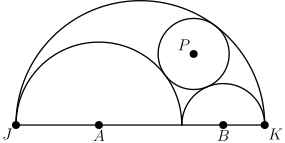
In the figure below, semicircles with centers at and and with radii and respectively, are drawn in the interior of, and sharing bases with, a semicircle with diameter The two smaller semicircles are externally tangent to each other and internally tangent to the largest semicircle. A circle centered at is drawn externally tangent to the two smaller semicircles and internally tangent to the largest semicircle. What is the radius of the circle centered at
Respuesta: B
Pista pequeña:
Sea el centro del semicírculo grande; entonces
Let be the center of the large semicircle; then
Pista grande:
Traza una perpendicular desde a e iguala las tres expresiones para el cuadrado de su altura
Drop a perpendicular from to and set the three expressions for its squared height equal
Solución:
El semicírculo grande tiene radio y centro el punto medio de Colocando en el origen, a lo largo de la base. Sea el radio del círculo en
Por tangencia, y Trazando una perpendicular desde a la base en la posición horizontal con altura el teorema de Pitágoras da
Igualar la primera expresión con la del medio da mientras que igualar la última con la del medio da Al sumarlas resulta así que
Por lo tanto, la respuesta correcta es B.
The large semicircle has radius and center the midpoint of Placing at the origin, along the base. Let be the radius of the circle at
By tangency, and Dropping a perpendicular from to the base at horizontal position with height the Pythagorean theorem gives
Equating the first expression with the middle one gives while equating the last expression with the middle one gives Adding yields so
Thus, the correct answer is B.
17.
Hay números complejos diferentes tales que ¿Para cuántos de ellos es un número real?
There are different complex numbers such that For how many of these is a real number?
Respuesta: D
Pista pequeña:
Escribe para
Write for
Pista grande:
Entonces que es real exactamente cuando es par
Then which is real exactly when is even
Solución:
Las soluciones son las raíces -ésimas de la unidad, para
Entonces que es real exactamente cuando es decir, cuando es par. Hay valores pares de en el rango.
Por lo tanto, la respuesta correcta es D.
The solutions are the th roots of unity, for
Then which is real exactly when i.e. when is even. There are even values of in the range.
Thus, the correct answer is D.
18.
Sea igual a la suma de los dígitos del entero positivo Por ejemplo, Para cierto entero positivo ¿Cuál de los siguientes podría ser el valor de ?
Let equal the sum of the digits of positive integer For example, For a particular positive integer Which of the following could be the value of
Respuesta: D
Pista pequeña:
Si termina en exactamente nueves, sumar reduce la suma de dígitos en y añade
If ends in exactly nines, adding drops the digit sum by and adds
Pista grande:
Así que revisa qué opción tiene esta forma
So check which choice has this form
Solución:
Sumar a aumenta la suma de dígitos en salvo que cada al final se convierte en un perdiendo Si termina en exactamente nueves, entonces
Así que los valores posibles son Entre las opciones, solo encaja (por ejemplo, terminando en cuatro precedidos de suficientes ).
Por lo tanto, la respuesta correcta es D.
Adding to increases the digit sum by except that each trailing turns into a losing If ends in exactly nines, then
So the possible values are Among the choices, only fits (for example, ending in four s preceded by enough s).
Thus, the correct answer is D.
19.
Un cuadrado de lado está inscrito en un triángulo rectángulo con lados de longitud y de modo que un vértice del cuadrado coincide con el vértice del ángulo recto del triángulo. Un cuadrado de lado está inscrito en otro triángulo rectángulo con lados de longitud y de modo que un lado del cuadrado queda sobre la hipotenusa del triángulo. ¿Cuánto vale ?
A square with side length is inscribed in a right triangle with sides of length and so that one vertex of the square coincides with the right-angle vertex of the triangle. A square with side length is inscribed in another right triangle with sides of length and so that one side of the square lies on the hypotenuse of the triangle. What is
Respuesta: D
Pista pequeña:
Un cuadrado con su esquina en el ángulo recto tiene lado
A square with its corner at the right angle has side
Pista grande:
Un cuadrado con un lado sobre una base de longitud y altura hacia esa base tiene lado usa la hipotenusa como base
A square with a side on a base of length and height to that base has side use the hypotenuse as the base
Solución:
Para el primer cuadrado, los dos triángulos más pequeños que recorta son semejantes al triángulo completo, lo que da así que (De forma equivalente, un cuadrado en el ángulo recto tiene lado )
Para el segundo cuadrado, toma la hipotenusa de longitud como base; la altura hacia ella es Un cuadrado con un lado sobre una base y altura tiene lado así que
Por lo tanto
Por lo tanto, la respuesta correcta es D.
For the first square, the two smaller triangles it cuts off are similar to the whole triangle, giving so (Equivalently, a square in the right angle has side )
For the second square, take the hypotenuse of length as base; the altitude to it is A square with a side on a base and height has side so
Therefore
Thus, the correct answer is D.
20.
¿Cuántos pares ordenados tales que es un número real positivo y es un entero entre y inclusive, satisfacen la ecuación ?
How many ordered pairs such that is a positive real number and is an integer between and inclusive, satisfy the equation
Respuesta: E
Pista pequeña:
Sea la ecuación se convierte en
Let the equation becomes
Pista grande:
O bien o bien cuenta los valores de para cada una de las bases permitidas
Either or count the values for each of the allowed bases
Solución:
Sea Como la ecuación es así que o
Si entonces válido para cada una de las bases. Si entonces lo que da valores de para cada base, es decir, pares.
En total hay pares ordenados.
Por lo tanto, la respuesta correcta es E.
Let Since the equation is so or
If then valid for every one of the bases. If then giving values of for each base, i.e. pairs.
In total there are ordered pairs.
Thus, the correct answer is E.
21.
Un conjunto se construye como sigue. Para empezar, Repetidamente, mientras sea posible, si es una raíz entera de algún polinomio para algún cuyos coeficientes son todos elementos de entonces se agrega a Cuando ya no se pueden agregar más elementos a ¿cuántos elementos tiene ?
A set is constructed as follows. To begin, Repeatedly, as long as possible, if is an integer root of some polynomial for some all of whose coefficients are elements of then is put into When no more elements can be added to how many elements does have?
Respuesta: D
Pista pequeña:
Por el teorema de la raíz racional, cualquier raíz entera de un polinomio con coeficientes en divide a su término constante
By the Rational Root Theorem, any integer root of a polynomial with coefficients in divides its constant term
Pista grande:
Partiendo de llega a muestra que nada más puede entrar
Starting from reach show nothing else can enter
Solución:
Usando la raíz entra en Luego entra como raíz de y entra a partir de
Ahora tiene raíz y da después, y dan En este punto,
No puede aparecer ningún otro entero. Por inducción, todo miembro no nulo de divide a Si un polinomio usado en la regla tiene término constante extraemos la mayor potencia posible de cualquier raíz no nula es entonces raíz de un polinomio cuyo término constante es el primer coeficiente no nulo del original. El teorema de la raíz racional muestra que la raíz divide a ese coeficiente, que por la hipótesis inductiva divide a Así, tiene elementos.
Por lo tanto, la respuesta correcta es D.
Using the root enters Then enters as a root of and enters from
Now has root and gives then and give At this point
No further integer can appear. Inductively, every nonzero member of divides If a polynomial used in the rule has constant term factor out the largest possible power of any nonzero root is then a root of a polynomial whose constant term is the first nonzero original coefficient. The Rational Root Theorem shows that the root divides this coefficient, which by the inductive hypothesis divides So has elements.
Thus, the correct answer is D.
22.
Se dibuja un cuadrado en el plano de coordenadas cartesiano con vértices en y Una partícula parte de Cada segundo se mueve con igual probabilidad a uno de los ocho puntos reticulares (puntos de coordenadas enteras) más cercanos a su posición actual, independientemente de sus movimientos anteriores. En otras palabras, la probabilidad es de que la partícula se mueva de a cada uno de o La partícula finalmente tocará el cuadrado por primera vez, ya sea en uno de los vértices del cuadrado o en uno de los puntos reticulares del interior de uno de los lados del cuadrado. La probabilidad de que toque en un vértice en lugar de en un punto interior de un lado es donde y son enteros positivos primos entre sí. ¿Cuánto vale ?
A square is drawn in the Cartesian coordinate plane with vertices at and A particle starts at Every second it moves with equal probability to one of the eight lattice points (points with integer coordinates) closest to its current position, independently of its previous moves. In other words, the probability is that the particle will move from to each of or The particle will eventually hit the square for the first time, either at one of the corners of the square or at one of the lattice points in the interior of one of the sides of the square. The probability that it will hit at a corner rather than at an interior point of a side is where and are relatively prime positive integers. What is
Respuesta: E
Pista pequeña:
Por simetría, sigue solo tres estados interiores: el centro, los cuatro vecinos que son puntos medios de aristas y los cuatro vecinos diagonales
By symmetry, track only three interior states: the center, the four edge-midpoint neighbors, and the four diagonal neighbors
Pista grande:
Escribe las ecuaciones de probabilidad de contacto para cada estado y resuelve el sistema lineal para el valor del centro
Write hitting-probability equations for each state and solve the linear system for the center’s value
Solución:
Por simetría, agrupa los puntos interiores relevantes en tres tipos: los puntos «de eje» y los puntos «diagonales» Sean las probabilidades de terminar tocando un vértice partiendo de un punto de tipo
Leyendo las probabilidades de transición (un punto en va a con probabilidad a con a con y al interior de un lado con etc.) se obtiene
Al resolver se obtiene La probabilidad buscada es así que
Por lo tanto, la respuesta correcta es E.
By symmetry, group the relevant interior points into three types: the “axis” points and the “diagonal” points Let be the probabilities of eventually hitting a corner starting from a point of type
Reading off the transition probabilities (a point in goes to with prob to with to with and to a side interior with etc.) gives
Solving yields The required probability is so
Thus, the correct answer is E.
23.
Para ciertos números reales y el polinomio tiene tres raíces distintas, y cada raíz de es también raíz del polinomio ¿Cuánto vale ?
For certain real numbers and the polynomial has three distinct roots, and each root of is also a root of the polynomial What is
Respuesta: C
Pista pequeña:
Como las tres raíces de son raíces de tenemos para una raíz extra
Since the three roots of are roots of we have for one extra root
Pista grande:
Iguala los coeficientes de para hallar luego
Match the coefficients to find then
Solución:
Como tiene tres raíces distintas, todas compartidas por la cuártica podemos escribir para alguna raíz restante Desarrollando,
Igualando el coeficiente de , así que Igualando el coeficiente de , así que
Entonces y así que
Por lo tanto, la respuesta correcta es C.
Since has three distinct roots all shared by the quartic we can write for some remaining root Expanding,
Matching the coefficient, so Matching the coefficient, so
Then and so
Thus, the correct answer is C.
24.
El cuadrilátero está inscrito en la circunferencia y tiene lados y Sean y puntos sobre tales que y Sea la intersección de la recta y la recta que pasa por paralela a Sea la intersección de la recta y la recta que pasa por paralela a Sea el punto de la circunferencia distinto de que está sobre la recta ¿Cuánto vale ?
Quadrilateral is inscribed in circle and has sides and Let and be points on such that and Let be the intersection of line and the line through parallel to Let be the intersection of line and the line through parallel to Let be the point on circle other than that lies on line What is
Respuesta: A
Pista pequeña:
Los paralelismos dan y
The parallels give and
Pista grande:
Combina esas razones con la potencia de un punto para obtener halla mediante la ley de cosenos
Combine those ratios with Power of a Point to get find via Law of Cosines
Solución:
Como y obtenemos y lo que da y Por lo tanto así que
La potencia del punto da y al combinar se obtiene Con y así que
Como es cíclico, y son suplementarios. La ley de cosenos en y da así que Por lo tanto
Por lo tanto, la respuesta correcta es A.
Because and we get and giving and Hence so
Power of a Point at gives and combining yields With and so
Since is cyclic, and are supplementary. The Law of Cosines on and gives so Therefore
Thus, the correct answer is A.
25.
Los vértices de un hexágono centralmente simétrico en el plano complejo están dados por Para cada se elige un elemento de al azar, independientemente de las demás elecciones. Sea el producto de los números seleccionados. ¿Cuál es la probabilidad de que ?
The vertices of a centrally symmetric hexagon in the complex plane are given by For each an element is chosen from at random, independently of the other choices. Let be the product of the numbers selected. What is the probability that
Respuesta: E
Pista pequeña:
Los dos elementos tienen módulo los otros cuatro tienen módulo
The two elements have magnitude the other four have magnitude
Pista grande:
Para necesitas exactamente de los factores de módulo grande y de los pequeños, y luego ajustar bien la fase
For you need exactly of the large-magnitude factors and of the small ones, then get the phase right
Solución:
Sea (cada uno de módulo ) y sea los otros cuatro elementos (cada uno de módulo ). Como obliga a y exactamente factores deben provenir de y de
Un producto de elementos de es igual a (real), y un producto de elementos de es igual a uno de Su producto es uno de cada uno igualmente probable, así que exactamente de estas configuraciones dan
La probabilidad de caer en el patrón de de , de es Multiplicando por se obtiene
Por lo tanto, la respuesta correcta es E.
Let (each of magnitude ) and be the other four elements (each of magnitude ). Since forces and exactly factors must come from and from
A product of elements of equals (real), and a product of elements of equals one of Their product is one of each equally likely, so exactly of these configurations give
The chance of landing in the -from-, -from- pattern is Multiplying by gives
Thus, the correct answer is E.