
Problemas del 2003 AMC 12B
¡Desplázate hacia abajo y presiona Iniciar para intentar el examen! O ve al PDF imprimible, la clave de respuestas, o las soluciones profesionales preparadas por LIVE by Po-Shen Loh.
Todos los problemas se usan con el permiso legal oficial de la Mathematical Association of America (MAA).
O salta directamente a un solo problema con su solución: 1 · 2 · 3 · 4 · 5 · 6 · 7 · 8 · 9 · 10 · 11 · 12 · 13 · 14 · 15 · 16 · 17 · 18 · 19 · 20 · 21 · 22 · 23 · 24 · 25
¿Quieres aprender de forma profesional con clases interactivas en video?
Con tiempo
1:15:00
1.
¿Cuál de las siguientes opciones es igual a
Which of the following is the same as
Respuesta: C
Pista pequeña:
Extrae una constante común del numerador y del denominador
Factor a common constant out of the numerator and the denominator
Pista grande:
Las dos sumas entre paréntesis son idénticas
The two parenthesized sums are identical
Solución:
Saca como factor del numerador y del denominador:
Las sumas iguales entre paréntesis se cancelan, y queda
Por lo tanto, la respuesta correcta es C.
Factor from the numerator and from the denominator:
The equal parenthesized sums cancel, leaving
Thus, the correct answer is C.
2.
Al contrae la enfermedad algebritis y debe tomar una pastilla verde y una pastilla rosa cada día durante dos semanas. Una pastilla verde cuesta más que una pastilla rosa, y las pastillas de Al cuestan en total durante las dos semanas. ¿Cuánto cuesta una pastilla verde?
Al gets the disease algebritis and must take one green pill and one pink pill each day for two weeks. A green pill costs more than a pink pill, and Al’s pills cost a total of for the two weeks. How much does one green pill cost?
Respuesta: D
Pista pequeña:
Dos semanas son días, así que primero halla el costo del par de pastillas de un día
Two weeks is days, so find the cost of one day’s pair of pills first
Pista grande:
Si una pastilla verde cuesta entonces la pastilla rosa cuesta y es el costo de un día
If a green pill costs then the pink pill costs and is one day’s cost
Solución:
A lo largo de días, el costo diario de las dos pastillas es
Sea el costo de una pastilla verde. La pastilla rosa cuesta así que lo que da
Por lo tanto, la respuesta correcta es D.
Over days the daily cost of the two pills is
Let be the cost of a green pill. The pink pill costs so giving
Thus, the correct answer is D.
3.
Rose llena cada una de las regiones rectangulares de su cantero rectangular de flores con un tipo distinto de flor. Las longitudes, en pies, de las regiones rectangulares de su cantero son las que se muestran en la figura. Ella planta una flor por pie cuadrado en cada región. Los asteres cuestan cada uno, las begonias cada una, las cannas cada una, las dalias cada una y los lirios de Pascua cada uno. ¿Cuál es el menor costo posible, en dólares, para su jardín?
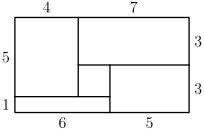
Rose fills each of the rectangular regions of her rectangular flower bed with a different type of flower. The lengths, in feet, of the rectangular regions in her flower bed are as shown in the figure. She plants one flower per square foot in each region. Asters cost each, begonias each, cannas each, dahlias each, and Easter lilies each. What is the least possible cost, in dollars, for her garden?
Respuesta: A
Pista pequeña:
Halla el área de cada una de las cinco regiones a partir de la figura
Find the area of each of the five regions from the figure
Pista grande:
Para minimizar el total, coloca la flor más cara en la región más pequeña, y así sucesivamente
To minimize the total, put the most expensive flower in the smallest region and so on
Solución:
Las cinco regiones tienen áreas y pies cuadrados.
Para minimizar el costo, planta las flores más caras en las regiones más pequeñas. El menor costo posible es
Por lo tanto, la respuesta correcta es A.
The five regions have areas and square feet.
To minimize the cost, plant the most expensive flowers in the smallest regions. The least possible cost is
Thus, the correct answer is A.
4.
Moe usa una cortadora para cortar su césped rectangular de pies por pies. La franja que corta tiene pulgadas de ancho, pero superpone cada corte en pulgadas para asegurarse de no dejar césped sin cortar. Camina a una velocidad de pies por hora mientras empuja la cortadora. ¿Cuál de las siguientes opciones se acerca más al número de horas que le tomará a Moe cortar su césped?
Moe uses a mower to cut his rectangular -foot by -foot lawn. The swath he cuts is inches wide, but he overlaps each cut by inches to make sure that no grass is missed. He walks at the rate of feet per hour while pushing the mower. Which of the following is closest to the number of hours it will take Moe to mow his lawn?
Respuesta: C
Pista pequeña:
Cada pasada corta efectivamente una franja de solo pulgadas de ancho debido a la superposición
Each pass effectively cuts a strip only inches wide because of the overlap
Pista grande:
Una franja de pulgadas mide pies de ancho, así que cada pie caminado corta pies cuadrados
A -inch strip is feet wide, so each foot walked mows square feet
Solución:
Debido a la superposición, cada pasada añade una franja de pulgadas pies de ancho. Así que cada pie que camina Moe corta pies cuadrados, es decir, pies cuadrados por hora.
El césped tiene un área de pies cuadrados, así que el tiempo es horas.
Por lo tanto, la respuesta correcta es C.
Because of the overlap, each pass adds a strip inches feet wide. So each foot Moe walks mows square feet, that is, square feet per hour.
The lawn has area square feet, so the time is hours.
Thus, the correct answer is C.
5.
Muchas pantallas de televisión son rectángulos que se miden por la longitud de sus diagonales. La razón entre la longitud horizontal y la altura en una pantalla de televisión estándar es ¿A cuál de las siguientes opciones se acerca más, en pulgadas, la longitud horizontal de una pantalla de televisión de pulgadas?
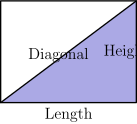
Many television screens are rectangles that are measured by the length of their diagonals. The ratio of the horizontal length to the height in a standard television screen is The horizontal length of a -inch television screen is closest, in inches, to which of the following?
Respuesta: D
Pista pequeña:
Con lados en razón la altura, la longitud y la diagonal están en razón
With sides in ratio the height, length, and diagonal are in ratio
Pista grande:
La diagonal es así que la longitud horizontal es de
The diagonal is so the horizontal length is of
Solución:
Un rectángulo con razón de lados tiene la altura, la longitud y la diagonal en razón Con diagonal la longitud horizontal es que es lo más cercano a
Por lo tanto, la respuesta correcta es D.
A rectangle with side ratio has height, length, and diagonal in ratio With diagonal the horizontal length is which is closest to
Thus, the correct answer is D.
6.
El segundo y el cuarto término de una sucesión geométrica son y ¿Cuál de las siguientes opciones es un posible primer término?
The second and fourth terms of a geometric sequence are and Which of the following is a possible first term?
Respuesta: B
Pista pequeña:
Si el primer término es y la razón es entonces y
If the first term is and the ratio is then and
Pista grande:
Al dividir las dos ecuaciones se obtiene así que
Dividing the two equations gives so
Solución:
Sea el primer término y la razón común. Entonces y así que y
El primer término es La opción aparece entre las opciones.
Por lo tanto, la respuesta correcta es B.
Let the first term be and the common ratio Then and so and
The first term is The choice appears among the options.
Thus, the correct answer is B.
7.
La alcancía de Penniless Pete no tiene ni un centavo, pero tiene monedas, todas de cinco, diez y veinticinco centavos, cuyo valor total es No necesariamente contiene monedas de los tres tipos. ¿Cuál es la diferencia entre la mayor y la menor cantidad de monedas de diez centavos que podría haber en la alcancía?
Penniless Pete’s piggy bank has no pennies in it, but it has coins, all nickels, dimes, and quarters, whose total value is It does not necessarily contain coins of all three types. What is the difference between the largest and smallest number of dimes that could be in the bank?
Respuesta: D
Pista pequeña:
Con monedas de cinco, de diez y de veinticinco centavos: y
With nickels, dimes, quarters: and
Pista grande:
Elimina para obtener luego acota de modo que sean enteros
Eliminate to get then bound so that are integers
Solución:
Sean las cantidades de monedas de cinco, diez y veinticinco centavos. Entonces y (dividiendo la ecuación del valor entre ).
Al restar se obtiene así que
El mayor ocurre en dando (con ). El menor ocurre en dando (con ). La diferencia es
Por lo tanto, la respuesta correcta es D.
Let be the numbers of nickels, dimes, quarters. Then and (dividing the value equation by ).
Subtracting gives so
The largest is at giving (with ). The smallest occurs at giving (with ). The difference is
Thus, the correct answer is D.
8.
Sea la suma de los dígitos del entero positivo Por ejemplo, y ¿Para cuántos valores de dos dígitos de se cumple ?
Let denote the sum of the digits of the positive integer For example, and For how many two-digit values of is
Respuesta: E
Pista pequeña:
Sea Para un de dos dígitos, está entre y
Let For a two-digit is between and
Pista grande:
obliga a o cuenta los de dos dígitos con cada suma de dígitos
forces or count two-digit with each digit sum
Solución:
Sea Como tenemos Entonces requiere o
Los números de dos dígitos con suma de dígitos son ( valores), y los que tienen suma de dígitos son ( valores), para un total de en conjunto.
Por lo tanto, la respuesta correcta es E.
Let Since we have Then requires or
The two-digit numbers with digit sum are ( values), and those with digit sum are ( values), for in all.
Thus, the correct answer is E.
9.
Sea una función lineal para la cual ¿Cuánto vale ?
Let be a linear function for which What is
Respuesta: D
Pista pequeña:
Una función lineal tiene una tasa de cambio constante (la pendiente)
A linear function has a constant rate of change (slope)
Pista grande:
La pendiente es y la respuesta es esa pendiente multiplicada por
The slope is and the answer is that slope times
Solución:
La pendiente de es
Por lo tanto
Por lo tanto, la respuesta correcta es D.
The slope of is
Therefore
Thus, the correct answer is D.
10.
Se pueden formar varias figuras uniendo dos triángulos equiláteros al pentágono regular en dos de las cinco posiciones que se muestran. ¿Cuántas figuras no congruentes se pueden construir de esta manera?
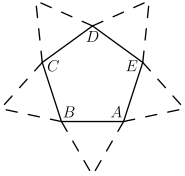
Several figures can be made by attaching two equilateral triangles to the regular pentagon in two of the five positions shown. How many non-congruent figures can be constructed in this way?
Respuesta: B
Pista pequeña:
Por simetría, supón que un triángulo se une a un lado fijo, y luego coloca el segundo
By symmetry, assume one triangle is attached to a fixed side, then place the second
Pista grande:
Solo los lados adyacentes frente a los no adyacentes al lado fijo dan formas distintas, salvo reflexión
Only the two sides adjacent versus non-adjacent to the fixed side give different shapes, up to reflection
Solución:
Supón que un triángulo se une al lado El segundo triángulo puede unirse a un lado que esté a un paso o a dos pasos de
Unirlo a o da dos figuras; unirlo a o da figuras que son imágenes especulares de estas respecto al eje de simetría del pentágono.
Así que solo hay figuras no congruentes.
Por lo tanto, la respuesta correcta es B.
Assume one triangle is attached to side The second triangle can be attached to a side that is one step away or two steps away from
Attaching it to or gives two figures; attaching it to or gives figures that are mirror images of these across the pentagon’s axis of symmetry.
So there are only non-congruent figures.
Thus, the correct answer is B.
11.
Cassandra pone su reloj en la hora correcta al mediodía. A la hora real de la PM, nota que su reloj marca las y segundos. Suponiendo que su reloj atrasa a una tasa constante, ¿cuál será la hora real cuando su reloj marque por primera vez las PM?
Cassandra sets her watch to the correct time at noon. At the actual time of PM, she notices that her watch reads and seconds. Assuming that her watch loses time at a constant rate, what will be the actual time when her watch first reads PM?
PM y segundos
PM and seconds
PM
PM
PM
PM
Respuesta: C
Pista pequeña:
En minutos reales el reloj registra solo minutos
In real minutes the watch records only minutes
Pista grande:
Si el reloj muestra minutos después del mediodía, la hora real es
If the watch shows minutes past noon, the real time is
Solución:
En minutos reales el reloj avanza solo minutos segundos minutos. Así que cuando el reloj muestra minutos después del mediodía, el tiempo real transcurrido es minutos.
El reloj marca las PM después de minutos registrados, así que el tiempo real transcurrido es minutos horas minutos después del mediodía. La hora real es las PM.
Por lo tanto, la respuesta correcta es C.
In real minutes the watch advances only minutes seconds minutes. So when the watch shows minutes past noon, the real elapsed time is minutes.
The watch reads PM after recorded minutes, so the real elapsed time is minutes hours minutes past noon. The actual time is PM.
Thus, the correct answer is C.
12.
¿Cuál es el mayor entero que es divisor de para todo entero positivo par ?
What is the largest integer that is a divisor of for all positive even integers
Respuesta: D
Pista pequeña:
Para par, los factores son cinco números impares consecutivos
For even the factors are five consecutive odd numbers
Pista grande:
Entre cualesquiera cinco números impares consecutivos, uno es múltiplo de y uno es múltiplo de
Among any five consecutive odd numbers, one is a multiple of and one is a multiple of
Solución:
Para par, los cinco factores son números impares consecutivos. Entre cualesquiera cinco números impares consecutivos, al menos uno es divisible entre y exactamente uno entre así que el producto siempre es divisible entre
Ningún divisor mayor funciona siempre: los productos para y son y cuyo máximo común divisor es
Por lo tanto, la respuesta correcta es D.
For even the five factors are consecutive odd numbers. Among any five consecutive odd numbers, at least one is divisible by and exactly one by so the product is always divisible by
No larger divisor always works: the products for and are and whose greatest common divisor is
Thus, the correct answer is D.
13.
Un cono de helado consiste en una esfera de helado de vainilla y un cono circular recto que tiene el mismo diámetro que la esfera. Si el helado se derrite, llenará exactamente el cono. Supón que el helado derretido ocupa del volumen del helado congelado. ¿Cuál es la razón entre la altura del cono y su radio?
An ice cream cone consists of a sphere of vanilla ice cream and a right circular cone that has the same diameter as the sphere. If the ice cream melts, it will exactly fill the cone. Assume that the melted ice cream occupies of the volume of the frozen ice cream. What is the ratio of the cone’s height to its radius?
Pista pequeña:
La esfera y el cono comparten el mismo radio el volumen de la esfera es
The sphere and cone share the same radius sphere volume is
Pista grande:
Iguala el del volumen de la esfera al volumen del cono
Set of the sphere’s volume equal to the cone’s volume
Solución:
Sea el radio común y la altura del cono. El helado derretido llena el cono, así que
Esto se simplifica a así que una razón de
Por lo tanto, la respuesta correcta es B.
Let be the common radius and the cone’s height. The melted ice cream fills the cone, so
This simplifies to so a ratio of
Thus, the correct answer is B.
14.
En el rectángulo y Los puntos y están en de modo que y Las rectas y se cortan en Halla el área de
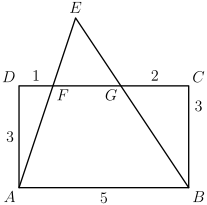
In rectangle and Points and are on so that and Lines and intersect at Find the area of
Respuesta: D
Pista pequeña:
y es semejante a
and is similar to
Pista grande:
Sea la distancia de a la recta igual a la distancia a es con razón
Let the distance from to line be the distance to is with ratio
Solución:
Como y los triángulos y son semejantes con razón
Sea la distancia de a la recta Entonces la distancia de a es y lo que da
La altura de es así que su área es
Por lo tanto, la respuesta correcta es D.
Since and triangles and are similar with ratio
Let the distance from to line be Then the distance from to is and giving
The height of is so its area is
Thus, the correct answer is D.
15.
Un octágono regular tiene un área de una unidad cuadrada. ¿Cuál es el área del rectángulo ?
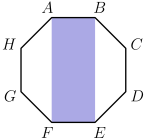
A regular octagon has an area of one square unit. What is the area of the rectangle
Respuesta: D
Pista pequeña:
Sea el centro del octágono, que es el punto medio de la diagonal
Let be the center of the octagon, which is the midpoint of diagonal
Pista grande:
es uno de los ocho triángulos desde el centro, así que tiene área
is one of the eight triangles from the center, so it has area
Solución:
Sea el centro del octágono. Al unir con los vértices se divide el octágono en triángulos congruentes, así que tiene área
Como es el punto medio de los triángulos y tienen áreas iguales, así que tiene área
El rectángulo queda dividido por la diagonal en dos triángulos congruentes, así que es la mitad de él. Por lo tanto tiene área
Por lo tanto, la respuesta correcta es D.
Let be the center of the octagon. Joining to the vertices splits the octagon into congruent triangles, so has area
Since is the midpoint of triangles and have equal areas, so has area
The rectangle is split by diagonal into two congruent triangles, so is half of it. Hence has area
Thus, the correct answer is D.
16.
Se construyen tres semicírculos de radio sobre el diámetro de un semicírculo de radio Los centros de los semicírculos pequeños dividen en cuatro segmentos de igual longitud, como se muestra. ¿Cuál es el área de la región sombreada que está dentro del semicírculo grande pero fuera de los semicírculos más pequeños?
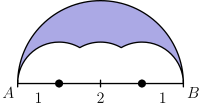
Three semicircles of radius are constructed on diameter of a semicircle of radius The centers of the small semicircles divide into four line segments of equal length, as shown. What is the area of the shaded region that lies within the large semicircle but outside the smaller semicircles?
Respuesta: E
Pista pequeña:
El semicírculo grande tiene área
The large semicircle has area
Pista grande:
Usa inclusión-exclusión: resta las dos intersecciones del área total de los tres semicírculos pequeños
Use inclusion-exclusion: subtract the two overlaps from the total area of the three small semicircles
Solución:
El semicírculo grande tiene área
Los tres semicírculos pequeños tienen área total antes de contar sus intersecciones. Los centros de cada par adyacente están a unidad de distancia, así que su intersección está delimitada por dos sectores de y un triángulo equilátero. Cada una de las dos intersecciones tiene por tanto área
El área sombreada es
Así, la respuesta correcta es E.
The large semicircle has area
The three small semicircles have total area before their overlaps are accounted for. The centers of each adjacent pair are unit apart, so their intersection is bounded by two sectors and an equilateral triangle. Each of the two overlaps therefore has area
The shaded area is
Thus, the correct answer is E.
17.
Si y ¿cuánto vale ?
If and what is
Respuesta: D
Pista pequeña:
Sea y las ecuaciones se vuelven lineales en y
Let and the equations become linear in and
Pista grande:
Resuelve y luego calcula
Solve and then compute
Solución:
Sea y Entonces y
Al resolver se obtiene y así que
Por lo tanto, la respuesta correcta es D.
Let and Then and
Solving gives and so
Thus, the correct answer is D.
18.
Sean y enteros positivos tales que El mínimo valor posible de tiene una factorización prima ¿Cuánto vale ?
Let and be positive integers such that The minimum possible value of has a prime factorization What is
Respuesta: B
Pista pequeña:
El mínimo usa solo los primos y así que escribe
The minimum uses only the primes and so write
Pista grande:
Iguala los exponentes de y se necesita y
Match exponents of and need and
Solución:
Para el mínimo ni ni tienen factores primos distintos de y Escribe así que Escribiendo necesitamos
Igualando exponentes: da el menor y da el menor Así que y
Por lo tanto, la respuesta correcta es B.
For the minimum neither nor has prime factors other than and Write so Writing we need
Matching exponents: gives the least and gives the least So and
Thus, the correct answer is B.
19.
Sea el conjunto de las permutaciones de la sucesión para las que el primer término no es Se elige una permutación al azar de La probabilidad de que el segundo término sea en su forma más simple, es ¿Cuánto vale ?
Let be the set of permutations of the sequence for which the first term is not A permutation is chosen randomly from The probability that the second term is in lowest terms, is What is
Respuesta: E
Pista pequeña:
Cuenta directamente: opciones para el primer término, luego para el resto
Count directly: choices for the first term, then for the rest
Pista grande:
Cuenta las permutaciones de cuyo segundo término es el primer término es o
Count permutations in whose second term is the first term is or
Solución:
El conjunto contiene permutaciones, ya que el primer término tiene opciones y los cuatro términos restantes se pueden ordenar de maneras.
Para que el segundo término sea el primer término debe ser o (no no ), lo que da opciones, y los tres términos restantes se pueden ordenar de maneras:
La probabilidad es así que
Por lo tanto, la respuesta correcta es E.
The set contains permutations, since the first term has choices and the remaining four terms can be arranged in ways.
For the second term to be the first term must be or (not not ), giving choices, and the remaining three terms can be arranged in ways:
The probability is so
Thus, the correct answer is E.
20.
Se muestra parte de la gráfica de . ¿Cuánto vale ?
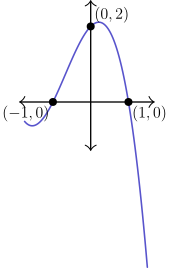
Part of the graph of is shown. What is
Respuesta: B
Pista pequeña:
Lee de la gráfica y
Read off and from the graph
Pista grande:
Sumar elimina y dejando
Adding eliminates and leaving
Solución:
La gráfica pasa por y Así que
Al sumar así que
Por lo tanto, la respuesta correcta es B.
The graph passes through and So
Adding so
Thus, the correct answer is B.
21.
Un objeto se mueve cm en línea recta de a gira un ángulo medido en radianes y elegido al azar del intervalo y se mueve cm en línea recta hasta ¿Cuál es la probabilidad de que ?
An object moves cm in a straight line from to turns at an angle measured in radians and chosen at random from the interval and moves cm in a straight line to What is the probability that
Respuesta: D
Pista pequeña:
Sea el ángulo interior en aplica la ley de los cosenos al
Let be the interior angle at apply the Law of Cosines to
Pista grande:
así que equivale a
so is equivalent to
Solución:
Sea el ángulo interior del en Por la ley de los cosenos,
Entonces significa es decir es decir
Como es uniforme en también lo es La probabilidad es
Por lo tanto, la respuesta correcta es D.
Let be the interior angle of at By the Law of Cosines,
Then means i.e. i.e.
As is uniform on so is The probability is
Thus, the correct answer is D.
22.
Sea un rombo con y Sea un punto en y sean y los pies de las perpendiculares desde a y respectivamente. ¿Cuál de las siguientes opciones se acerca más al mínimo valor posible de ?
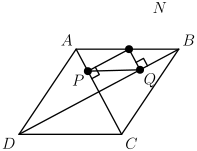
Let be a rhombus with and Let be a point on and let and be the feet of the perpendiculars from to and respectively. Which of the following is closest to the minimum possible value of
Respuesta: C
Pista pequeña:
Sea el centro; las diagonales se cruzan en ángulo recto, así que es un rectángulo y
Let be the center; the diagonals meet at right angles, so is a rectangle and
Pista grande:
es mínimo cuando es el pie de la altura desde en el triángulo rectángulo con catetos y
is smallest when is the foot of the altitude from in right triangle with legs and
Solución:
Sea la intersección de las diagonales. Entonces el es rectángulo en con catetos y El cuadrilátero tiene ángulos rectos en y así que es un rectángulo y
El mínimo de es la altura desde hasta en el Como al igualar las dos expresiones del área se obtiene
Esto es lo más cercano a
Por lo tanto, la respuesta correcta es C.
Let be the intersection of the diagonals. Then is right-angled at with legs and Quadrilateral has right angles at and so it is a rectangle and
The minimum of is the altitude from to in Since equating the two area expressions gives
This is closest to
Thus, the correct answer is C.
23.
El número de intersecciones con el eje en la gráfica de en el intervalo es más cercano a
The number of -intercepts on the graph of in the interval is closest to
Respuesta: A
Pista pequeña:
cuando para un entero no nulo es decir
when for a nonzero integer i.e.
Pista grande:
Cuenta los enteros con
Count integers with
Solución:
Las intersecciones ocurren donde es decir para un entero no nulo
La condición se convierte en
El número de tales enteros es lo más cercano a
Por lo tanto, la respuesta correcta es A.
The intercepts occur where that is for a nonzero integer
The condition becomes
The number of such integers is closest to
Thus, the correct answer is A.
24.
Se eligen enteros positivos y de modo que y el sistema de ecuaciones y tiene exactamente una solución. ¿Cuál es el mínimo valor de ?
Positive integers and are chosen so that and the system of equations and has exactly one solution. What is the minimum value of
Respuesta: C
Pista pequeña:
La gráfica de es lineal por tramos con pendientes
The graph of is piecewise linear with slopes
Pista grande:
La recta tiene pendiente una única intersección obliga a que toque el vértice en donde
The line has slope a single intersection forces it to touch the corner at where
Solución:
La función es lineal por tramos, con pendientes y vértices en La recta tiene pendiente
Una recta de pendiente corta la gráfica exactamente una vez solo si pasa por el vértice más a la izquierda donde la pendiente salta de a Al sustituir, así que
Como necesitamos de modo que Esta cota se alcanza tomando y Por tanto, el mínimo es
Por lo tanto, la respuesta correcta es C.
The function is piecewise linear with slopes and corners at The line has slope
A line of slope meets this graph exactly once only if it passes through the leftmost corner where the graph’s slope jumps from to Substituting, so
Since we need so This bound is attained: take and Therefore the minimum is
Thus, the correct answer is C.
25.
Se eligen al azar e independientemente tres puntos en un círculo. ¿Cuál es la probabilidad de que las tres distancias por pares entre los puntos sean menores que el radio del círculo?
Three points are chosen randomly and independently on a circle. What is the probability that all three pairwise distances between the points are less than the radius of the circle?
Respuesta: D
Pista pequeña:
Una cuerda es más corta que el radio exactamente cuando su arco mide menos de
A chord is shorter than the radius exactly when its arc measures less than
Pista grande:
Las tres cuerdas por pares son cortas precisamente cuando los tres puntos están dentro de algún arco de
All three pairwise chords are short precisely when the three points lie within some arc
Solución:
Una cuerda tiene longitud menor que el radio exactamente cuando el arco que subtiende es menor que ya que la cuerda de un arco de es igual al radio.
Las tres cuerdas por pares son más cortas que el radio precisamente cuando los tres puntos están todos dentro de algún arco de
En cualquier configuración exitosa, exactamente uno de los tres puntos es el extremo en sentido antihorario de uno de esos arcos que los contienen (salvo casos frontera de probabilidad cero). Ese extremo se puede elegir de maneras, y cada uno de los otros dos puntos tiene, de forma independiente, probabilidad de caer en los siguientes Por lo tanto, la probabilidad es
Por lo tanto, la respuesta correcta es D.
A chord has length less than the radius exactly when the arc it subtends is less than since a chord of a arc equals the radius.
All three pairwise chords are shorter than the radius precisely when the three points all lie within some arc of
For any successful configuration, exactly one of the three points is the counterclockwise endpoint of such a containing arc (apart from probability-zero boundary cases). Choose that endpoint in ways; each of the other two points independently has probability of lying in the next Hence the probability is
Thus, the correct answer is D.