
Problemas del 2001 AMC 12
¡Desplázate hacia abajo y presiona Iniciar para intentar el examen! O ve al PDF imprimible, la clave de respuestas, o las soluciones profesionales preparadas por LIVE by Po-Shen Loh.
Todos los problemas se usan con el permiso legal oficial de la Mathematical Association of America (MAA).
O salta directamente a un solo problema con su solución: 1 · 2 · 3 · 4 · 5 · 6 · 7 · 8 · 9 · 10 · 11 · 12 · 13 · 14 · 15 · 16 · 17 · 18 · 19 · 20 · 21 · 22 · 23 · 24 · 25
¿Quieres aprender de forma profesional con clases interactivas en video?
Con tiempo
1:15:00
1.
La suma de dos números es Supongamos que se suma a cada número y luego cada uno de los números resultantes se duplica. ¿Cuál es la suma de los dos números finales?
The sum of two numbers is Suppose is added to each number and then each of the resulting numbers is doubled. What is the sum of the final two numbers?
Respuesta: E
Pista pequeña:
Sumar a cada uno de los dos números aumenta su suma en
Adding to each of the two numbers increases their sum by
Pista grande:
Duplicar cada número duplica la suma
Doubling each number doubles the sum
Solución:
Sumar a cada número eleva la suma de a Duplicar cada número duplica la suma, lo que da
Por lo tanto, la respuesta correcta es E.
Adding to each number raises the sum from to Doubling each number doubles the sum, giving
Thus, the correct answer is E.
2.
Sean y el producto y la suma, respectivamente, de los dígitos del entero Por ejemplo, y Supongamos que es un número de dos dígitos tal que ¿Cuál es el dígito de las unidades de ?
Let and denote the product and the sum, respectively, of the digits of the integer For example, and Suppose is a two-digit number such that What is the units digit of
Respuesta: E
Pista pequeña:
Escribe donde es el dígito de las decenas y es el dígito de las unidades
Write where is the tens digit and is the units digit
Pista grande:
La ecuación se simplifica a
The equation simplifies to
Solución:
Escribe Entonces y así que Esto se reduce a Como podemos dividir entre para obtener
El dígito de las unidades de es
Por lo tanto, la respuesta correcta es E.
Write Then and so This reduces to Since we can divide by to get
The units digit of is
Thus, the correct answer is E.
3.
El impuesto estatal sobre la renta donde vive Kristin se aplica a una tasa de sobre los primeros del ingreso anual más sobre cualquier cantidad por encima de Kristin notó que el impuesto estatal sobre la renta que pagó equivalía al de su ingreso anual. ¿Cuál fue su ingreso anual?
The state income tax where Kristin lives is levied at the rate of of the first of annual income plus of any amount above Kristin noticed that the state income tax she paid amounted to of her annual income. What was her annual income?
Respuesta: B
Pista pequeña:
Sea su ingreso dólares con y escribe el impuesto de dos maneras diferentes
Let her income be dollars with and write the tax two different ways
Pista grande:
Plantea ; los términos con se cancelan
Set ; the terms cancel
Solución:
Sea su ingreso dólares. Escribiendo el impuesto con ambas descripciones y multiplicando por
Al expandir, cada término que contiene se cancela, dejando así que y
Por lo tanto, la respuesta correcta es B.
Let her income be dollars. Writing the tax with both descriptions and multiplying by
Expanding, every term containing cancels, leaving so and
Thus, the correct answer is B.
4.
La media de tres números es más que el menor de los números y menos que el mayor. La mediana de los tres números es ¿Cuál es su suma?
The mean of three numbers is more than the least of the numbers and less than the greatest. The median of the three numbers is What is their sum?
Respuesta: D
Pista pequeña:
Sea la media; el número menor es y el mayor es
Let be the mean; the least number is and the greatest is
Pista grande:
La mediana es el número del medio así que
The median is the middle number so
Solución:
Sea la media. El número menor es el mayor es y el número del medio es la mediana Su suma es así que
Esto da así que la suma de los tres números es
Por lo tanto, la respuesta correcta es D.
Let be the mean. The least number is the greatest is and the middle number is the median Their sum is so
This gives so the sum of the three numbers is
Thus, the correct answer is D.
5.
¿Cuál es el producto de todos los enteros positivos impares menores que ?
What is the product of all positive odd integers less than
Respuesta: D
Pista pequeña:
El producto de todos los números impares es igual a dividido entre el producto de todos los números pares hasta
The product of all odd numbers equals divided by the product of all even numbers up to
Pista grande:
Los números pares son
The even numbers are
Solución:
El producto de todos los enteros de a es así que el producto de los impares es dividido entre el producto de los pares.
Los números pares se factorizan como
En consecuencia, el producto de los enteros impares es
Por lo tanto, la respuesta correcta es D.
The product of every integer from to is so the product of the odd ones is divided by the product of the even ones.
The even numbers factor as
Therefore the product of the odd integers is
Thus, the correct answer is D.
6.
Un número de teléfono tiene la forma donde cada letra representa un dígito diferente. Los dígitos en cada parte del número están en orden decreciente; es decir, y Además, y son dígitos pares consecutivos; y son dígitos impares consecutivos; y Halla
A telephone number has the form where each letter represents a different digit. The digits in each part of the number are in decreasing order; that is, and Furthermore, and are consecutive even digits; and are consecutive odd digits; and Find
Respuesta: E
Pista pequeña:
Cuatro dígitos impares consecutivos decrecientes deben ser o
Four consecutive decreasing odd digits must be or
Pista grande:
El dígito impar sobrante se ubica en y junto con dos dígitos pares que suman debe ser
The leftover odd digit sits in and with two even digits summing to it must be
Solución:
Los cuatro dígitos impares consecutivos decrecientes son o dejando un dígito impar ( o ) para
Como y los otros dos dígitos de son pares, el dígito impar debe ser (un obligaría a que los dos dígitos pares sumaran ). Así que los dos dígitos pares suman
Los tres dígitos pares consecutivos decrecientes son o dejando los pares de dígitos pares o para Solo suma así que y
Por lo tanto, la respuesta correcta es E.
The four consecutive decreasing odd digits are either or leaving one odd digit ( or ) for
Since and the other two digits of are even, the odd digit must be (a would force the two even digits to sum to ). So the two even digits sum to
The three consecutive decreasing even digits are or leaving the even pairs or for Only sums to so and
Thus, the correct answer is E.
7.
Una organización benéfica vende boletos benéficos por un total de Algunos boletos se venden a precio completo (una cantidad entera de dólares), y el resto se vende a mitad de precio. ¿Cuánto dinero recaudan los boletos a precio completo?
A charity sells benefit tickets for a total of Some tickets sell for full price (a whole dollar amount), and the rest sell for half price. How much money is raised by the full-price tickets?
Respuesta: A
Pista pequeña:
Con boletos a precio completo a un precio el total es
With full-price tickets at price the total is
Pista grande:
Esto se convierte en y está entre y
This becomes and lies between and
Solución:
Supongamos que boletos se venden a precio completo de dólares. Entonces así que
Como necesitamos un factor de con El único factor así es que da y
Los boletos a precio completo recaudan dólares.
Por lo tanto, la respuesta correcta es A.
Let tickets sell at full price dollars. Then so
Since we need a factor of with The only such factor is giving and
The full-price tickets raise dollars.
Thus, the correct answer is A.
8.
¿Cuál de los siguientes conos se puede formar a partir de un sector de de un círculo de radio al alinear los dos lados rectos?
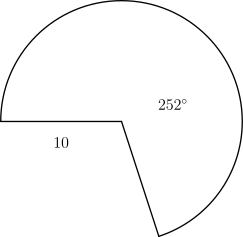
Which of the cones below can be formed from a sector of a circle of radius by aligning the two straight sides?


Respuesta: C
Pista pequeña:
El radio del sector se convierte en la generatriz del cono, así que la generatriz es
The radius of the sector becomes the slant height of the cone, so the slant height is
Pista grande:
La longitud del arco del sector se convierte en la circunferencia de la base:
The arc length of the sector becomes the base circumference:
Solución:
Cuando el sector se enrolla en un cono, su radio se convierte en la generatriz, y su arco se convierte en el círculo de la base.
La longitud del arco es así que la circunferencia de la base es y el radio de la base es
Por lo tanto, el cono tiene radio de base y generatriz que es la opción C.
Así, la respuesta correcta es C.
When the sector is rolled into a cone, its radius becomes the slant height, and its arc becomes the base circle.
The arc length is so the base circumference is and the base radius is
The cone therefore has base radius and slant height which is choice C.
Thus, the correct answer is C.
9.
Sea una función que satisface para todos los números reales positivos y Si ¿cuál es el valor de ?
Let be a function satisfying for all positive real numbers and If what is the value of
Respuesta: C
Pista pequeña:
Escribe como por un factor conveniente
Write as times a convenient factor
Pista grande:
Solución:
Elige y de modo que Entonces
Por lo tanto, la respuesta correcta es C.
Choose and so that Then
Thus, the correct answer is C.
10.
El plano está teselado por cuadrados congruentes y pentágonos congruentes como se indica. El porcentaje del plano que está encerrado por los pentágonos es lo más cercano a
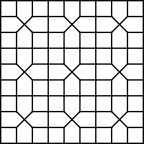
The plane is tiled by congruent squares and congruent pentagons as indicated. The percent of the plane that is enclosed by the pentagons is closest to
Respuesta: D
Pista pequeña:
El patrón se repite en bloques de cuadrados unitarios
The pattern repeats in blocks of unit squares
Pista grande:
En cada bloque, los cuatro cuadrados que siguen siendo cuadrados constituyen del área
In each block, the four squares that stay square make up of the area
Solución:
El patrón se repite sobre un bloque de nueve cuadrados unitarios. Cuatro de estos nueve cuadrados no están cubiertos por pentágonos; el resto del área pertenece a los pentágonos.
Así que los pentágonos encierran lo cual es lo más cercano a
Por lo tanto, la respuesta correcta es D.
The pattern repeats over a block of nine unit squares. Four of these nine squares are not covered by pentagons; the rest of the area belongs to the pentagons.
So the pentagons enclose which is closest to
Thus, the correct answer is D.
11.
Una caja contiene exactamente cinco fichas, tres rojas y dos blancas. Las fichas se retiran al azar una a la vez sin reemplazo hasta que se extraen todas las fichas rojas o todas las fichas blancas. ¿Cuál es la probabilidad de que la última ficha extraída sea blanca?
A box contains exactly five chips, three red and two white. Chips are randomly removed one at a time without replacement until all the red chips are drawn or all the white chips are drawn. What is the probability that the last chip drawn is white?
Respuesta: D
Pista pequeña:
Imagina extraer las cinco fichas y registrar el orden completo
Imagine drawing all five chips and recording the full order
Pista grande:
La extracción termina en la segunda blanca exactamente cuando la última ficha del orden completo es roja
The drawing ends on the second white exactly when the very last chip in the full order is red
Solución:
Imagina continuar hasta que se retiren las cinco fichas. El proceso en realidad se detiene en una ficha blanca exactamente cuando las blancas se agotan antes que las rojas, es decir, cuando la última ficha del orden completo es roja.
La última de las cinco fichas tiene la misma probabilidad de ser cualquier ficha, así que es roja con probabilidad
Por lo tanto, la respuesta correcta es D.
Imagine continuing until all five chips are removed. The process actually stops on a white chip exactly when the whites run out before the reds, i.e. when the last chip in the full ordering is red.
The last of the five chips is equally likely to be any chip, so it is red with probability
Thus, the correct answer is D.
12.
¿Cuántos enteros positivos que no exceden son múltiplos de o pero no de ?
How many positive integers not exceeding are multiples of or but not
Respuesta: B
Pista pequeña:
Primero cuenta los múltiplos de o usando
First count multiples of or using
Pista grande:
Luego resta los que también son divisibles entre es decir, los múltiplos de o
Then subtract those also divisible by i.e. the multiples of or
Solución:
Los múltiplos de o hasta suman usando y
Entre estos, los divisibles entre son los múltiplos de o : usando y
El conteo es
Por lo tanto, la respuesta correcta es B.
Multiples of or up to number using and
Among these, the ones divisible by are multiples of or : using and
The count is
Thus, the correct answer is B.
13.
La parábola con ecuación y vértice se refleja respecto a la recta Esto da como resultado la parábola con ecuación ¿Cuál de los siguientes es igual a ?
The parabola with equation and vertex is reflected about the line This results in the parabola with equation Which of the following equals
Respuesta: E
Pista pequeña:
Observa que es la primera parábola evaluada en y es la segunda en
Note that is the first parabola evaluated at and is the second at
Pista grande:
Reflejar respecto a envía el valor en cada a
Reflecting about sends the value at each to
Solución:
El valor es la primera parábola en y es la parábola reflejada en
Reflejar la curva respecto a reemplaza cada altura por Así que en las dos alturas suman
Por lo tanto, la respuesta correcta es E.
The value is the first parabola at and is the reflected parabola at
Reflecting the curve about replaces each height by So at the two heights sum to
Thus, the correct answer is E.
14.
Dado el polígono regular de nueve lados ¿cuántos triángulos equiláteros distintos en el plano del polígono tienen al menos dos vértices en el conjunto ?
Given the nine-sided regular polygon how many distinct equilateral triangles in the plane of the polygon have at least two vertices in the set
Respuesta: D
Pista pequeña:
Cada par de vértices es un lado de exactamente dos triángulos equiláteros
Each pair of vertices is a side of exactly two equilateral triangles
Pista grande:
Esto cuenta triángulos, pero los tres triángulos con todos los vértices se cuentan tres veces cada uno
This counts triangles, but the three all-vertex triangles get counted three times each
Solución:
Cada uno de los pares de vértices es un lado de exactamente dos triángulos equiláteros, lo que da triángulos contados con multiplicidad.
Los triángulos y tienen sus tres vértices en el conjunto, así que cada uno se cuenta tres veces en lugar de una, un exceso de cada uno.
El número de triángulos distintos es
Por lo tanto, la respuesta correcta es D.
Each of the pairs of vertices is a side of exactly two equilateral triangles, giving triangles counted with multiplicity.
The triangles and have all three vertices in the set, so each is counted three times instead of once, an overcount of apiece.
The number of distinct triangles is
Thus, the correct answer is D.
15.
Un insecto vive en la superficie de un tetraedro regular con aristas de longitud Desea viajar sobre la superficie del tetraedro desde el punto medio de una arista hasta el punto medio de la arista opuesta. ¿Cuál es la longitud del trayecto más corto? (Nota: dos aristas de un tetraedro son opuestas si no tienen ningún extremo común.)
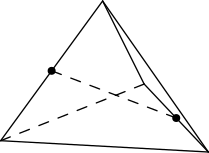
An insect lives on the surface of a regular tetrahedron with edges of length It wishes to travel on the surface of the tetrahedron from the midpoint of one edge to the midpoint of the opposite edge. What is the length of the shortest such trip? (Note: Two edges of a tetrahedron are opposite if they have no common endpoint.)
Respuesta: B
Pista pequeña:
Despliega las dos caras que cruza la trayectoria en una sola figura plana
Unfold the two faces the path crosses into a single flat figure
Pista grande:
Las dos caras forman un rombo de lado y los puntos medios se convierten en puntos medios de lados opuestos
The two faces form a rhombus of side and the midpoints become midpoints of opposite sides
Solución:
Un trayecto más corto sale de la arista inicial por una de las dos caras que la contienen y llega a la arista opuesta por una de las dos caras que contienen a esta. Cualquier par de caras así comparte una arista. Al desplegar ese par se obtiene un rombo de lado formado por dos triángulos equiláteros.
Los dos puntos medios de aristas opuestas se convierten en los puntos medios de lados opuestos de este rombo, que están exactamente a unidad de distancia a lo largo de un segmento recto. Doblar de vuelta preserva la longitud, así que el trayecto más corto es
Por lo tanto, la respuesta correcta es B.
A shortest path leaves the starting edge through one of its two incident faces and reaches the opposite edge through one of its two incident faces. Any such pair of faces shares an edge. Unfolding that pair gives a rhombus of side made of two equilateral triangles.
The two opposite-edge midpoints become the midpoints of opposite sides of this rhombus, which are exactly unit apart along a straight segment. Folding back preserves the length, so the shortest trip is
Thus, the correct answer is B.
16.
Una araña tiene un calcetín y un zapato para cada una de sus ocho patas. ¿En cuántos órdenes diferentes puede la araña ponerse sus calcetines y zapatos, suponiendo que, en cada pata, el calcetín debe ponerse antes que el zapato?
A spider has one sock and one shoe for each of its eight legs. In how many different orders can the spider put on its socks and shoes, assuming that, on each leg, the sock must be put on before the shoe?
Respuesta: D
Pista pequeña:
Hay objetos, así que ordenamientos sin restricción
There are items, so orderings with no restriction
Pista grande:
En cada pata el calcetín precede al zapato en exactamente la mitad de todos los ordenamientos, y las ocho patas son independientes
On each leg the sock precedes the shoe in exactly half of all orderings, and the eight legs are independent
Solución:
Piensa en los objetos ( calcetines y zapatos) dispuestos en algún orden: hay disposiciones.
Para cada pata, el calcetín viene antes que el zapato en exactamente la mitad de todas las disposiciones. Imponer esto en las ocho patas de forma independiente divide entre dando
Por lo tanto, la respuesta correcta es D.
Think of the items ( socks and shoes) arranged in some order: there are arrangements.
For each leg, the sock comes before the shoe in exactly half of all arrangements. Imposing this on all eight legs independently divides by giving
Thus, the correct answer is D.
17.
Se selecciona al azar un punto del interior del pentágono con vértices y ¿Cuál es la probabilidad de que sea obtuso?
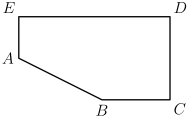
A point is selected at random from the interior of the pentagon with vertices and What is the probability that is obtuse?
Respuesta: C
Pista pequeña:
es obtuso exactamente cuando está dentro del círculo que tiene a como diámetro
is obtuse exactly when lies inside the circle having as diameter
Pista grande:
Ese semicírculo está enteramente dentro del pentágono, así que compara su área con el área del pentágono
That semicircle lies entirely inside the pentagon, so compare its area to the pentagon’s area
Solución:
cuando está sobre el círculo con diámetro centrado en con radio El ángulo es obtuso cuando está dentro de este círculo.
El semidisco relevante está completamente dentro del pentágono, con área
El pentágono es el rectángulo con esquinas menos el triángulo así que su área es
La probabilidad es
Por lo tanto, la respuesta correcta es C.
when is on the circle with diameter centered at with radius The angle is obtuse when is inside this circle.
The relevant half-disk lies wholly within the pentagon, with area
The pentagon is the rectangle with corners minus triangle so its area is
The probability is
Thus, the correct answer is C.
18.
Un círculo centrado en con radio y un círculo centrado en con radio son tangentes exteriormente. Un tercer círculo es tangente a los dos primeros y a una de sus tangentes exteriores comunes, como se muestra. El radio del tercer círculo es
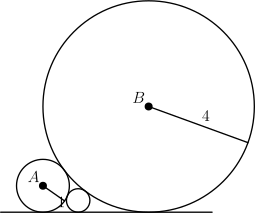
A circle centered at with a radius of and a circle centered at with a radius of are externally tangent. A third circle is tangent to the first two and to one of their common external tangents as shown. The radius of the third circle is
Respuesta: D
Pista pequeña:
Para dos círculos de radios y ambos tangentes a una recta y entre sí, sus puntos de contacto sobre la recta están a de distancia
For two circles of radii and both tangent to a line and to each other, their contact points on the line are apart
Pista grande:
El punto de contacto del círculo pequeño divide el segmento:
The contact point of the small circle splits the segment:
Solución:
Cuando dos círculos mutuamente tangentes de radios y descansan sobre una recta, la distancia entre sus puntos de tangencia es
Los puntos de contacto de los círculos grandes están a de distancia. Colocando el círculo pequeño de radio entre ellos, sus dos distancias de tangencia se suman:
Entonces así que y
Por lo tanto, la respuesta correcta es D.
When two mutually tangent circles of radii and both rest on a line, the distance between their points of tangency is
The big circles’ contact points are apart. Placing the small circle of radius between them, its two tangent distances add up:
Then so and
Thus, the correct answer is D.
19.
El polinomio tiene la propiedad de que la media de sus ceros, el producto de sus ceros y la suma de sus coeficientes son todos iguales. Si la intersección con el eje de la gráfica de es ¿cuánto vale ?
The polynomial has the property that the mean of its zeros, the product of its zeros, and the sum of its coefficients are all equal. If the -intercept of the graph of is what is
Respuesta: A
Pista pequeña:
Por Vieta, la suma de los ceros es y el producto es la suma de coeficientes es
By Vieta, the sum of the zeros is and the product is the sum of coefficients is
Pista grande:
La intersección con el eje da así que el valor común es el producto de los ceros
The -intercept gives so the common value is the product of the zeros
Solución:
La intersección con el eje es Por las fórmulas de Vieta, el producto de los ceros es la media de los ceros es y la suma de los coeficientes es
Los tres son iguales a De obtenemos
Entonces se convierte en así que
Por lo tanto, la respuesta correcta es A.
The -intercept is By Vieta’s formulas the product of the zeros is the mean of the zeros is and the sum of the coefficients is
All three are equal to From we get
Then becomes so
Thus, the correct answer is A.
20.
Los puntos y están en el primer cuadrante y son los vértices del cuadrilátero El cuadrilátero formado al unir los puntos medios de y es un cuadrado. ¿Cuál es la suma de las coordenadas del punto ?
Points and lie in the first quadrant and are the vertices of quadrilateral The quadrilateral formed by joining the midpoints of and is a square. What is the sum of the coordinates of point
Respuesta: C
Pista pequeña:
Sean y los puntos medios de y halla y primero
Let and be the midpoints of and find and first
Pista grande:
El siguiente punto medio satisface rotado (misma longitud, perpendicular)
The next midpoint satisfies rotated (same length, perpendicular)
Solución:
Los puntos medios son de y de
Para que el cuadrilátero de puntos medios sea un cuadrado, los lados consecutivos son perpendiculares e iguales. Con el lado hacia el punto medio de debe ser así que
Como es el punto medio de y obtenemos La suma de sus coordenadas es
Por lo tanto, la respuesta correcta es C.
The midpoints are of and of
For the midpoint quadrilateral to be a square, consecutive sides are perpendicular and equal. With the side to the midpoint of must be so
Since is the midpoint of and we get The sum of its coordinates is
Thus, the correct answer is C.
21.
Cuatro enteros positivos y tienen un producto de y satisfacen
¿Cuánto vale ?
Four positive integers and have a product of and satisfy
What is
Respuesta: D
Pista pequeña:
Suma a cada ecuación para que el lado izquierdo se factorice: y así sucesivamente
Add to each equation so the left side factors: and so on
Pista grande:
tiene un factor de pero no, así que es un múltiplo de
has a factor of but does not, so is a multiple of
Solución:
Sumar a cada ecuación factoriza los lados izquierdos:
Como tiene un factor de mientras que no es divisible entre el factor debe llevar el Entre los divisores de solo hace que divida a
Entonces y dando (En efecto, )
Así que
Por lo tanto, la respuesta correcta es D.
Adding to each equation factors the left sides:
Since has a factor of while is not divisible by the factor must carry the Among divisors of only makes divide
Then and giving (Indeed )
So
Thus, the correct answer is D.
22.
En el rectángulo los puntos y están sobre de modo que y es el punto medio de Además, corta a en y a en El área del rectángulo es Halla el área del triángulo
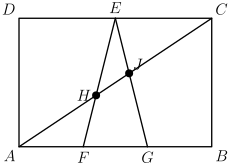
In rectangle points and lie on so that and is the midpoint of Also, intersects at and at The area of rectangle is Find the area of triangle
Respuesta: C
Pista pequeña:
El triángulo tiene base y la altura completa, así que su área es del rectángulo
Triangle has base and the full height, so its area is of the rectangle
Pista grande:
Usa para obtener y a partir de triángulos semejantes
Use to get and from similar triangles
Solución:
El triángulo tiene base y altura igual a la altura del rectángulo, así que su área es
Como los triángulos y son semejantes con razón así que De la misma manera
Entonces dando
Por lo tanto, la respuesta correcta es C.
Triangle has base and height equal to the rectangle’s height, so its area is
Because triangles and are similar with ratio so Likewise
Then giving
Thus, the correct answer is C.
23.
Un polinomio de grado cuatro con coeficiente principal y coeficientes enteros tiene dos ceros reales, ambos enteros. ¿Cuál de los siguientes también puede ser un cero del polinomio?
A polynomial of degree four with leading coefficient and integer coefficients has two real zeros, both of which are integers. Which of the following can also be a zero of the polynomial?
Respuesta: A
Pista pequeña:
Factoriza las dos raíces enteras: el factor restante es con enteros
Factor out the two integer roots: the remaining factor is with integers
Pista grande:
Los ceros complejos son iguala la parte real y verifica que sea un entero
The complex zeros are match the real part and check that is an integer
Solución:
Escribiendo con raíces enteras igualar coeficientes obliga a que y sean enteros.
Los otros dos ceros son Una parte real de requiere lo que hace que la parte imaginaria sea
La opción A necesita es decir, un entero, así que funciona. Las demás opciones obligan a que no sea entero (por ejemplo, la opción E necesita y la opción D necesita con ).
Por lo tanto, la respuesta correcta es A.
Writing with integer roots matching coefficients forces and to be integers.
The other two zeros are A real part of requires making the imaginary part
Choice A needs i.e. an integer, so it works. The other choices force a non-integer (for example choice E needs and choice D needs with ).
Thus, the correct answer is A.
24.
En el triángulo El punto está sobre de modo que y Halla
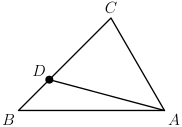
In triangle Point is on so that and Find
Respuesta: D
Pista pequeña:
El ángulo exterior da
The exterior angle gives
Pista grande:
Baja una perpendicular desde a la recta en entonces es -- con
Drop a perpendicular from to line at then is -- with
Solución:
Sea el pie de la perpendicular desde a la recta El ángulo exterior de da así que es un triángulo -- con
Entonces es isósceles con y como también, es isósceles con
Además así que es isósceles con Por lo tanto haciendo que el triángulo rectángulo sea isósceles con
Por lo tanto
Así, la respuesta correcta es D.
Let be the foot of the perpendicular from to line The exterior angle of gives so is a -- triangle with
Then is isosceles with and since too, is isosceles with
Also so is isosceles with Hence making right triangle isosceles with
Therefore
Thus, the correct answer is D.
25.
Considera sucesiones de números reales positivos de la forma en las que cada término después del primero es menos que el producto de sus dos vecinos inmediatos. ¿Para cuántos valores diferentes de aparece el término en algún lugar de la sucesión?
Consider sequences of positive real numbers of the form in which every term after the first is less than the product of its two immediate neighbors. For how many different values of does the term appear somewhere in the sequence?
más de
more than
Respuesta: D
Pista pequeña:
La condición se reordena a lo que te permite avanzar
The condition rearranges to letting you march forward
Pista grande:
Hacer esto repetidamente muestra que la sucesión es periódica con periodo así que solo puede ser uno de cinco términos
Doing this repeatedly shows the sequence is periodic with period so can only be one of five terms
Solución:
Si son términos consecutivos, entonces así que Aplicando esto repetidamente, los primeros cinco términos son después de lo cual y reaparecen, así que la sucesión es periódica con periodo
Aquí es el segundo término. Al igualar a cada uno de los otros cuatro términos mostrados se obtiene, respectivamente, Estos cuatro valores son positivos y distintos. El segundo término vale y la periodicidad muestra que no hay otras posiciones que considerar.
Así que hay valores de
Por lo tanto, la respuesta correcta es D.
If are consecutive terms then so Applying this repeatedly, the first five terms are after which and recur, so the sequence is periodic with period
Here is the second term. Setting each of the other four displayed terms equal to gives, respectively, These four values are positive and distinct. The second term itself is and periodicity shows there are no other positions to consider.
So there are values of
Thus, the correct answer is D.